Topics:
Sponsors:
Administrative Law & Regulation Practice Group
•
Civil Rights Practice Group
•
Corporations & Securities Practice Group
•
Criminal Law & Procedure Practice Group
•
Energy & Environment Practice Group
•
Federalism & Separation of Powers Practice Group
•
Financial Services Practice Group
•
Free Speech Practice Group
•
Intellectual Property Practice Group
•
International & National Security Law Practice Group
•
Labor & Employment Law Practice Group
•
Litigation Practice Group
•
Professional Responsibility & Legal Education Practice Group
•
Religious Liberty Practice Group
•
Communications & Technology Practice Group
- In-Person Event
The Mayflower Renaissance Washington, DC Hotel
1127 Connecticut Ave NW
Washington, DC 20036
1127 Connecticut Ave NW
Washington, DC 20036

 From enforcing and defending the Defense of Marriage Act, implementing the Affordable Care Act, enforcing federal marijuana laws, to making changes to sentencing guidelines, the Executive Branch has chosen less than vigorous action. What are the limits on the Executive’s authority to defer? When may, and may not, the Executive choose not to act, or to act less vigorously, and still meet the requirements of the Take Care Clause?


 The Administrative Procedure Act (APA) defines the process by which federal regulatory agencies are to adopt and enforce federal regulations. Many commentators, however, argue that the federal government has for years engaged in the practice of implementing and enforcing policy while evading the notice and comment requirements of the APA. Critics site informal agency guidance, opinion letters, regional office actions, and other agency actions that purport to bind at least some stakeholders. What are the limits? How real are other commentators complaints about the “sue and settle” phenomenon, described as a less-than-adversarial suit brought against, for example, the Environmental Protection Agency (EPA). Such a suit, it is claimed, argues for an expansion or broader reading of the EPA’s regulatory authority which, after resolution of the suit via settlement, is agreed to by all parties. Finally, what are the limits of unilateral action by a President via executive order?



 The Internal Revenue Service (IRS) is in the headlines almost daily. This panel will discuss the IRS’s proposed revision to 501(c)(4) rules, the targeting of certain organizations in IRS review and approval processes, as well as the IRS’s determination, currently the subject of litigation, that individuals who participate in federally-run as well as state-run health care exchanges established under the Affordable Care Act are entitled to subsidies.




 Under disparate impact analysis, certain practices might be considered discriminatory if they have a disproportionate adverse impact on a protected class of persons, even without discriminatory intent. A number of commentators have noted an expansion of the use of disparate impact analysis in the federal government to areas other than employment, now including education, housing, government contracting, and auto financing, to name a few. Our panel of experts will discuss whether or not there has been such an increase, and, if so, what the ramifications might be.








 What are the duties and responsibilities of the Legislative and Judicial Branch in policing Executive Branch activities? Has the administrative state grown to an extent that the very balance of power between the three branches has changed, and have the coordinate branches taken a step back? When it comes to the separation of powers, and ensuring one branch does not encroach on the proper authority of another, Federalist 51 advises that, “Ambition must be made to counteract ambition.” Should Congress provide more robust oversight, or use its power of the purse more readily to rein in the Executive? Has the judiciary, through the non-delegation doctrine, Chevron deference, and its recent City of Arlington decision, struck the right balance? These and other questions will be addressed by our panelists.


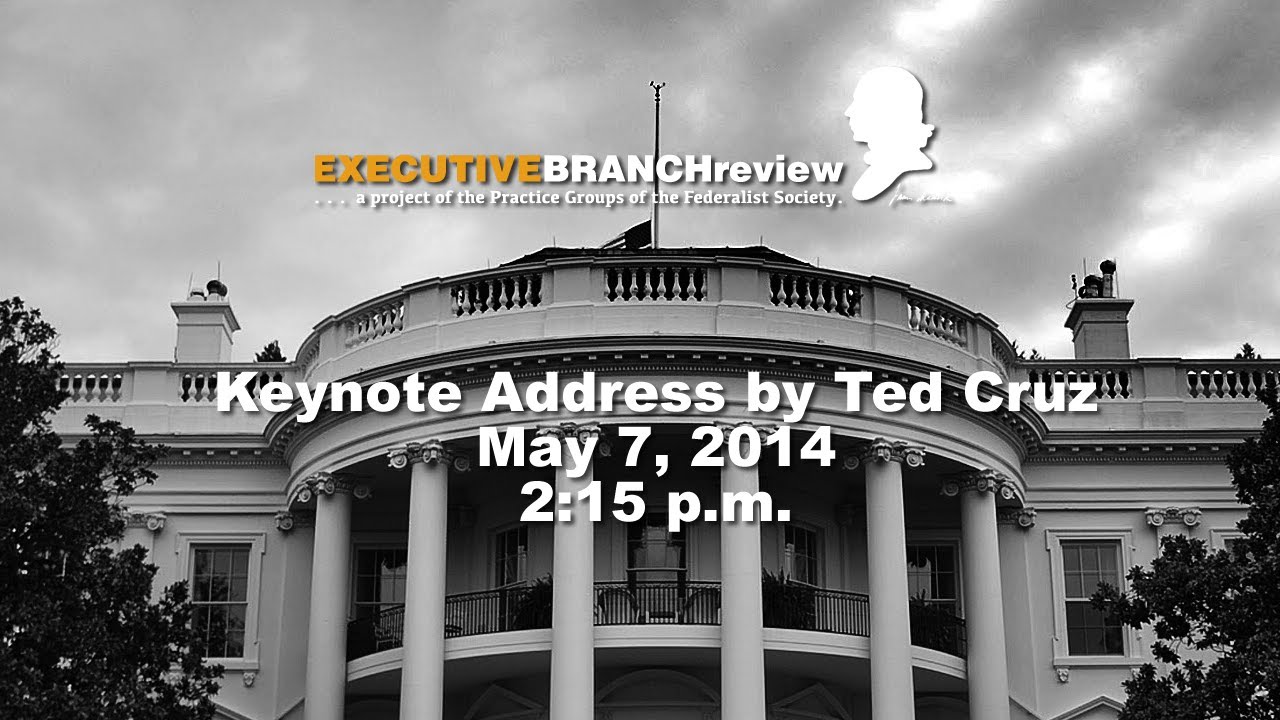
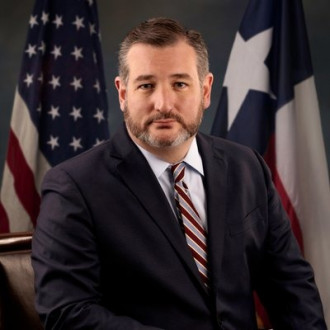
 A key element of the Practice Groups' Executive Branch Review project is our annual conference. This year's Executive Branch Review Conference took place on May 7th at the Mayflower Hotel in Washington, D.C. Senator Ted Cruz of Texas delivered the Keynote Address at the Federalist Society's Second Annual Executive Branch Review Conference.