Facts of the Case
An 1876 law provided that postmasters of the first, second, and third classes shall be appointed and may be removed by the President with the advice and consent of the Senate. President Woodrow Wilson removed Myers, a postmaster first class, without seeking Senate approval.
Questions
Did the Act unconstitutionally restrict the President's power to remove appointed officials?
Conclusions
-
Yes. After tracing legislative debate of the First Congress in 1789 which dealt with the interpretation of the President's appointment power, Chief Justice Taft concluded that the power to remove appointed officers is vested in the President alone. According to Taft, to deny the President that power would not allow him to "discharge his own constitutional duty of seeing that the laws be faithfully executed."
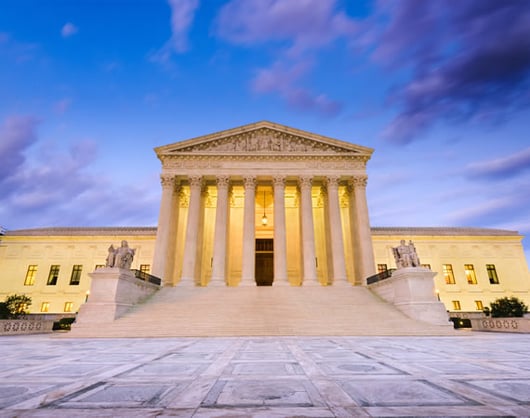
From the Courthouse Steps: Trump v. Slaughter and Trump v. Cook
In Trump v. Slaughter, the Supreme Court held 6-3 that the Federal Trade Commission's (FTC)...

Courthouse Steps Oral Argument: Trump v. Slaughter
Humphrey's Executor v. United States, decided in 1935, upheld the Federal Trade Commission Act, declaring...
A Seat at the Sitting - December 2025
The December Docket in 90 Minutes or Less
Each month, a panel of constitutional experts convenes to discuss the Court’s upcoming docket sitting...
Agency Independence and Accountability to the Executive
President Trump’s February 18 “Ensuring Accountability for All Agencies” Executive Order directs independent regulatory agencies...

You’re Fired! Trump, Tenure Protection, and the Future of Humphrey’s Executor
The recent flurry of firings in the federal government has sparked new questions surrounding the...

Remedies in Presidential Removal Cases: A Shifting Landscape
The Supreme Court's decision in Collins v. Yellen represented a paradigm shift. Now, in cases...

Daniel Webster Debate Series: Does America Have a Unitary Executive?
The Federalist Society's Georgetown Law Chapter'sDaniel Webster Debate Series presents Daniel Webster Debate Series:Does America...

Who Runs the FDIC in a New Administration?
The FDIC board of directors has been convulsed by the widely publicized dispute over who controls...
The End of Independent Agencies? Restoring Presidential Control of the Executive Branch
Federalist Society Review, Volume 22
On the day that President Joe Biden took office, among his first official acts was...
Appointments Clause Back in the Supreme Court: Patent Office Judges as Principal or Inferior Officers
Federalism and Separation of Powers Practice Group Teleforum
Eleven months ago the Federal Circuit held that the Administrative Patent Judges who serve on...
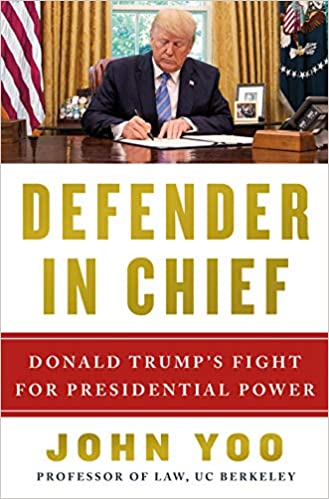
The Accidental Defender of the Constitution
Federalist Society Review, Volume 21
A Review of Defender in Chief: Donald Trump’s Fight for Presidential Power, by John Yoo,...

Life After Seila Law: The Emerging Presidential Removal Power Docket at the Supreme Court
The Federalist Society is pleased to announce its Student Blog Initiative, a project of the...
The Take Care Act
Yesterday, Senator Lee introduced a nine-page bill that would, following the next presidential election, eliminate...
Independent Agencies: How Independent is Too Independent?
2018 National Lawyers Convention
Justice Scalia put it bluntly in Morrison v. Olson: “There are now no lines.” Morrison,...
Independent Agencies: How Independent is Too Independent?
2018 National Lawyers Convention
Justice Scalia put it bluntly in Morrison v. Olson: “There are now no lines.” Morrison,...
Introducing “Article V 2.0”: The Compact for a Balanced Budget
Engage Volume 15, Issue 2
This article discusses the use of interstate compacts to advance Article V amendments to the U.S....

The States and the NLRB: A Study in Comparative Sovereignty
Engage Volume 12, Issue 3, November 2011
Under a system of government that diffuses power and makes institutional “[a]mbition . . ....

Independent Agencies: How Independent is Too Independent?
2018 National Lawyers Convention
The Mayflower Hotel - East Room1127 Connecticut Avenue, NW
Washington, DC 20036