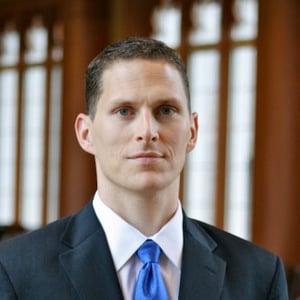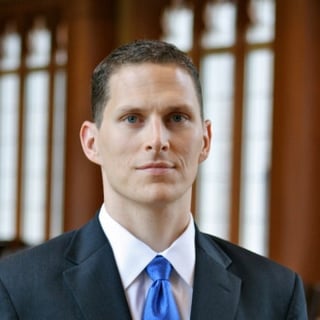
Randy Kozel joined the Law School faculty in 2011. He was named the Distinguished Teacher of the Year by the Class of 2014. He also directs the Notre Dame Program on Constitutional Structure.
Kozel teaches and researches in fields including constitutional law, federal courts, information privacy, and contract law, with a particular focus on the role of precedent in legal decision making. His recent scholarship exploring the connection between precedent and interpretive philosophy has been published or is forthcoming in journals including the Northwestern University Law Review, the Michigan Law Review, the California Law Review, the Vanderbilt Law Review, and the Texas Law Review. His book, entitled Settled Versus Right: A Theory of Precedent, makes the case for using precedent to bridge interpretive disagreements.
Kozel received his J.D., magna cum laude, from Harvard Law School, where he was the Articles Committee Chair of the Harvard Law Review. He served as a law clerk for U.S. Supreme Court Justice Anthony M. Kennedy and for Judge Alex Kozinski at the U.S. Court of Appeals for the 9th Circuit. He has also practiced as a litigator with a large law firm and as Special Counsel to the General Counsel at General Electric Company.
*****
A person listed on this page has spoken or otherwise participated in Federalist Society events, publications, or multimedia presentations. A person's appearance on this list does not imply any other endorsement or relationship between the person and the Federalist Society. In most cases, the biographical information on a person's bio page is provided directly by the person, and the Federalist Society does not edit or otherwise endorse that information. The Federalist Society takes no position on particular legal or public policy issues. All expressions of opinion by a speaker or author are those of the individual.

History and Tradition: Stare Decisis by Another Name?
Northwestern Student Chapter
Northwestern Pritzker School of Law375 E Chicago Ave
Chicago, IL 60611
Revitalizing Stare Decisis
Northwestern Student Chapter
Northwestern Pritzker School of Law375 E Chicago Ave
Chicago, IL 60611
Common Good Originalism
Wisconsin Student Chapter
Wisconsin Law School975 Bascom Mall
Madison, WI 53706
Showcase Panel II: Whither Precedent?
2023 National Lawyers Convention
The Mayflower Hotel1127 Connecticut Avenue NW
Washington, DC 20006

Precedent & Stare Decisis
Ohio State Student Chapter
Zoom Webinar -- Ohio State55 West 12th Avenue
Columbus, OH 43210
Showcase Panel II: Whither Precedent?
2023 National Lawyers Convention
No one maintains that the Court has always and forever been originalist in its orientation....
Showcase Panel II: Whither Precedent?
2023 National Lawyers Convention
No one maintains that the Court has always and forever been originalist in its orientation....
Panel: Originalism and Stare Decisis
22nd Annual Federalist Society Faculty Conference
On January 3-4, 2020, the Federalist Society hosted its 22nd annual Faculty Conference at the...
Panel: Originalism and Stare Decisis
22nd Annual Federalist Society Faculty Conference
On January 3-4, 2020, the Federalist Society hosted its 22nd annual Faculty Conference at the...

Liberty Month Revisited: Stare Decisis and the Separation of Powers
This month we are sharing a selection of paired pieces from The Federalist Society's Liberty...