Prof. J. Joel Alicea's Remarks Upon Receiving Joseph Story Award
2026 National Student Symposium
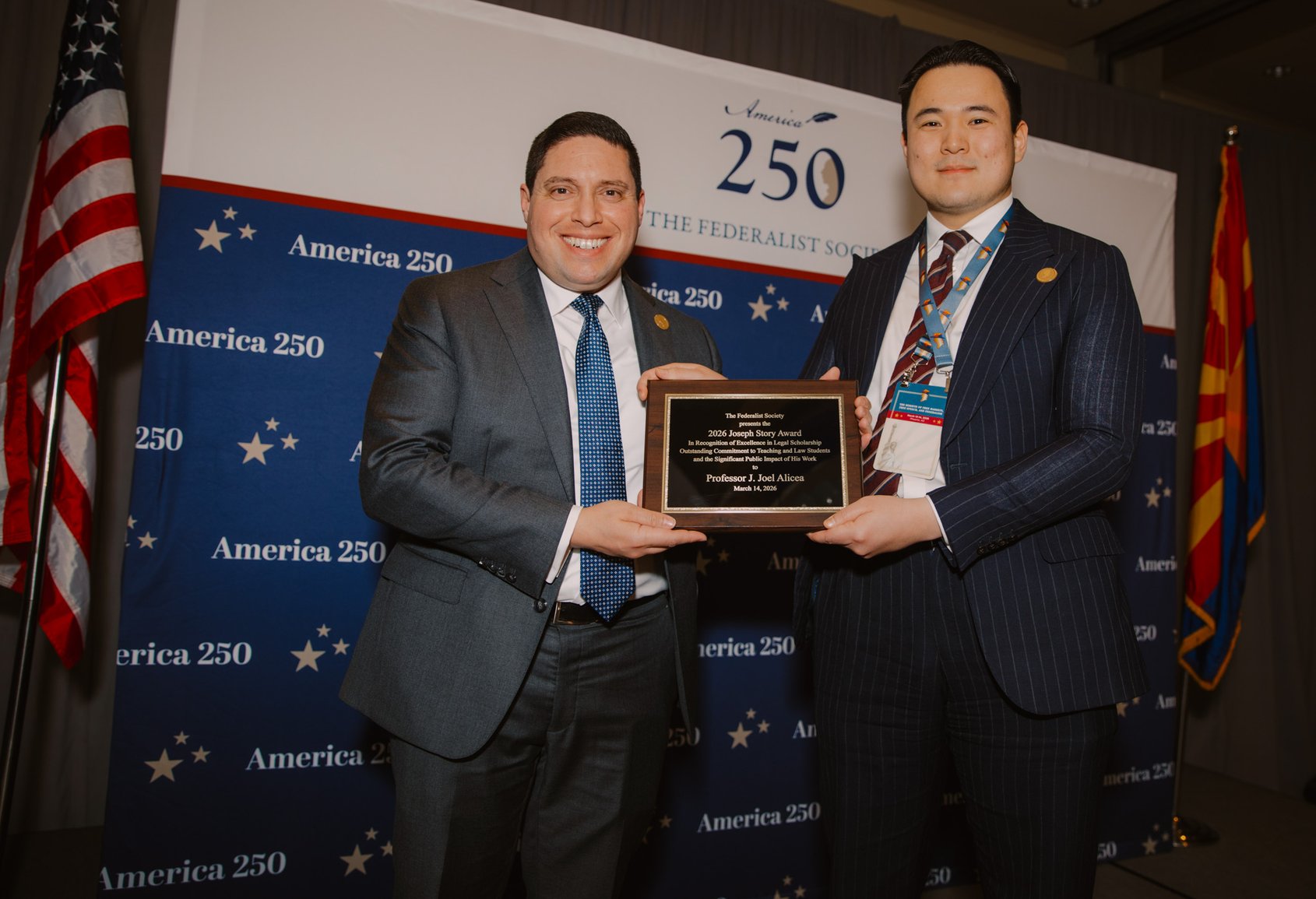
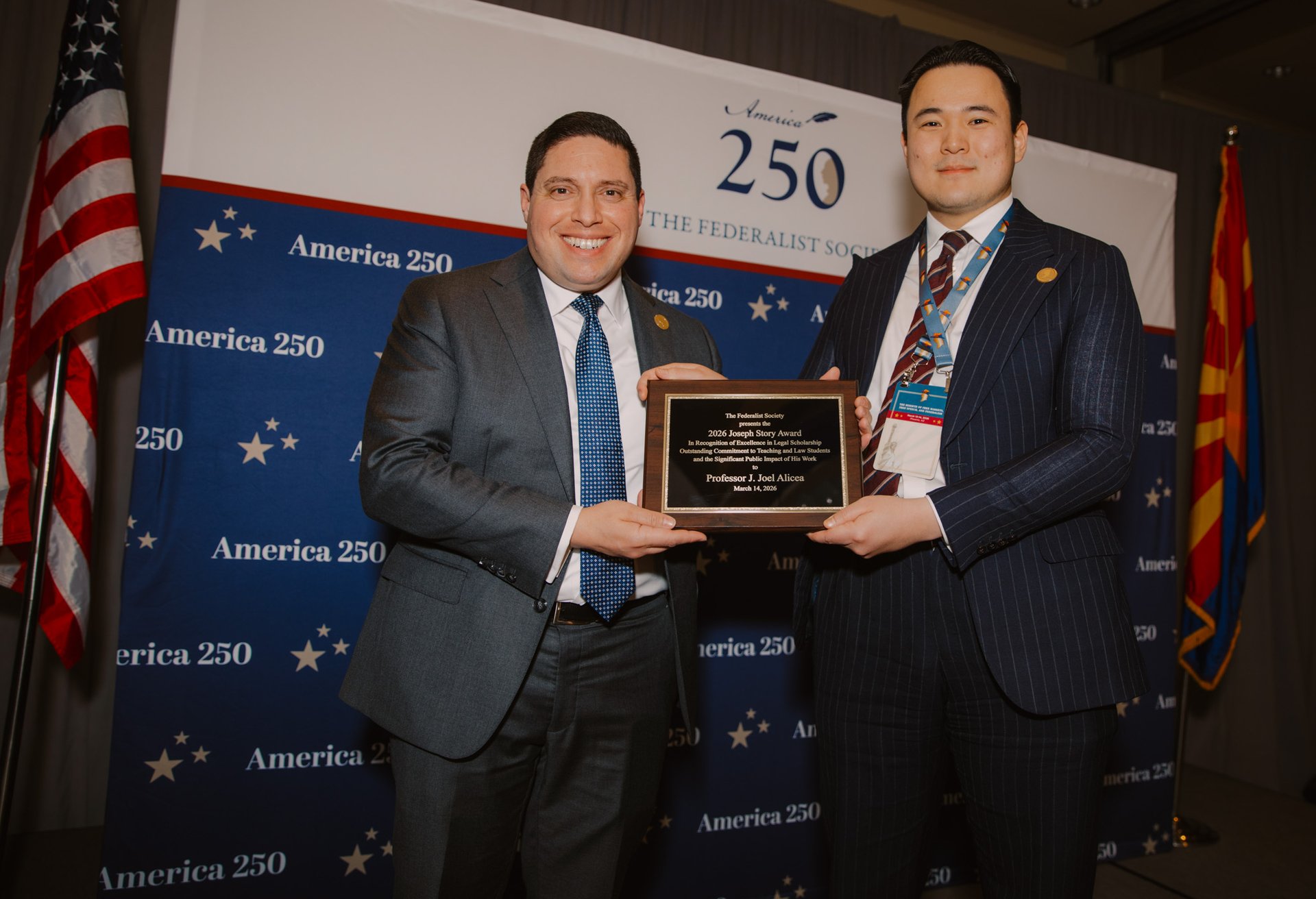
Thank you to Sheldon Gilbert, Lee Otis, and the award committee for this tremendous honor. I am deeply humbled to join the company of scholars who have received this award. Two of the past recipients are my most important academic mentors: Robert P. George at Princeton and John Manning at Harvard. While I confess that I feel myself unworthy to share any honor with those two great men, I accept this award in the hope that I may one day live up to their high example as scholars and teachers.
Because that is what this award recognizes: scholarship and teaching. We have a particular need for both at this moment in our history. We need scholars who pursue the truth wherever it may lead, and we need teachers who inculcate a love for the truth in their students. These sound like ordinary tasks—indeed the defining features of the vocation of a law professor. But in our time, the pursuit and teaching of the truth is far from uncontroversial.
When Professor George began his career at Princeton in the mid-1980s, the main challenge came from the denial that there was truth. The “dictatorship of relativism,” as Cardinal Ratzinger called it, presided over a sprawling empire, encompassing every major legal, cultural, and academic institution in the West, including the Supreme Court. This was the cultural milieu that produced that infamous passage from Planned Parenthood v. Casey: “At the heart of liberty is the right to define one’s own concept of existence, of meaning, of the universe, and of the mystery of human life.” Much of the work of conservative scholars and teachers in the 1990s through the early twenty-first century was the reassertion that there could be a truth of the matter when it comes to law and morality, and the Federalist Society played a key role in that effort.
While there is still a strong strain of relativism in our culture today, that is not the major threat to the truth, in my estimation. In some ways, the threat today is more pernicious: an indifference to the truth. It is not a denial that there is truth but a ridiculing of those who would adhere to the truth when the truth stands in the way of achieving certain goals. This disposition is often the result of good and sincere motives, but it is also the fruit of despair about our future. Those who adopt it are usually deeply concerned about the state of our politics and our culture; they perceive grave threats to all that they hold dear and feel almost hopeless that their way of life can endure; and they therefore cast aside any qualms that stand in the way of seizing power—judicial or otherwise—and using it against the threats to those things they cherish. This tendency can be seen across the political and ideological spectrum, and it is especially palpable among students and young people generally.
I have great sympathy for the motivations that undergird this tendency when it comes from the right. I, too, grew up witnessing many alarming and dangerous attacks on the moral and constitutional foundations of our Republic by the political and legal left. I, too, saw the weakness of earlier conservative leaders and officials usher in devastating setbacks.
But an ends-justifies-the-means mentality will not lead to the salvation of the things we hold dear. It will put those things to the torch in the name of saving them. It will leave our successors with an inheritance of ashes. Despair can only produce despair.
The better path is a firm and abiding confidence in the goodness of the things we defend. Now, that is not to deny that strong action is necessary at this moment in our history. No one has cheered louder than I have at the astonishing successes of recent years, successes that were only possible through a clear-eyed appraisal of our challenges, and firm and steadfast leadership in the face of those challenges. Many things that should have been done long ago have been or are being done. And that is cause for celebration.
But in pursuing—even aggressively pursuing—those noble objectives, we cannot be indifferent to the means by which we pursue them. We at the Federalist Society are the keepers of a legal tradition whose importance transcends the anxieties of any historical moment. For more than 40 years, this organization has stood against the ends-justifies-the means mentality that has so long characterized the left and that was epitomized by Roe v. Wade. Dobbs v. Jackson Women’s Health Organization, by contrast, was not just the greatest human rights achievement in America since Brown v. Board of Education; it was also an emphatic repudiation of the left’s subordination of the Constitution to their ideological ends. The repudiation of Roe was based on the truth that there are moral rights and moral wrongs, and the usurpation of power and the violation of legitimate laws are deep moral wrongs.
The Federalist Society has understood this for decades. Previous recipients of this award like Professors George and Manning articulated it in their scholarship and taught it to their students. May all of us remain good stewards of the inheritance we have been given by those who came before us. Thank you.
Note from the Editor: The Federalist Society takes no positions on particular legal and public policy matters. Any expressions of opinion are those of the author. We welcome responses to the views presented here. To join the debate, please email us at info@fedsoc.org.