Professor J. Joel Alicea Named 37th Recipient of the Federalist Society’s Joseph Story Award
Note from the Editor: The Federalist Society takes no positions on particular legal and public policy matters. Any expressions of opinion are those of the author. We welcome responses to the views presented here. To join the debate, please email us at info@fedsoc.org.
The Federalist Society is delighted to announce that Professor J. Joel Alicea of The Catholic University of America, Columbus School of Law, is the 37th recipient of the Federalist Society’s Joseph Story Award. The Joseph Story Award is given annually to a junior scholar (ten years or less on the tenure track or 40 and under) who has demonstrated excellence in legal scholarship, a commitment to teaching the law, concern and charity for their students, and who has made a significant impact in advancing the rule of law in a free society. The Story Award is named for Joseph Story, who was appointed to the Supreme Court at the age of 32, served as the first Dane Professor of Law at Harvard, and wrote Commentaries on the Constitution of the United States. The Story Award is the successor to the Paul M. Bator Award, established in 1989 in memory of Professor Bator for similar purposes.
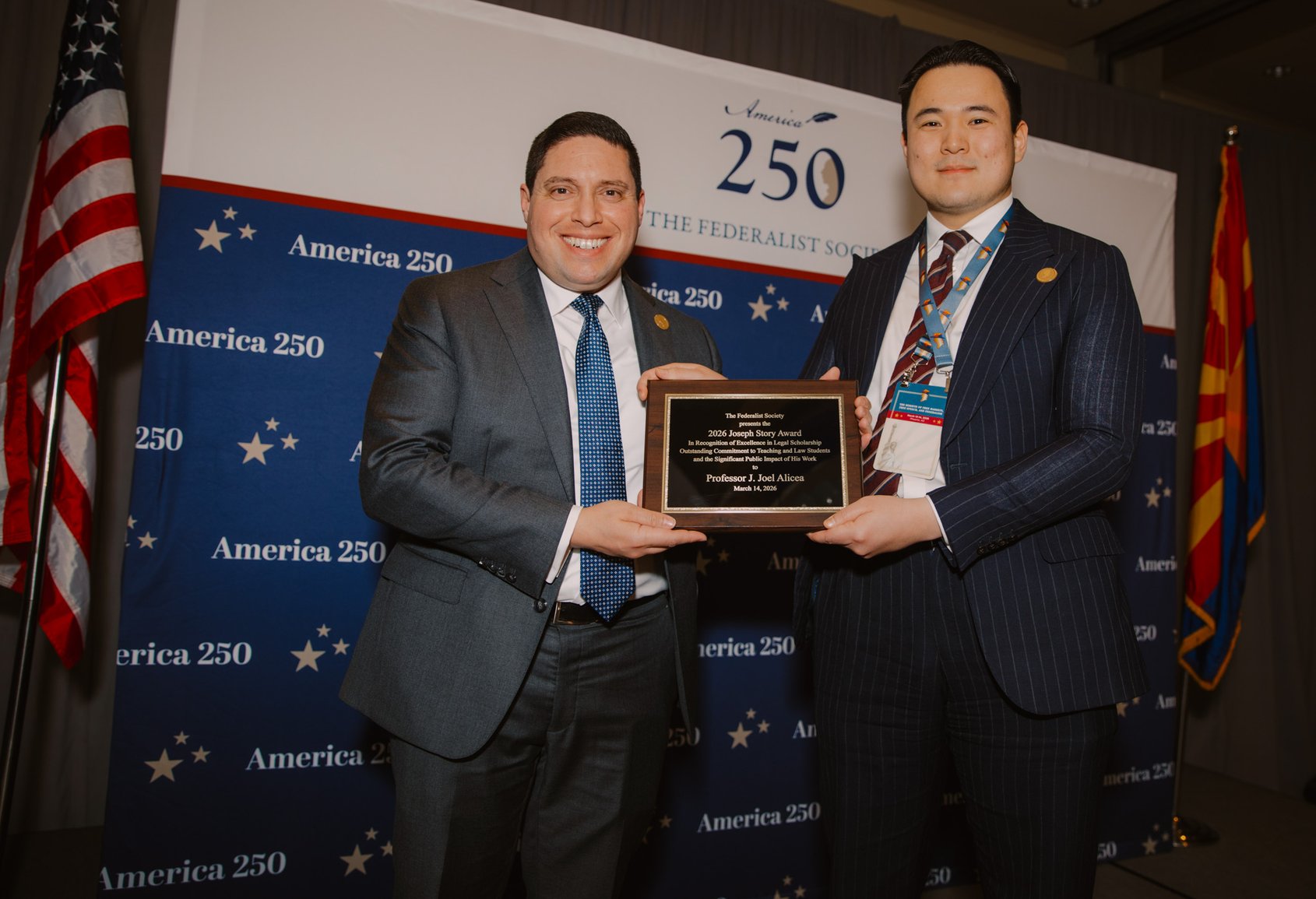
Nominated by colleagues and students, Professor Joel Alicea received the Story Award on March 14, 2026, at the Federalist Society’s Annual Student Symposium, hosted by Arizona State University’s Federalist Society Student Chapter. Spencer Shia, the 2026 Joseph Story Award Chair at the University of Chicago and student member of the selection committee, presented the award to Professor Alicea on behalf of the Federalist Society.
Many supporters of Professor Alicea pointed to the quantity, quality and rigor of his scholarship. Stephen Payne, the Dean and Knights of Columbus Professor of Law at Professor Alicea’s home institution, the Columbus School of Law at Catholic University, noted, “After four years at our school, Joel had already published more top twenty law journal articles than our entire faculty collectively had in its history.” Much of this writing focuses on constitutional theory. Shia pointed to Originalism and Truth Telling, The Moral Theory of Original Meaning, and the extensively debated Bruen Was Right as some of Professor Alicea's most influential and prominent works. These articles and others have made Professor Alicea a major player in some of the most significant debates on constitutional theory and interpretation taking place in the legal academy today.
As both Dean Payne and Mr. Shia emphasized, the reach of Professor Alicea’s scholarship extends well beyond pure academic debates. It has made a significant impact in the Supreme Court as well. Before the Supreme Court was even considering Bruen, Professor Alicea co-wrote a piece for the National Journal, Against the Tiers of Scrutiny, laying the groundwork for a different approach to determining the scope of the right to keep and bear arms. More recently, as Mr. Shia pointed out, in 2024, Justice Kavanaugh cited Professor Alicea’s Practice Based Constitutional Theories article in his Rahimi concurrence.
Professor Alicea’s work has also, and perhaps as importantly, made a major impact on students, who find his writing accessible, engaging, and digestible. This is particularly clear in the case of The Moral Authority of Original Meaning, which has achieved almost a cult following among law students wrestling with this question.
Finally, the Catholic University's Student Chapter also praised Professor Alicea’s efforts to explain legal questions to the general public. They pointed particularly to his New York Times essay, “The Supreme Court Is Divided in More Ways than you’d think.” In that essay, Professor Alicea explains: "This Supreme Court, contrary to accusations that it is lawless and political, is more committed to a particular constitutional theory than any Supreme Court has been since at least the 1940s" but that while six of the Justices have deep theoretical agreements they also have deep theoretical disagreements.
Beyond his writing, in their nomination letter, the Catholic University Student Chapter also emphasized Professor Alicea’s excellence as a teacher. Alex Kagan, President of Catholic University Student Chapter, stated on behalf of the chapter that Professor Alicea "raises the bar for students, encouraging them to think independently and fully grasp the concepts at hand while fostering an environment where students can ask difficult questions and see different sides of issues." Enthusiasm for his teaching is not limited to the chapter: in 2025 the Columbus Law students voted Professor Alicea "Professor of the Year."
Finally, both his colleagues and students have noted that more broadly, Professor Alicea’s presence at the law school has been, in the words of Dean Payne, transformative. As the student chapter letter notes, Professor Alicea’s Center for the Constitution and the Catholic Intellectual Tradition has become a fixture in the broader legal community, from its events hosting four Supreme Court Justices and many other judges, to its Aquinas fellowship for young legal professionals, to the scholarship it has fostered.
Professor Alicea’s excellence as a teacher and thinker was on display in his remarks accepting the award. He began by acknowledging Robert P. George of Princeton and John Manning of Harvard, two previous recipients of the Award who served as mentors and examples to him throughout his legal and teaching career. He remarked that these two men served as prime examples of excellence in teaching and scholarship, which, Professor Alicea noted, "We have a particular need for both [of] at this moment in our history."
In particular, Professor Alicea said, "We need scholars who pursue the truth wherever it may lead, and we need teachers who inculcate a love for the truth in their students. These sound like ordinary tasks—indeed the defining features of the vocation of a law professor. But in our time, the pursuit and teaching of the truth is far from uncontroversial."
Professor Alicea went on to note that the challenges facing his mentor, Robert George, at the start of his tenure, were not the same as the challenges that professors are facing today. According to Professor Alicea, when Professor George began teaching at Princeton, the biggest challenge was the "dictatorship of relativism" or the belief that there was no truth. "Much of the work of conservative scholars and teachers in the 1990s through the early twenty-first century," Professor Alicea said, "was the reassertion that there could be a truth of the matter when it comes to law and morality, and the Federalist Society played a key role in that effort."
Today, however, Professor Alicea stated, the greatest threat is not denial of the existence of truth but indifference to it. Indifference to the truth, Alicea noted, is in some ways more pernicious because it is not a denial that there is truth, but rather a "ridiculing of those who would adhere to the truth when the truth stands in the way of achieving certain goals."
"This disposition," Professor Alicea said, "is often the result of good and sincere motives, but it is also the fruit of despair about our future. Those who adopt it are usually deeply concerned about the state of our politics and our culture; they perceive grave threats to all that they hold dear and feel almost hopeless that their way of life can endure; and they therefore cast aside any qualms that stand in the way of seizing power and using it against the threats to those things they cherish. This tendency can be seen across the political and ideological spectrum, and it is especially palpable among students and young people generally."
While noting that he has "great sympathy for the motivations that undergird this tendency when it comes from the right," Professor Alicea continued, "an ends-justifies-the-means mentality will not lead to the salvation of the things we hold dear. It will put those things to the torch in the name of saving them. It will leave our successors with an inheritance of ashes. Despair can only produce despair."
Instead, Professor Alicea said, what the times call for is “a firm and abiding confidence in the goodness of the things we defend. . . . But in pursuing—even aggressively pursuing—those noble objectives, we cannot be indifferent to the means by which we pursue them. We at the Federalist Society are the keepers of a legal tradition whose importance transcends the anxieties of any historical moment. For more than 40 years, this organization has stood against the ends-justifies-the means mentality that has so long characterized the legal left and that was epitomized by Roe v. Wade. Dobbs v. Jackson Women’s Health Organization, by contrast, was not just the greatest human rights achievement in America since Brown v. Board of Education; it was also an emphatic repudiation of the left’s subordination of the Constitution to their ideological ends. The repudiation of Roe was based on the truth that there are moral rights and moral wrongs, and the usurpation of power and the violation of legitimate laws are deep moral wrongs."
"The Federalist Society," Professor Alicea concluded, "has understood this for decades. Previous recipients of this award like Professors George and Manning articulated it in their scholarship and taught it to their students. May all of us remain good stewards of the inheritance we have been given by those who came before us."