
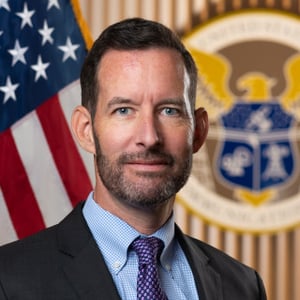
Chief of Staff, Federal Communications Commission (FCC)
Mr. Delacourt is Chief of Staff of the Federal Communications Commission. In this role, he manages the Chairman's policy agenda and strategic initiatives and serves as Chief Operating Officer for the Agency. He has a broad range of experience in telecommunications and technology law and policy spanning both the governmental and private sectors. Scott joined the FCC from Wiley Rein LLP where he served as Partner and Chair of the Wireless Practice Group. He previously served in leadership positions at the FCC, including Deputy Bureau Chief and Chief of Staff of the Wireless Bureau, Senior Counsel in the Office of General Counsel, and Legal Advisor to the Wireless Bureau Chief. Scott received his Law Degree, cum laude, from the University of Michigan Law School, and his Bachelor’s Degree, summa cum laude, from Georgetown University.
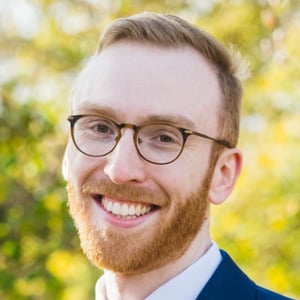
Director of Broadband and Spectrum Policy, Information Technology and Innovation Foundation
Joe Kane is director of broadband and spectrum policy at ITIF. Previously, he was a technology policy fellow at the R Street Institute, where he covered spectrum policy, broadband deployment and regulation, competition, and consumer protection. Earlier, Joe was a graduate research fellow at the Mercatus Center, where he worked on Internet policy issues, telecom regulation, and the role of the FCC.
Joe interned in the office of FCC Chairman Ajit Pai. He also interned with the satellite and terrestrial network provider SES, the Satellite Industry Association, the Competitive Enterprise Institute, and the American Action Forum. Joe holds a J.D. from The Catholic University of America, a master’s in economics from George Mason University, and a bachelor’s in political science from Grove City College.
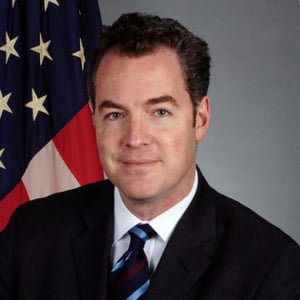
President and Founder, JKC Consulting LLC
John Kneuer is the President and Founder of JKC Consulting LLC. He sits on multiple public and private company boards.
Prior to starting Kneuer LLC, Mr. Kneuer served as the Assistant Secretary of Commerce for Communications and Information. In this capacity Mr. Kneuer was the principal advisor to the President of the United States on telecommunications policy and the Administrator of the National Telecommunications and Information Administration ("NTIA").In addition to representing the Executive Branch in domestic and international telecommunications and information policy activities, NTIA also manages the federal use of spectrum; performs cutting edge telecommunications research and engineering, including resolving technical telecommunications issues for the federal government and private sector; and administers infrastructure and public telecommunications facilities grants.
Prior to his service at NTIA, Mr. Kneuer served as a Senior Associate at the law firm of Piper Rudnick in Washington, D.C., providing regulatory and legislative representation to corporate clients in the telecommunications, defense, and transportation industries. Earlier in his career, Mr. Kneuer served as the Executive Director for Government Relations at the Industrial Telecommunications Association, and prior to that served as an Attorney-Advisor in the Commercial Wireless Division of the Federal Communications Commission's Wireless Bureau. Mr. Kneuer received B.A. and J.D. degrees from the Catholic University of America.
Founder and President, Salt Point Strategies
David Redl is the Founder and President of Salt Point Strategies, a strategic advising firm focused on the technology and telecom sectors. David is an attorney and former government executive with experience in both the legislative and executive branches of the U.S. government in the telecommunications, media, and technology fields.
David previously served as Assistant Secretary of Commerce for Communications and Information and the Administrator of the National Telecommunications and Information Administration. During his tenure, he led U.S. efforts to ensure American leadership in 5G, to bring broadband to more rural Americans, and to promote a free, open, and secure Internet around the world.
David also represented the United States in international forums, including leading U.S. efforts before the Internet Corporation for Assigned Names and Numbers, the Inter-American Telecommunication Commission, the Organisation for Economic Co-operation and Development, and the International Telecommunication Union.
In the legislative branch, David served as Chief Counsel for Communications and Technology on the majority staff of the U.S. House of Representatives Committee on Energy and Commerce. While at Energy and Commerce, he worked extensively on telecommunications, media, and technology laws, including the successful passage of laws authorizing the first-ever spectrum incentive auction, the creation of the First Responder Network Authority, and reauthorization of the satellite television laws.
Prior to his government service, David started his career as Director of Regulatory Affairs at CTIA, an international trade association of the wireless communications industry.
Mr. Redl received his B.A. in Journalism and his B.A. in Political Science from the Pennsylvania State University and his J.D. from the Catholic University of America with a certificate from the Institute for Communications Law Studies. He is a member of the New York and District of Columbia Bars.

Of Counsel, Spencer Fane LLP
Anthony J. “A.J.” Ferate has built a multi-faceted background in the areas of the law, policy, energy, campaigns and elections, and defense over the last 20 years.
Through recent representation as Vice President of Regulatory Affairs for the Oklahoma Independent Petroleum Association (“OIPA”), A.J. held responsibilities over government efforts outside of the legislative branch on matters as broad as water, electric generation, commodity marketing, land matters, and seismicity. A.J. also maintained responsibility for legal matters at OIPA, including amicus briefing in appellate matters. A.J.’s extensive experience also includes management of public policy strategy for a Fortune 500 company.
For the past eleven years, A.J. has volunteered as General Counsel and spokesman for the Oklahoma Republican Party and has represented a number of elected officials, including U.S. Senator James Lankford, former statewide elected officials, a number of state legislators, and members of Congress.
Additionally, A.J. has assisted elected officials serve their constituents in all branches of government. Early in his career, A.J. held legislative aide duties in the Nebraska Legislature, then went on to work for former Nebraska Treasurer David Heineman. A.J. gained experience in the judiciary while serving Judge Gary L. Lumpkin at the Oklahoma Court of Criminal Appeals, the highest criminal appellate court in Oklahoma. Following this service, A.J. began work with Denise A. Bode of the Oklahoma Corporation Commission, assisting her in her duties regulating 70 percent of Oklahoma’s economy, including oil and gas and electric utilities.
A.J. honorably served ten years as an intelligence analyst for the United States Naval Reserve, including time at the Office of Naval Intelligence in the greater Washington DC area.
Opinion pieces authored or ghostwritten by A.J. have been published in the Seattle Times, Politico, Law360, The Oklahoman, Tulsa World and The Journal Record. A.J. has also been interviewed by national and international newspapers, and has also appeared on national radio programs including NPR’s The Diane Rehm Show and On Point with Tom Ashbrook.
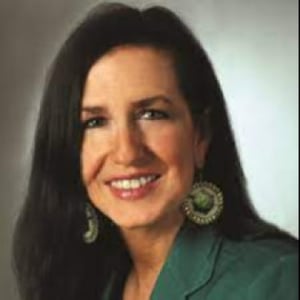
Shareholder, Greenberg Traurig
Jennifer Weddle is the Co-Chair of Greenberg Traurig's American Indian Law Practice and has wide-ranging experience in complex regulatory and jurisdictional issues, with a focus in Indian law, handling a variety of matters for tribal and non-tribal clients. She has a dynamic, inter-disciplinary practice that centers on providing strategies for resolving complex jurisdictional problems. Much of her practice focuses in the areas of tribal economic development and natural resources development. Jennifer also has U.S. Supreme Court experience, including serving as one of the attorneys for the respondent in Nevada v. Hicks (2001) and representing the petitioners in Ute Mountain Ute Tribe v. Padilla (2012) and Grand Canyon Skywalk Development, LLC v. Grand Canyon Resort Corporation (2013) and cert stage amici in Saginaw-Chippewa Tribe v. NLRB (2016) and United States v. Cooley (2020) and amici on the merits in Lewis v. Clarke (2017), U.S. v. Washington (2018), Carpenter v. Murphy (2018), McGirt v. Oklahoma (2020), and United States v. Cooley (2021).
Jennifer's work also includes negotiations for mineral leasing employment matters and representation before federal agencies. She has also been involved in civil litigation, working on numerous complex federal, state and tribal litigation matters, including class action tort litigation and large commercial disputes. Her transactional experience includes oil and gas renewables projects throughout the west, as well as Endangered Species Act work. Jennifer frequently assists tribes, banks and non-bank entities with financing and regulatory matters with Indian law components. Jennifer has wide-ranging project siting experience, including the application of NEPA, NHPA, and other environmental laws on tribal and public lands, including with respect to large linear multi-state energy and infrastructure projects. Jennifer has deep transactional, regulatory and litigation experience involving very complex matters with both legal and policy components.
Jennifer is past President of the National Native American Bar Association and past two-term Chair of the Federal Bar Association Indian Law Section. She currently serves as the Tenth Circuit Representative on the American Bar Association Standing Committee on the Federal Judiciary, a role she has held since 2018, spanning the evaluations for more than two dozen federal judicial nominees at every level of the federal courts. She is a ’00 graduate of Harvard Law School and a ’97 graduate of the University of Michigan (Classical Languages and Literature).

Milton R. Underwood Chair in Free Enterprise, Vanderbilt University Law School
Brian Fitzpatrick is the Milton R. Underwood Chair in Free Enterprise and Professor of Law at Vanderbilt Law School, where his research focuses on class action litigation, federal courts, judicial selection, and constitutional law. He is best known for his empirical studies of class action settlements as well as his book The Conservative Case for Class Actions (University of Chicago Press, 2019). Professor Fitzpatrick joined Vanderbilt's law faculty in 2007 after serving as the John M. Olin Fellow at New York University School of Law. He graduated first in his class from Harvard Law School and went on to clerk for Judge Diarmuid O'Scannlain on the U.S. Court of Appeals for the Ninth Circuit and Justice Antonin Scalia on the U.S. Supreme Court. After his clerkships, Professor Fitzpatrick practiced commercial and appellate litigation for several years at Sidley Austin in Washington, D.C., and served as Special Counsel for Supreme Court Nominations to U.S. Senator John Cornyn. Before earning his law degree, Fitzpatrick graduated summa cum laude with a bachelor's of science in chemical engineering from the University of Notre Dame. He has received the Hall-Hartman Outstanding Professor Award, which recognizes excellence in classroom teaching, for his Civil Procedure and Federal Courts courses.
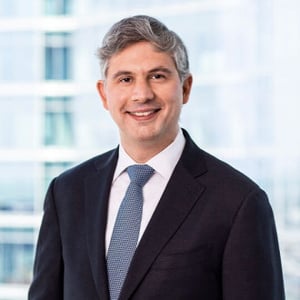
Partner, Keller Postman
Ashley Keller is one of the founding Partners of Keller Postman LLC. An experienced trial and appellate lawyer, Ashley helps set strategic direction across virtually all of the firm’s cases. He represents clients in a wide variety of practice areas and types of claims, including product-liability, antitrust, class action, and arbitration matters.
Ashley is one of the leaders of Keller Postman’s national product-liability practice. He leverages his ability to detangle complex concepts and develop novel legal theories to support individual client matters and as counsel on numerous product-liability multidistrict litigation matters. He chairs the plaintiffs’ Law & Briefing Committee in the Zantac (Ranitidine) Product Liability MDL in the U.S. District Court for the Southern District of Florida.
Ashley also litigates complex antitrust and class action matters. Among his notable cases, Ashley represents numerous States in antitrust litigation against Google for monopolizing products and services used by advertisers and publishers in online-display advertising.
Ashley also has played a central role in developing the firm’s pioneering arbitration practice, which includes pursuing individual arbitrations for clients whose claims are subject to arbitration clauses with class-action waivers. In part through managing the complexity of pursuing these individual claims simultaneously, the firm has secured millions in settlements for more than 500,000 employees and consumers.
Before launching Keller Postman, Ashley co-founded the litigation finance firm Gerchen Keller Capital, which grew to more than $1.3 billion in assets under management and was the world’s largest private investment manager focused on legal and regulatory risk prior to being acquired by Burford Capital in 2016.
Previously, Ashley was a partner at Bartlit Beck Herman Palenchar & Scott LLP, The American Lawyer’s litigation boutique of the year. While there, he handled various trial and appellate matters involving multi-billion-dollar securities and patent cases, contract disputes, mass torts, and class actions.
Ashley also worked as an analyst at Alyeska Investment Group, a Chicago-based market-neutral hedge fund, where he focused on investments in companies facing litigation and other complicated regulatory matters.
Ashley was named a 2021 Plaintiffs’ Lawyers Trailblazer by the National Law Journal. He is also listed on Lawdragon’s 500 Leading Lawyers in America, Lawdragon’s 500 Leading Plaintiff Consumer Lawyers, Lawdragon’s Leading Plaintiff Financial Lawyers, National Trial Lawyers’ Top 100, and Illinois Super Lawyers.
Ashley was a law clerk for Justice Anthony M. Kennedy at the Supreme Court of the United States and Judge Richard Posner at the U.S. Court of Appeals for the Seventh Circuit. He graduated magna cum laude from Harvard College, received his M.B.A. from the University of Chicago Booth School of Business and received his J.D. from the University of Chicago Law School, where he graduated first in his class.
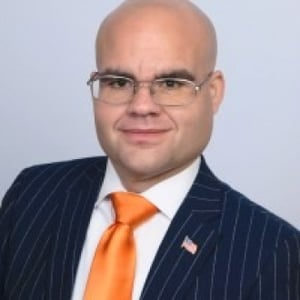
Counsel, Keller Postman LLC
John Masslon is a Counsel at Keller Postman LLC, where he works on a broad range of disputes, including products liability and consumer protections suits. He helps develop legal strategies, writes briefs, and presents argument on legal questions. Before joining Keller Postman, John was senior litigation counsel at Washington Legal Foundation. There, he wrote about 100 amicus briefs supporting free enterprise in courts across the country. He filed the first amicus brief in the Supreme Court supporting the challenge to OSHA’s vaccine mandate. He also filed a brief supporting ending the in-house proceedings at the Securities and Exchange Commission. Previously, John served as assistant solicitor general in a state attorney general’s office. There, he was first chair in a federal trial challenging a state election law that was ultimately upheld. He also wrote the briefs that convinced the state supreme court to uphold the State’s right-to-work statute.
John obtained his B.S. in economics with a minor in mathematical sciences from Clemson University. He then received his J.D. and LL.M. in Taxation from Georgetown University Law Center. After law school, John worked for Judge Arthur J. Schwab of the United States District Court for the Western District of Pennsylvania and clerked for Judge Judith Ference Olson of the Superior Court of Pennsylvania.
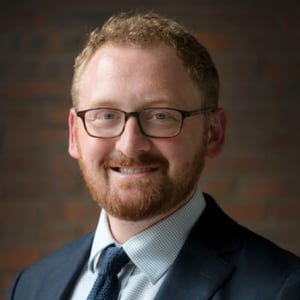
Fellow, Brookings Institution; General Counsel and Senior Editor, Lawfare; Senior Fellow, National Security Law Program,, Columbia Law School
Scott R. Anderson is a Visiting Fellow in Governance Studies at the Brookings Institution, where he was previously a David M. Rubenstein Fellow. He is also a Senior Editor and Counsel for Lawfare and a Senior Fellow with the National Security Law Program at Columbia Law School.
A former U.S. diplomat and government attorney, Mr. Anderson is an expert in foreign relations law, international law, and national security law and policy, particularly as they relate to the Middle East region. In addition to being a regular contributor to Lawfare and the Lawfare podcast, he has written on related issues for numerous publications, including Defense One, Foreign Affairs, Foreign Policy, Texas National Security Review, The Hill, and The Washington Post. He has appeared on a range of national and international television and radio broadcasts, including Al Jazeera English, BBC, CBS News, CNN, Fox News, and NPR, and his analysis and commentary have frequently been cited in the print media, including by the Associated Press, New York Times, Wall Street Journal, and Washington Post. He has been a policy advisor for national political campaigns and has served as a consultant and expert witness in litigation matters. In addition, he has taught at both the Georgetown University Law Center and Columbia Law School.
Mr. Anderson previously served as an attorney-adviser for the U.S. Department of State and as the legal adviser for the U.S. Embassy in Baghdad, Iraq. In these capacities, he advised policymakers on domestic and international legal issues relating to U.S. foreign and national security policy, most often in relation to the Middle East and North Africa. At various times, his portfolio included bilateral relations with Iraq, counter-Islamic State efforts in Iraq and Syria, diplomatic and sovereign immunity issues, the Persian Gulf region, select matters relating to the Israeli-Palestinian conflict, terrorism-related civil litigation, U.S. and international economic sanctions, and the Yemen conflict. He also helped to represent the Department in a number of litigation and international arbitration matters, including matters before the U.S. Supreme Court.
Between his government service and joining the Brookings Institution, Mr. Anderson was a law clerk for the U.S. Court of Appeals for the District of Columbia Circuit and an International Affairs Fellow with the Council on Foreign Relations, in which capacity he was in residence at Harvard Law School and Harvard Kennedy School. He is a graduate of the University of Virginia and Yale Law School and resides with his family in Washington, D.C.
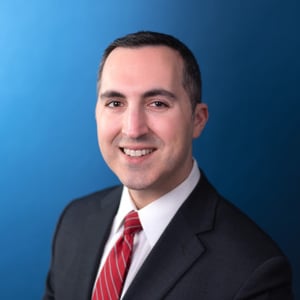
Senior Advisor, Foundation for Defense of Democracies
Richard Goldberg is a senior advisor at FDD. From 2019-2020, Richard served as the Director for Countering Iranian Weapons of Mass Destruction for the White House National Security Council. He previously served as chief of staff for Illinois Governor Bruce Rauner and deputy chief of staff and senior foreign policy adviser to former U.S. Senator Mark Kirk of Illinois in both the U.S. House and Senate.
As a staff associate for the House Appropriations Subcommittee on State-Foreign Operations, Richard worked on a wide range of issues related to U.S. foreign assistance, including foreign military financing, international security assistance, international peacekeeping, development, global health and economic support funds. He was a founding staff director of the House U.S.-China Working Group and was among the first Americans ever to visit China’s human space launch center. A leader in efforts to expand U.S. missile defense cooperation with Israel, Richard played a key role in U.S. funding for the Arrow-3 program, Iron Dome and the deployment of an advanced missile defense radar to the Negev Desert.
In the Senate, Richard emerged as a leading architect of the toughest sanctions imposed on the Islamic Republic of Iran. He was the lead Republican negotiator for three rounds of sanctions targeting the Central Bank of Iran, the SWIFT financial messaging service, and entire sectors of the Iranian economy. Richard also drafted and negotiated legislation promoting human rights and democracy in Iran, including sanctions targeting entities that provide the Iranian regime with the tools of repression. His Iran sanctions work was featured in the book The Iran Wars.
As the governor’s chief of staff, Richard managed government in America’s fifth-largest state with oversight of all day-to-day operations, including homeland security, public safety, and public health. He also spearheaded the first-ever state legislation to divest public pension funds from companies engaged in boycotts of Israel, which sparked a nationwide initiative in state capitols around America.
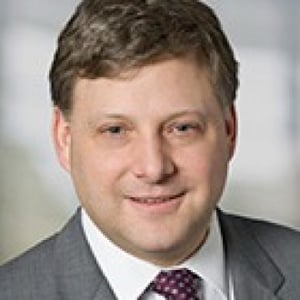
Partner, Sullivan & Cromwell LLP
Eric Kadel is engaged in a wide variety of corporate, transactional and regulatory matters. He is a member of the Firm’s Corporate and Finance, Financial Services, Investment Management, Alternative Investment Management, Cybersecurity, and Commodities, Futures and Derivatives Groups. With regard to financings, Mr. Kadel regularly represents participants in capital markets transactions, and dealers and end users in connection with structuring and documenting a wide variety of swaps and other derivatives, including equity, credit default and commodity swaps, options and forwards. Mr. Kadel’s work in the investment management area includes advising public and private investment companies and investment advisers on a wide variety of transactional, regulatory, compliance and other matters, including registration and regulation. Mr. Kadel also advises clients of the Firm regarding developments in the laws regulating the financial services industry and on cybersecurity issues. Mr. Kadel is currently an adjunct professor at George Washington University Law School.
In addition, Mr. Kadel is one of the principal partners in the Firm’s International Trade and Investment practice. He counsels and represents clients on questions about U.S. economic sanctions, including those administered by the Treasury Department’s Office of Foreign Assets Control (“OFAC”), United States antiboycott requirements under the Export Administration Regulations administered and enforced by the Commerce Department’s Office of Antiboycott Compliance within the Bureau of Industry and Security, Bank Secrecy Act/anti‐money laundering laws and the U.S. Foreign Corrupt Practices Act (“FCPA”). Mr. Kadel’s practice includes analysis of proposed transactions and business relationships; due diligence and design and review of compliance procedures and strategies; and internal investigations, voluntary disclosures and government enforcement actions. Mr. Kadel also regularly advises clients regarding questions arising under Exon-Florio and the transaction review process administered by the Committee on Foreign Investment in the United States (“CFIUS”), and has represented clients before CFIUS on many national security reviews.

Founder and Executive Director, National Security Institute; Assistant Professor of Law, Antonin Scalia Law School, George Mason University
Jamil N. Jaffer is the Founder and Executive Director of the National Security Institute at the Antonin Scalia Law School at George Mason University where he also serves as an Assistant Professor of Law, Director of the National Security Law and Policy Program, and Director of the Cyber, Intelligence, and National Security LLM Program. Jamil also teaches classes on counterterrorism, intelligence, surveillance, cybersecurity, and other national security matters, as well as a summer course held abroad with U.S. Supreme Court Justice Neil M. Gorsuch. Jamil is also affiliated with Stanford University’s Center for International Security and Cooperation and previously served as a Visiting Fellow at the Hoover Institution from 2016 to 2019.
Jamil is also a Venture Partner with Paladin Capital Group, where he assists the firm with investments across the full range of its themes and theses, including a focus on dual-use national security technologies. Jamil also serves on the board of directors of RangeForce, a cybersecurity training and readiness platform startup and Tozny, a digital identity startup, and on the advisory boards of U.S. Strategic Metals, North America’s largest primary producer of cobalt, a critical mineral used in EV batteries, aerospace, and other national security applications; and Constella Intelligence, a deep and dark web intelligence startup. Jamil also serves as an advisor to Beacon Global Strategies, a strategic advisory firm and Duco, a technology platform startup that connects corporations with geopolitical and international business experts. Jamil is also the managing director of Trigraph Caveat Capital, a private investment vehicle.
Among other things, Jamil currently serves on the Board of Directors for the Greater Washington Board of Trade, the Board of Advisors for the Global Cyber Alliance, and the Advisory Board of the Foundation for the Defense of Democracies’ Center on Cyber and Tech Innovation, the Executive Committee of the Reagan Institute Strategy Group. Jamil is also a Fellow at the Academy for Judaic, Christian, and Islamic Studies, an advisor to the Concordia Summit, and is a member of the Board of Directors for the Center for Intelligence Policy, the Board of Directors of Speech First, and the Executive Committee of the International Law and National Security Practice Group of the Federalist Society.
Immediately prior to his current positions, from 2015-2021, Jamil served as a senior business leader at IronNet Cybersecurity, helping take the company from a bootstrapped first-year technology products startup through two rounds of venture capital fundraising, growing from 40 employees to over 300, and through its listing on New York Stock Exchange. In his role as IronNet's Senior Vice President for Strategy, Partnerships & Corporate Development, Jamil worked directly for the co-CEOs of the company, Gen (ret.) Keith B. Alexander, the former Director of the National Security Agency and Founding Commander of U.S. Cyber Command, and Bill Welch, the former COO of Zscaler and Duo; in that role, Jamil led all of the company’s strategic and technology partnership efforts, including developing go-to-market and technology integration plans with some of the largest cloud platforms and cybersecurity companies in the market, evaluating potential acquisition targets, and developing overall corporate strategy and thought leadership around collective security and collaborative defense in the cyber arena.
Prior to his time at IronNet, Jamil served on the leadership team of the Senate Foreign Relations Committee as Chief Counsel and Senior Advisor under Chairman Bob Corker (R-TN), where he worked on key national security and foreign policy issues, including leading the drafting of the proposed Authorization for the Use of Military Force against ISIS in 2014 and 2015, the AUMF against Syria in 2013, and revisions to the 9/11 AUMF against al Qaeda. Jamil was also the lead architect of the Iran Nuclear Agreement Review Act and two sanctions laws against Russia for its first intervention in Ukraine.
Prior to joining SFRC, Jamil served as Senior Counsel to the House Permanent Select Committee on Intelligence under Chairman Mike Rogers (R-MI) where he led the committee’s oversight of NSA surveillance, NRO intelligence issues, and NGA analytic and collection matters, as well as intelligence community-wide counterterrorism issues. Jamil was also the lead architect of the Cyber Intelligence Sharing and Protection Act, the nation’s first cyber threat intelligence sharing legislation that was signed into law in 2015.
In the Bush Administration, Jamil served in the White House as an Associate Counsel to the President, handling Defense Department, State Department, and intelligence community matters, and serving as one of the White House Counsel’s primary representatives to the National Security Council Deputies Committee.
Prior to the White House, Jamil served on the leadership team of the Justice Department’s National Security Division as Counsel to the Assistant Attorney General for National Security, where he focused on counterterrorism and intelligence matters. At NSD, Jamil helped lead the division’s work on In re: Directives, the first ever two-party litigated matter in the FISA Court and the second case before the FISA Court of Review in its 30-year history. Jamil also led NSD’s efforts on the President’s Comprehensive National Cybersecurity Initiative (CNCI), including the drafting of NSPD-54/HSPD-23, and related classified matters, and advised the National Security Agency (NSA) and U.S. Cyber Command’s predecessor organization, the Joint Function Component Command for Network Warfare (JFCC-NW), on matters related to cyber intelligence collection and offensive cyber activities. For his work on these matters, Jamil was awarded the Assistant Attorney General’s Award for Special Initiative and was among the group of lawyers awarded the Director of National Intelligence’s 2008 Legal Award (Team of the Year – Cyber Legal).
Jamil also served in other positions in the Justice Department, including in the Office of Legal Policy, where he worked on the confirmations of Chief Justice John G. Roberts, Jr. and Justice Samuel A. Alito, Jr. to the United States Supreme Court.
Jamil also served as a lawyer in private practice at Kellogg Huber, a Washington, DC-based litigation boutique, as a policy advisor to Congressman Bob Goodlatte (R-VA), and as a staff member or senior advisor on a number of political campaigns, including two presidential campaigns and a presidential transition team. While in law school, Jamil was a member of the University of Chicago Law Review, managing editor of the Chicago Journal of International Law, and National Symposium Editor of the Harvard Journal of Law & Public Policy. Following law school, Jamil served as a law clerk to Judge Edith H. Jones of the United States Court of Appeals for the Fifth Circuit and, later in his career, as a law clerk to then-Judge Neil M. Gorsuch when he first joined the United States Court of Appeals for the Tenth Circuit as well as a law clerk to Justice Neil Gorsuch when he joined the U.S. Supreme Court.
Jamil has published multiple op-eds and academic articles on national security, foreign policy, cybersecurity, counterterrorism, encryption, and intelligence matters, and is the co-author of a book chapter with former NSA Director Gen. (Ret.) Keith B. Alexander on national security and the press in National Security, Leaks, and the Freedom of the Press: The Pentagon Papers Fifty Years On (2021) and a book chapter with former CIA Director Gen. (ret.) Mike Hayden on ISIS, al Qaeda, and other international terrorist groups in Choosing to Lead: American Foreign Policy for a Disordered World (2015). Jamil has also written book chapters on cybersecurity and surveillance, as well as op-eds and policy papers with former Attorney General Michael B. Mukasey, former National Counterterrorism Center Director Matt Olsen, and Congressman Mike Waltz (R-FL), among others.
Jamil has previously taught graduate-level courses in intelligence law and policy at George Washington University’s Elliott School of International Affairs and the National Intelligence University, served an outside advisor to the Cyberspace Solarium Commission, and has recently testified before committees of the U.S. Senate and House of Representatives on China, cybersecurity, counterterrorism, and other national security matters. Jamil has also recently appeared on a range of national television and radio outlets including CNN, Fox News, Fox Business, MSNBC, Bloomberg, PBS, Voice of America, and National Public Radio, and in various print and online publications, including the Wall Street Journal, New York Times, and the Washington Post on a range of national security matters including cybersecurity, counterterrorism, surveillance, encryption, privacy, and foreign policy issues.
Jamil holds degrees from UCLA (BA, cum laude), the University of Chicago Law School (JD, with honors), and the United States Naval War College (MA, with distinction).
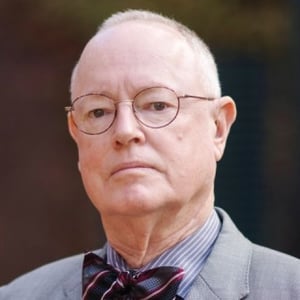
John C. Jeffries, Jr., Distinguished Professor of Law, University of Virginia School of Law
Paul B. Stephan is an expert on international business, international dispute resolution and comparative law, with an emphasis on Soviet and post-Soviet legal systems. In addition to writing prolifically in these fields, Stephan has advised governments and international organizations, taken part in cases in the Supreme Court of the United States, the federal courts, and various foreign judicial and arbitral proceedings, and lectured to professionals and scholarly groups around the world on issues raised by the globalization of the world economy. During 2006-07, he served as counselor on international law in the U.S. Department of State, and in 2020-21 as special counsel to the general counsel in the Department of Defense. He was a coordinating reporter for the American Law Institute’s Restatement (Fourth) of the Foreign Relations Law of the United States.
Stephan received his B.A. and M.A. from Yale University in 1973 and 1974, respectively, and his J.D. from the University of Virginia in 1977. Before returning to Virginia, he clerked for Judge Levin Campbell of the U.S. Court of Appeals for the First Circuit and for U.S. Supreme Court Justice Lewis F. Powell Jr. He has taught as a visiting professor at the Moscow State Institute for International Relations, the University of Vienna, Münster University, Lausanne University, Melbourne University, University of Pantheon-Assas (Paris II), Sciences Po, Paris I, the Interdisciplinary Centre Herzliya, Sydney University, the Peking University School of Transnational Law in Shenzhen, China, the University of Tartu’s Pärna College, and Liverpool University. He also has visited at Columbia Law School and Duke Law School, and served as a scholar in residence in the London office of Wilmer Hale.
After the collapse of the Soviet Union, Stephan took part in a variety of projects involving law reform in former socialist states. He worked in Russia, Georgia, Ukraine, Albania and Slovakia on behalf of the U.S. Treasury and in Kazakhstan and Azerbaijan on behalf of the International Monetary Fund. He also organized training programs for tax administrators and judges from all of the formerly socialist countries under the auspices of the Organization for Economic Cooperation and Development. His casebooks on international business, international trade and investment, and Doing Business in Emerging Markets are used at law schools both in the United States and abroad. He is the co-author, with Robert Scott, of The Limits of Leviathan: Contract Theory and the Enforcement of International Law (Cambridge University Press, 2006), and the author of The World Crisis and International Law: The Knowledge Economy and the Battle for the Future (2023). His current research focuses on the legal issues related to the Russian invasion of Ukraine and legal responses to the rise of big data.

Adam Griffin is a graduate of the University of North Carolina School of Law. During law school, he served as a research assistant to Professor Stephen E. Sachs and UNC Law Dean Martin Brinkley. After law school, Adam spent two years litigating for liberty at the Institute for Justice as an inaugural Law and Liberty Fellow. He then served as a law clerk to Chief Judge Richard E. Myers in the United States District Court for the Eastern District of North Carolina, and previously worked at Pacific Legal Foundation and the Civil Rights Division of the Department of Justice.

Attorney, Pacific Legal Foundation
Jeff McCoy is an attorney at Pacific Legal Foundation. Jeff joined PLF in 2017. Since then, he has focused his litigation on separation of powers and private property rights. Jeff also leads PLF’s coastal land rights initiative, which seeks to strengthen and defend statutory and constitutional protections for coastal property owners across the country.
Throughout his career, Jeff has worked for various organizations that promote individual liberty and limited government. Prior to joining PLF, Jeff was a staff attorney at Mountain States Legal Foundation in Lakewood, Colorado, for five years. His work at Mountain States included helping secure victory for a Wyoming private property owner in U.S. Supreme Court case Marvin M. Brandt Revocable Trust v. United States. Besides Mountain States, Jeff worked as an intern for the Cato Institute during the spring of 2008, and after his first year of law school, he worked as a Charles G. Koch Summer Fellow at the Institute for Justice’s Seattle office.
Jeff received his B.A. degree in political science and philosophy from the University of Colorado in 2007 and his law degree, also from the University of Colorado, in 2011. During his time at law school, Jeff had the honor of working as a judicial extern for then-Judge Neil Gorsuch at the U.S. Court of Appeals for the Tenth Circuit.

Judge, United States Court of Appeals, Sixth Circuit
Amul R. Thapar serves as a judge on the United States Court of Appeals for the Sixth Circuit. His judicial career began in 2007 when President George W. Bush nominated him to serve on the Eastern District of Kentucky, making him the first South Asian Article III judge in American history. In 2017, he became President Donald J. Trump’s first appellate court nominee.
Before joining the bench, Judge Thapar served as the United States Attorney for the Eastern District of Kentucky. While United States Attorney, Judge Thapar worked on the Attorney General’s Advisory Committee (“AGAC”) and chaired the AGAC’s Controlled Substances and Asset Forfeiture subcommittee. He also served on the Terrorism and National Security subcommittee, the Violent Crime subcommittee, and the Child Exploitation working group.
Judge Thapar has worked in private practice, at Williams & Connolly in Washington, D.C., and Squire, Sanders & Dempsey in Cincinnati, Ohio. He also served as an Assistant United States Attorney in both the Southern District of Ohio and the District of Columbia.
Judge Thapar received his undergraduate degree from Boston College and his law degree from the University of California, Berkeley. After graduating, Judge Thapar worked as a law clerk to the Honorable S. Arthur Spiegel of the United States District Court for the Southern District of Ohio, and the Honorable Nathaniel R. Jones of the United States Court of Appeals for the Sixth Circuit.
Judge Thapar has also published in the Yale Law Journal, Michigan Law Review, and Catholic University Law Review. He teaches courses on originalism, the Federalists and Anti-Federalists, and legal writing at Notre Dame Law School, the University of Virginia School of Law, and Vanderbilt Law School.

Executive Vice President, The Federalist Society
Dean Reuter is Executive Vice President at the Federalist Society for Law and Public Policy Studies. He has served in two federal government agency Offices of the Inspector General, as Counsel to the Inspector General and Deputy Inspector General, responsible for policing the use of federal funds granted and contracted through those agencies. As such, he helped conduct and oversee criminal investigations across the country. He is the principal author of the non-fiction book, The Hidden Nazi: The Untold Story of America's Deal with the Devil, and editor of Liberty’s Nemesis: The Unchecked Expansion of the State and Confronting Terror: 9/11 and the Future of American National Security. He was appointed by the President and served as Vice-Chairman of the Board of Directors of the Corporation for National and Community Service, and recently served as an appointee on the U.S. Commission on Presidential Scholars. He is a graduate of Hood College (BA with Honors) and the University of Maryland School of Law.

Partner, Earth & Water Law
Susan Bodine is a partner at Earth & Water Law.
Susan Bodine is a former Assistant Administrator for EPA’s Office of Enforcement and Compliance Assurance (OECA). Prior to this position, Susan served as Chief Counsel for the Senate Committee on Environment and Public Works and previously worked for the House Committee on Transportation and Infrastructure.
This is Susan’s second position at EPA, having served as Assistant Administrator for the Office of Solid Waste and Emergency Response (now the Office of Land and Emergency Management) from 2006 to 2009.
Susan has also practiced environmental law at Covington and Burling LLP and at Barnes and Thornburg LLP.
Susan is a graduate of Princeton University and the University of Pennsylvania School of Law.
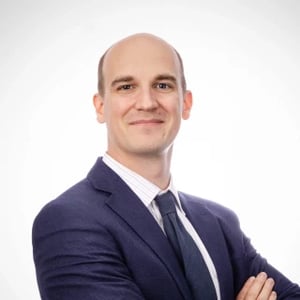
Managing Partner, Boyden Gray PLLC
Michael Buschbacher is the managing partner of Boyden Gray PLLC. He represents public and private companies, trade associations, non-profits, and individuals in high-stakes litigation and administrative proceedings, with a particular focus on environmental and energy matters.
In addition to trial-level work, Mr. Buschbacher maintains an active appellate practice, both as merits counsel and as counsel for amici curiae. He has written amicus briefs quoted by the Seventh and Ninth Circuits. And his Supreme Court advocacy has been cited by The New Yorker, The New York Times, and E&E News. Mr. Buschbacher’s commentary on legal issues has been published in The Wall Street Journal, Newsweek, and The American Conservative.
Before joining the firm, Mr. Buschbacher served at the U.S. Department of Justice as counsel to the Assistant Attorney General for the Environment and Natural Resources Division. There, he advised senior Department leadership, served as the lead attorney on several lawsuits, and helped draft policy memoranda for the Department on the proper scope and procedure for environmental enforcement. Prior to serving in the government, Mr. Buschbacher was an associate in the D.C. office of Sidley Austin.
Mr. Buschbacher is a former clerk to Judge Alice M. Batchelder of the U.S. Court of Appeals for the Sixth Circuit and to Magistrate Judge Paul R. Cherry of the U.S. District Court for the Northern District of Indiana.
Mr. Buschbacher holds a B.A. in Music and Germanic Studies from Indiana University and a J.D., magna cum laude, from Notre Dame Law School.
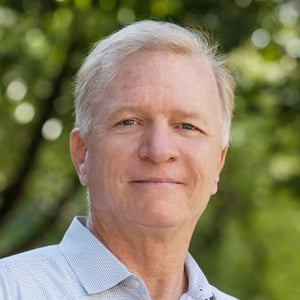
Executive Director, Environmental Integrity Project
Eric has served as Executive Director since he co-founded the organization in 2002. Previously, Eric served as director of EPA’s Office of Civil Enforcement from 1997 to 2002, where he received a Presidential Rank Award, as well as the John Marshall award from the Justice Department for his leadership in negotiating an industry-wide cleanup of petroleum refineries. Eric’s career at EPA began in 1990, and included an appointment as special assistant to the Deputy Administrator. Prior to his service at EPA, Eric worked as an environmental attorney for two and a half years at Morgan, Lewis & Bockius, and spent six years on Capitol Hill working for various members of Congress. Eric received his law degree from Georgetown University, and his B.A. from Vanderbilt University.
United States Senate, Alaska
Dan Sullivan was sworn in as Alaska’s eighth United States Senator on January 6, 2015. Sullivan serves on four Senate committees vital to Alaska: the Commerce, Science and Transportation Committee; the Armed Services Committee; the Environment and Public Works Committee; and the Veterans' Affairs Committee.
Prior to his election to the U.S. Senate, Sullivan served as Alaska’s Attorney General and Commissioner of the Alaska Department of Natural Resources. As Alaska's Attorney General, Sullivan’s number one priority was protecting Alaskans, their physical safety, financial well-being, and individual rights – particularly Alaska’s most vulnerable. During his tenure he spearheaded a comprehensive statewide strategy – the “Choose Respect” campaign – to combat Alaska’s high rates of domestic violence and sexual assault. Under Sullivan’s leadership, the Department of Law also undertook an aggressive strategy of initiating and intervening in litigation aimed at halting federal government overreach into the lives of Alaskans and their economy.
As Commissioner of the Alaska Department of Natural Resources, Sullivan managed one of the largest portfolios of oil, gas, minerals, renewable energy, timber, land, and water in the world. Working closely with Alaska’s Governor and state legislature, Sullivan developed numerous strategies that spurred responsible resource development, energy security, and a dramatic increase in good-paying jobs across a number of critical sectors in the Alaska economy. He also developed a comprehensive plan to streamline and reform the state’s regulatory and permitting system.
Sullivan is one of a select number of Alaskan attorneys who has held judicial clerkships on both the highest federal and state courts in Alaska. He served as a judicial law clerk for Judge Andrew Kleinfeld of the United States Court of Appeals for the Ninth Circuit in Fairbanks, Alaska and for Chief Justice Warren Matthews of the Alaska Supreme Court in Anchorage, Alaska. Sullivan also served as a judicial law clerk/intern for Judge James L. Buckley on the United States Court of Appeals for the District of Columbia Circuit.
Sullivan has a distinguished record of military and national security service. He is currently an infantry officer and Lieutenant Colonel in the U.S. Marine Corps Reserves. Over the past 21 years, Sullivan has served in a variety of command and staff billets on active duty and in the reserves, including: TRAP Force Commander and 81mm mortar Platoon Commander, 31st Marine Expeditionary Unit (Special Operations Capable); Weapons Company Executive Officer, Second Battalion, Fifth Marines; Commanding Officer, Delta Company, Anti-Terrorism Battalion; Executive Officer, Echo Company, Fourth Reconnaissance Battalion; and Commanding Officer, 6thAir Naval Gunfire Liaison Company (ANGLICO). In 2004, Sullivan was recalled to active duty for a year and a half to serve as a staff officer to the Commander of U.S. Central Command, General John Abizaid, spending substantial time deployed in the Middle East, the Horn of Africa, and Central Asia. In July 2013, Sullivan was recalled to active duty to serve with a Joint Task Force in Afghanistan focusing on dismantling terrorist networks and criminalizing the Taliban insurgency.
Sullivan served in the Administration of President George W. Bush as the U.S. Assistant Secretary of State for Economic, Energy, and Business under Secretary of State Condoleezza Rice. He focused on fighting terrorist financing, and implementing policies relating to international energy, economic, trade, finance, transportation, telecommunications, and Arctic issues. Sullivan also served as a Director in the International Economics Directorate of the National Security Council staff at the White House.
Sullivan earned a B.A. in Economics from Harvard University in 1987 and a joint law and Masters of Science in Foreign Service from Georgetown University in 1993. Dan and his wife Julie Fate Sullivan were married over 20 years ago in Julie’s hometown of Fairbanks, Alaska. They have three teenage daughters: Meghan, Isabella and Laurel.
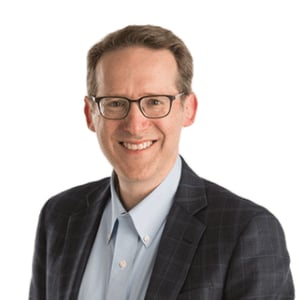
Assistant Administrator (Nominee), United States Environmental Protection Agency
Professor David M. Uhlmann has been nominated by President Biden to serve as assistant administrator for enforcement and compliance assurance at the U.S. Environmental Protection agency. If confirmed by the United States Senate, Professor Uhlmann will take a leave of absence from Michigan Law so that he can lead federal criminal, civil, and administrative enforcement of the environmental laws, including the Clean Air Act, the Clean Water Act, hazardous waste laws, the Safe Drinking Water Act, and the Toxic Substances Control Act.
Professor Uhlmann is an internationally recognized expert on environmental law, leading authority on criminal enforcement of the environmental laws in the United States, and highly-regarded advocate for environmental stewardship and corporate sustainability programs. At Michigan Law he is the Jeffrey F. Liss Professor from Practice and the director of the Environmental Law and Policy Program. Professor Uhlmann previously served for 17 years as a federal prosecutor, including seven years as chief of the Environmental Crimes Section at the U.S. Department of Justice. In that role, he led prosecution of environmental and wildlife crimes nationwide, coordinated national legislative, policy, and training initiatives regarding criminal enforcement, and chaired the Justice Department’s Environmental Crimes Policy Committee. He earned a reputation for prosecuting polluters aggressively and fairly, presided over expansion of the environmental crimes program, and strengthened relationships with the Environmental Protection Agency, the Coast Guard, and other law enforcement partners. His work as lead prosecutor in United States v. Elias is chronicled in The Cyanide Canary. He received numerous Justice Department and EPA awards for his precedent-setting prosecutions, including the first environmental justice criminal trial.
Professor Uhlmann served from 2017 to 2020 as the Counselor to the Michigan Law alumnus Larry D. Thompson, the Compliance Monitor and Independent Auditor appointed by the Justice Department and EPA in the wake of the Volkswagen diesel scandal. In addition to advising the monitor, Professor Uhlmann made numerous presentations to the Volkswagen and Audi boards regarding environmental law in the United States, corporate accountability, and promoting environmental stewardship and an ethical culture. Professor Uhlmann has testified before Congress about the use of environmental protections to address shortcomings in worker safety laws and redressing environmental harm in corporate settlements; he has lectured widely about corporate crime and the exercise of prosecutorial discretion in cases involving corporate wrongdoing. Professor Uhlmann’s views on corporate accountability for the Gulf oil spill and the VW diesel scandal, the urgency of climate disruption, and the need to promote a sustainable future for all Americans have been published in The New York Times, The Atlantic, the American Constitution Society’s Issue Briefs series, and numerous top law reviews. Professor Uhlmann leads the efforts of nearly 400 Michigan Law students participating in the Environmental Crimes Project, the first comprehensive empirical study of criminal enforcement under U.S. pollution laws. At Michigan Law, Professor Uhlmann has hosted conferences, lecture series, and pro bono projects, led campus-wide sustainability efforts, and mentored a next generation of environmental lawyers committed to public service and public interest work.
Professor Uhlmann is a fellow in the American College of Environmental Lawyers, which invited him to join their Board of Regents earlier this year. He was named a “Conservation Hero” by the Michigan League of Conservation Voters and selected by the University of Michigan to be a Distinguished Faculty Fellow in Sustainability. Uhlmann received his JD from Yale Law School and his BA in history and political science with high honors from Swarthmore College. Following law school, he clerked for U.S. District Court Judge Marvin H. Shoob in Atlanta, Georgia.
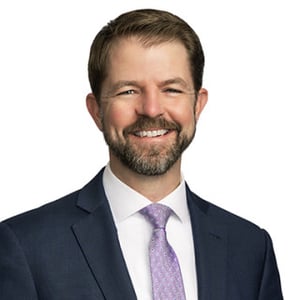
Partner, Baker Botts LLP
Drawing from two decades of experience in senior government, in-house corporate, and private law firm roles, Jeff Wood helps clients with federal enforcement, compliance, litigation, permitting, and policy challenges primarily in the energy and environmental fields.
Prior to joining Baker Botts, Mr. Wood served for almost two years as the Acting Assistant Attorney General (AAG) for the Justice Department's Environment and Natural Resources Division (ENRD). In that capacity, Mr. Wood led ENRD and its more than 600 attorneys and staff representing EPA, Departments of the Interior, Energy, and Defense, and other agencies in civil and criminal enforcement and defensive environmental, energy, and natural resources litigation.
As the top official in ENRD, Mr. Wood managed a complex organization with an annual budget exceeding $200 million and a docket of more than 6,000 cases and matters. E&E News noted that “Wood maintains a strong relationship with ENRD's career staff” (Greenwire, Oct. 31, 2018). He previously served on the staff of the United States Senate Committee on Environment and Public Works.
At the Justice Department, Mr. Wood oversaw the Division's civil and criminal enforcement programs and was responsible for developing legal strategies and approving briefs in key cases including filings before the Supreme Court and Courts of Appeals in coordination with the Office of Solicitor General. In this role, Mr. Wood held the highest level security clearance and worked closely with top leadership at DOJ, EPA, the Interior Department, USDA, the Energy Department, Transportation Department, FERC, NRC and across the Executive Branch, including the White House.
With many years of both private law firm and in-house legal experience, Mr. Wood has handled complex environmental enforcement, regulatory, policy, and litigation matters for electric utilities, energy companies, maritime companies, mining companies, real estate developers, financial institutions, industrial companies and manufacturers, business coalitions, associations, small businesses, and individual property owners. Drawing from his experiences in-house, Mr. Wood brings a common-sense, cost-effective, client-focused approach to his work every day.
With a strong national reputation, Mr. Wood is a frequent speaker on environmental law and policy matters, with recent speeches and presentations at the Environmental Law Institute, Harvard Law School, Vanderbilt Law School, American University Law School, American Bar Association Environmental Law Conferences, the Texas Environmental SuperConference, Air Force Judge Advocate General School's Advanced Environmental Law Course, Baker Institute's Center for Energy Studies (Rice University), and many other venues. He frequently appears in national news to share insights on significant environmental law and policy issues, including recent quotes in the New York Times, Washington Post, Wall Street Journal, Bloomberg, Law360, and E&E News, among others.
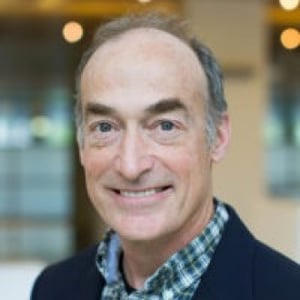
Professor of Law, Georgetown Law
William W. Buzbee is a professor of law at Georgetown University Law Center. In his teaching and scholarship, he specializes in environmental law, legislation and regulation, and administrative law. Recent publications focus on climate regulation, deregulation and law governing agency policy change, and federalism. He also offers seminars on advanced environmental, regulatory, and constitutional law subjects, with his most recent seminar focused on “The Art of Regulatory War.”
Professor Buzbee’s books include the recently published Fighting Westway: Environmental Law, Citizen Activism, and the Regulatory War that Transformed New York City (Cornell University Press 2014) and Preemption Choice: The Theory, Law and Reality of Federalism’s Core Question(Cambridge University Press, hardcover 2009, paperback 2011) (William W. Buzbee editor and contributor). He has been a co-author of the 5th , 6th, 7th and forthcoming 8th editions of Environmental Protection: Law and Policy (Aspen/Wolters Kluwer). Law review scholarship includes publications in New York University Law Review, University of Pennsylvania Law Review, Michigan Law Review, Stanford Law Review (co-authored), Cornell Law Review (co-authored), Duke Law Journal (forthcoming), George Washington Law Review, Iowa Law Review, The Journal of Law and Politics and in an array of other journals, books, news outlets, and blogs. Three of his articles have been named among the 10 best environmental or land use law articles of that year and republished in the Land Use and Environment Law Review. He regularly assists with appellate and Supreme Court environmental, federalism, and regulatory litigation, and also has testified before congressional committees on environmental and regulatory matters. He has published op-eds on regulatory and environmental issues with The New York Times, The Hill, CNN, and been quoted and interviewed by numerous press and media outlets.
Professor Buzbee joined Georgetown from Emory Law School, where he was a professor of law and directed its Environmental and Natural Resources Law Program. He also co-directed Emory’s Center on Federalism and Intersystemic Governance. He has been a visiting professor of law at Columbia, Cornell and Illinois law schools. He has also served as a professor for the Leiden-Amsterdam-Columbia Law School Summer Program in American Law. Professor Buzbee is a founding Member Scholar of the Center for Progressive Reform, a Washington D.C.-based regulatory think tank. Professor Buzbee was awarded the 2007-2008 Emory Williams Teaching Award for excellence in teaching. Professor Buzbee clerked for United States Judge Jose A. Cabranes, and before becoming a professor was an attorney-fellow at the Natural Resources Defense Council, and did environmental, land use and litigation work for the New York City law firm, Patterson, Belknap, Webb & Tyler. JD, Columbia Law School, 1986; BA, Amherst College, magna cum laude, 1983.
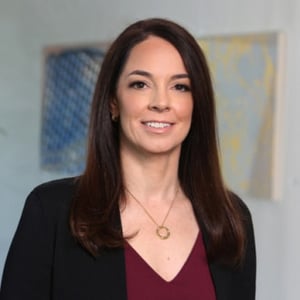
Partner, Hunton Andrews Kurth
A co-leader of Hunton Andrews Kurth’s environmental practice, Deidre is lauded in Chambers USA, 2016 as “extremely capable,” “very familiar with the regulations and agencies,” and excels at giving clients “good insight into getting an expeditious outcome.” Her practice focuses exclusively on environmental, energy and administrative law.
Deidre represents clients on permitting, compliance and litigation relating to the Clean Water Act (CWA), the Endangered Species Act (ESA), the National Environmental Policy Act (NEPA) and other environmental statutes. She frequently counsels clients on administrative rulemaking and policy, providing regulatory clarifications when necessary, and drafting federal and state legislation on myriad intricate issues. She is also well known for negotiating and obtaining permits for complicated energy and development projects. Her clients include development companies, oil and natural gas pipelines, electric utilities, agricultural interests, state and local agencies, and various trade associations.
Prior to entering private practice, Deidre served as assistant general counsel of the Army at the Pentagon, advising the secretary of the Army on environmental and land use issues involving the Corps of Engineers’ Civil Works and section 404 Regulatory program, as well as the Base Realignment and Closure (BRAC) program. Deidre has extensive experience with federal regulatory agencies, military departments and the US Department of Justice.

Special Counsel, Hunton Andrews Kurth
After serving on the United State Court of Appeals for the D. C. Circuit from 2005, Judge Griffith stepped down from the bench in 2020. Currently he is a Lecturer on Law at Harvard Law School, a Fellow at the Wheatley Institute at Brigham Young University, and Special Counsel in the Washington, DC office of the law firm of Hunton Andrews Kurth. Most recently, he was a member of President Biden's Commission on the Supreme Court. He is the author of Civic Charity and the Constitution , and the co-author, along with former judges Michael Luttig and Michael McConnell, of Lost, Not Stolen: The Conservative Case that Trump Lost and Biden Won the 2020 Presidential Election. https://lostnotstolen.org/ . Before being appointed to the D. C. Circuit, Judge Griffith was the General Counsel at BYU; Senate Legal Counsel, the non-partisan chief legal officer of the U. S. Senate; and a partner at Wiley, Rein & Fielding. Long active in rule-of-law programs in former communist nations, Judge Griffith is a member of the international advisory board of the CEELI Institute in Prague. He is a graduate of BYU and the University of Virginia School of Law and is a member of the American Law Institute.
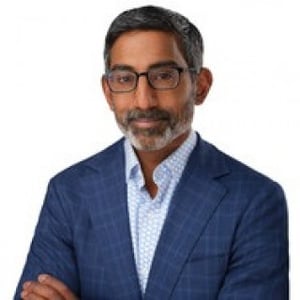
Senior Vice President of Programs, Earthjustice
Sam Sankar is Earthjustice’s Senior Vice President for Programs. Sam leads our Program Leadership Team, which develops Earthjustice’s strategy for carrying out our mission through litigation, lobbying and regulatory advocacy, and communications.
Sam has been working on environmental issues throughout his career, which has included service as a line attorney at the Justice Department’s Environment and Natural Resources Division, as a senior executive at General Electric, and as deputy chief counsel of a presidential commission formed to investigate the 2010 Deepwater Horizon oil spill. He has also worked as a boat captain, machinist, and senior advisor to The Nature Conservancy.
Sam received his B.S. in civil engineering from Cornell University, an M.S. in environmental engineering from Stanford University, and his law degree from the University of California, Berkeley. After law school, he clerked for Judge William Fletcher of the Ninth Circuit, Judge Louis Pollak of the Eastern District of Pennsylvania, and Justice Sandra Day O’Connor of the U.S. Supreme Court.
Sam lives in Washington, D.C., with his wife and two children.
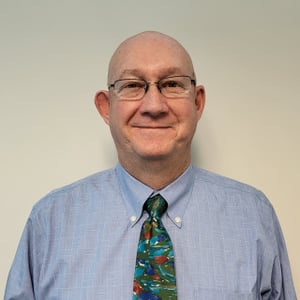
Vice President, Legal Advocacy, Office of General Counsel, National Association of Home Builders
Tom obtained his undergraduate degree in Mechanical Engineering from the University of Delaware and graduated from Widener University School of Law in 1994.
Tom joined NAHB’s Litigation Department in the fall of 1999. Currently he oversees NAHB’s litigation efforts where he develops NAHB’s legal strategies and provides litigation support to local home builders associations. He also supports NAHB’s lobbyists, and coordinates with NAHB’s regulatory staff to identify government activities (i.e. regulations or guidance documents) that may require involvement by the Litigation Department. One of the first cases Tom worked on for NAHB was United States v. Deaton where NAHB argued that the Deaton wetland was not a “water of the United States.” 20 years later we were proven right.

Federal Spectrum Coordination: Pitfalls and Progress
Scott D. Delacourt, Joe Kane, John Kneuer, David Redl
As wireless devices become critical to our daily lives, the process of allocating and managing...
Courthouse Steps Decision: Arizona v. Navajo Nation
Anthony J. Ferate, Jennifer H. Weddle
On Thursday, June 22, 2023, the Supreme Court issued its decision in Arizona v. Navajo...
Courthouse Steps Decision: Mallory v. Norfolk Southern Railway Co.
Brian T. Fitzpatrick, Ashley Keller, John Masslon
On Tuesday, June 27, 2023, the Supreme Court issued its decision in Mallory v. Norfolk...
Panel I: The Economic War: What Has Been Done, What Can Be Done, and What Should Be Done?
Scott R. Anderson, Richard Goldberg, Eric J. Kadel, Jamil N. Jaffer, Paul B. Stephan
The Russia-Ukraine War has been fought not just with bullets, bombs, and bytes, but also...
Courthouse Steps Decision: Wilkins v. United States
Adam F. Griffin, Jeffrey McCoy
On March 28, 2023, the Supreme Court handed down its decision in Wilkins v. United States....
Talks With Authors: Judge Amul Thapar on "The People's Justice"
Amul R. Thapar, Dean Reuter
On June 20, Judge Amul Thapar of the Sixth Circuit published "The People's Justice," in...
Topics
The Supreme Court’s Confused Decision in Haaland v. Brackeen
On June 15, the Supreme Court issued Haaland v. Brackeen. Among other issues, the Court...
Environmental Enforcement: Policies, Priorities, and the Rule of Law
Susan P. Bodine, Michael Buschbacher, Eric Schaeffer, Dan Sullivan, David Uhlmann, Jeffrey H. Wood
Registration is now closed. We will take walk-ins at the door. Online attendees: the livestream...
Environmental Enforcement Keynote Address by Senator Dan Sullivan
Our Nation’s environmental laws and regulations are designed to foster the responsible use of natural...
Courthouse Steps Decision: Sackett v. Environmental Protection Agency
William W. Buzbee, Deidre G. Duncan, Thomas B. Griffith, Sambhav Sankar, Thomas J. Ward
Sponsors: Environmental Law & Property Rights Practice GroupDC Young Lawyers ChapterHunton Andrews Kurth LLP Where:Hunton...