
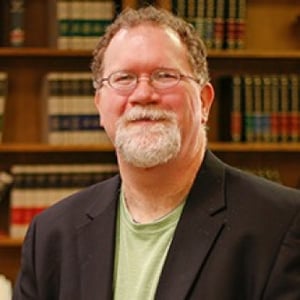
Chief Academic Officer & Vice Chancellor for Strategic Initiatives, State University System of Florida
Jason Jewell chairs the Department of Humanities at Faulkner University, where he directs online degree programs based on the Great Books at both the undergraduate and graduate levels. On campus he teaches courses in the humanities and social/behavioral science departments and the Great Books Honors Program.
He received a Ph.D. in humanities from Florida State University, an M.A. in history from Pepperdine University, and a B.A. in history and music from Harding University.
He is associate editor of the Journal of Faith and the Academy and a member of the editorial board of two other academic journals. He is a contributor to Christian Faith and Social Justice: Five Views (Bloomsbury, 2014) and The Inklings and King Arthur (2018), and he has contributed to six academic journals and five encyclopedias. His writing has also appeared in numerous magazines and popular journals..
In addition to directing honors students in the GBH program, Jacobs serves as a Faulkner Foundations teacher, a sponsor for Alpha Chi National Honor Society, and a sponsor for Images in Ink, an annual creative arts publication published by the university every spring. He also serves on the board of Cornerstone Classical Christian Academy, a private k-12 school that works with the same spiritual and academic mindset as guides him at Faulkner.
“I am convinced,” he says, “that learning centered around Christ and a classical or Great Books methodology promotes a more virtuous human being, allowing one to know God better and love His creation better, too. It is my deep hope to instill this sort of learning in future generations. One simply cannot argue with the sort of excellence and deep Christian charity such education promotes. As such, I can think of no better expenditure of my time than working among my fellow brothers and sisters in Christ and reading and discussing great books with as many and as varied students as possible.”
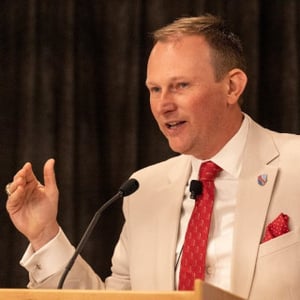
Senior Advisor and Research Fellow, The Heritage Foundation
Allen Mendenhall is a Senior Advisor for the Capital Markets Initiative and Research Fellow in the Thomas A. Roe Institute for Economic Policy Studies at the Heritage Foundation in Washington, D.C. Previously, he served as Associate Dean and Grady Rosier Professor in the Sorrell College of Business at Troy University, where he also directed the Manuel H. Johnson Center for Political Economy. He is also a Visiting Fellow at the Madden Center for Value Creation at Florida Atlantic University.
His books include Literature and Liberty: Essays in Libertarian Literary Criticism (2014), Oliver Wendell Holmes Jr., Pragmatism, and the Jurisprudence of Agon: Aesthetic Dissent and the Common Law (2017), Of Bees and Boys: Lines from a Southern Lawyer (2017), The Southern Philosopher: Collected Essays of John William Corrington (2017), Writers on Writing: Conversations with Allen Mendenhall (2019), The Three Ps of Liberty: Pragmatism, Pluralism, and Polycentricity (2020), Shouting Softly: Essays on Law, Literature, and Culture (2021), A Glooming Peace This Morning (2023, a novel), and Controversies Among Conservatives: Conversations on Conservatism, Vol. II (2024, edited with Marcus Witcher and Kevin Hughes). His monthly segment “Word to the Wise” appears on Troy Public Radio (WTSU 89.9, WRWA 88.7, WTJB 91.7), and he writes a weekly column for 1819 News, Alabama’s bold and innovative conservative news outlet.
Mendenhall holds a B.A. in English from Furman University, an M.A. in English from West Virginia University, a J.D. from West Virginia University College of Law, an LL.M. in transnational law from Temple University Beasley School of Law, and a Ph.D. in English from Auburn University.
From 2016 to 2020, he was Associate Dean and Founding Executive Director of the Blackstone & Burke Center for Law & Liberty at Faulkner University’s Thomas Goode Jones School of Law in Montgomery, Alabama. He edited Southern Literary Review for over a decade (2011–2022) and has served as a visiting scholar (2020) and trustee (2023) at the American Institute for Economic Research (AIER), an adjunct legal associate at the Cato Institute (2009), a Mises Canada Emerging Scholar with the Ludwig von Mises Institute Canada (2014), an elected member of the Mont Pelerin Society (2024), an associate of the Abbeville Institute (2011–present), a Humane Studies Fellow with the Institute for Humane Studies (2011–2012), a staff attorney for Chief Justice Roy S. Moore of the Supreme Court of Alabama (2013–2016), an Assistant Attorney General in the State of Alabama Office of Attorney General Luther Strange (2016), an AmPhil Fundraising Fellow with the Center for Civil Society of American Philanthropic (2023–2024), an Advisory Council Member of the Law & Liberty Circle at the Universidad Francisco Marroquín (2024–present), an elected member (2012) and former trustee (2018–2022) of the Philadelphia Society, an associated scholar at the Ludwig von Mises Institute (2017–present), a policy adviser for the Heartland Institute (2016–present), former president of the Alabama Association of Scholars (2017–2020), president of the Montgomery Lawyers Chapter of the Federalist Society (2013–present), and Chairman of the Board of Managers of the Alabama Center for Law & Liberty (2022–2024). In 2023, he was an inaugural recipient of the Freedom and Opportunity Academic Prize from the Heritage Foundation. In 2024, he was a Club For Growth Foundation Fellow and a Lincoln Fellow with the Claremont Institute for the Study of Statesmanship and Political Philosophy. Alabama Governor Kay Ivey appointed him to the 2025–26 State Textbook Committee of the Alabama Department of Education.
He has taught in university English departments, business schools, a humanities department, a law school, a Japanese private school (juku), and a penitentiary, and he serves or has served on numerous boards of organizations as wide-ranging as the Alabama Public Television Foundation Authority (2019–2025), the Young Professionals Board of the Alabama Humanities Foundation (2015–2016), the Society for Law and Culture (a division of the Russell Kirk Center for Cultural Renewal) (2017–present), Trinity Christian School (2017–2020), Ivy Classical Academy (2025–present), and the Philadelphia Society (2018–2022). He served on the advisory council of the Ludwig von Mises Institute’s Master of Arts degree and Certificate Program in Austrian Economics from 2021–2023. While in private practice in Atlanta, he represented non-profit corporations and litigated cases involving real property, contracts, collections, foreclosures, restrictive covenants, and real estate transactions. He graduated from Leadership Lee County (Alabama), the Alabama State Bar Leadership Forum (Class 14), and the Atlas Leadership Academy of Atlas Network. He has authored hundreds of publications, including fiction and poetry, and studied under the creative writers Gilbert Allen, Michael Blumenthal, William Aarnes, and Chantel Acevedo.
His academic writing has appeared or is forthcoming in such peer-reviewed journals as The Journal Jurisprudence, The Canadian Journal of Law and Jurisprudence, Public Choice, The Political Science Reviewer, Journal of Markets & Morality, Journal of Private Enterprise, The Texas Review of Law and Politics, European Journal of Pragmatism and American Philosophy, Contemporary Pragmatism, The South Carolina Review, Academic Questions, The Independent Review, Quarterly Journal of Austrian Economics, Modernist Cultures, The British Journal of American Legal Studies, and in law reviews published by Georgetown University Law Center, UC Berkeley School of Law, The University of Texas School of Law, Emory University School of Law, Indiana University Maurer School of Law, Texas A&M University School of Law, and Michigan State University College of Law.
His writing for popular media has appeared in Newsweek, Fox News, Fox Business, The Wall Street Journal, The Washington Times, National Review, The American Spectator, Pacific Standard, The Hill, The Los Angeles Review of Books, The American Conservative, City Journal, The Daily Caller, The Federalist, Public Discourse, Law & Liberty, The Epoch Times, The American Mind, The Freeman, Liberty, RealClearMarkets, The University Bookman, The Daily Signal, Chronicles, The Christian Lawyer, Writer’s Digest, The Conversation, and elsewhere. He has spoken at Harvard University, Brown University, Georgetown University Law Center, Francisco Marroquín University, Furman University, George Mason University, University of British Columbia, University of Nevada-Las Vegas, Auburn University, West Virginia University, the Alabama State Capitol, the Alabama Supreme Court, and other universities and locations.
He has been quoted or cited in Fox Business, Fox News, Forbes, The Washington Post, The Washington Times, The National Review, The Daily Caller, Le Monde, Times Higher Education, The College Fix, The Blaze Media, Campus Reform, Inside Higher Education, and U.S. News and World Report, and published by such organizations as the Ludwig von Mises Institute, the Ludwig von Mises Institute Canada, the Mercatus Center, the Foundation for Economic Education, the Intercollegiate Studies Institute, the American Institute for Economic Research, the Charlemagne Institute, the Independent Institute, the Rockford Institute, the Russell Kirk Center for Cultural Renewal, the American Ideas Institute, Atlas Society, the Heartland Institute, the Abbeville Institute, the National Association of Scholars, the James G. Martin Center for Academic Renewal, and the Libertarian Alliance. He frequently appears on radio and television on networks as wide-ranging as Fox News, Newsmax, Alabama Public Television, NewsNation, Al Jazeera, C-SPAN, Bill O’Reilly’s “No Spin News,” NTD News, The Daily Wire, Steve Bannon’s “War Room,” and BBC World News.

Tazewell Taylor Professor of Law and William H. Cabell Research Professor, William & Mary Law School
Jonathan H. Adler joined the William & Mary law faculty as the Tazwell Taylor Professor of Law and William H. Cabell Research Professor in 2025. Prior to joining the faculty, he was the inaugural Johan Verheij Memorial Professor of Law and the founding Director of the Coleman P. Burke Center for Environmental Law at the Case Western Reserve University School of Law.
Professor Adler is the author or editor of seven books, including Climate Liberalism: Perspectives on Liberty, Property and Pollution (Palgrave, 2023), Marijuana Federalism: Uncle Sam and Mary Jane (Brookings Institution Press, 2020), Business and the Roberts Court (Oxford University Press, 2016) and Rebuilding the Ark: New Perspectives on Endangered Species Act Reform (AEI Press, 2011).
His articles have appeared in publications ranging from the Harvard Environmental Law Review and Yale Journal on Regulation to the Wall Street Journal, New York Times, and Washington Post. He has testified before Congress a dozen times, and his work has been cited in the U.S. Supreme Court. A 2024 study identified Professor Adler as the seventh most cited legal academic in administrative and environmental law from 2019 to 2023.
Professor Adler is a contributing editor to Civitas Outlook and a regular contributor to the popular legal blog, The Volokh Conspiracy. A regular commentator on constitutional and regulatory issues, he has appeared on numerous radio and television programs, ranging from the PBS Newshour and National Public Radio to the Fox News Channel and Entertainment Tonight.
Professor Adler is a senior fellow at the Property & Environment Research Center in Bozeman, Montana. In 2018, Professor Adler was elected to membership in the American Law Institute and helped co-found the organization Checks and Balances. In 2024, Professor Adler was appointed a public member of the Administrative Conference of the United States.
Professor Adler clerked for the Honorable David B. Sentelle on the U.S. Court of Appeals for the District of Columbia Circuit.
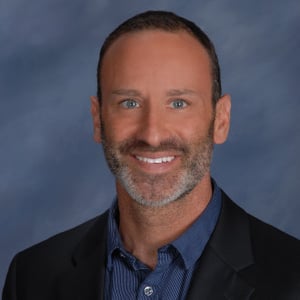
Professor of Law, Wayne Law
Noah Hall's expertise is in environmental and water law, and his research focuses on issues of environmental governance, federalism, and transboundary pollution and resource management.
He joined the Wayne Law faculty in 2005. For the 2014-15 academic year, he served as the Law School's associate dean for student affairs. Previously, he taught at the University of Michigan Law School and was an attorney with the National Wildlife Federation, where he managed the Great Lakes Water Resources Program for the nation's largest conservation organization. Hall also worked in private practice for several years, representing a variety of business and public-interest clients in litigated and regulatory matters. He has extensive litigation experience and numerous published decisions in state and federal courts. He continues to represent a variety of clients in significant environmental policy disputes. From 2016-2019, Hall served as special assistant attorney general for Michigan for the Flint water investigation.
Hall is founder of the Great Lakes Environmental Law Center, a nonprofit environmental organization that provides legal assistance to community organizations, environmental non-governmental organizations, and local, state and regional governments. He continues to serve as the Great Lakes Environmental Law Center's scholarship director.
He graduated from the University of Michigan Law School and University of Michigan School of Natural Resources and Environment, concentrating in environmental policy. After law school, he clerked for the Hon. Kathleen A. Blatz, chief justice of the Minnesota Supreme Court.

Senior Fellow and Director of Constitutional Studies, Manhattan Institute
Ilya Shapiro is a senior fellow and director of constitutional studies at the Manhattan Institute and a contributing editor of City Journal. Previously he was executive director and senior lecturer at the Georgetown Center for the Constitution, and before that a vice president of the Cato Institute.
Shapiro is the author of Lawless: The Miseducation of America’s Elites (2025) and Supreme Disorder: Judicial Nominations and the Politics of America’s Highest Court (2020), coauthor of Religious Liberties for Corporations? (2014), and editor of 11 volumes of the Cato Supreme Court Review (2008-18). He has contributed to a variety of academic, popular, and professional publications, including the Wall Street Journal, Harvard Journal of Law & Public Policy, Washington Post, Los Angeles Times, USA Today, National Review, and Newsweek. He also regularly provides commentary for various media outlets, writes the Shapiro’s Gavel newsletter on Substack, and once appeared on the Colbert Report.
Shapiro has testified many times before Congress and state legislatures and has filed more than 500 amicus curiae “friend of the court” briefs in the Supreme Court. He lectures regularly on behalf of the Federalist Society, is a member of the board of fellows of the Jewish Policy Center, was an inaugural Washington Fellow at the National Review Institute, and has been an adjunct law professor at the George Washington University and University of Mississippi. He is also the chairman of the board of advisers of the Mississippi Justice Institute, a barrister in the Edward Coke Appellate Inn of Court, and a former member of the Virginia Advisory Committee to the U.S. Commission on Civil Rights.
Earlier in his career, Shapiro was a special assistant/adviser to the Multi-National Force in Iraq on rule-of-law issues and practiced at Patton Boggs and Cleary Gottlieb. Before entering private practice, he clerked for Judge E. Grady Jolly of the U.S. Court of Appeals for the Fifth Circuit. He holds an AB from Princeton University, an MSc from the London School of Economics, and a JD from the University of Chicago Law School.
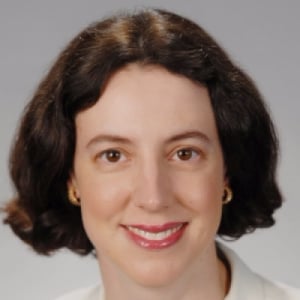
Donald Phillip Rothschild Research Professor, George Washington University Law School
Renée Lettow Lerner is Donald Phillip Rothschild Research Professor of Law at George Washington University Law School.
Professor Lerner works in the fields of U.S. and English legal history, civil and criminal procedure, and comparative law. She advises judges, lawyers, and government officials from the United States and countries in Europe, Latin America, and Asia about the differences between adversarial and nonadversarial legal systems.
She writes extensively about the history of American juries. Her work includes not only scholarly articles, but also online publications intended for a broader audience of legal professionals and the public. In many different settings, she has debated the role of juries with other academics and with lawyers. She has a book forthcoming with Oxford University Press in the Very Short Introduction Series entitled “The Jury.” She is also working on a book about the American civil jury, from the colonial period to the present.
She is the author, with John Langbein and Bruce Smith, of the book History of the Common Law: The Development of Anglo-American Legal Institutions (2009).
Her recent writings include a book review of Amalia D. Kessler’s Inventing American Exceptionalism: The Origins of American Adversarial Legal Culture, 1800-1877, 67 J. Legal Ed. 888 (2018); “How the Creation of Appellate Courts in England and the United States Limited Judicial Comment on Evidence to the Jury,” 40 Journal of the Legal Profession 215 (2016); “The Troublesome Inheritance of Americans in Magna Carta and Trial by Jury,” in Magna Carta and its Modern Legacy 77-98 (Robert Hazell and James Melton eds., Cambridge University Press 2015); and “The Failure of Originalism in Preserving Constitutional Rights to Civil Jury Trial,” 22 William & Mary Bill of Rights Journal 811 (2014).
Professor Lerner received an A.B. summa cum laude in history from Princeton University. She was a Rhodes Scholar at Oxford University, where she studied English legal history. At Yale Law School, she was Articles Editor of the Yale Law Journal. She served as a law clerk to Justice Anthony M. Kennedy of the U.S. Supreme Court and to Judge Stephen F. Williams of the U.S. Court of Appeals for the District of Columbia Circuit. From 2003 to 2005, she served as Deputy Assistant Attorney General in the Office of Legal Counsel at the U.S. Department of Justice.
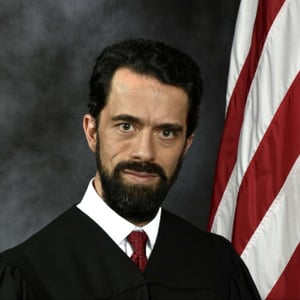
Judge, United States Court of Appeals, Third Circuit
Stephanos Bibas is a judge on the U.S. Court of Appeals for the Third Circuit. Judge Bibas was previously a professor of law and criminology at the University of Pennsylvania Law School. As director of the Penn Law Supreme Court Clinic, he argued six cases before the Supreme Court of the United States and filed briefs in dozens of others. He graduated summa cum laude and Phi Beta Kappa from Columbia University in 1989 with a B.A. in political theory and from Oxford University in 1991 with a B.A. in jurisprudence. He then earned his J.D. from Yale Law School in 1994.
After graduating from Yale Law, Judge Bibas clerked for Judge Patrick Higginbotham of the U.S. Court of Appeals for the Fifth Circuit and Justice Anthony Kennedy on the Supreme Court and was a litigation associate at Covington & Burling LLP in Washington, D.C. Thereafter, Judge Bibas served as an Assistant U.S. Attorney in the Southern District of New York, where he successfully prosecuted the world’s leading expert in Tiffany stained glass for hiring a grave robber to steal priceless Tiffany windows from cemeteries. Before his tenure at Penn Law, Judge Bibas taught at the University of Chicago Law School and the University of Iowa College of Law and was a research fellow at Yale Law School. He has published two books and seventy scholarly articles.
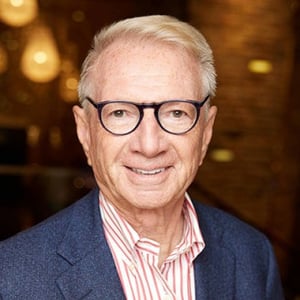
Senior Labor and Employment Counsel, CHRO Association
Roger King is a highly regarded labor relations attorney, whose career spans more than 40 years. Roger recently retired as a partner with Jones Day law firm. He now serves as Senior Labor and Employment counsel for the Association.
Roger specializes in labor and employment, healthcare, collective bargaining, contract administration and representation campaigns. Roger represented the winning side as co-counsel in the landmark U.S. Supreme Court case known as Noel Canning, which successfully challenged President Obama’s authority to make recess appointments to the National Labor Relations Board.
After graduating from Cornell University Law School, he was a Captain and Legal Services Officer in the United States Air Force, on the Staff of United States Senator Robert Taft, Jr. and, subsequently, was appointed as Professional Staff Counsel to the United States Senate Labor Committee.
Roger has testified before both the U.S. Senate and House Labor Committees, is a fellow of the College of Labor and Employment Lawyers, and serves on the Advocacy Committee of the American Society for Healthcare Human Resources Association (ASHHRA) and on the Executive Committee of the Ohio State Bar Association Labor and Employment Law Section Council.
He is a nationally recognized author/speaker on employment matters and has represented employers regarding labor and employment issues both before administrative agencies and in federal and state courts. He has represented the U.S. Chamber of Commerce, the Society for Human Resource Management (SHRM), the HR Policy Association (HRPA), the National Manufactures Association (NAM), the American Hospital Association (AHA), and the Coalition for a Democratic Workplace (CDW) in federal courts regarding numerous labor law issues.
Other clients Roger has represented include the Cleveland Clinic Foundation, Catholic Health Partners, MedStar Health, HCA, Texas Health Resources, Unity Point Health, UHS, Trinity Health, National Beef, General Cable, Orlando Health, ProMedica, Premier Health, Cedars-Sinai, Yale New Haven Health System, McLaren Health Care Corporation, Ohio, California and American Hospital Associations, Bon Secoure Health System, Kaleida Health, Sisters of Levenworth Health System, Lakeland Regional Medical Center, Clarion Clinic, Fisher-Titus Medical Center, Saint Joseph Health System, Benefis Healthcare, Community Health Systems, American Water Works, Macy’s Inc., Verizon and General Motors.
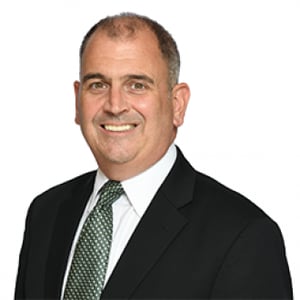
Shareholder, Littler Mendelson P.C.
James A. Paretti, Jr. is an experienced management-side employment and labor relations attorney with in-depth political and policy knowledge of labor, pension, healthcare and employment law, regulations and legislation. Jim is well versed in all aspects of legislative and political processes with demonstrated knowledge in the substance of federal labor and employment policy. He has over two decades of experience working with federal legislators and policymakers, including former Speaker of the U.S. House of Representatives, Chairmen of the U.S. House Committee on Education and the Workforce, and senior level administration officials.
Prior to joining Littler, Jim was chief of staff and senior counsel to the acting chair of the Equal Employment Opportunity Commission. He provided legal and political counsel with respect to all aspects of agency business, administered and managed the Office of the Chair where he was responsible for over 2,200 employees and a 375 million dollar annual budget, and served as primary liaison to regulated stakeholders and Capitol Hill.
His extensive experience includes developing policy and providing legal counsel on the Committee on Education and Labor in the U.S. House of Representatives as well as coordinating external communications and media relations for a senior member of Congress. Jim represented corporate and nonprofit clients in employment litigation in federal and state court, before administrative agencies and in private arbitration while with two Boston firms.
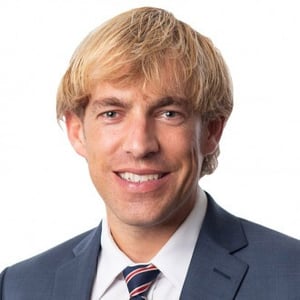
Principal, Spero Law LLC
Christopher Mills is the founder of Spero Law LLC. He was previously a partner at a national law firm and a Constitutional Law Fellow at the Becket Fund for Religious Liberty. He served as a law clerk to Justice Clarence Thomas on the U.S. Supreme Court during October Term 2018. He also clerked for the Honorable David B. Sentelle, then-Chief Judge of the U.S. Court of Appeals for the D.C. Circuit. He has authored briefs and motions in the Supreme Court, courts of appeals, and trial courts, and successfully argued before the D.C. Circuit. He has served as special counsel to South Carolina Governor Henry McMaster, and is an Adjunct Professor at the Charleston School of Law.
A 2012 magna cum laude graduate of Harvard Law School, Christopher was a senior editor of the Harvard Law Review, an editor of the Harvard Journal of Law and Public Policy, and served on the Executive Board of the Harvard Federalist Society. In 2009, he graduated Phi Beta Kappa and summa cum laude with a degree in economics from Furman University.
Christopher lives in Charleston, South Carolina with his wife, children, and golden retriever.
Senior Fellow and Director of Constitutional Studies, Manhattan Institute
Ilya Shapiro is a senior fellow and director of constitutional studies at the Manhattan Institute and a contributing editor of City Journal. Previously he was executive director and senior lecturer at the Georgetown Center for the Constitution, and before that a vice president of the Cato Institute.
Shapiro is the author of Lawless: The Miseducation of America’s Elites (2025) and Supreme Disorder: Judicial Nominations and the Politics of America’s Highest Court (2020), coauthor of Religious Liberties for Corporations? (2014), and editor of 11 volumes of the Cato Supreme Court Review (2008-18). He has contributed to a variety of academic, popular, and professional publications, including the Wall Street Journal, Harvard Journal of Law & Public Policy, Washington Post, Los Angeles Times, USA Today, National Review, and Newsweek. He also regularly provides commentary for various media outlets, writes the Shapiro’s Gavel newsletter on Substack, and once appeared on the Colbert Report.
Shapiro has testified many times before Congress and state legislatures and has filed more than 500 amicus curiae “friend of the court” briefs in the Supreme Court. He lectures regularly on behalf of the Federalist Society, is a member of the board of fellows of the Jewish Policy Center, was an inaugural Washington Fellow at the National Review Institute, and has been an adjunct law professor at the George Washington University and University of Mississippi. He is also the chairman of the board of advisers of the Mississippi Justice Institute, a barrister in the Edward Coke Appellate Inn of Court, and a former member of the Virginia Advisory Committee to the U.S. Commission on Civil Rights.
Earlier in his career, Shapiro was a special assistant/adviser to the Multi-National Force in Iraq on rule-of-law issues and practiced at Patton Boggs and Cleary Gottlieb. Before entering private practice, he clerked for Judge E. Grady Jolly of the U.S. Court of Appeals for the Fifth Circuit. He holds an AB from Princeton University, an MSc from the London School of Economics, and a JD from the University of Chicago Law School.
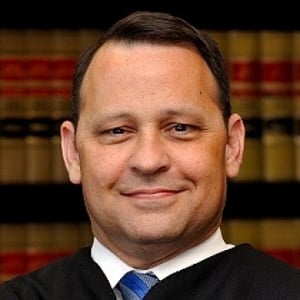
Arizona Supreme Court
Justice John Lopez IV serves on the Arizona Supreme Court. Before his appointment to the Supreme Court, Justice Lopez served as Arizona’s Solicitor General. Before that, he served in the U.S. Attorney’s Office as Executive assistant U.S. attorney; Chief assistant, U.S. Attorney's office in Phoenix; Chief of the Financial Crimes and Public Integrity Section; and Deputy appellate chief. Previous to that, Lopez worked as a legal advisor in the Regime Crimes Liaison Office of the Department of Justice, as an attorney with Bryan Cave, and a law clerk to Justice Charles Jones of the Arizona Supreme Court.
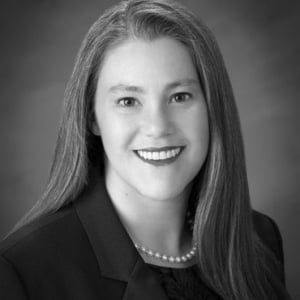
Judge, Arizona Court of Appeals, Division One
The Honorable Jennifer M. Perkins began service on the Arizona Court of Appeals, Division One, on October 30, 2017. At the time of her appointment by Governor Douglas Ducey, Judge Perkins was Assistant Solicitor General for the State of Arizona.
Judge Perkins was born in Portales, New Mexico, and primarily raised in Albuquerque. She attended the prestigious Albuquerque Academy from 1988-1995, before moving to Washington D.C. to attend the Elliott School of International Affairs at the George Washington University as a National Merit Scholar. Therafter, she relocated again to Dallas, Texas, and earned her juris doctor from the SMU Dedman School of Law, graduating cum laude in 2002.
Judge Perkins started her career at the law firm of Browning & Peifer (now Peifer, Hanson, Mullins, and Baker) in Albuquerque, New Mexico. While there, she litigated complex commercial matters including class action plaintiff and defense work, and assisted with employment and contract litigation. In 2003, the judge accompanied the Honorable James O. Browning in transitioning to the federal district court bench, serving as his first law clerk.
After her clerkship, Judge Perkins moved to Arizona to work for the Institute for Justice, Arizona Chapter, a public interest law firm. She spent five years with IJ-AZ litigating civil rights cases in Arizona and across the country. In 2009, the judge became Disciplinary Counsel for the Arizona Commission on Judicial Conduct, where she reviewed and prosecuted ethics complaints against state court judges throughout Arizona. After five years serving the state in this capacity, Judge Perkins entered private practice by joining an appellate law firm in Phoenix. While there, she worked on state and federal appeals involving a wide range of legal subjects, including complex business disputes, property rights, judicial ethics, and personal injury matters.
In January 2015, Judge Perkins joined the Office of the Arizona Attorney General to serve as the first Assistant Solicitor General; in that capacity, she was responsible for oversight of Attorney General Opinions and served as ethics counsel to the entire office. In addition to these two primary roles, the judge assisted on a variety of matters including trial and appellate litigation of election-related matters; federal appellate litigation with the Federalism Unit; state criminal appeals; and drafting amicus briefs on behalf of Arizona in state and federal courts.
Director of Attorney Recruiting and Diversity, Snell & Wilmer

Justice versus Social Justice
Jason Jewell, Allen P. Mendenhall
On August 22, 2019, the Federalist Society's Montgomery Lawyers Chapter hosted an event at the...
Welcome to the Federalist Society
George Washington Student Chapter
Washington, DCIntroduction to the Federalist Society
Pennsylvania Student Chapter
Philadelphia, PAThe Equal Employment Opportunity Commission EEO-1 Component 2 Pay Data Reporting Rule
TeleforumShould Rivers Have Rights? [POLICYbrief]
Jonathan H. Adler, Noah Hall
Should rivers or other natural features be granted "rights" to protect them from environmental harms?...
Supreme Court Roundup: October Term 2018 [SCOTUSbrief]
Ilya Shapiro
While the Supreme Court’s last term included a number of blockbuster decisions, the majority of...
Topics
Alaska Attorney General Warns that Proposed Rule 8.4(f) Is Unconstitutional
On September 5 at 1 p.m., the Alaska Bar Association Board of Governors will hear...
Topics
Labor Law Conflict: The EEO-1 Component 2 Pay Data Reporting Rule
Over the last few years, there has been an increasing number of initiatives by various...
A Review of the Supreme Court’s Last Term and Preview of the Upcoming One
Columbia Lawyers Chapter
Charleston, SCWhy Become a FedSoc Member?
Arizona State Student Chapter
Phoenix, AZ