

Senior Fellow and Director of Constitutional Studies, Manhattan Institute
Ilya Shapiro is a senior fellow and director of constitutional studies at the Manhattan Institute and a contributing editor of City Journal. Previously he was executive director and senior lecturer at the Georgetown Center for the Constitution, and before that a vice president of the Cato Institute.
Shapiro is the author of Lawless: The Miseducation of America’s Elites (2025) and Supreme Disorder: Judicial Nominations and the Politics of America’s Highest Court (2020), coauthor of Religious Liberties for Corporations? (2014), and editor of 11 volumes of the Cato Supreme Court Review (2008-18). He has contributed to a variety of academic, popular, and professional publications, including the Wall Street Journal, Harvard Journal of Law & Public Policy, Washington Post, Los Angeles Times, USA Today, National Review, and Newsweek. He also regularly provides commentary for various media outlets, writes the Shapiro’s Gavel newsletter on Substack, and once appeared on the Colbert Report.
Shapiro has testified many times before Congress and state legislatures and has filed more than 500 amicus curiae “friend of the court” briefs in the Supreme Court. He lectures regularly on behalf of the Federalist Society, is a member of the board of fellows of the Jewish Policy Center, was an inaugural Washington Fellow at the National Review Institute, and has been an adjunct law professor at the George Washington University and University of Mississippi. He is also the chairman of the board of advisers of the Mississippi Justice Institute, a barrister in the Edward Coke Appellate Inn of Court, and a former member of the Virginia Advisory Committee to the U.S. Commission on Civil Rights.
Earlier in his career, Shapiro was a special assistant/adviser to the Multi-National Force in Iraq on rule-of-law issues and practiced at Patton Boggs and Cleary Gottlieb. Before entering private practice, he clerked for Judge E. Grady Jolly of the U.S. Court of Appeals for the Fifth Circuit. He holds an AB from Princeton University, an MSc from the London School of Economics, and a JD from the University of Chicago Law School.

Milton R. Underwood Chair in Free Enterprise, Vanderbilt University Law School
Brian Fitzpatrick is the Milton R. Underwood Chair in Free Enterprise and Professor of Law at Vanderbilt Law School, where his research focuses on class action litigation, federal courts, judicial selection, and constitutional law. He is best known for his empirical studies of class action settlements as well as his book The Conservative Case for Class Actions (University of Chicago Press, 2019). Professor Fitzpatrick joined Vanderbilt's law faculty in 2007 after serving as the John M. Olin Fellow at New York University School of Law. He graduated first in his class from Harvard Law School and went on to clerk for Judge Diarmuid O'Scannlain on the U.S. Court of Appeals for the Ninth Circuit and Justice Antonin Scalia on the U.S. Supreme Court. After his clerkships, Professor Fitzpatrick practiced commercial and appellate litigation for several years at Sidley Austin in Washington, D.C., and served as Special Counsel for Supreme Court Nominations to U.S. Senator John Cornyn. Before earning his law degree, Fitzpatrick graduated summa cum laude with a bachelor's of science in chemical engineering from the University of Notre Dame. He has received the Hall-Hartman Outstanding Professor Award, which recognizes excellence in classroom teaching, for his Civil Procedure and Federal Courts courses.
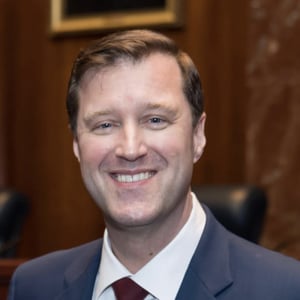
Justice, Texas Supreme Court
Evan Young is a Justice of the Supreme Court of Texas. Governor Greg Abbott, who appointed Young to fill an unexpired term, swore him into office on November 10, 2021. Justice Young was elected to a full term in November 2022.
Young graduated summa cum laude from Duke University in 1999, where he was inducted into Phi Beta Kappa. He was a British Marshall Scholar at Oxford University, where he completed his studies in 2001 and earned a First Class Honours degree in Modern History, focusing on British constitutional history. He earned his law degree from Yale Law School in 2004.
Young then worked as a lawyer in the judicial and executive branches of the federal government. He first served as a law clerk to Judge J. Harvie Wilkinson III of the U.S. Court of Appeals for the Fourth Circuit, and then to Justice Antonin Scalia at the U.S. Supreme Court. In 2006, after his clerkship with Justice Scalia ended, Justice Young became Counsel to the Attorney General at the U.S. Department of Justice, serving in the Office of the Attorney General under Attorneys General Alberto R. Gonzales and Michael B. Mukasey. While on the Attorney General’s staff, he accepted a detail to the U.S. Embassy in Baghdad, Iraq, where he was the Deputy Rule of Law Coordinator. In that position he worked to assist the Iraqi government in its efforts to strengthen its legal regime, including, for example, its courts and prison system.
Young returned to Texas and joined the Austin office of Baker Botts L.L.P. in 2009. His practice focused on trial and appellate litigation. He argued cases before both the Supreme Court of the United States and the Supreme Court of Texas, as well as many federal and state appellate courts. He represented clients across the country before every level of the state and federal judiciary.
Before joining the Texas Supreme Court, Young was appointed in 2017 by Governor Abbott and confirmed by the Texas Senate to serve as a member of the Texas Judicial Council, which is the policy-making body for the Texas Judiciary. In 2015, the Texas Supreme Court appointed him to the Supreme Court Advisory Committee, which assists the Court in drafting the rules that govern litigation in Texas courts. He served on both until his elevation to the bench.
Justice Young is an elected member of the American Law Institute and a member of the Texas Philosophical Society. He has been an adjunct law professor for many years at the University of Texas School of Law, where he has frequently taught the Federal Courts and Religious Liberty courses. He also has been an adjunct professor at the University of Mississippi School of Law, where he has taught multiple courses involving U.S. Supreme Court history. He served as Chair of the State Bar of Texas Business Law Section, Chair of the National Center for Missing and Exploited Children's Texas Regional Office, and Trustee of the Texas Supreme Court Historical Society.
Justice Young and his wife, Tobi, live in Austin with their daughter.
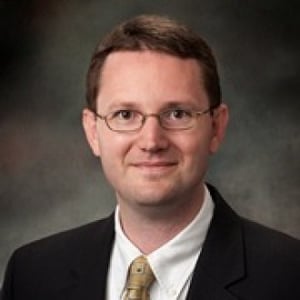
Assistant City Attorney, City of Arlington City Attorney's Office
Joshua Skinner is an assistant city attorney with the City of Arlington, Texas, with almost two decades of experience in civil rights, employment litigation, local government defense, and appellate advocacy.

Partner, FisherBroyles LLP
Paul Beard II is an environmental and land-use partner with FisherBroyles LLP.
JD/MPP student, NYU School of Law and the Harvard Kennedy School
Daniel Cheung was a 2015 summer law clerk with Alston & Bird and is presently a JD/MPP student at the NYU School of Law and the Harvard Kennedy School.

Topics
A Strong Showing for Evenwel Plaintiffs in One-Person, One-Vote Argument
Why shouldn’t vote weight matter in drawing district lines, “especially when voter-based apportionment…is being substantially...
Topics
SCOTUS Opinions: 12/8/2015
Today the Court released one opinion: In the case of Shapiro v. McManus, the judgment of the...
Topics
SCOTUS Orders: 12/7/2015
The Court's latest Order list is here. There were no new substantive grants of cert.,...
Topics
Legal News Roundup: 12/7/2015
The Supreme Court denied certiorari in a case upholding a Chicago suburb's ban on semiautomatic...
The Sweet Mystery of Anthony Kennedy - Federalist Society Event
Salt Lake City, UtahMullenix v. Luna - Post-Decision SCOTUScast
Joshua Skinner
On November 9, 2015, the Supreme Court decided Mullenix v. Luna without oral argument. The question in...
Supreme Court Preview
Greenville, South CarolinaPatel v. Texas Department of Licensing and Regulation and the “Fight on the Right” over Substantive Due Process
Fort Worth, TexasTopics
Supremacy and the Supreme Court
Since Marbury v. Madison in 1803, it’s been “settled law” that the Supreme Court is...
Utility Air Regulatory Group v. EPA: A Foreshadowing of Things to Come?
Paul J. Beard, Daniel Cheung
On June 23, 2014, the United States Supreme Court issued its decision in Utility Air...