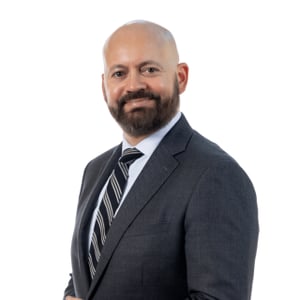
Judge, United States Court of Appeals, Eleventh Circuit
Biography
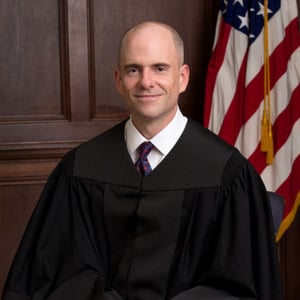
Judge Kevin C. Newsom is a member of the United States Court of Appeals for the Eleventh Circuit. He sits in Birmingham, Alabama.
Before his appointment to the bench, Judge Newsom was the head of the appellate practice group at Bradley Arant Boult Cummings LLP and, before that, the Solicitor General of Alabama. As a practicing lawyer, Judge Newsom argued four cases in the Supreme Court of the United States, and nearly 40 more in the United States Courts of Appeals and state supreme and appellate courts.
Judge Newsom graduated summa cum laude from Samford University and magna cum laude from Harvard Law School, where he was an articles editor on the Harvard Law Review. Following law school, Judge Newsom clerked for Judge Diarmuid F. O’Scannlain of the United States Court of Appeals for the Ninth Circuit and Justice David H. Souter of the Supreme Court of the United States.
Judge Newsom teaches at Harvard Law School, Yale Law School, Stanford Law School, and the University of Chicago Law School. His published work has appeared in the Yale Law Journal and the Harvard Law Review.
Judge, United States Court of Appeals, District of Columbia Circuit
Biography
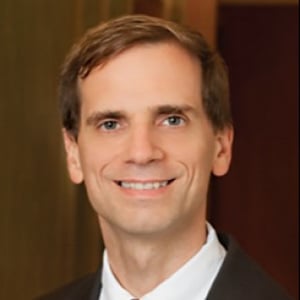
Judge Katsas was appointed to the D.C. Circuit in December 2017. He graduated from Princeton University and Harvard Law School, where he was an executive editor on the Harvard Law Review. Between 1989 and 1992, he served as a law clerk to Judge Edward Becker on the Third Circuit, to then-Judge Clarence Thomas on the D.C. Circuit, and to Justice Thomas on the Supreme Court. Between 1992 and 2001, he was an associate and then partner in the Washington office of Jones Day, where he specialized in appellate and complex civil litigation. Between 2001 and 2009, he served in many senior positions in the Department of Justice, including as Assistant Attorney General for the Civil Division and as Acting Associate Attorney General. In 2009, he returned to Jones Day. From January to December 2017, he served as Deputy Assistant to the President and Deputy Counsel to the President.
Before joining the bench, Judge Katsas argued more than 75 appeals, including three cases in the Supreme Court, 13 cases in the D.C. Circuit, and cases in every other federal court of appeals. By appointment of the Chief Justice, he served on the Advisory Committee on Appellate Rules from 2013 to 2017. In 2016, he was elected to membership in the American Academy of Appellate Lawyers.
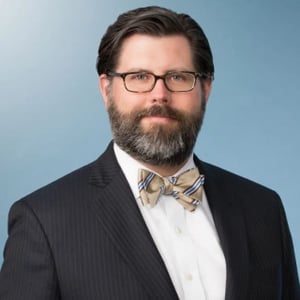
Brian J. Paul is an appellate lawyer and leads law teams in high-stakes commercial litigation. He has briefed and argued everything from weighty abstract constitutional issues to dollars-and-cents business issues and everything in-between, both on appeal and in trial courts around the country. A member of the American Law Institute, recent past-president of the Seventh Circuit Bar Association and top-tier ranked Chambers appellate lawyer, Brian had one client say about him: “Brian is one of the most respected and skilled appellate lawyers, not only in Indianapolis but across the country. He is trusted to deliver timely guidance on complex issues.” Another said: “He is excellent. I enjoyed working with him. He is able to put things into layman’s terms and explains things really well. His written and oral advocacy are short, crisp and to the point.”
Clients hire Brian to digest the complex, and make the complex simple and compelling for busy, generalist judges. In his writing, he strives to cut through jargon and legalese, and distill things down to what’s important. In his oral advocacy, by intense preparation, he strives to be the advocate whom judges trust for the right answers. In the dozens of cases he has argued, Brian has helped clients win on both sides of the “v.” His recent representations include:
AXIS Ins. Co. v. Am. Specialty Ins. & Risk Servs., No. 23-1698, 2024 WL 3665333, ___ F.4th ___ (7th Cir. Aug. 6, 2024). Representing AXIS Insurance Co., Brian obtained a reversal of an adverse summary judgment ruling in a case holding that the parties' indemnification contract neither expressly nor impliedly obligated the indemnitee to tender a defense to the indemnitor before settling claims against the indemnitee.
Circle City Broad. I, LLC v. AT&T Servs., Inc., 99 F.4th 378 (7th Cir. 2024). Representing AT&T Services, Inc., and DirectTV, LLC, Brian successfully defended a favorable summary judgment ruling in a case involving alleged discrimination in contracting under 42 U.S.C. § 1981 holding that the plaintiff failed to demonstrate that a jury could reasonably find that the defendants' decision not to pay broadcast retransmission fees for the rights to carry two Indianapolis-based television stations reflected anything other than lawful business choices responsive to dynamics of the television broadcast market.
Wells v. Freeman Co., 94 F.4th 608 (7th Cir. 2024). Representing The Freeman Company, Brian successfully defended a favorable summary judgment ruling in a Title VII case holding that the plaintiff could not sue for sexual harassment because she was not the company’s employee, but instead an independent contractor.
Mellowitz v. Ball State Univ., 221 N.E.3d 1214 (Ind. 2023). Representing Ball State University, Brian successfully defended the constitutionality of a state law that barred class actions seeking refunds of tuition and fees based on the university’s cancellation of in-person classes due to the COVID-19 pandemic.
Klaassen v. Trustees of Indiana Univ., 7 F.4th 592 (7th Cir. 2021) and Klaassen v. Trustees of Indiana Univ., 24 F.4th 638 (7th Cir. 2022). Representing Indiana University, Brian successfully defended the constitutionality of the school’s COVID vaccine mandate policy.
Nat’l Collegiate Athletic Ass’n v. Finnerty, 191 N.E.3d 211 (Ind. 2022). Representing the NCAA, Brian secured the reversal of a discovery ruling that would have allowed high-ranking executives to be deposed without any consideration of their unique role in the organization.
Westwood One Radio Networks, LLC v. Nat’l Collegiate Athletic Ass’n, 172 N.E.3d 294 (Ind. Ct. App. 2021). Representing the NCAA, Brian successfully beat back a request for an injunction preventing the Association from terminating an exclusive radio broadcast agreement.
Reid Hosp. & Health Care Servs., Inc. v. Conifer Revenue Cycle Sols., LLC, 8 F.4th 642 (7th Cir. 2021). Representing Reid Hospital & Health Care Services, Brian secured the reversal of a summary judgment ruling that denied the hospital the ability to seek tens of millions of dollars in compensation for breach of a revenue collection services contract.
Delgado v. U.S. Dep’t of Just., 979 F.3d 550 (7th Cir. 2020). Representing an agent of the Bureau of Alcohol, Tobacco, Firearms & Explosives, Brian obtained the reversal of an agency decision that declined to force an investigation into whether the agent had been retaliated against and denied promotions, in violation of the Whistleblower Protection Act, for reporting his suspicions that another agent had testified falsely during a federal criminal trial.
River Ridge Dev. Auth. v. Outfront Media, LLC, 146 N.E.3d 906 (Ind. 2020). Representing River Ridge Development Authority, Brian got a reversal of a six-figure attorney’s fees award.
Indiana Off. of Util. Consumer Couns. v. S. Indiana Gas & Elec. Co., 200 N.E.3d 915 (Ind. 2023). Representing the Indiana Energy Association as amicus curiae (friend of the court), Brian helped secure the reversal of a lower appellate court ruling that misinterpreted a statute governing customer credits for excess distributed generation of electricity.
Duke Energy Indiana, LLC v. City of Noblesville, 234 N.E.3d 173 (Ind. 2024). Representing the Indiana Energy Association as amicus curiae, Brian helped secure the reversal of a lower appellate court ruling in a case holding that only the Indiana Utility Regulatory Commission can decide whether a city ordinance implicating a public-utility function is unreasonable.
President and Senior Counsel, Casey Law Office, P.C.
Biography
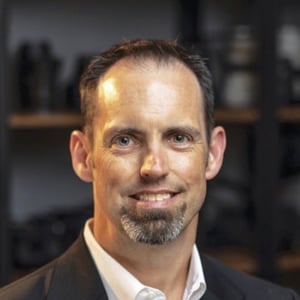
Stephen Casey is President and Senior Counsel at Casey Law Office, P.C. After high school, Stephen entered the United States Navy, and while there supervised operation of nuclear reactors in the United States Navy for eight years, holding several leadership and supervisory positions in what is regularly acknowledged as one of the most academically rigorous program in the United States military. In 1999, Stephen finished his naval service and attended LeTourneau University in Longview, Texas, where he double-majored in Biblical Studies and History-Political Science, graduating with a 4.0 GPA. He continued his education at Regent University School of Divinity, earning a pre-doctoral Master of Arts in Biblical Interpretation. Subsequently, Stephen attended Regent University School of Law, where he was selected based on his writing skills to serve as an editor for Regent's Law Review. Stephen also was active with the Federalist Society, and participated in moot courts.
Both during and after law school Stephen clerked with several firms and was selected in 2008 to clerk with the Texas Supreme Court in the chambers of former Justice Scott Brister. Following his time on the Court, Stephen decided to open his own law practice so he could tailor cases to client's individual needs. Stephen is also an Allied Attorney with the Alliance Defending Freedom, a Blackstone Fellow, and serves as Co-Founder and Chief Counsel for the Texas Center for Defense of Life. Stephen also continues to serve in the Federalist Society.
Stephen lives in Round Rock with his wife and five children, where they are active in the community. He and his family attend Austin Vineyard Church, and he remains activing in local, state, and national political issues.
Vice President & Legal Director, National Right To Work Legal Defense Foundation
Biography
Raymond J. LaJeunesse, Jr., is Vice President and Legal Director of the National Right to Work Legal Defense Foundation, a non-profit legal aid organization. He was the first Staff Attorney employed by the Foundation and has more than forty-five years of experience helping workers in litigation in federal and state courts and administrative agencies over the abuses of compulsory unionism.
Mr. LaJeunesse has argued four cases in the United States Supreme Court. Those cases include Lehnert v. Ferris Faculty Ass’n, 500 U.S. 507 (1991), which limited the purposes for which compulsory union fees collected from public employees may lawfully be spent; Air Line Pilots Ass’n v. Miller, 523 U.S. 866 (1998), which established that unions cannot compel nonmembers to exhaust union-established remedies before going to court to challenge compulsory union fees; and Marquez v. Screen Actors Guild, 525 U.S. 33 (1998), in which the Court recognized that unions must notify employees that they can satisfy the “membership” requirement of “union shop” agreements by just paying fees for union bargaining activities and need not join and pay full dues to keep their jobs. He also was lead attorney in Hohe v. Casey, 956 F.2d 399 (3d Cir. 1992), in which more than $8.3 million in compulsory agency fees was recovered from the American Federation of State, County and Municipal Employees for a class of 57,000 nonmembers.
Mr. LaJeunesse is the author of several published articles about labor law, has testified before Congressional committees several times, and was an Advisor on the Transition Team for Labor- Related Agencies, Office of the President-Elect, in 1980-81 and a legislative aide to a member of the Virginia state legislature. He is a Vice Chairman of the Federalist Society’s Labor and Employment Law Practice Group and has spoken or debated at the Society’s National Lawyers Convention and at many Lawyers and Student Chapters on such topics as Right to Work laws, compulsory unionism arrangements, the misuse of union dues for politics, union organizing tactics (“card check” vs. secret-ballot elections), and the future of the union movement.
Washington & Lee University, LL.B., 1967
Providence College, A.B., Humanities, cum laude, 1964
Dean and Jesse H. Choper Distinguished Professor of Law, UC Berkeley School of Law
Biography
Erwin Chemerinsky became the 13th Dean of Berkeley Law on July 1, 2017, when he joined the faculty as the Jesse H. Choper Distinguished Professor of Law.
Prior to assuming this position, from 2008-2017, he was the founding Dean and Distinguished Professor of Law, and Raymond Pryke Professor of First Amendment Law, at University of California, Irvine School of Law, with a joint appointment in Political Science. Before that he was the Alston and Bird Professor of Law and Political Science at Duke University from 2004-2008, and from 1983-2004 was a professor at the University of Southern California Law School, including as the Sydney M. Irmas Professor of Public Interest Law, Legal Ethics, and Political Science. He also has taught at DePaul College of Law and UCLA Law School.
He is the author of eleven books, including leading casebooks and treatises about constitutional law, criminal procedure, and federal jurisdiction. His most recent books are, We the People: A Progressive Reading of the Constitution for the Twenty-First Century (Picador Macmillan) published in November 2018, and two books published by Yale University Press in 2017, Closing the Courthouse Doors: How Your Constitutional Rights Became Unenforceable and Free Speech on Campus (with Howard Gillman).
He also is the author of more than 200 law review articles. He writes a regular column for the Sacramento Bee, monthly columns for the ABA Journal and the Daily Journal, and frequent op-eds in newspapers across the country. He frequently argues appellate cases, including in the United States Supreme Court.
In 2016, he was named a fellow of the American Academy of Arts and Sciences. In 2017, National Jurist magazine again named Dean Chemerinsky as the most influential person in legal education in the United States.
Dr. John Eastman is the former Henry Salvatori Professor of Law & Community Service and former Dean at Chapman University's Dale E. Fowler School of Law, where he had been a member of the faculty since 1999, specializing in Constitutional Law, Legal History, and Property. He is a founding director of the Center for Constitutional Jurisprudence, a public interest law firm affiliated with the Claremont Institute that he founded in 1999. He has a Ph.D. in Government from the Claremont Graduate School and a J.D. from the University of Chicago Law School, and a B.A. in Politics and Economics from the University of Dallas. He serves as the Chairman of the Board of the National Organization for Marriage.
Prior to joining the Chapman law faculty, Dr. Eastman served as a law clerk to the Honorable Clarence Thomas, Associate Justice, Supreme Court of the United States, and to the Honorable J. Michael Luttig, Judge, United States Court of Appeals for the Fourth Circuit and practiced law with the national law firm of Kirkland & Ellis. Dr. Eastman has also represented numerous clients in important constitutional law matters and has argued before the Supreme Court. On behalf of the Claremont Institute Center for Constitutional Jurisprudence, he has participated as amicus curiae before the Supreme Court of the United States, U.S. Courts of Appeals, and State Supreme Courts in more than one hundred cases of constitutional significance, including Boy Scouts of America v. Dale, Zelman v. Simmons-Harris (the school vouchers case), Kelo v. New London, Ct. (eminent domain), and Van Orden v. Perry (the 10 Commandments case). He has also appeared as an expert legal commentator on numerous television and radio programs, including C-SPAN, Fox News, PBS, NewsHour, and The O'Reilly Factor.
Sandra Segal Ikuta was confirmed as a judge of the U.S. Court of Appeals for the Ninth Circuit on June 19, 2006. She filled a judgeship vacant since September 1, 2000, when Chief Judge Emeritus James R. Browning took senior status.
Before becoming a U.S. Circuit Judge, California Gov. Arnold Schwarzenegger appointed her to be deputy secretary and general counsel of the California Resources Agency in January 2004.
Prior to her political appointment, Judge Ikuta was a partner at the Los Angeles office of O'Melveny & Myers LLP. She joined the law firm in 1990 as an associate and became a partner in 1997. She specialized in environmental and natural resources law and co-chaired the firm's environmental practice group. She previously served as a law clerk for U.S. Supreme Court Justice Sandra Day O'Connor, 1989-90, and Judge Alex Kozinski of the U.S. Court of Appeals for the Ninth Circuit, 1988-89.
Prior to her legal career, Judge Ikuta took an unorthodox career path, which included serving as the first female editor-in-chief of a national martial arts magazine.
She received her J.D. from the University of California at Los Angeles School of Law and a Master of Science from Columbia University School of Journalism. She earned her undergraduate degree from the University of California at Berkeley in 1976.
In addition to her duties as an active U.S. Circuit Judge, Judge Ikuta was an appointed member of the Judicial Conference of the U.S. Advisory Committee on Bankruptcy Rules.
Roger Clegg is a Board Member at and former President and General Counsel of the Center for Equal Opportunity. He focuses on legal issues arising from civil rights laws--including the regulatory impact on business and the problems in higher education created by affirmative action. A former Deputy Assistant Attorney General in the Reagan and Bush administrations, Clegg held the second highest positions in both the Civil Rights Division (1987-91) and in the Environment and Natural Resources Division (1991-93). He has held several other positions at the U.S. Justice Department, including Assistant to the Solicitor General (1985-87), Associate Deputy Attorney General (1984-85), and Acting Assistant Attorney General in the Office of Legal Policy (1984). Clegg is a graduate of Yale University Law School (1981).
Milton R. Underwood Chair in Free Enterprise, Vanderbilt University Law School
Biography
Brian Fitzpatrick is the Milton R. Underwood Chair in Free Enterprise and Professor of Law at Vanderbilt Law School, where his research focuses on class action litigation, federal courts, judicial selection, and constitutional law. He is best known for his empirical studies of class action settlements as well as his book The Conservative Case for Class Actions (University of Chicago Press, 2019). Professor Fitzpatrick joined Vanderbilt's law faculty in 2007 after serving as the John M. Olin Fellow at New York University School of Law. He graduated first in his class from Harvard Law School and went on to clerk for Judge Diarmuid O'Scannlain on the U.S. Court of Appeals for the Ninth Circuit and Justice Antonin Scalia on the U.S. Supreme Court. After his clerkships, Professor Fitzpatrick practiced commercial and appellate litigation for several years at Sidley Austin in Washington, D.C., and served as Special Counsel for Supreme Court Nominations to U.S. Senator John Cornyn. Before earning his law degree, Fitzpatrick graduated summa cum laude with a bachelor's of science in chemical engineering from the University of Notre Dame. He has received the Hall-Hartman Outstanding Professor Award, which recognizes excellence in classroom teaching, for his Civil Procedure and Federal Courts courses.
Judge, United States Court of Appeals, Eleventh Circuit
Biography
Judge Kevin C. Newsom is a member of the United States Court of Appeals for the Eleventh Circuit. He sits in Birmingham, Alabama.
Before his appointment to the bench, Judge Newsom was the head of the appellate practice group at Bradley Arant Boult Cummings LLP and, before that, the Solicitor General of Alabama. As a practicing lawyer, Judge Newsom argued four cases in the Supreme Court of the United States, and nearly 40 more in the United States Courts of Appeals and state supreme and appellate courts.
Judge Newsom graduated summa cum laude from Samford University and magna cum laude from Harvard Law School, where he was an articles editor on the Harvard Law Review. Following law school, Judge Newsom clerked for Judge Diarmuid F. O’Scannlain of the United States Court of Appeals for the Ninth Circuit and Justice David H. Souter of the Supreme Court of the United States.
Judge Newsom teaches at Harvard Law School, Yale Law School, Stanford Law School, and the University of Chicago Law School. His published work has appeared in the Yale Law Journal and the Harvard Law Review.