U.S. Supreme Court Decides Most Important Religious Parental Rights Case in Half a Century
Note from the Editor: The Federalist Society takes no positions on particular legal and public policy matters. Any expressions of opinion are those of the author. We welcome responses to the views presented here. To join the debate, please email us at info@fedsoc.org.
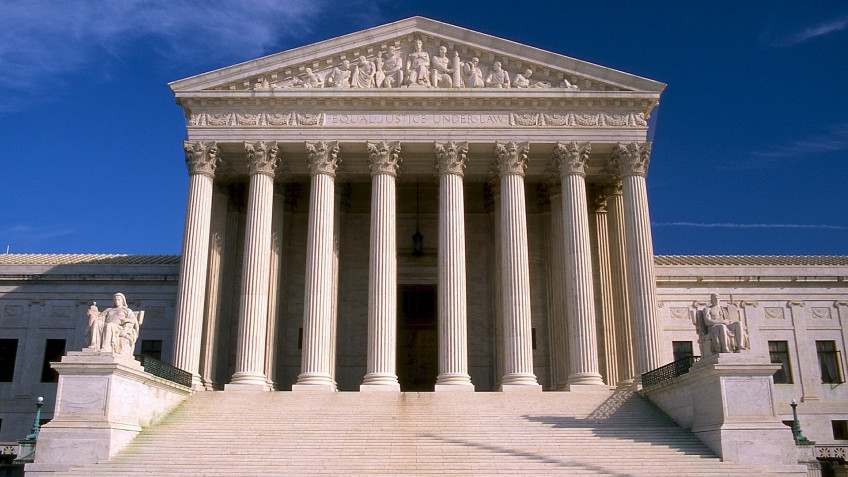
In what should come as no surprise to those who followed oral argument in the case, the U.S. Supreme Court ruled 6-3 in favor of Maryland parents in Mahmoud v. Taylor. The parents had raised a free exercise challenge to a newly adopted curriculum that read books promoting LGBTQ lifestyles to children as early as Pre-K after the school board refused to provide notice when the books would be read or allow parents to opt their children out. The parents had sought a preliminary injunction in lower courts, but those courts had ruled there was no substantial burden on the parents’ free exercise rights because there was no coercion.
The majority opinion, written by Justice Alito and joined by Chief Justice Roberts and Justices Thomas, Gorsuch, Kavanaugh, and Barrett, made clear that while coercion would be sufficient to satisfy the Free Exercise Clause’s burden requirement, it is not necessary. And the Court found the parents’ free exercise was burden because the government “required] them to submit their children to instruction that poses ‘a very real threat of undermining’ the religious beliefs and practices that the parents wish to instill.” In other words, by substantially interfering with their children’s religious development, the government sufficiently burdened the parents’ religious liberty.
What is more, pointing to this substantial interference language from Yoder v. Wisconsin, the Court clarified that when such a burden occurs, rather than move to the traditional next step of the analysis—asking whether the law or state action is neutral and generally applicable—courts skip that step and move straight to strict scrutiny. The Mahmoud majority also took pains to note that Yoder should not be limited to its facts, as many lower courts have done. This doctrinal clarification will make it easier for some parents to avoid Smith’s obstacle of neutrality and general applicability, advancing more free exercise claims to strict scrutiny analysis where they have a high probability of prevailing. The majority, however, refused to determine whether Smith’s hybrid-rights doctrine should be embraced or scrapped, punting such a decision for another day in a footnote since determining such was not necessary for the case.
Finally, the Court found that the school board’s policy failed strict scrutiny because it lacked a compelling interest given that the Board permitted opt outs for similar material on sexuality and gender “in a variety of other circumstances.” Ultimately, the Court granted the parents a preliminary injunction.
Justice Thomas, who joined the majority in full, wrote a concurrence “to highlight additional reasons why the Board's policy cannot survive constitutional scrutiny” and “emphasize an important implication of this decision for schools across the country.” Specifically, Justice Thomas noted that teaching sexuality and gender-related curriculum to young children is a recent development with no evidence that the generations of children who did not receive such teaching were stunted in their civic development. He also observed that the curriculum “betrays an attempt to impose ideological conformity with specific views on sexuality and gender,” something the government cannot do in the face of parents’ constitutional rights. Finally, he declared that “when schools or boards attempt to employ their curricula to interfere with religious exercise, courts should carefully police such ingenious defiance of the Constitution no less than they do in other contexts.”
Justice Sotomayor wrote a dissent, joined by Justices Kagan and Jackson, lamenting that the majority has undermined the ability of children from diverse backgrounds “to practice living in our multicultural society,” which “is critical to our Nation’s civic vitality.”