
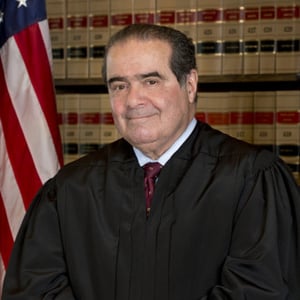
Associate Justice, United States Supreme Court
Antonin Scalia, Associate Justice, was born in Trenton, New Jersey, March 11, 1936. He married Maureen McCarthy and has nine children- Ann Forrest, Eugene, John Francis, Catherine Elisabeth, Mary Clare, Paul David, Matthew, Christopher James, and Margaret Jane. He received his A.B. from Georgetown University and the University of Fribourg, Switzerland, and his LL.B. from Harvard Law School, and was a Sheldon Fellow of Harvard University from 1960-1961. He was in private practice in Cleveland, Ohio from 1961-1967, a Professor of Law at the University of Virginia from 1967-1971, and a Professor of Law at the University of Chicago from 1977-1982, and a Visiting Professor of Law at Georgetown University and Stanford University. He was chairman of the American Bar Association's Section of Administrative Law, 1981-1982, and its Conference of Section Chairmen, 1982-1983. He served the federal government as General Counsel of the Office of Telecommunications Policy from 1971-1972, Chairman of the Administrative Conference of the United States from 1972-1974, and Assistant Attorney General for the Office of Legal Counsel from 1974-1977. He was appointed Judge of the United States Court of Appeals for the District of Columbia Circuit in 1982. President Reagan nominated him as an Associate Justice of the Supreme Court, and he took his seat September 26, 1986.

Director, Independent Women's Law Center, Independent Women's
Jennifer C. Braceras, a member of the Federalist Society Board of Visitors, is the director of Independent Women’s Law Center and a former member of the U.S. Commission on Civil Rights.
Ms. Braceras is a graduate of the Harvard Law School, where she served as an editor of the Law Review. After law school, she clerked for two federal judges and practiced labor and employment law with the Boston law firm Ropes & Gray.
A long time political columnist and editor, Ms. Braceras's writing has appeared in a variety of publications, including the Wall Street Journal, the Boston Globe, the Hill, and National Review Online. She co-hosts At the Bar, a bimonthly virtual happy hour discussion about issues at the intersection of law, politics, and culture.
Vice President for Education and Employment, National Women's Law Center

Founder and Co-President Emerita, National Women's Law Center
Described as "guiding the battles of the women's rights movement" by the New York Times, Marcia Greenberger is the founder and Co-President of the National Women's Law Center. The creation of the Center forty years ago established her as the first full-time women's rights legal advocate in Washington, D.C.
A recognized expert on women and the law, particularly in the areas of education and employment, health and reproductive rights, and family economic security, Ms. Greenberger has been a leader in securing the passage of major legislation, counsel in landmark litigation establishing new legal protections for women, and the author of numerous published articles. Examples include the Lilly Ledbetter Fair Pay Act, the Pregnancy Discrimination Act, the Civil Rights Act of 1991 providing critical protections against sexual harassment on the job, and Supreme Court victories strengthening protections for students and teachers against sex discrimination in schools.
Her leadership and contributions are reflected in the professional honors she has received and the numerous boards on which she has served. She has been given the James Wilson Award and the Alumni Award of Merit from the University of Pennsylvania Law School and the Trustees’ Council of Penn Women "Beacon" Leadership Award, the American Bar Association Margaret Brent Award for 2012, the National Association of Women Lawyers' Arabella Babb Mansfield Award, and an honorary Doctor of Laws degree from Lafayette College as well as the Woman Lawyer of the Year Award by the D.C. Women's Bar Association and the William J. Brennan, Jr. Award by the District of Columbia Bar. Additionally, she has been recognized by Working Woman Magazine as one of the 25 heroines whose activities over 25 years have helped women in the workplace, by Washingtonian Magazine as one of Washington, D.C.'s most powerful women, by Legal Times as a "Top Lawyer" and one of its "30 Champions", and by Legal Times and The National Law Journal as one of "Washington's Most Influential Women Lawyers." She has received the Dr. Jane Evans Pursuit of Justice Award from Women of Reform Judaism, A Woman of Genius Award from Trinity College, the "21 Leaders of the 21st Century" Award from Womens eNews, and the Woman of Distinction Award from Soroptimist International of the Americas. She was elected to the Court of Honor of the Philadelphia High School for Girls, received the Hope Award from Calvary Women's Shelter and awards from the National Family Planning and Reproductive Health Association and the Center for Law and Social Policy. She received a Presidential appointment to the National Skill Standards Board, and currently serves as a member of the Executive Committee of the Leadership Conference on Civil Rights.
Ms. Greenberger received her B.A. with honors and J.D. cum laude from the University of Pennsylvania. She practiced law with the Washington, D.C., firm of Caplin and Drysdale before she started and became Director of the Women's Rights Project of the Center for Law and Social Policy, which became the National Women's Law Center in 1981.

President, Committee for Justice
Curt Levey is President of the Committee For Justice, an organization devoted to advancing constitutionally limited government and individual liberty. He is a veteran of Supreme Court and other judicial confirmation battles and serves on the executive committee of the Federalist Society's Civil Rights Practice Group.
After graduating Harvard Law School with honors and clerking for the U.S. Court of Appeals for the Sixth Circuit, Mr. Levey served as Director of Legal & Public Affairs at the Center for Individual Rights (CIR). There he worked on landmark Supreme Court cases, including the University of Michigan affirmative action cases and the successful constitutional challenge to the Violence Against Women Act. After CIR, Mr. Levey headed the Title IX policy group at the U.S. Department of Education.
Before attending law school, Mr. Levey earned an M.S. and B.A. in computer science from Brown University and worked in the field of artificial intelligence (AI). He invented a new type of AI technology, for which he wrote a successful patent application.

Executive Director, Independent Women's Forum
Sabrina L. Schaeffer is the managing partner of Evolving Strategies. Prior to launching Evolving Strategies, Sabrina worked in numerous communications positions. She served as the speechwriter for Senator George Voinovich of Ohio, the Director of Media Relations and Public Affairs at the Republican Jewish Coalition in Washington, DC, where she frequently served as a spokeswoman for the organization, and a member of the communications team for Bob McEwen's primary campaign in Ohio's second district. As a Communications Associate at the White House Writers Group, Sabrina worked extensively on designing and orchestrating projects for a range of intellectual, government, and corporate clients on issues including energy policy, transportation policy, and telecommunication deregulation. While working for the White House Writers Group, she also acted as a liaison at the U.S. Department of Labor, where she helped launch "The Skilled Trades Initiative." Sabrina began her career in Washington as an assistant to former United Nations Ambassador Jeane J. Kirkpatrick at the American Enterprise Institute. She has commented on politics and political culture in publications such as Forbes, The Weekly Standard, The Washington Times, Foxnews.com, Philanthropy Magazine, National Review Online, Doublethink, Policy Review, Tech Central Station, and American Enterprise Online as well as on NBC, MSNBC, Fox News Channel and radio stations across the country. Sabrina received her M.A. in Politics from the University of Virginia, where she focused on media effects and political behavior. Her thesis utilized data from a survey experiment to explore how different message frames regarding social security reform impacted public opinion. Sabrina also earned an M.A. in American History also at UVA. Sabrina currently lives in Arlington, VA with her husband Adam and their three energetic children.

Professor of Law, University of San Diego School of Law (Retired)
Gail Heriot is a recently retired law professor from the University of San Diego. She also served as a member of the U.S. Commission on Civil Rights from 2007 to 2025. She is also the chairman of the board of the American Civil Rights Project and the chair emerita of the Civil Rights practice group at the Federalist Society for Law & Public Policy.
Professor Heriot is a prolific writer in the area of civil rights. She is the author of many law review articles. She is also the editor (along with Maimon Schwarzschild) of the 2021 anthology, A Dubious Expediency: How Race Preferences Damage Higher Education. Her upcoming book is entitled, Why We Walk on Eggshell: How Our Civil Rights Laws Helped Bring About the Woke Era—And the Trump Era, Too.
Her writings for a general audience have appeared in the Wall Street Journal, the San Diego Union-Tribune, the National Review and many other newspapers and magazines.
In 1996, she co-chaired the successful “Yes on Proposition 209” campaign, which amended the California Constitution to prohibit state-sponsored discrimination or preferential treatment based on race, sex, color, ethnicity or national origin. In 2020, she co-chaired the “No on Proposition 16” campaign, which successfully prevented Proposition 209’s repeal.

Assistant Professor, Florida Coastal School of Law
Professor Rod Sullivan practiced maritime law for 25 years before joining the faculty at Florida Coastal School of Law and is a Board Certified specialist in Admiralty and Maritime Law. During his years of practice he tried over 100 jury and non-jury cases in both federal and state courts in Florida and Georgia.
Professor Sulivan regularly teaches Constitutional Law, Administrative Law, Admiralty and Maritime Law, and the global Climate Change Seminar.
Professor Sullivan successfully argued before the United States Supreme Court on behalf of Edgar Townsend in the case of Atlantic Sounding, Inc. v. Townsend, 129 S. Ct. 2561 (2009). In a 5-4 decision written by Justice Clarence Thomas the Supreme Court decided that a seaman who was wrongfully denied medical care by his employer could seek punitive damages.
Professor Sullivan appeared as counsel for certain voters in Nassau County, Florida in the 2000 Presidential Election recount case in Tallahassee, Florida which came to be known as Bush v. Gore. He also served in the Merchant Marine Ready Reserve program of the U. S. Naval Reserve, earning the rank of Lieutenant.
Professor of Law, University of San Diego School of Law (Retired)
Gail Heriot is a recently retired law professor from the University of San Diego. She also served as a member of the U.S. Commission on Civil Rights from 2007 to 2025. She is also the chairman of the board of the American Civil Rights Project and the chair emerita of the Civil Rights practice group at the Federalist Society for Law & Public Policy.
Professor Heriot is a prolific writer in the area of civil rights. She is the author of many law review articles. She is also the editor (along with Maimon Schwarzschild) of the 2021 anthology, A Dubious Expediency: How Race Preferences Damage Higher Education. Her upcoming book is entitled, Why We Walk on Eggshell: How Our Civil Rights Laws Helped Bring About the Woke Era—And the Trump Era, Too.
Her writings for a general audience have appeared in the Wall Street Journal, the San Diego Union-Tribune, the National Review and many other newspapers and magazines.
In 1996, she co-chaired the successful “Yes on Proposition 209” campaign, which amended the California Constitution to prohibit state-sponsored discrimination or preferential treatment based on race, sex, color, ethnicity or national origin. In 2020, she co-chaired the “No on Proposition 16” campaign, which successfully prevented Proposition 209’s repeal.

Deputy District Attorney, Philadelphia District Attorney's Office
Ronald Eisenberg heads the Law Division of the Philadelphia District Attorney's Office. The 60 lawyers in the division handle appeals, habeas corpus and civil litigation, and legislative matters. Mr. Eisenberg has appeared at all levels of the state and federal court system, and has argued several cases in the United States Supreme Court.
Mr. Eisenberg is a member of the Pennsylvania Supreme Court Investigating Grand Jury Task Force and the Advisory Committee for the Pennsylvania Suggested Standard Criminal Jury Instructions. He has represented his office on the Pennsylvania Advisory Committee on Wrongful Convictions, was an adjunct professor at Temple University School of Law, teaching legal writing and research, and has served on the Pennsylvania Criminal Rules and Appellate Rules Committees. He is a past president and current board member of the Association of Government Attorneys in Capital Litigation, a national organization of capital prosecutors.
Mr. Eisenberg received his bachelor's degree from Haverford College in 1978 and his law degree from the University of Pennsylvania Law School in 1981.
J.D., University of Pennsylvania
B.A., Haverford College
Director, Independent Women's Law Center, Independent Women's
Jennifer C. Braceras, a member of the Federalist Society Board of Visitors, is the director of Independent Women’s Law Center and a former member of the U.S. Commission on Civil Rights.
Ms. Braceras is a graduate of the Harvard Law School, where she served as an editor of the Law Review. After law school, she clerked for two federal judges and practiced labor and employment law with the Boston law firm Ropes & Gray.
A long time political columnist and editor, Ms. Braceras's writing has appeared in a variety of publications, including the Wall Street Journal, the Boston Globe, the Hill, and National Review Online. She co-hosts At the Bar, a bimonthly virtual happy hour discussion about issues at the intersection of law, politics, and culture.
Vice President for Education and Employment, National Women's Law Center
Founder and Co-President Emerita, National Women's Law Center
Described as "guiding the battles of the women's rights movement" by the New York Times, Marcia Greenberger is the founder and Co-President of the National Women's Law Center. The creation of the Center forty years ago established her as the first full-time women's rights legal advocate in Washington, D.C.
A recognized expert on women and the law, particularly in the areas of education and employment, health and reproductive rights, and family economic security, Ms. Greenberger has been a leader in securing the passage of major legislation, counsel in landmark litigation establishing new legal protections for women, and the author of numerous published articles. Examples include the Lilly Ledbetter Fair Pay Act, the Pregnancy Discrimination Act, the Civil Rights Act of 1991 providing critical protections against sexual harassment on the job, and Supreme Court victories strengthening protections for students and teachers against sex discrimination in schools.
Her leadership and contributions are reflected in the professional honors she has received and the numerous boards on which she has served. She has been given the James Wilson Award and the Alumni Award of Merit from the University of Pennsylvania Law School and the Trustees’ Council of Penn Women "Beacon" Leadership Award, the American Bar Association Margaret Brent Award for 2012, the National Association of Women Lawyers' Arabella Babb Mansfield Award, and an honorary Doctor of Laws degree from Lafayette College as well as the Woman Lawyer of the Year Award by the D.C. Women's Bar Association and the William J. Brennan, Jr. Award by the District of Columbia Bar. Additionally, she has been recognized by Working Woman Magazine as one of the 25 heroines whose activities over 25 years have helped women in the workplace, by Washingtonian Magazine as one of Washington, D.C.'s most powerful women, by Legal Times as a "Top Lawyer" and one of its "30 Champions", and by Legal Times and The National Law Journal as one of "Washington's Most Influential Women Lawyers." She has received the Dr. Jane Evans Pursuit of Justice Award from Women of Reform Judaism, A Woman of Genius Award from Trinity College, the "21 Leaders of the 21st Century" Award from Womens eNews, and the Woman of Distinction Award from Soroptimist International of the Americas. She was elected to the Court of Honor of the Philadelphia High School for Girls, received the Hope Award from Calvary Women's Shelter and awards from the National Family Planning and Reproductive Health Association and the Center for Law and Social Policy. She received a Presidential appointment to the National Skill Standards Board, and currently serves as a member of the Executive Committee of the Leadership Conference on Civil Rights.
Ms. Greenberger received her B.A. with honors and J.D. cum laude from the University of Pennsylvania. She practiced law with the Washington, D.C., firm of Caplin and Drysdale before she started and became Director of the Women's Rights Project of the Center for Law and Social Policy, which became the National Women's Law Center in 1981.
President, Committee for Justice
Curt Levey is President of the Committee For Justice, an organization devoted to advancing constitutionally limited government and individual liberty. He is a veteran of Supreme Court and other judicial confirmation battles and serves on the executive committee of the Federalist Society's Civil Rights Practice Group.
After graduating Harvard Law School with honors and clerking for the U.S. Court of Appeals for the Sixth Circuit, Mr. Levey served as Director of Legal & Public Affairs at the Center for Individual Rights (CIR). There he worked on landmark Supreme Court cases, including the University of Michigan affirmative action cases and the successful constitutional challenge to the Violence Against Women Act. After CIR, Mr. Levey headed the Title IX policy group at the U.S. Department of Education.
Before attending law school, Mr. Levey earned an M.S. and B.A. in computer science from Brown University and worked in the field of artificial intelligence (AI). He invented a new type of AI technology, for which he wrote a successful patent application.
Executive Director, Independent Women's Forum
Sabrina L. Schaeffer is the managing partner of Evolving Strategies. Prior to launching Evolving Strategies, Sabrina worked in numerous communications positions. She served as the speechwriter for Senator George Voinovich of Ohio, the Director of Media Relations and Public Affairs at the Republican Jewish Coalition in Washington, DC, where she frequently served as a spokeswoman for the organization, and a member of the communications team for Bob McEwen's primary campaign in Ohio's second district. As a Communications Associate at the White House Writers Group, Sabrina worked extensively on designing and orchestrating projects for a range of intellectual, government, and corporate clients on issues including energy policy, transportation policy, and telecommunication deregulation. While working for the White House Writers Group, she also acted as a liaison at the U.S. Department of Labor, where she helped launch "The Skilled Trades Initiative." Sabrina began her career in Washington as an assistant to former United Nations Ambassador Jeane J. Kirkpatrick at the American Enterprise Institute. She has commented on politics and political culture in publications such as Forbes, The Weekly Standard, The Washington Times, Foxnews.com, Philanthropy Magazine, National Review Online, Doublethink, Policy Review, Tech Central Station, and American Enterprise Online as well as on NBC, MSNBC, Fox News Channel and radio stations across the country. Sabrina received her M.A. in Politics from the University of Virginia, where she focused on media effects and political behavior. Her thesis utilized data from a survey experiment to explore how different message frames regarding social security reform impacted public opinion. Sabrina also earned an M.A. in American History also at UVA. Sabrina currently lives in Arlington, VA with her husband Adam and their three energetic children.
Director, Independent Women's Law Center, Independent Women's
Jennifer C. Braceras, a member of the Federalist Society Board of Visitors, is the director of Independent Women’s Law Center and a former member of the U.S. Commission on Civil Rights.
Ms. Braceras is a graduate of the Harvard Law School, where she served as an editor of the Law Review. After law school, she clerked for two federal judges and practiced labor and employment law with the Boston law firm Ropes & Gray.
A long time political columnist and editor, Ms. Braceras's writing has appeared in a variety of publications, including the Wall Street Journal, the Boston Globe, the Hill, and National Review Online. She co-hosts At the Bar, a bimonthly virtual happy hour discussion about issues at the intersection of law, politics, and culture.
Vice President for Education and Employment, National Women's Law Center
Founder and Co-President Emerita, National Women's Law Center
Described as "guiding the battles of the women's rights movement" by the New York Times, Marcia Greenberger is the founder and Co-President of the National Women's Law Center. The creation of the Center forty years ago established her as the first full-time women's rights legal advocate in Washington, D.C.
A recognized expert on women and the law, particularly in the areas of education and employment, health and reproductive rights, and family economic security, Ms. Greenberger has been a leader in securing the passage of major legislation, counsel in landmark litigation establishing new legal protections for women, and the author of numerous published articles. Examples include the Lilly Ledbetter Fair Pay Act, the Pregnancy Discrimination Act, the Civil Rights Act of 1991 providing critical protections against sexual harassment on the job, and Supreme Court victories strengthening protections for students and teachers against sex discrimination in schools.
Her leadership and contributions are reflected in the professional honors she has received and the numerous boards on which she has served. She has been given the James Wilson Award and the Alumni Award of Merit from the University of Pennsylvania Law School and the Trustees’ Council of Penn Women "Beacon" Leadership Award, the American Bar Association Margaret Brent Award for 2012, the National Association of Women Lawyers' Arabella Babb Mansfield Award, and an honorary Doctor of Laws degree from Lafayette College as well as the Woman Lawyer of the Year Award by the D.C. Women's Bar Association and the William J. Brennan, Jr. Award by the District of Columbia Bar. Additionally, she has been recognized by Working Woman Magazine as one of the 25 heroines whose activities over 25 years have helped women in the workplace, by Washingtonian Magazine as one of Washington, D.C.'s most powerful women, by Legal Times as a "Top Lawyer" and one of its "30 Champions", and by Legal Times and The National Law Journal as one of "Washington's Most Influential Women Lawyers." She has received the Dr. Jane Evans Pursuit of Justice Award from Women of Reform Judaism, A Woman of Genius Award from Trinity College, the "21 Leaders of the 21st Century" Award from Womens eNews, and the Woman of Distinction Award from Soroptimist International of the Americas. She was elected to the Court of Honor of the Philadelphia High School for Girls, received the Hope Award from Calvary Women's Shelter and awards from the National Family Planning and Reproductive Health Association and the Center for Law and Social Policy. She received a Presidential appointment to the National Skill Standards Board, and currently serves as a member of the Executive Committee of the Leadership Conference on Civil Rights.
Ms. Greenberger received her B.A. with honors and J.D. cum laude from the University of Pennsylvania. She practiced law with the Washington, D.C., firm of Caplin and Drysdale before she started and became Director of the Women's Rights Project of the Center for Law and Social Policy, which became the National Women's Law Center in 1981.
President, Committee for Justice
Curt Levey is President of the Committee For Justice, an organization devoted to advancing constitutionally limited government and individual liberty. He is a veteran of Supreme Court and other judicial confirmation battles and serves on the executive committee of the Federalist Society's Civil Rights Practice Group.
After graduating Harvard Law School with honors and clerking for the U.S. Court of Appeals for the Sixth Circuit, Mr. Levey served as Director of Legal & Public Affairs at the Center for Individual Rights (CIR). There he worked on landmark Supreme Court cases, including the University of Michigan affirmative action cases and the successful constitutional challenge to the Violence Against Women Act. After CIR, Mr. Levey headed the Title IX policy group at the U.S. Department of Education.
Before attending law school, Mr. Levey earned an M.S. and B.A. in computer science from Brown University and worked in the field of artificial intelligence (AI). He invented a new type of AI technology, for which he wrote a successful patent application.
Executive Director, Independent Women's Forum
Sabrina L. Schaeffer is the managing partner of Evolving Strategies. Prior to launching Evolving Strategies, Sabrina worked in numerous communications positions. She served as the speechwriter for Senator George Voinovich of Ohio, the Director of Media Relations and Public Affairs at the Republican Jewish Coalition in Washington, DC, where she frequently served as a spokeswoman for the organization, and a member of the communications team for Bob McEwen's primary campaign in Ohio's second district. As a Communications Associate at the White House Writers Group, Sabrina worked extensively on designing and orchestrating projects for a range of intellectual, government, and corporate clients on issues including energy policy, transportation policy, and telecommunication deregulation. While working for the White House Writers Group, she also acted as a liaison at the U.S. Department of Labor, where she helped launch "The Skilled Trades Initiative." Sabrina began her career in Washington as an assistant to former United Nations Ambassador Jeane J. Kirkpatrick at the American Enterprise Institute. She has commented on politics and political culture in publications such as Forbes, The Weekly Standard, The Washington Times, Foxnews.com, Philanthropy Magazine, National Review Online, Doublethink, Policy Review, Tech Central Station, and American Enterprise Online as well as on NBC, MSNBC, Fox News Channel and radio stations across the country. Sabrina received her M.A. in Politics from the University of Virginia, where she focused on media effects and political behavior. Her thesis utilized data from a survey experiment to explore how different message frames regarding social security reform impacted public opinion. Sabrina also earned an M.A. in American History also at UVA. Sabrina currently lives in Arlington, VA with her husband Adam and their three energetic children.

Senior Assistant Attorney General, Office of the Attorney General of Virginia
Ms. Burnett is a Senior Assistant Attorney General with the Office of the Attorney General of Virginia and has served as the Director of the office’s Capital Litigation Unit for twelve years, supervising the litigation in all death penalty direct appeals, and in all post-conviction/habeas corpus actions involving death-row inmates. She has broad appellate and post-conviction/habeas corpus experience in the Commonwealth’s lower and appellate courts, the United States District Courts, and the United States Court of Appeals for the Fourth Circuit. She has argued five death penalty cases in the Supreme Court of the United States. She is a past President of the national Association of Government Attorneys in Capital Litigation, and has served on its board for several years. She regularly speaks at seminars on death penalty issues. She joined the Office of the Attorney General of Virginia in 1985 after receiving her law degree from the University of Richmond T.C. Williams School of Law. As an undergraduate student, she attended the University of South Carolina and Mary Baldwin College and received her Bachelor of Arts degree, cum laude, in 1982 from Virginia Commonwealth University.

Lecturer in Law, Michigan State University College of Law
Professor Pucillo comes to Michigan State University College of Law from the University of North Carolina School of Law, where he taught Civil Procedure and Constitutional Law as a visiting professor during the 2009-10 academic year. He spent the previous academic year teaching Administrative Law, Constitutional Law, Constitutional Litigation, and Federal Courts at Tulane University Law School. Prior to those appointments, he served on the faculty of Ave Maria School of Law in Ann Arbor, Michigan, where he was awarded tenure.
Before he began teaching law, Professor Pucillo practiced as a litigation associate in the Washington, D.C., office of Skadden, Arps, Slate, Meagher & Flom. He also completed several judicial clerkships, including one with Judge Ronald Lee Gilman of the U.S. Court of Appeals for the Sixth Circuit.
Professor Pucillo's primary area of scholarly interest is federal jurisdiction and procedure, especially in the appellate realm. His most recent publications have appeared in the Tulane Law Review, the Rutgers Law Review, and the Oklahoma Law Review.

A Conversation with Justice Antonin Scalia
Philadelphia, PennsylvaniaLozman v. City of Riviera Beach, Florida - Post-Argument SCOTUScast
Rod Sullivan
On October 1, 2012, the Supreme Court heard oral argument in Lozman v. City of Riviera...
Fisher v. University of Texas at Austin - Post-Argument SCOTUScast
Gail L. Heriot
On October 10, 2012, the Supreme Court heard oral argument in Fisher v. University of...
Tibbals v. Carter and Ryan v. Gonzales - Post-Argument SCOTUScast
Ronald Eisenberg
On October 9, 2012, the Supreme Court heard oral argument in Tibbals v. Carter and Ryan v. Gonzales....
Ledbetter and Beyond: Does the Media Oversimplify Gender Issues?
Jennifer C. Braceras, Fatima Goss Graves, Marcia D. Greenberger, Curt Levey, Sabrina L. Schaeffer
Five years ago, in Ledbetter v. Goodyear Tire Corporation, the U.S. Supreme Court said paychecks...
Ledbetter and Beyond: Does the Media Oversimplify Gender Issues?
Jennifer C. Braceras, Fatima Goss Graves, Marcia D. Greenberger, Curt Levey, Sabrina L. Schaeffer
Five years ago, in Ledbetter v. Goodyear Tire Corporation, the U.S. Supreme Court said paychecks...
Ledbetter and Beyond: Does the Media Oversimplify Gender Issues?
Civil Rights Practice Group and the Committee for Justice
Washington, DCJohnson v. Williams - Post-Argument SCOTUScast
Katherine Burnett
On October 3, 2012, the Supreme Court heard oral argument in Johnson v. Williams. The question...
United States v. Bormes - Post-Argument SCOTUScast
Philip Pucillo
On October 2, 2012 the Supreme Court heard oral argument in United States v. Bormes. The...
Fisher v. University of Texas: Affirmative Action Revisited by the Supreme Court