



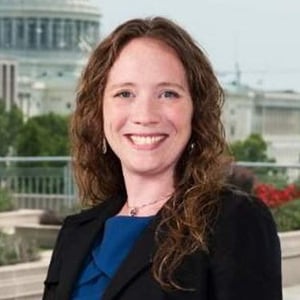





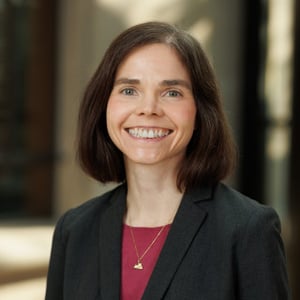
Tara Leigh Grove is the Vinson & Elkins Chair in Law at the University of Texas School of Law. Grove graduated summa cum laude from Duke University and magna cum laude from Harvard Law School, where she served as the Supreme Court Chair of the Harvard Law Review. Grove clerked for Judge Emilio Garza on the U.S. Court of Appeals for the Fifth Circuit, and then spent four years as an attorney for the U.S. Department of Justice, Civil Division, Appellate Staff, where she argued fifteen cases in the courts of appeals.
Grove’s research focuses on the federal judiciary, interpretive theory, and the constitutional separation of powers. She has published with such prestigious law journals as the Harvard Law Review, the Yale Law Journal, the Columbia Law Review, the University of Pennsylvania Law Review, the New York University Law Review, the University of Chicago Law Review, the Virginia Law Review, the Texas Law Review, the Cornell Law Review, the Northwestern University Law Review, and the Vanderbilt Law Review. Grove has received awards for both her research and her teaching.
In 2021, Grove served on the Presidential Commission on the Supreme Court of the United States, a bipartisan commission created by President Biden and charged with examining proposals for Supreme Court reform. Since 2022, Grove has worked on the Princeton Initiative on Reclaiming the Constitutional Powers of Congress, which brings together former members of Congress, political scientists, and law professors. Grove serves as the Co-Chair of the section on the Appointments Process for the Princeton Initiative. Grove is a co-author of Low & Jeffries' Federal Courts and the Law of Federal-State Relations, a leading federal courts casebook, and she has served as the Chair of the Federal Courts Section of the Association of American Law Schools. Grove has been a visiting professor at both Harvard Law School and Northwestern Pritzker School of Law.








From Chambers to the Front Page: Supreme Court Leaks and Judicial Integrity
Stephanie Barclay, Carrie Campbell Severino, Annie Donaldson Talley
What happens when confidential Supreme Court deliberations make their way into the press—most recently through...
Arthur N. Rupe Debate: Judging the Supreme Court's Emergency Docket
Jonathan H. Adler, Chad A. Readler, Jed Shugerman
The Federalist Society at UVA Law is pleased to host their 7th Annual Originalism...
Daniel Webster Debate Series: Do Nationwide Injunctions Undermine the President's Lawful Authority?
John G. Malcolm, Chad A. Readler, Stephen I. Vladeck
The Federalist Society's Georgetown Law Chapter'sDaniel Webster Debate Series presents Daniel Webster Debate Series:Do...
Young Legal Scholars Paper Presentations
Sadie Rose Blanchard, Jud Campbell, Benjamin Chen, Tara Leigh Grove, Robert Leider, Tyler B. Lindley, Robert T. Miller, Luke J. Schumacher, Brian Gary Slocum, Keith E. Whittington, Christina M. Mulligan
Featuring: Prof. Sadie Blanchard, "Adjudicating ESG Reputation," Associate Professor of Law, Notre Dame Law School...
Practice Groups: The Continued Independence of the Judiciary
Daniel Epps, James C. Ho, Edith H. Jones, Kannon K. Shanmugam, Stephen I. Vladeck
Recent times have seen growing criticism of the Supreme Court's legitimacy, with some claiming that...
Practice Groups: The Continued Independence of the Judiciary
Daniel Epps, James C. Ho, Edith H. Jones, Kannon K. Shanmugam, Stephen I. Vladeck
Recent times have seen growing criticism of the Supreme Court's legitimacy, with some claiming that...
Practice Groups: The Continued Independence of the Judiciary
2024 National Lawyers Convention
Washington, DCWhat Does "New" Mean? Agency Action Post-Chevron
Jonathan Brightbill, Richard A. Epstein, Andrew Mergen, Robert V. Percival
Last term, the Supreme Court handed down its ruling in Loper Bright Enterprises v. Raimondo. ...
Daniel Webster Debate Series: Should the Court Shut Down Its "Shadow Docket"?
The Federalist Society's Georgetown Law Chapter'sDaniel Webster Debate Series presents Daniel Webster Debate Series: Should...
Panel IV: Does Federalism Lead to a More United or Disunited Democracy?
Jud Campbell, Michael S. Greve, Andrew Oldham, Ilya Somin
The United States is constitutionally not one, but fifty-one, democracies. How can they all fit...