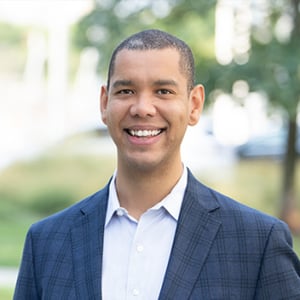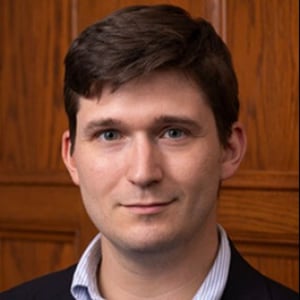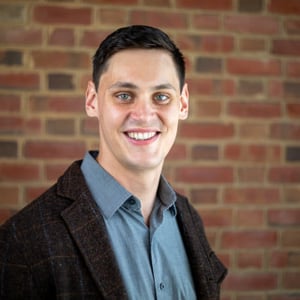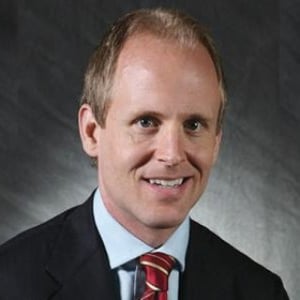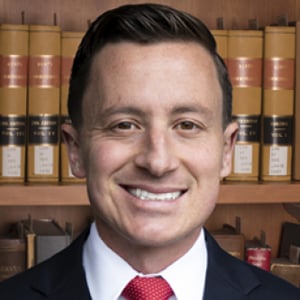
Tyler Lindley joined BYU Law School in 2024 as an Associate Professor of Law. His research centers on the judicial role and the historical evolution of the judiciary in America. He has extensively examined and published on judicial remedies, federal courts, constitutional law, and administrative law. His scholarly contributions have been or will be featured in the Alabama Law Review, BYU Law Review, Georgia Law Review, Virginia Law Review, and Wake Forest Law Review.
Professor Lindley holds a bachelor's degree in economics from Brigham Young University (2018) and a Juris Doctor from The University of Chicago Law School (2021). During his legal studies, he served as a judicial extern for Judge Ryan Nelson on the US Court of Appeals for the Ninth Circuit. Prior to joining the faculty at BYU Law, he clerked for Chief Judge William Pryor on the US Court of Appeals for the Eleventh Circuit and Judge Gregory Katsas on the US Court of Appeals for the D.C. Circuit. He also served as a Research Fellow at BYU Law between his clerkships.
*****
A person listed on this page has spoken or otherwise participated in Federalist Society events, publications, or multimedia presentations. A person's appearance on this list does not imply any other endorsement or relationship between the person and the Federalist Society. In most cases, the biographical information on a person's bio page is provided directly by the person, and the Federalist Society does not edit or otherwise endorse that information. The Federalist Society takes no position on particular legal or public policy issues. All expressions of opinion by a speaker or author are those of the individual.

Qualified Immunity and Remedies for Constitutional Violations: What is the Law and Does It Work?
Utah Lawyer Chapter
Foley and Lardner95 S State St, Suite 2500
Salt Lake City, UT 84111
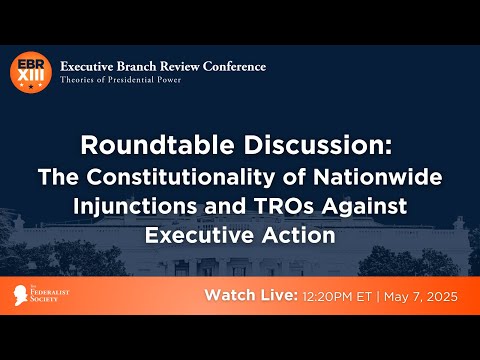
Roundtable Discussion: The Constitutionality of Nationwide Injunctions and TROs Against Executive Action
The Mayflower Hotel1127 Connecticut Avenue
Washington, DC 20036
Leviathan, or is The President Becoming Too Powerful?
Brigham Young Student Chapter
J. Reuben Clark Law School341 E Campus Dr
Provo, UT 84602

Reconstructing Section 1983
Chicago Student Chapter
The University of Chicago Law School1111 E. 60th Street
Chicago, IL 60636

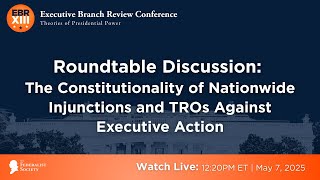
Roundtable Discussion: The Constitutionality of Nationwide Injunctions and TROs Against Executive Action
CLE credit for this event is available at On-Demand CLE. In recent years, the use of...
Williams v. Reed - Post-Decision SCOTUScast
Tyler Lindley
On February 21, 2025, the U.S. Supreme Court issued their 9-0 opinion in Williams v. Reed. The...
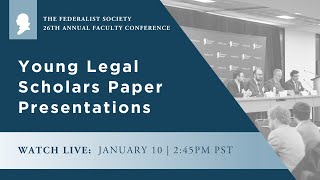
Young Legal Scholars Paper Presentations
Featuring: Prof. Sadie Blanchard, "Adjudicating ESG Reputation," Associate Professor of Law, Notre Dame Law School...
Young Legal Scholars Paper Presentations
Featuring: Prof. Sadie Blanchard, "Adjudicating ESG Reputation," Associate Professor of Law, Notre Dame Law School...
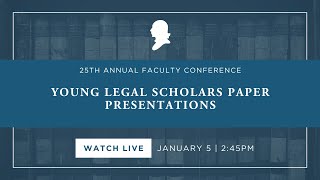
Young Legal Scholars Paper Presentations
Featuring: Prof. Stephanie Barclay, "Constitutional Rights as Protected Reasons," Associate Professor of Law, Notre Dame Law School Prof....