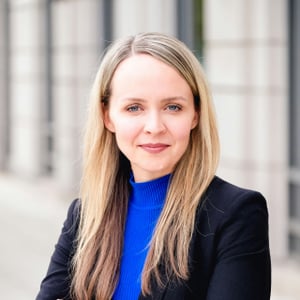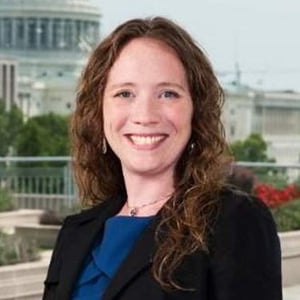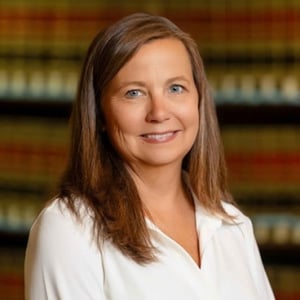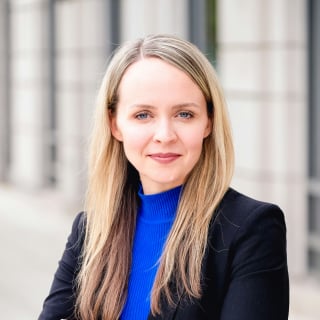
Stephanie Barclay is a Professor of Law at Georgetown Law School, and the Faculty Director of the Georgetown Center for the Constitution. Her research focuses on the role our different democratic institutions play in protecting minority rights, particularly at the intersection of free speech and religious exercise. Barclay‘s work is published or is forthcoming in leading journals such as the Harvard Law Review, the Chicago Law Review, the University of Pennsylvania Law Review, and the Yale Law Journal Forum. One of her articles was also selected for the 2020 Stanford/Harvard/Yale Junior Faculty Forum. Her work has been featured in many media outlets, including The New York Times, The Wall Street Journal, The Washington Post, USA Today, Bloomberg BNA, The Hill, and Law 360. And her work has also been cited by the U.S. Supreme Court.
Prior to joining Georgetown, Barclay was twice voted Professor of the Year. Barclay has also litigated constitutional cases at both the trial and appellate level, including before the U.S. Supreme Court. Barclay served as a law clerk to Judge N. Randy Smith on the U.S. Court of Appeals for the Ninth Circuit, and to Justice Neil M. Gorsuch of the U.S. Supreme Court.
Barclay is a Faculty Affiliate at the Constitutional Law Center at Stanford Law School; and she is a Nootbaar Fellow at the Nootbaar Institute on Law, Religion, and Ethics at Pepperdine University. She currently serves as the Chair for the AALS Law and Religion Section and as a Member of the Executive Committee for the AALS Constitutional Law Section. She graduated summa cum laude from BYU Law School, where she was elected to the Order of the Coif. She is completing a Ph.D. in Law at Oxford University as a Clarendon Scholar and a Tang Scholar.
*****
A person listed on this page has spoken or otherwise participated in Federalist Society events, publications, or multimedia presentations. A person's appearance on this list does not imply any other endorsement or relationship between the person and the Federalist Society. In most cases, the biographical information on a person's bio page is provided directly by the person, and the Federalist Society does not edit or otherwise endorse that information. The Federalist Society takes no position on particular legal or public policy issues. All expressions of opinion by a speaker or author are those of the individual.
Panel 4: "The Laws of Nature and of Nature's God"
Washington, DC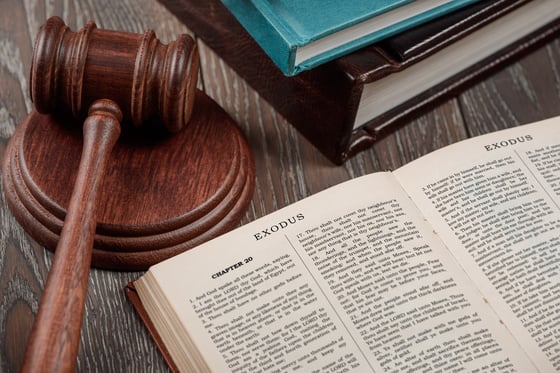
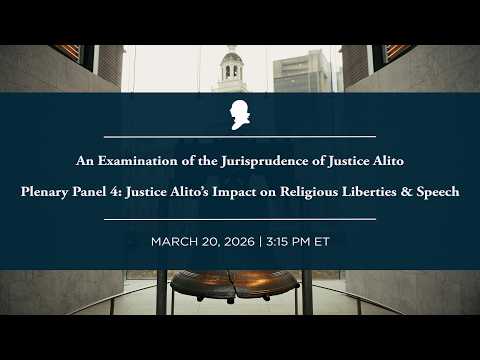
Plenary Panel 4: Justice Alito’s Impact on Religious Liberties & Speech
An Examination of the Jurisprudence of Supreme Court Associate Justice Samuel Alito
University of Pennsylvania Carey Law School3501 Sansom Street
Philadelphia, PA 19104

The Future of Religious Liberty at the Supreme Court
DC Young Lawyer Chapter
2nd Floor Conference Space (FedSoc)1776 I Street NW
Washington, DC 20006
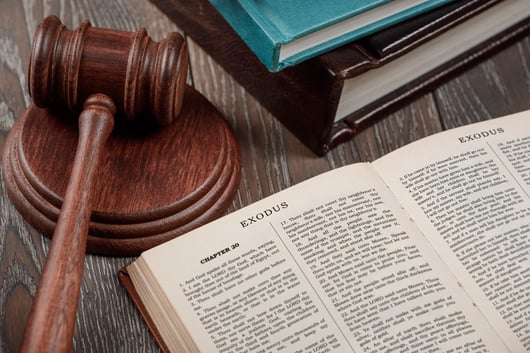
Litigation Update: Ten Commandments in Public Schools
This week, the en banc U.S. Court of Appeals for the Fifth Circuit held that...
Litigation Update: Ten Commandments in Public Schools
This week, the en banc U.S. Court of Appeals for the Fifth Circuit held that...
From Chambers to the Front Page: Supreme Court Leaks and Judicial Integrity
What happens when confidential Supreme Court deliberations make their way into the press—most recently through...
From Chambers to the Front Page: Supreme Court Leaks and Judicial Integrity
What happens when confidential Supreme Court deliberations make their way into the press—most recently through...
Courthouse Steps Decision: Chiles v. Salazar
Chiles v. Salazar addressed whether a Colorado law prohibiting “conversion therapy” violates the First...