
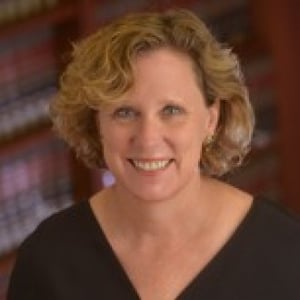
Shirley Shapiro Professor of Environmental Law and Faculty Co-Director of the Emmett Institute on Climate Change and the Environment, UCLA School of Law
Ann Carlson is the Shirley Shapiro Professor of Environmental Law and the Faculty Co-Director of the Emmett Institute on Climate Change and the Environment at UCLA School of Law. She is a leading scholar of climate change and air pollution law and policy, the co-author of a top casebook on Environmental Law (with Dan Farber and William Boyd), and the co-editor, with Dallas Burtraw, of a book from Cambridge University Press, Lessons from the Clean Air Act: Building Durability and Flexibility into U.S. Climate and Energy Policy. She has published numerous articles in leading law reviews, including California, Harvard, Michigan, Northwestern, and UCLA. Carlson is currently serving as the Speaker of the California Assembly’s representative to the Independent Emissions Market Advisory Committee. She is a frequent media commentator and blogs at Legal Planet. She is the recipient of the UCLA Distinguished Teaching Award, the Eby Award for the Art of Teaching and the Rutter Award for Excellence in Teaching, and is the 2017 University of California Sustainability Champion. Carlson is a magna cum laude graduate of both UC Santa Barbara and Harvard Law School.
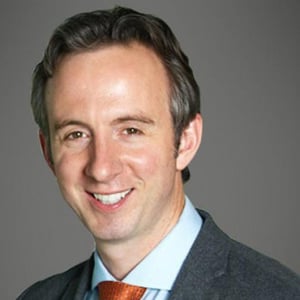
Professor of Law, University of Minnesota Law School
Professor James W. Coleman is a scholar of energy law. He specializes in North American energy infrastructure, transport, and trade. He is also a nonresident senior fellow at the American Enterprise Institute focused on energy policy.
Professor Coleman has testified before Congress on steps to speed up energy infrastructure permits. He also worked with a team of experts as part of Alberta's Royalty Review to revise the Canadian province's management of its vast oil and gas resources.
Before joining Minnesota, Professor Coleman taught at Southern Methodist University's Dedman School of Law, the University of Calgary’s law and business schools, and Harvard Law School. Earlier, he practiced environmental and appellate law at Sidley Austin in Washington, D.C., and clerked for the Honorable Steven M. Colloton of the U.S. Court of Appeals for the Eighth Circuit.
Professor Coleman received two degrees from Harvard University—a J.D. (cum laude) and B.A. in biology (magna cum laude with highest honors in the field). As a result of his undergraduate thesis on butterfly genetics, which required fieldwork in Central Asia, a species of lycaenid butterfly was named after him—Agrodiaetus ripartii colemani.

Partner, Gibson Dunn & Crutcher LLP
Miguel A. Estrada is a partner in the Washington, D.C. office of Gibson, Dunn & Crutcher.
Mr. Estrada has represented clients before federal and state courts throughout the country in a broad range of matters. He has argued 24 cases before the United States Supreme Court, and briefed many others. He has also argued dozens of appeals in the lower federal courts.
Best Lawyers® recognized Mr. Estrada as a 2020 Lawyer of the Year in Intellectual Property Litigation and as a Lawyer of the Year in Appellate Practice. He has been recognized by Benchmark Litigation as a 2020 U.S. Appellate Litigation “Star”. In 2014, The American Lawyer named Mr. Estrada a “Litigator of the Year,” praising his “brains and tenacity” and noting he is the lawyer to call for “a tough, potentially unwinnable case.” From 2014-2021, Chambers & Partners has named him as one of a handful of attorneys that it ranked in the top tier among the nation’s leading appellate lawyers. Chambers & Partners noted that “clients are impressed by his intellect and ability, with one saying, ‘His papers are just blindingly clear in what they say and devastating in how they marshal the arguments.’” The Atlantic described his oral argument in a 2014 high-profile separation-of-powers case as “one of the most dazzling arguments the marble chamber has heard in many years.”
Mr. Estrada was selected by his peers for inclusion in the 2020 edition of The Best Lawyers in America® in the area of Appellate Law, in addition to previous recognition by the publication in the specialties of Bet-the-Company Litigation, Commercial Litigation and Criminal Defense: White Collar, Intellectual Property Litigation, and Regulatory Enforcement Litigation in the areas of SEC, Telecom, and Energy. In 2017, he was elected as a member of the American Law Institute. In 2021, Mr. Estrada was named among the Lawdragon 500 Leading Lawyers in America. In 2004, Legal Times named him one of the top 12 appellate litigators in the D.C. area, noting that “people who follow appellate practice in Washington have known for several years that Estrada . . . is one of the best around.” Also in 2004, Washingtonian Magazine named him one of the top constitutional law lawyers “who could become one of the legends of the Supreme Court bar.”
Mr. Estrada joined Gibson Dunn in 1997, after serving for five years as Assistant to the Solicitor General of the United States. He previously served as Assistant U.S. Attorney and Deputy Chief of the Appellate Section, U.S. Attorney’s Office, Southern District of New York. In those capacities, Mr. Estrada represented the government in numerous jury trials and in many appeals before the U.S. Court of Appeals for the Second Circuit. Before joining the U.S. Attorney’s Office, Mr. Estrada practiced corporate law in New York with Wachtell, Lipton, Rosen & Katz.
Mr. Estrada is a Trustee of the Supreme Court Historical Society. He was formerly a member of the Board of Visitors of Harvard Law School.
Mr. Estrada served as a law clerk to the Honorable Anthony M. Kennedy in the U.S. Supreme Court from 1988 to 1989 and to the Honorable Amalya L. Kearse in the U.S. Court of Appeals for the Second Circuit from 1986 to 1987. He received a J.D. degree magna cum laude in 1986 from Harvard Law School, where he was editor of the Harvard Law Review. Mr. Estrada graduated with an A.B. degree magna cum laude and Phi Beta Kappa in 1983 from Columbia College, New York. He is fluent in Spanish and proficient in French.
Representative Supreme Court matters include:
In 2011, the Supreme Court appointed Mr. Estrada to brief and argue two criminal cases –Dorsey v. United States and Hill v. United States – in which the Solicitor General declined to defend the judgments of the court of appeals. Mr. Estrada was appointed to argue the position that the Solicitor General had declined to defend.
Mr. Estrada was also part of the team that successfully presented then Governor Bush’s position to the Supreme Court in Bush v. Gore (2000). Other cases that Mr. Estrada handled in the Supreme Court include Granholm v. Heald (2005) (dormant Commerce Clause and Twenty-First Amendment), Vermont Agency of Natural Resources v. United States ex rel. Stevens (2000) (False Claims Act, Article III standing and Eleventh Amendment immunity), Old Chief v. United States (1997) (rules of evidence), United States v. Mezzanatto (1995) (evidence and plea bargaining), United States v. Robertson (1995) (constitutional limits on Congress’s Commerce Clause powers), Citizens Bank of Maryland v. Strumpf (1995) (bankruptcy law), and NOW, Inc. v. Scheidler (1994) (RICO).
Recent Court of Appeals matters include:
In addition, Mr. Estrada is lead appellate counsel to Vivendi S.A. in two securities-fraud appeals from jury verdicts that are currently pending in the Second Circuit, and to the National Association of Broadcasters in a challenge to certain procedures promulgated by the FCC in connection with the upcoming Spectrum Auction. Mr. Estrada also recently presented argument before the D.C. Circuit on behalf of the tobacco industry in a first amendment challenge to certain compelled disclosures that were imposed as part of the government’s long-running civil RICO case against the industry.
Other matters:

Co-Chairman, The Federalist Society for Law and Public Policy Studies
Leonard is Co-Chairman and former Executive Vice President of the Federalist Society, joining the organization over 25 years ago. Since that time he has been instrumental in helping the organization top 70,000, focusing on the growth of lawyers membership, operations and activities advancing limited, constitutional government. In addition to his work at the Society, Leonard has advised President Trump on judicial selection, assisted with the Gorsuch and Kavanaugh Supreme Court selection and confirmation process, and served as a member of the transition team. He also organized the outside coalition efforts in support of the Roberts and Alito U.S. Supreme Court confirmations. Leonard was appointed by President George W. Bush to three terms to the U.S. Commission on International Religious Freedom as chairman. He was also a U.S. Delegate to the UN Council and UN Commission on Human Rights during the Bush Administration. Leonard was the recipient of the 2009 Bradley Prize, along with the other founders and directors of the Federalist Society, for his work in advancing freedom and the rule of law. He is the coeditor of Presidential Leadership: Rating the Best and the Worst in the White House, as well as the author of opinion editorials in the New York Times,The Wall Street Journal, and Washington Post. Leonard holds degrees from Cornell University and Cornell Law School. He presently resides in Northern Virginia, where he and his wife Sally have raised their seven children.
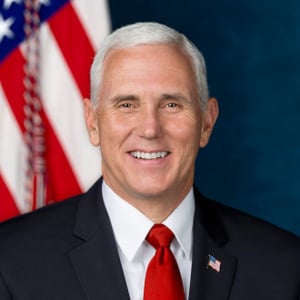
48th Vice President of the United States
Michael R. Pence was born in Columbus, Indiana, on June 7, 1959, one of six children born to Edward and Nancy Pence. As a young boy he had a front row seat to the American Dream. After his grandfather immigrated to the United States when he was 17, his family settled in the Midwest. The future Vice President watched his Mom and Dad build everything that matters—a family, a business, and a good name. Sitting at the feet of his mother and his father, who started a successful convenience store business in their small Indiana town, he was raised to believe in the importance of hard work, faith, and family.
Vice President Pence set off for Hanover College, earning his bachelor’s degree in history in 1981. While there, he renewed his Christian faith which remains the driving force in his life. He later attended Indiana University School of Law and met the love of his life, Second Lady Karen Pence.
After graduating, Vice President Pence practiced law, led the Indiana Policy Review Foundation, and began hosting The Mike Pence Show, a syndicated talk radio show and a weekly television public affairs program in Indiana. Along the way he became the proud father to three children, Michael, Charlotte, and Audrey.
Growing up in Indiana, surrounded by good, hardworking Hoosiers, Vice President Pence always knew that he needed to give back to the state and the country that had given him so much. In 2000, he launched a successful bid for his local congressional seat, entering the United States House of Representatives at the age of 40.
The people of East-Central Indiana elected Vice President Pence six times to represent them in Congress. On Capitol Hill he established himself as a champion of limited government, fiscal responsibility, economic development, educational opportunity, and the U.S. Constitution. His colleagues quickly recognized his leadership ability and unanimously elected him to serve as Chairman of the House Republican Study Committee and House Republican Conference Chairman. In this role, the Vice President helped make government smaller and more effective, reduce spending, and return power to state and local governments.
In 2013, Vice President Pence left the nation’s capital when Hoosiers elected him the 50th Governor of Indiana. He brought the same limited government and low tax philosophy to the Indiana Statehouse. As Governor, he enacted the largest income tax cut in Indiana history, lowering individual income tax rates, the business personal property tax, and the corporate income tax in order to strengthen the State’s competitive edge and attract new investment and good-paying jobs. Due to his relentless focus on jobs, the state’s unemployment rate fell by half during his four years in office, and at the end of his term, more Hoosiers were working than at any point in the state’s 200-year history.
As Governor of Indiana, Vice President Pence increased school funding, expanded school choice, and created the first state-funded Pre-K plan in Indiana history. He made career and technical education a priority in every high school. Under Vice President Pence’s leadership, Indiana, known as “The Crossroads of America,” invested more than $800 million in new money for roads and bridges across the state. Despite the record tax cuts and new investments in roads and schools, the state remained fiscally responsible, as the Vice President worked with members of the Indiana General Assembly to pass two honestly balanced budgets that left the state with strong reserves and AAA credit ratings that were the envy of the nation.
It was Indiana’s success story, Vice President Pence’s record of legislative and executive experience, and his strong family values that prompted President Donald Trump to select Mike Pence as his running mate in July 2016. The American people elected President Donald Trump and Vice President Pence on November 8, 2016. President Donald Trump and Vice President Pence entered office on January 20, 2017.
In February 2021, Vice President Mike Pence joined the Heritage Foundation as a distinguished visiting fellow. The Heritage Foundation helped shape Vice President Mike Pence’s conservative philosophy for decades and played a pivotal role advancing conservative policies throughout the Trump Administration. Vice President Pence also joined Young America’s Foundation as the Ronald Reagan Presidential Scholar. Long before Mike Pence became Vice President to President Donald Trump, the vision and leadership of Ronald Reagan inspired his youth.
Vice President Mike Pence remains grateful for the grace of God, the love and support of his family, and the blessings of liberty that are every American’s birthright.

Explainer Episode 1 – The Green New Deal
Ann Carlson, James W. Coleman
In this inaugural episode of the Regulatory Transparency Project's Explainer podcast series, Ann Carlson and...
2019 Annual Supreme Court Round Up
Miguel A. Estrada
The Washington, DC Lawyers Chapter presents its Annual Supreme Court Round Up Featuring The cost...
Keynote Address by Vice President Michael R. Pence
Leonard A. Leo, Mike Pence
The seventh annual Executive Branch Review Conference took place on May 8, 2019, at the...