
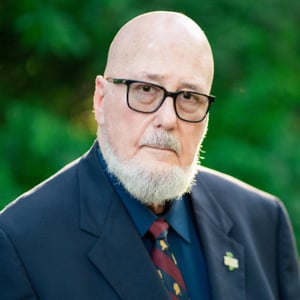
Senior Fellow, National Security Institute, Antonin Scalia School of Law, George Mason University; Retired Professor, Distinguished Fellow and Co-Founder, Center for National Security Law, University of Virginia School of Law (1987-2020)
Robert F. Turner holds both professional and academic doctorates from the University of Virginia School of Law. He co-founded the Center for National Security Law with Professor John Norton Moore in April 1981 and served as its associate director for 39 years, except for two periods of government service in the 1980s and during 1994-95, when he occupied the Charles H. Stockton Chair of International Law at the U.S. Naval War College in Newport, Rhode Island. He retired from UVA in January 2020 and currently serves as a non-resident senior fellow at the GMU National Security Institute. He also served briefly in 2020 as President of the Crime Prevention Research Center—one of the most respected pro-Second Amendment groups in the country—while its founder, Dr. John Lott, was on leave of absence.
A former Army captain and veteran of two tours in Vietnam, Turner served as a research associate and public affairs fellow at Stanford's Hoover Institution on War, Revolution and Peace before spending five years in the mid-1970s as national security adviser to U.S. Senator Robert P. Griffin, a member of the Senate Foreign Relations Committee (where Turner anticipated by seven years the Supreme Court’s landmark INS v. Chadha decision, striking down legislative vetoes). He also served in the executive branch during the Reagan administration as a member of the Senior Executive Service, first in the Pentagon as special assistant to the undersecretary of defense for policy, then in the White House as counsel to the President's Intelligence Oversight Board, and at the State Department as principal deputy and then acting assistant secretary for legislative affairs. In 1986, he became the first president of the congressionally established United States Institute of Peace.
A former three-term chairman of the ABA Standing Committee on Law and National Security (and for many years editor of the ABA National Security Law Report), Turner also chaired the Executive-Congressional Relations Subcommittee of the ABA Section on International Law and Practice and chaired or co-chaired the National Security Law Subcommittee of the Federalist Society’s International and National Security Law Practice Group for several years.
Turner taught undergraduate courses at Virginia on international law, U.S. foreign policy, the Vietnam War and foreign policy and the law in what is now the Woodrow Wilson Department of Politics. In addition, he co-taught National Security Law and advanced national security law seminars on the Indochina War and on war and peace with Moore at the Law School.
The author or editor of 18 books and monographs (including co-editor of the Center's 1,600-page National Security Law & Policy casebook, National Security Law Documents, and Legal Issues in the Struggle Against Terror) and numerous articles in law reviews and other professional journals, Turner has also contributed articles to most of the major U.S. newspapers, including The New York Times and USA Today. In an op-ed published in The International Herald Tribune in September 1990, he and Moore were the first to call for a war-crimes trial for Iraqi dictator Saddam Hussein and for international controls over Iraq's weapons of mass destruction, and the following month he wrote the lead story in The Washington Post Sunday Outlook Section, “Killing Saddam: Would It Be a Crime?,” arguing that Hussein would be a lawful target during Operation Desert Storm. (His reasoning contributed to the modern legal justification for drone strikes targeting specific terrorist leaders.) Three years before the terrorist attacks of September 11, 2001, Turner published an op-ed in USA Today entitled: “In Self-defense, U.S. Has Right to Kill bin Laden.”
In July 2007, he co-authored an article in The Washington Post with former U.S. Marine Corps Commandant General P.X. Kelley, “War Crimes and the White House,” criticizing the use of unlawful “enhanced interrogation techniques” by the Central Intelligence Agency. On the 40th anniversary of the fall of Saigon he authored an article in The Wall Street Journal, “Saigon’s Fall Still Echoes Today,” noting that after the war ended, Hanoi admitted it had made a decision in 1959 to open the Ho Chi Minh Trail and start sending troops, weapons and supplies into South Vietnam to overthrow its government — just as the United States had charged. In 2010 Turner received the first “person of the year” award from SACEI, a major Vietnamese-American human rights organization.
A frequent lecturer and debater, Turner has spoken at more than 100 law schools around the nation and in other fora — taking on as many as four opponents at a time. His debate opponents have included former or future deans of Yale, Stanford, the University of Chicago and Berkeley law schools. Following a 1987 debate against Dean Harlan Cleveland (Rhodes Scholar, U.S. Ambassador to NATO, and Presidential Medal of Freedom recipient) in which Turner defended the legality of U.S. support for the Nicaraguan contras during the Reagan Administration, the host student debating societies awarded Turner the victory by an 85-to-15 percent margin.
Turner has also written and lectured widely on University of Virginia founder and America’s third president Thomas Jefferson. In 2000-2001 he chaired the Jefferson-Hemings Scholars Commission. In his 2012 book Master of the Mountain, Jefferson critic Henry Wiencek described Turner as “Jefferson’s chief scholarly defender."
A former distinguished lecturer at the U.S. Military Academy at West Point, Turner is a member of the Council on Foreign Relations, the Academy of Political Science, the Committee on the Present Danger, The Heterodox Academy, and other professional organizations. He maintained a 4.0 gpa as a graduate student at Stanford in History and Political Science and in the UVA Department of Government and Foreign Affairs and was the first person admitted directly to the UVA academic law doctorate (SJD) program without first being required to earn an LL.M. master’s degree. He was selected for inclusion in Who’s Who in American Law less than two years after graduating from law school and Who’s Who in the World before he reached the age of 40. Turner has testified before more than a dozen different congressional committees on issues of international or constitutional law and other topics.
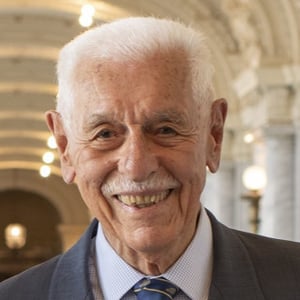
Judge, United States Court of Appeals, Ninth Circuit
Judge Carlos Bea serves as a judge on the United States Court of Appeals for the Ninth Circuit. He received his Bachelor's Degree from Stanford University in 1956 and his J.D. from Stanford Law School in 1958. Judge Bea was born in San Sebastian, Spain, and immigrated with his family to Cuba in 1939. In 1952, he represented Cuba on the Cuban National basketball team in the Helsinki Olympics. Judge Bea became a naturalized citizen of the United States in 1958. He engaged in private practice in San Francisco, principally in the area of civil trials (jury and non-jury), from 1959-75 at Dunne, Phelps & Mills and from 1975-90 at Carlos Bea, A Law Corporation. He taught courses in civil litigation advocacy at Hastings College of Law and Stanford Law School. From 1990 to 2003, Judge Bea served as a judge of the San Francisco Superior Court. He was nominated by President George W. Bush to the United States Court of Appeals for the Ninth Circuit and was confirmed in 2003.
Judge Bea and his wife Louise reside in San Francisco, where they raised their four sons, Sebastian, Alexander, Nicholas, and Dominic.
President and CEO, Castro Synergies, LLC and Commissioner, U.S. Commission on Civil Rights
Marty Castro is the President and CEO of Castro Synergies, LLC, which provides strategic consulting services to corporations, entrepreneurs and non-profit organizations that seek to collaborate with and have a positive social impact on diverse communities.
Mr. Castro was appointed by President Barack Obama to the U.S. Commission on Civil Rights in January of 2011.
In December 2009, Mr. Castro was appointed by Illinois Governor Pat Quinn to Chair the Illinois Human Rights Commission. The Human Rights Commission is the State public body that arbitrates complaints of civil rights violations in housing, employment, public accommodations and financial credit.
Mr. Castro is chair of the board of the National Museum of Mexican Art, the only accredited Latino Museum in the United States. He also serves on the board of the Chicago Community Trust. Mr. Castro is a former national board member of the Mexican American Legal Defense and Educational Fund and former chair of the Hispanic National Bar Association’s U.S. Supreme Court Committee. Mr. Castro is also the former chair of the Judicial Nominations Commission for the Northern District of Illinois, by appointment of U.S. Senator Richard Durbin.
For his leadership and accomplishments, Mr. Castro has received numerous awards and recognitions, including the National Medical Fellowships’ Humanitarian Award; the Hispanic National Bar Association’s Cesar Chavez Humanitarian Award; the Edwin A. Rothschild Civil Liberties Award from the American Civil Liberties Union of Illinois; and the Thurgood Marshall Lifetime Achievement Award from the Association of Corporate Counsel, Chicago Chapter.
Mr. Castro received his B.A. in political science in 1985 from DePaul University and his Juris Doctorate degree from the University of Michigan Law School in 1988.
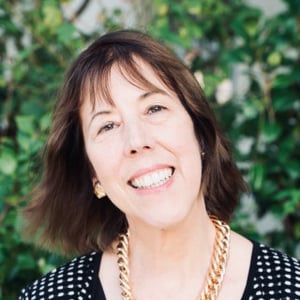
Professor of Law, University of San Diego School of Law (Retired)
Gail Heriot is a recently retired law professor from the University of San Diego. She also served as a member of the U.S. Commission on Civil Rights from 2007 to 2025. She is also the chairman of the board of the American Civil Rights Project and the chair emerita of the Civil Rights practice group at the Federalist Society for Law & Public Policy.
Professor Heriot is a prolific writer in the area of civil rights. She is the author of many law review articles. She is also the editor (along with Maimon Schwarzschild) of the 2021 anthology, A Dubious Expediency: How Race Preferences Damage Higher Education. Her upcoming book is entitled, Why We Walk on Eggshell: How Our Civil Rights Laws Helped Bring About the Woke Era—And the Trump Era, Too.
Her writings for a general audience have appeared in the Wall Street Journal, the San Diego Union-Tribune, the National Review and many other newspapers and magazines.
In 1996, she co-chaired the successful “Yes on Proposition 209” campaign, which amended the California Constitution to prohibit state-sponsored discrimination or preferential treatment based on race, sex, color, ethnicity or national origin. In 2020, she co-chaired the “No on Proposition 16” campaign, which successfully prevented Proposition 209’s repeal.
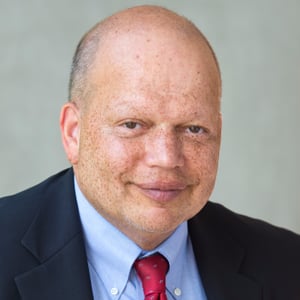
Julius L. Chambers Distinguished Professor of Law and Director of the Center for Civil Rights, University of North Carolina School of Law
Theodore M. Shaw is the Julius L. Chambers Distinguished Professor of Law and Director of the Center for Civil Rights at the University of North Carolina School of Law at Chapel Hill. Professor Shaw teaches Civil Procedure and Advanced Constitutional Law/Fourteenth Amendment. Before joining the faculty of UNC Law School, from 2008-2014 Professor Shaw taught at Columbia University Law School, where he was Professor of Professional Practice. During that time he was also “Of Counsel” to the law firm of Norton Rose Fulbright (formerly Fulbright & Jaworski, LLP). His practice involved civil litigation and representation of institutional clients on matters concerning diversity and civil rights.
Professor Shaw was the fifth Director-Counsel and President of the NAACP Legal Defense and Educational Fund, Inc., for which he worked in various capacities over the span of twenty-six years. He has litigated education, employment, voting rights, housing, police misconduct, capital punishment and other civil rights cases in trial and appellate courts, and in the United States Supreme Court.From 1982 until 1987, he litigated education, housing, and capital punishment cases and directed LDF's education litigation docket. In 1987, under the direction of LDF's third Director-Counsel, Julius Chambers, Mr. Shaw relocated to Los Angeles to establish LDF's Western Regional Office. In 1990, Mr. Shaw left LDF to join the faculty of the University of Michigan Law School, where he taught Constitutional Law, Civil Procedure and Civil Rights. While at Michigan, he played a key role in initiating a review of the law school's admissions practices and policies, and served on the faculty committee that promulgated the admissions program that was upheld by the U.S. Supreme Court in 2003 in Grutter v. Bollinger.
In 1993, Mr. Shaw returned to LDF as Associate Director-Counsel, and in 2004, he became LDF's fifth Director-Counsel. Mr. Shaw's legal career began as a Trial Attorney in the Honors Program of the United States Department of Justice, Civil Rights Division in Washington, D.C., where he worked from 1979 until 1982.
Mr. Shaw has testified on numerous occasions before Congress and before state and local legislatures. His human rights work has taken him to Africa, Asia, Europe, and South America. In addition to teaching at Columbia and at Michigan Law School, Professor Shaw held the 1997-1998 Haywood Burns Chair at CUNY School of Law at Queens College and the 2003 Phyllis Beck Chair at Temple Law School. He was a visiting scholar at the Constitution Center in Philadelphia in 2008-2009. He is a member of the faculty of the Practicing Law Institute (PLI).
Mr. Shaw served on the Obama Transition Team after the 2008 presidential election, as team leader for the Civil Rights Division of the Justice Department.
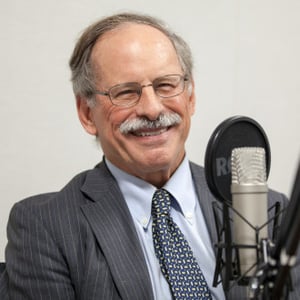
Freelance Journalist and Author
Stuart Taylor, Jr. is a Washington writer focusing on legal and policy issues and a National Journal contributing editor. He occasionally practices law.
Taylor has coauthored three books. All have been acclaimed by commentators across the ideological spectrum. In January 2017, KC Johnson and Taylor authored The Campus Rape Frenzy: The Attack on Due Process at America's Universities. In 2012, Richard Sander and Taylor authored Mismatch: How Affirmative Action Hurts Students It's Intended to Help, and Why Universities Won't Admit It. In 2007, Taylor and Johnson authored Until Proven Innocent: Political Correctness and the Shameful Injustices of the Duke Lacrosse Rape Fraud. Sander and Taylor have also filed amicus briefs in Supreme Court cases involving admissions preferences.
Since 1980, Taylor has done reporting and commentary about issues ranging from the biggest Supreme Court cases to race, voting rights, mindlessly excessive criminal penalties, guilt-presuming campus rape processes, journalistic bias, the death penalty, war powers, gerrymandering, guns, polarization, civil liberties, national security, torture, campaign finance, education, impeachment, and other issues. He has often been called one of the nation's best legal journalists and is known for challenging both liberal and conservative conventional wisdom.
Taylor was a reporter for The New York Times from 1980-1988, covering legal affairs and then the Supreme Court. He wrote commentaries and long features for The American Lawyer, Legal Times and their affiliates from 1989-1997, and for National Journal and Newsweek from 1998 through 2010. He has written (less often) on a freelance basis for numerous publications since 2010. He has written op-eds for The Washington Post, The New York Times, The Wall Street Journal, The Los Angeles Times, USA Today, and The New York Daily News and longer commentaries for RealClearPolitics, The Atlantic, The New Republic, the (late) Weekly Standard, National Review, Slate, The Daily Beast, Harper’s, Reader’s Digest, Time and other magazines. He has been interviewed on all major television and radio networks. He taught “Law and the News Media” at Stanford Law School in 2011 and 2012 and practices law on occasion.
Taylor graduated from Princeton University in 1970 with an A.B. in History. After working as a reporter for the Baltimore Evening Sun and Sun from 1971-1974, he moved to Harvard Law School, was a Harvard Law Review note editor, and graduated in 1977 at the top of his class, with high honors. He also won a Frederick Sheldon Traveling Fellowship and traveled around the world in 1977-1978 while studying freedom of the press in the United Kingdom and Kenya.
Taylor practiced law with Wilmer, Cutler & Pickering, in Washington, D.C., from 1977-1980 before returning to journalism in 1980 by joining the Washington Bureau of The New York Times.
Taylor's journalism honors include the 2009 Northern California Innocence Project Media Award for his work on the Duke lacrosse rape fraud; a 2002 National Headliner Award for best special magazine column on one subject; and a share of The American Lawyer’s National Magazine Award for a March 1990 special issue on the drug war. He was a National Magazine Award finalist in 1993 and 1997 and was nominated by The New York Times for a Pulitzer Prize in 1988.

Former President & CEO, The Federalist Society for Law and Public Policy Studies
Eugene B. Meyer, former President and CEO of the Federalist Society, has served as Executive Director, CEO, and/or President of the organization for more than 40 years. He is responsible for shepherding the organization from a small group of law students to a community of 90,000 lawyers, law students, academics, judges, and others interested in the rule of law. The Society now includes a Student Chapter at nearly every ABA-accredited law school in the country and Lawyers Chapters in 220 major cities across the nation. Gene earned his B.A. in history at Yale in 1975 and his M.A. in political science from the London School of Economics in 1976. Gene currently serves on the boards of the U.S. Chess Center, the Holman Foundation, the Sarah Scaife Foundation, and the advisory board of the Adam Smith Society. He holds the title of International Chess Master.
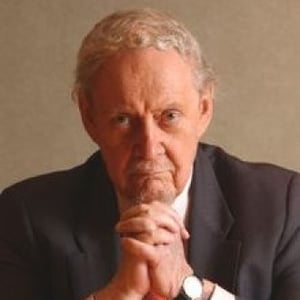
Former Judge, U.S. Court of Appeals, DC Circuit
Robert Heron Bork served as Solicitor General, acting Attorney General, and judge for the United States Court of Appeals for the District of Columbia Circuit. Judge Bork passed away in December 2012.
Tribute to Judge Robert Bork by John McGinnis - Event Audio/Video
Celebration of the Life of Robert Heron Bork 1927-2012
Judge Robert H. Bork: His Life and Legacy - Practice Group Podcast
A Conference Discussing the Contributions of Judge Robert H. Bork - June 26, 2007

Professor Emeritus of Law, Antonin Scalia Law School, George Mason University
Jeremy A. Rabkin is a Professor Emeritus of Law at the Antonin Scalia Law School, George Mason University. Before joining the faculty in June 2007, he was for over two decades a professor in the Department of Government at Cornell University. Professor Rabkin serves on the board of directors of the Center for Individual Rights, a public interest law firm based in Washington, D.C. Previously he was a board member of the U.S. Institute of Peace and the board of academic advisors of the American Enterprise Institute.
Professor Rabkin’s books include Law Without Nations? (Princeton University Press, 2005). He authored “If You Need a Friend, Don’t Call a Cosmopolitan,” a chapter in Varieties of Sovereignty and Citizenship (Sigal R. Ben-Porath & Rogers M. Smith eds., University of Pennsylvania Press, 2012). His articles have appeared in major law reviews and political science journals and his journalistic contributions in a range of magazines and newspapers, including the Washington Post and the Wall Street Journal.
United States Court of Appeals, Second Circuit
Dennis Jacobs is the Chief Judge of the United States Court of Appeals for the Second Circuit. He became Chief Judge on October 1, 2006. At the time of his appointment in 1992, he was a partner in the New York law firm of Simpson Thacher & Bartlett.
Judge Jacobs received his B.A. degree from Queens College of the City University of New York in 1964; his M.A. degree from New York University in 1965; and his J.D. degree from the New York University School of Law in 1973.
Judge Jacobs was a lecturer in the English Department of Queens College of the City University of New York from 1967 until 1969. He was in private practice from 1973 with the New York law firm of Simpson, Thacher & Bartlett, serving as a partner there from 1980 until his judicial appointment.
In 1997-2004, Judge Jacobs was a member of the Committee on Judicial Resources of the Judicial Conference of the United States; starting in 1999 he was chair of that committee.
Judge Jacobs is a native of New York City.
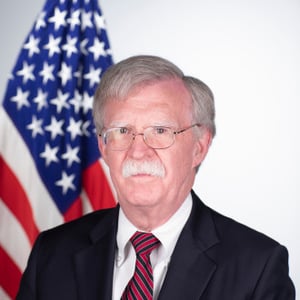
Former United States National Security Advisor
John R. Bolton served as Assistant to the President and National Security Advisor from April 2018 to September 2019.
Prior to his appointment, Ambassador Bolton served as a senior fellow at the American Enterprise Institute (AEI); of counsel at Kirkland & Ellis; a contributor to FOX News Channel and FOX Business Network; and his op-ed articles were regularly featured in major media publications.
Ambassador Bolton was appointed as United States Permanent Representative to the United Nations on August 1, 2005 and served until his resignation in December 2006. Prior to his appointment, Ambassador Bolton served as Under Secretary of State for Arms Control and International Security from May 2001 to May 2005.
Other positions he has previously held include Assistant Secretary for International Organization Affairs at the Department of State, 1989-1993; Assistant Attorney General, Department of Justice, 1985-1989; Assistant Administrator for Program and Policy Coordination, U.S. Agency for International Development, 1982-1983 and General Counsel, U.S. Agency for International Development, 1981-1982.
Ambassador Bolton is the author of Surrender is Not an Option: Defending America at the U.N. and Abroad, published by Simon and Shuster (November 2007) and How Barack Obama is Endangering our National Sovereignty, published by Encounter Books (April 2010).
Ambassador Bolton was born in Baltimore, Maryland. He graduated with a Bachelor of Arts degree, summa cum laude, Phi Beta Kappa, from Yale College in 1970, and received his Juris Doctor from Yale Law School in 1974. He currently resides in Maryland with his wife, Gretchen. They have one daughter, Jennifer Sarah, who also graduated from Yale College, and received her MBA and SM degrees from MIT in 2014 and is currently a senior manager at Nissan’s facility in Nashville.
Judge, United States Court of Appeals, Ninth Circuit
Judge Carlos Bea serves as a judge on the United States Court of Appeals for the Ninth Circuit. He received his Bachelor's Degree from Stanford University in 1956 and his J.D. from Stanford Law School in 1958. Judge Bea was born in San Sebastian, Spain, and immigrated with his family to Cuba in 1939. In 1952, he represented Cuba on the Cuban National basketball team in the Helsinki Olympics. Judge Bea became a naturalized citizen of the United States in 1958. He engaged in private practice in San Francisco, principally in the area of civil trials (jury and non-jury), from 1959-75 at Dunne, Phelps & Mills and from 1975-90 at Carlos Bea, A Law Corporation. He taught courses in civil litigation advocacy at Hastings College of Law and Stanford Law School. From 1990 to 2003, Judge Bea served as a judge of the San Francisco Superior Court. He was nominated by President George W. Bush to the United States Court of Appeals for the Ninth Circuit and was confirmed in 2003.
Judge Bea and his wife Louise reside in San Francisco, where they raised their four sons, Sebastian, Alexander, Nicholas, and Dominic.
President and CEO, Castro Synergies, LLC and Commissioner, U.S. Commission on Civil Rights
Marty Castro is the President and CEO of Castro Synergies, LLC, which provides strategic consulting services to corporations, entrepreneurs and non-profit organizations that seek to collaborate with and have a positive social impact on diverse communities.
Mr. Castro was appointed by President Barack Obama to the U.S. Commission on Civil Rights in January of 2011.
In December 2009, Mr. Castro was appointed by Illinois Governor Pat Quinn to Chair the Illinois Human Rights Commission. The Human Rights Commission is the State public body that arbitrates complaints of civil rights violations in housing, employment, public accommodations and financial credit.
Mr. Castro is chair of the board of the National Museum of Mexican Art, the only accredited Latino Museum in the United States. He also serves on the board of the Chicago Community Trust. Mr. Castro is a former national board member of the Mexican American Legal Defense and Educational Fund and former chair of the Hispanic National Bar Association’s U.S. Supreme Court Committee. Mr. Castro is also the former chair of the Judicial Nominations Commission for the Northern District of Illinois, by appointment of U.S. Senator Richard Durbin.
For his leadership and accomplishments, Mr. Castro has received numerous awards and recognitions, including the National Medical Fellowships’ Humanitarian Award; the Hispanic National Bar Association’s Cesar Chavez Humanitarian Award; the Edwin A. Rothschild Civil Liberties Award from the American Civil Liberties Union of Illinois; and the Thurgood Marshall Lifetime Achievement Award from the Association of Corporate Counsel, Chicago Chapter.
Mr. Castro received his B.A. in political science in 1985 from DePaul University and his Juris Doctorate degree from the University of Michigan Law School in 1988.
Professor of Law, University of San Diego School of Law (Retired)
Gail Heriot is a recently retired law professor from the University of San Diego. She also served as a member of the U.S. Commission on Civil Rights from 2007 to 2025. She is also the chairman of the board of the American Civil Rights Project and the chair emerita of the Civil Rights practice group at the Federalist Society for Law & Public Policy.
Professor Heriot is a prolific writer in the area of civil rights. She is the author of many law review articles. She is also the editor (along with Maimon Schwarzschild) of the 2021 anthology, A Dubious Expediency: How Race Preferences Damage Higher Education. Her upcoming book is entitled, Why We Walk on Eggshell: How Our Civil Rights Laws Helped Bring About the Woke Era—And the Trump Era, Too.
Her writings for a general audience have appeared in the Wall Street Journal, the San Diego Union-Tribune, the National Review and many other newspapers and magazines.
In 1996, she co-chaired the successful “Yes on Proposition 209” campaign, which amended the California Constitution to prohibit state-sponsored discrimination or preferential treatment based on race, sex, color, ethnicity or national origin. In 2020, she co-chaired the “No on Proposition 16” campaign, which successfully prevented Proposition 209’s repeal.
Julius L. Chambers Distinguished Professor of Law and Director of the Center for Civil Rights, University of North Carolina School of Law
Theodore M. Shaw is the Julius L. Chambers Distinguished Professor of Law and Director of the Center for Civil Rights at the University of North Carolina School of Law at Chapel Hill. Professor Shaw teaches Civil Procedure and Advanced Constitutional Law/Fourteenth Amendment. Before joining the faculty of UNC Law School, from 2008-2014 Professor Shaw taught at Columbia University Law School, where he was Professor of Professional Practice. During that time he was also “Of Counsel” to the law firm of Norton Rose Fulbright (formerly Fulbright & Jaworski, LLP). His practice involved civil litigation and representation of institutional clients on matters concerning diversity and civil rights.
Professor Shaw was the fifth Director-Counsel and President of the NAACP Legal Defense and Educational Fund, Inc., for which he worked in various capacities over the span of twenty-six years. He has litigated education, employment, voting rights, housing, police misconduct, capital punishment and other civil rights cases in trial and appellate courts, and in the United States Supreme Court.From 1982 until 1987, he litigated education, housing, and capital punishment cases and directed LDF's education litigation docket. In 1987, under the direction of LDF's third Director-Counsel, Julius Chambers, Mr. Shaw relocated to Los Angeles to establish LDF's Western Regional Office. In 1990, Mr. Shaw left LDF to join the faculty of the University of Michigan Law School, where he taught Constitutional Law, Civil Procedure and Civil Rights. While at Michigan, he played a key role in initiating a review of the law school's admissions practices and policies, and served on the faculty committee that promulgated the admissions program that was upheld by the U.S. Supreme Court in 2003 in Grutter v. Bollinger.
In 1993, Mr. Shaw returned to LDF as Associate Director-Counsel, and in 2004, he became LDF's fifth Director-Counsel. Mr. Shaw's legal career began as a Trial Attorney in the Honors Program of the United States Department of Justice, Civil Rights Division in Washington, D.C., where he worked from 1979 until 1982.
Mr. Shaw has testified on numerous occasions before Congress and before state and local legislatures. His human rights work has taken him to Africa, Asia, Europe, and South America. In addition to teaching at Columbia and at Michigan Law School, Professor Shaw held the 1997-1998 Haywood Burns Chair at CUNY School of Law at Queens College and the 2003 Phyllis Beck Chair at Temple Law School. He was a visiting scholar at the Constitution Center in Philadelphia in 2008-2009. He is a member of the faculty of the Practicing Law Institute (PLI).
Mr. Shaw served on the Obama Transition Team after the 2008 presidential election, as team leader for the Civil Rights Division of the Justice Department.
Freelance Journalist and Author
Stuart Taylor, Jr. is a Washington writer focusing on legal and policy issues and a National Journal contributing editor. He occasionally practices law.
Taylor has coauthored three books. All have been acclaimed by commentators across the ideological spectrum. In January 2017, KC Johnson and Taylor authored The Campus Rape Frenzy: The Attack on Due Process at America's Universities. In 2012, Richard Sander and Taylor authored Mismatch: How Affirmative Action Hurts Students It's Intended to Help, and Why Universities Won't Admit It. In 2007, Taylor and Johnson authored Until Proven Innocent: Political Correctness and the Shameful Injustices of the Duke Lacrosse Rape Fraud. Sander and Taylor have also filed amicus briefs in Supreme Court cases involving admissions preferences.
Since 1980, Taylor has done reporting and commentary about issues ranging from the biggest Supreme Court cases to race, voting rights, mindlessly excessive criminal penalties, guilt-presuming campus rape processes, journalistic bias, the death penalty, war powers, gerrymandering, guns, polarization, civil liberties, national security, torture, campaign finance, education, impeachment, and other issues. He has often been called one of the nation's best legal journalists and is known for challenging both liberal and conservative conventional wisdom.
Taylor was a reporter for The New York Times from 1980-1988, covering legal affairs and then the Supreme Court. He wrote commentaries and long features for The American Lawyer, Legal Times and their affiliates from 1989-1997, and for National Journal and Newsweek from 1998 through 2010. He has written (less often) on a freelance basis for numerous publications since 2010. He has written op-eds for The Washington Post, The New York Times, The Wall Street Journal, The Los Angeles Times, USA Today, and The New York Daily News and longer commentaries for RealClearPolitics, The Atlantic, The New Republic, the (late) Weekly Standard, National Review, Slate, The Daily Beast, Harper’s, Reader’s Digest, Time and other magazines. He has been interviewed on all major television and radio networks. He taught “Law and the News Media” at Stanford Law School in 2011 and 2012 and practices law on occasion.
Taylor graduated from Princeton University in 1970 with an A.B. in History. After working as a reporter for the Baltimore Evening Sun and Sun from 1971-1974, he moved to Harvard Law School, was a Harvard Law Review note editor, and graduated in 1977 at the top of his class, with high honors. He also won a Frederick Sheldon Traveling Fellowship and traveled around the world in 1977-1978 while studying freedom of the press in the United Kingdom and Kenya.
Taylor practiced law with Wilmer, Cutler & Pickering, in Washington, D.C., from 1977-1980 before returning to journalism in 1980 by joining the Washington Bureau of The New York Times.
Taylor's journalism honors include the 2009 Northern California Innocence Project Media Award for his work on the Duke lacrosse rape fraud; a 2002 National Headliner Award for best special magazine column on one subject; and a share of The American Lawyer’s National Magazine Award for a March 1990 special issue on the drug war. He was a National Magazine Award finalist in 1993 and 1997 and was nominated by The New York Times for a Pulitzer Prize in 1988.

First Principles: Are Judicial and Legislative Oversight of NSA Constitutional?
Robert F. Turner
First Principles: Are Judicial and Legislative Oversight of NSA Constitutional? Robert F. Turner* This issue...
Civil Rights: Who Benefits from Affirmative Action and Race and Gender Consciousness?
Carlos T. Bea, Martin Castro, Gail L. Heriot, Theodore M. Shaw, Stuart S. Taylor
The Civil Rights Practice Group hosted this panel on "Who Benefits from Affirmative Action and...
Civil Rights: Who Benefits from Affirmative Action and Race and Gender Consciousness?
2012 National Lawyers Convention
Washington, DC2003 Barbara K. Olson Memorial Lecture - Transcript
Eugene B. Meyer, Robert H. Bork
Address by Robert H. Bork, Senior Fellow, American Enterprise Instituteand Co-Chairman, Federalist Society Board of...
Panel Proceedings: The Pinochet Case & Head of State Immunity
Kenneth Roth, Jeffrey Greenbaum, Jeremy A. Rabkin, Dennis Jacobs, John R. Bolton
Editor's Note: This issue is dedicated to a panel discussion on International Law and Head...