
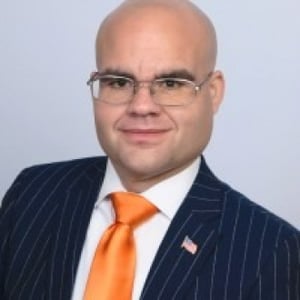
Counsel, Keller Postman LLC
John Masslon is a Counsel at Keller Postman LLC, where he works on a broad range of disputes, including products liability and consumer protections suits. He helps develop legal strategies, writes briefs, and presents argument on legal questions. Before joining Keller Postman, John was senior litigation counsel at Washington Legal Foundation. There, he wrote about 100 amicus briefs supporting free enterprise in courts across the country. He filed the first amicus brief in the Supreme Court supporting the challenge to OSHA’s vaccine mandate. He also filed a brief supporting ending the in-house proceedings at the Securities and Exchange Commission. Previously, John served as assistant solicitor general in a state attorney general’s office. There, he was first chair in a federal trial challenging a state election law that was ultimately upheld. He also wrote the briefs that convinced the state supreme court to uphold the State’s right-to-work statute.
John obtained his B.S. in economics with a minor in mathematical sciences from Clemson University. He then received his J.D. and LL.M. in Taxation from Georgetown University Law Center. After law school, John worked for Judge Arthur J. Schwab of the United States District Court for the Western District of Pennsylvania and clerked for Judge Judith Ference Olson of the Superior Court of Pennsylvania.
Counsel, Keller Postman LLC
John Masslon is a Counsel at Keller Postman LLC, where he works on a broad range of disputes, including products liability and consumer protections suits. He helps develop legal strategies, writes briefs, and presents argument on legal questions. Before joining Keller Postman, John was senior litigation counsel at Washington Legal Foundation. There, he wrote about 100 amicus briefs supporting free enterprise in courts across the country. He filed the first amicus brief in the Supreme Court supporting the challenge to OSHA’s vaccine mandate. He also filed a brief supporting ending the in-house proceedings at the Securities and Exchange Commission. Previously, John served as assistant solicitor general in a state attorney general’s office. There, he was first chair in a federal trial challenging a state election law that was ultimately upheld. He also wrote the briefs that convinced the state supreme court to uphold the State’s right-to-work statute.
John obtained his B.S. in economics with a minor in mathematical sciences from Clemson University. He then received his J.D. and LL.M. in Taxation from Georgetown University Law Center. After law school, John worked for Judge Arthur J. Schwab of the United States District Court for the Western District of Pennsylvania and clerked for Judge Judith Ference Olson of the Superior Court of Pennsylvania.
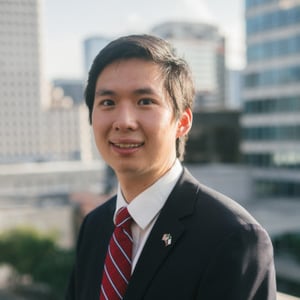
State District Judge, Austin, Texas
Cory Liu is a state district judge in Austin, Texas. He previously served as assistant general counsel to Texas Governor Greg Abbott. Mr. Liu clerked for Judge Andrew Oldham on the U.S. Court of Appeals for the Fifth Circuit and Judge Danny Boggs on the U.S. Court of Appeals for the Sixth Circuit. He was Editor-in-Chief of the Harvard Journal of Law & Public Policy and is a graduate of Harvard Law School and the University of Chicago.

Attorney, Institute for Justice
Anya Bidwell (née Cherkasova) leads IJ’s Project on Immunity and Accountability (“PIA”). Through this project, Anya works to promote judicial engagement and ensure that government officials are held to account when they violate individuals’ constitutional rights. Anya also serves as an adviser on the American Law Institute’s Restatement of the Law, Constitutional Torts project.
One of Anya’s PIA cases—Gonzalez v. Trevino—was heard by the United States Supreme Court on March 20, 2024. She argued the case for the petitioner, with the goal of convincing the Justices that retaliatory arrests not involving on-the-spot decisions by police officers should be actionable under the First Amendment regardless of probable cause. The decision is expected in June.
This was Anya’s third appearance before the U.S. Supreme Court. She second-chaired Brownback v. King (an excessive force case) and Tennessee Wine & Spirits Retailers Association v. Thomas (a commerce clause case) in November 2020 and January 2019 respectfully.
Before joining IJ, Anya worked for a top national law firm, handling cases in trial and appellate courts. She earned her J.D. with honors from the University of Texas. Two years prior to entering law school, Anya received a master’s degree in Global Policy Studies, also from the University of Texas, and wrote a thesis on asymmetric warfare.
Anya spent her childhood in Ukraine and Kyrgyzstan. At 16, she left her family behind and came to America on a university scholarship. Her upbringing motivated her to study law and become an advocate for a strong, independent judiciary.
Anya’s work has been featured in numerous publications, including the Washington Post, the Wall Street Journal, the New York Times, USA Today, and the Guardian. She is also the host of live recordings of our Short Circuit podcast and a co-producer of our documentary-style podcast Bound by Oath.
Counsel, Keller Postman LLC
John Masslon is a Counsel at Keller Postman LLC, where he works on a broad range of disputes, including products liability and consumer protections suits. He helps develop legal strategies, writes briefs, and presents argument on legal questions. Before joining Keller Postman, John was senior litigation counsel at Washington Legal Foundation. There, he wrote about 100 amicus briefs supporting free enterprise in courts across the country. He filed the first amicus brief in the Supreme Court supporting the challenge to OSHA’s vaccine mandate. He also filed a brief supporting ending the in-house proceedings at the Securities and Exchange Commission. Previously, John served as assistant solicitor general in a state attorney general’s office. There, he was first chair in a federal trial challenging a state election law that was ultimately upheld. He also wrote the briefs that convinced the state supreme court to uphold the State’s right-to-work statute.
John obtained his B.S. in economics with a minor in mathematical sciences from Clemson University. He then received his J.D. and LL.M. in Taxation from Georgetown University Law Center. After law school, John worked for Judge Arthur J. Schwab of the United States District Court for the Western District of Pennsylvania and clerked for Judge Judith Ference Olson of the Superior Court of Pennsylvania.

Judge, United States Court of Appeals, District of Columbia Circuit
Judge Katsas was appointed to the D.C. Circuit in December 2017. He graduated from Princeton University and Harvard Law School, where he was an executive editor on the Harvard Law Review. Between 1989 and 1992, he served as a law clerk to Judge Edward Becker on the Third Circuit, to then-Judge Clarence Thomas on the D.C. Circuit, and to Justice Thomas on the Supreme Court. Between 1992 and 2001, he was an associate and then partner in the Washington office of Jones Day, where he specialized in appellate and complex civil litigation. Between 2001 and 2009, he served in many senior positions in the Department of Justice, including as Assistant Attorney General for the Civil Division and as Acting Associate Attorney General. In 2009, he returned to Jones Day. From January to December 2017, he served as Deputy Assistant to the President and Deputy Counsel to the President.
Before joining the bench, Judge Katsas argued more than 75 appeals, including three cases in the Supreme Court, 13 cases in the D.C. Circuit, and cases in every other federal court of appeals. By appointment of the Chief Justice, he served on the Advisory Committee on Appellate Rules from 2013 to 2017. In 2016, he was elected to membership in the American Academy of Appellate Lawyers.

Senior Associate, Hogan Lovells
Sean Marotta's practice is as broad and diverse as the Appellate group's. He has briefed cases in the Supreme Court, federal courts of appeals, and state intermediate and courts of last resort. Mr. Marotta has also drafted petitions for certiorari, briefs in opposition, merits briefs, and amicus briefs in support of certiorari on the merits. Mr. Marotta has developed particular know-how in automotive, administrative, and media litigation.
Mr. Marotta has argued close to a dozen appeals in state and federal courts. He has argued in the New Jersey Supreme Court, the Third and Seventh Circuits, the New York Appellate Division, and the Florida District Court of Appeal.
Mr. Marotta previously clerked for the Honorable Jane Grall of the New Jersey Superior Court, Appellate Division. While in law school, Mr. Marotta was the Senior Articles Editor of the William & Mary Law Review and graduated as the class valedictorian.
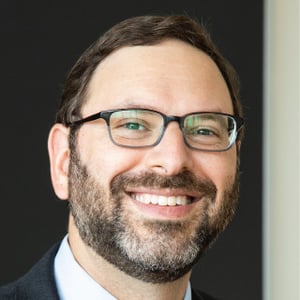
Antonin Scalia Professor of Law, Harvard Law School
Stephen E. Sachs is the Antonin Scalia Professor of Law at Harvard Law School, where he teaches civil procedure, conflict of laws, and seminars on constitutional law. His research focuses on the law and theory of constitutional interpretation, the jurisdiction of state and federal courts, the history of procedure and private law, and the role of the general common law in the U.S. legal system.
Sachs has authored numerous articles, essays, and book chapters. He is an elected member of the American Law Institute, an adviser to the ALI’s project on the Restatement of the Law (Third), Conflict of Laws, a former member of the Judicial Conference’s Advisory Committee on Appellate Rules, and a founding member of the Academic Freedom Alliance.
In 2020, Sachs received the Federalist Society’s Joseph Story Award, which recognizes a young academic who has demonstrated excellence in legal scholarship, a commitment to teaching, a concern for students, and who has made a significant public impact in a manner that advances the rule of law in a free society.
Sachs previously taught at Duke University School of Law and as a visiting professor at the University of Chicago Law School. Before entering academia, he practiced in the Washington, D.C., litigation group of Mayer Brown LLP, and he clerked for Chief Justice John G. Roberts Jr. as well as for Judge Stephen F. Williams of the U.S. Court of Appeals for the D.C. Circuit.
Sachs received his J.D. from Yale Law School, where he was executive editor of the Yale Law Journal and served both as executive editor and articles editor of the Yale Law & Policy Review. A Rhodes Scholar, he graduated from Oxford University with a first-class BA (Hons) degree in philosophy, politics, and economics. He received his A.B. degree summa cum laude in history from Harvard University, earning the Sophia Freund Prize.
Sachs is a licensed attorney in Massachusetts and the District of Columbia, and he is authorized to practice before the D.C. Circuit, the Second Circuit, the Seventh Circuit, and the Supreme Court of the United States.

Originalism, Precedent, and the Wisconsin Constitution
Milwaukee Lawyers Chapter
Milwaukee, WICourthouse Steps Oral Argument: Mallory v. Norfolk Southern
John Masslon
On November 8, 2022, the U.S. Supreme Court will hear oral argument in Mallory v....
Courthouse Steps Oral Argument: Mallory v. Norfolk Southern
John Masslon
On November 8, 2022, the U.S. Supreme Court will hear oral argument in Mallory v....
Courthouse Steps Oral Argument: Mallory v. Norfolk Southern
TeleforumState Court Docket Watch: Texas Department of Health v. Crown
Cory R. Liu
In Texas Department of State Health Services v. Crown Distributing LLC, the Texas Supreme Court...
Topics
Mallory v. Norfolk Southern: Oral Argument Preview
In Mallory v. Norfolk Southern Railway Co., the Supreme Court will consider whether state courts...
State Court Docket Watch: Bauserman v. Unemployment Insurance Agency
Anya Bidwell
Late last term, the United States Supreme Court all but eliminated the ability of individuals...
Who Decides: Questions of State Power, Corporate Power, and Originalism at Stake in Mallory v. Norfolk Southern Railway
TransUnion, Article III, and Expanding the Judicial Role
Jacob Phillips
In 2021’s TransUnion v. Ramirez, the Supreme Court confirmed that Article III standing requires a...
Topics
What Adam Liptak Doesn’t Know about Brown v. Board and Originalism
Adam Liptak, the New York Times’ Supreme Court reporter, recently published an article in which...