
Mr. Mirengoff is a retired attorney in Washington, D.C. and is a blogger at powerlineblog.com.
President, JCN
Carrie Campbell Severino is the president of the JCN, and co-author with Mollie Hemingway of the bestselling book Justice on Trial: The Kavanaugh Confirmation and the Future of the Court. As a go-to expert on the confirmation process, Mrs. Severino has been extensively quoted in the media. She regularly appears on television, including FOX, CNN, MSNBC, C-SPAN, and ABC’s This Week.
Severino writes and speaks on a wide range of judicial issues, including the constitutional limits on government, the federal nomination process, and state judicial selection. She has testified before Congress on constitutional questions and briefed Senators on judicial nominations, and regularly files briefs in high-profile Supreme Court cases. She was a law clerk to Supreme Court Justice Clarence Thomas and to Judge David B. Sentelle of the U.S. Court of Appeals for the D.C. Circuit, and is a graduate of Harvard Law School (J.D.), Duke University (B.A., Biology), and Michigan State University (M.A., Linguistics).
Professor of Law, UCLA School of Law
Paul J. Schierl Professor of Law, University of Notre Dame Law School
Professor Richard W. Garnett teaches and writes in the areas of constitutional law, criminal law, the First Amendment, and law and religion. He is a leading authority on questions and debates regarding religious freedom and church-state relations, and is the founding director of Notre Dame Law School’s Program on Church, State, and Society.
Garnett clerked for the late Chief Justice of the United States, William H. Rehnquist, and also for the late Chief Judge of the United States Court of Appeals for the Eighth Circuit, Richard S. Arnold. He earned his J.D. from Yale Law School in 1995 and his B.A., summa cum laude, from Duke University in 1990. He joined the faculty in 1999 after practicing law in Washington, D.C. with Miller, Cassidy, Larroca & Lewin.

Patrick Hotung Professor of Constitutional Law, Georgetown University Law Center; Faculty Director, Georgetown Center for the Constitution
Randy E. Barnett is the Patrick Hotung Professor of Constitutional Law at the Georgetown University Law Center and is the Faculty Director of the Georgetown Center for the Constitution. After graduating from Northwestern University and Harvard Law School, he tried many felony cases as a prosecutor in the Cook County States’ Attorney’s Office in Chicago. A recipient of a Guggenheim Fellowship in Constitutional Studies and the Bradley Prize, Professor Barnett has been a visiting professor at Penn, Northwestern and Harvard Law School.
Professor Barnett’s publications includes thirteen books, more than one hundred articles and reviews, as well as numerous op-eds. His most recent book is Felony Review: Tales of True Crime and Corruption in Chicago (2026). His other books on the Constitution include: A Life for Liberty: The Making of an American Originalist (2024); The Original Meaning of the Fourteenth Amendment: Its Letter and Spirit (2021) (with Evan Bernick); An Introduction to Constitutional Law: 100 Supreme Court Cases Everyone Should Know (2019) (with Josh Blackman); Restoring the Lost Constitution: The Presumption of Liberty (2nd ed. 2013); Our Republican Constitution: Securing the Liberty and Sovereignty of We the People (2016); and Constitutional Law: Cases in Context (5th ed. forthcoming 2027) (with Josh Blackman). His books on contracts are The Oxford Introductions to U.S. Law: Contracts (2010) and Contracts: Cases and Doctrine (7th ed. 2021) (with Nate Oman). And he is the author of The Structure of Liberty: Justice and the Rule of Law (2nd ed. 2014).
In 2004, he argued the medical marijuana case of Gonzalez v. Raich before the U.S. Supreme Court. In 2012, he was one of the lawyers representing the National Federation of Independent Business in its constitutional challenge to the Affordable Care Act in NFIB v. Sebelius. He’s appeared in numerous documentaries and portrayed a prosecutor in the 2010 science-fiction feature film, InAlienable: The Movie. On X he is @RandyEBarnett
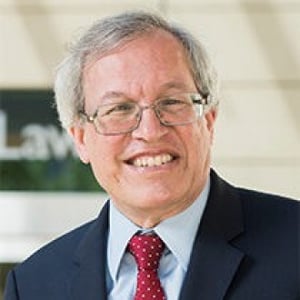
Dean and Jesse H. Choper Distinguished Professor of Law, UC Berkeley School of Law
Erwin Chemerinsky became the 13th Dean of Berkeley Law on July 1, 2017, when he joined the faculty as the Jesse H. Choper Distinguished Professor of Law.
Prior to assuming this position, from 2008-2017, he was the founding Dean and Distinguished Professor of Law, and Raymond Pryke Professor of First Amendment Law, at University of California, Irvine School of Law, with a joint appointment in Political Science. Before that he was the Alston and Bird Professor of Law and Political Science at Duke University from 2004-2008, and from 1983-2004 was a professor at the University of Southern California Law School, including as the Sydney M. Irmas Professor of Public Interest Law, Legal Ethics, and Political Science. He also has taught at DePaul College of Law and UCLA Law School.
He is the author of eleven books, including leading casebooks and treatises about constitutional law, criminal procedure, and federal jurisdiction. His most recent books are, We the People: A Progressive Reading of the Constitution for the Twenty-First Century (Picador Macmillan) published in November 2018, and two books published by Yale University Press in 2017, Closing the Courthouse Doors: How Your Constitutional Rights Became Unenforceable and Free Speech on Campus (with Howard Gillman).
He also is the author of more than 200 law review articles. He writes a regular column for the Sacramento Bee, monthly columns for the ABA Journal and the Daily Journal, and frequent op-eds in newspapers across the country. He frequently argues appellate cases, including in the United States Supreme Court.
In 2016, he was named a fellow of the American Academy of Arts and Sciences. In 2017, National Jurist magazine again named Dean Chemerinsky as the most influential person in legal education in the United States.
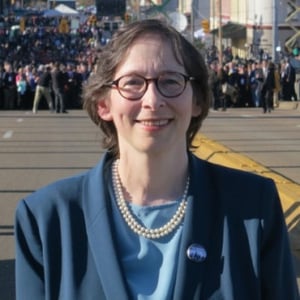
Kenneth and Harle Montgomery Professor of Public Interest Law and Co-Director, Supreme Court Litigation Clinic, Stanford Law School
A productive scholar and an award-winning teacher, Pamela S. Karlan is co-director of the school’s Supreme Court Litigation Clinic, where students litigate live cases before the Court. One of the nation’s leading experts on voting and the political process, she has served as a commissioner on the California Fair Political Practices Commission, an assistant counsel and cooperating attorney for the NAACP Legal Defense Fund, and a Deputy Assistant Attorney General in the Civil Rights Division of the U.S. Department of Justice (where she received the Attorney General’s Award for Exceptional Service – the department’s highest award for employee performance – as part of the team responsible for implementing the Supreme Court’s decision in United States v. Windsor). Professor Karlan is the co-author of leading casebooks on constitutional law, constitutional litigation, and the law of democracy, as well as numerous scholarly articles.
Before joining the Stanford Law School faculty in 1998, she was a professor of law at the University of Virginia School of Law and served as a law clerk to Justice Harry A. Blackmun of the U.S. Supreme Court and Judge Abraham D. Sofaer of the U.S. District Court for the Southern District of New York. Karlan is a member of the American Academy of Arts and Sciences, the American Academy of Appellate Lawyers, and the American Law Institute.
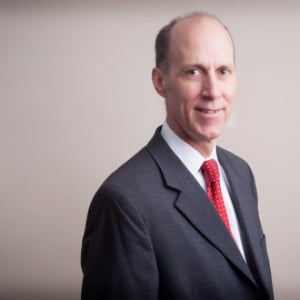
Distinguished Senior Fellow and Antonin Scalia Chair in Constitutional Studies, Ethics and Public Policy Center
Edward Whelan is a Distinguished Senior Fellow of the Ethics and Public Policy Center and holds EPPC’s Antonin Scalia Chair in Constitutional Studies. He is the longest-serving President in EPPC’s history, having held that position from March 2004 through January 2021.
Mr. Whelan directs EPPC’s program on The Constitution, the Courts, and the Culture. His areas of expertise include constitutional law and the judicial confirmation process. As a contributor to National Review Online’s Bench Memos blog, he has been a leading commentator on nominations to the Supreme Court and the lower courts and on issues of constitutional law. He has written essays and op-eds for leading newspapers—including the Wall Street Journal, the New York Times, and the Washington Post—opinion journals, and academic symposia and law reviews. The National Law Journal has named Mr. Whelan among its “Champions and Visionaries” in the practice of law in D.C.
Mr. Whelan is co-editor of three volumes of Supreme Court Justice Antonin Scalia’s work: Scalia Speaks: Reflections on Law, Faith, and Life Well Lived (Crown Forum, 2017), a New York Times bestselling collection of speeches by Justice Scalia; On Faith: Lessons from an American Believer (Crown Forum, 2019), a collection of Justice Scalia’s writings on faith and religion; and The Essential Scalia: On the Constitution, the Courts, and the Rule of Law (Crown Forum, 2020), a collection of Justice Scalia’s views on legal issues.
Mr. Whelan, a lawyer and a former law clerk to Justice Scalia, has served in positions of responsibility in all three branches of the federal government. From just before the terrorist attacks of September 11, 2001, until joining EPPC in 2004, Mr. Whelan was the Principal Deputy Assistant Attorney General for the Office of Legal Counsel in the U.S. Department of Justice. In that capacity, he advised the White House Counsel’s Office, the Attorney General and other senior DOJ officials, and departments and agencies throughout the executive branch on difficult and sensitive legal questions. Mr. Whelan previously served on Capitol Hill as General Counsel to the U.S. Senate Committee on the Judiciary. In addition to clerking for Justice Scalia, he was a law clerk to Judge J. Clifford Wallace of the U.S. Court of Appeals for the Ninth Circuit.
In 1981 Mr. Whelan graduated with honors from Harvard College and was inducted into Phi Beta Kappa. He received his J.D. magna cum laude in 1985 from Harvard Law School, where he was a member of the Board of Editors of the Harvard Law Review.
For more on Mr. Whelan’s background, see this interview.

Dr. John Eastman is the former Henry Salvatori Professor of Law & Community Service and former Dean at Chapman University's Dale E. Fowler School of Law, where he had been a member of the faculty since 1999, specializing in Constitutional Law, Legal History, and Property. He is a founding director of the Center for Constitutional Jurisprudence, a public interest law firm affiliated with the Claremont Institute that he founded in 1999. He has a Ph.D. in Government from the Claremont Graduate School and a J.D. from the University of Chicago Law School, and a B.A. in Politics and Economics from the University of Dallas. He serves as the Chairman of the Board of the National Organization for Marriage.
Prior to joining the Chapman law faculty, Dr. Eastman served as a law clerk to the Honorable Clarence Thomas, Associate Justice, Supreme Court of the United States, and to the Honorable J. Michael Luttig, Judge, United States Court of Appeals for the Fourth Circuit and practiced law with the national law firm of Kirkland & Ellis. Dr. Eastman has also represented numerous clients in important constitutional law matters and has argued before the Supreme Court. On behalf of the Claremont Institute Center for Constitutional Jurisprudence, he has participated as amicus curiae before the Supreme Court of the United States, U.S. Courts of Appeals, and State Supreme Courts in more than one hundred cases of constitutional significance, including Boy Scouts of America v. Dale, Zelman v. Simmons-Harris (the school vouchers case), Kelo v. New London, Ct. (eminent domain), and Van Orden v. Perry (the 10 Commandments case). He has also appeared as an expert legal commentator on numerous television and radio programs, including C-SPAN, Fox News, PBS, NewsHour, and The O'Reilly Factor.
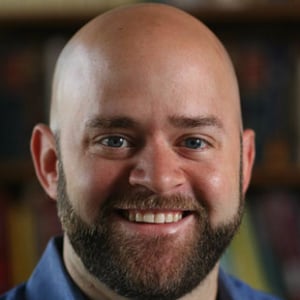
Charles E. Rice Professor of Law, Concurrent Professor of Political Science, & Director, de Nicola Center for Ethics and Culture, University of Notre Dame Law School
Professor Carter Snead is one of the world’s leading experts on public bioethics – the governance of science, medicine, and biotechnology in the name of ethical goods. His research explores issues relating to neuroethics, enhancement, human embryo research, assisted reproduction, abortion, and end-of-life decision-making.
He is the author of What It Means to be Human: The Case for the Body in Public Bioethics (Harvard University Press, October 2020), which was named by the Wall Street Journal as one of the “Ten Best Books of 2020;” in his review for the same paper, Yuval Levin called it “among the most important works of moral philosophy produced so far in this century.” In May of 2022, it was listed in The New York Times as one of “Ten Books to Understand the Abortion Debate in the United States.” Snead and the book received the 2021 “Expanded Reason Award” (given by Francisco de Vitoria University (Madrid) and the Joseph Ratzinger/Benedict XVI Vatican Foundation), and has been reviewed and discussed in such publications as the Wall Street Journal, The New York Times, New York Post, USA Today, Bloomberg Opinion, Il Foglio, Christian Post, The Review of Metaphysics, American Journal of Jurisprudence, America Magazine, First Things, The New Atlantis, Plough, The Boston Pilot, Public Discourse, Practical Ethics (Oxford University), Legal Ethics Forum, Church Life Journal, Law & Liberty, Angelus News, Mirror of Justice, Crux, Mars Hill Audio Journal, Mercator Net, BioEdge, Front Porch Republic, The National Catholic Register, The American Conservative, Fare Forward, Catholic World Report, The Gospel Coalition, Chronicles: A Magazine of American Culture, The Human Life Review, Eikon, Salvo, The Catholic Thing, The Daily Signal, and National Review.
Additionally, he has written more than 70 journal articles, book chapters, and essays. His scholarly works appear in such publications as the New York University Law Review, the Harvard Law Review Forum, the Vanderbilt Law Review, Constitutional Commentary, Quaderni Costituzionali (Italy’s premier journal of constitutional law), the Yale Journal of Health Policy, Law and Ethics, the Journal of Medicine and Philosophy, and Political Science Quarterly. He is also the editor of two book series for the University of Notre Dame Press – “Catholic Ideas for a Secular World” and “Notre Dame Studies in Bioethics and Medical Ethics.” Snead teaches Law & Bioethics, Health Law, Torts, and Constitutional Criminal Procedure.
In addition to his scholarship and teaching, Snead has provided advice on the legal and public policy dimensions of bioethical questions to officials in all three branches of the U.S. government, and in several intergovernmental fora. Prior to joining the law faculty at Notre Dame, Snead served as general counsel to The President’s Council on Bioethics (Chaired by Dr. Leon R. Kass), where he was the primary drafter of the 2004 report, “Reproduction and Responsibility: The Regulation of New Biotechnologies.” He has testified in the U.S. House of Representatives on regulatory questions concerning RU-486 (the abortion pill). In 2013, he testified in the Texas state legislature on the constitutionality of a proposed fetal pain bill. Snead led the U.S. government delegation to UNESCO and served as its chief negotiator for the Universal Declaration on Bioethics and Human Rights, adopted in October 2005. He served as the U.S. government’s Permanent Observer to the Council of Europe’s Steering Committee on Bioethics, where he assisted in its efforts to elaborate international instruments and standards for the ethical governance of science and medicine. In conjunction with the American Association for the Advancement of Science, he has lectured to state and federal judges on the uses of neuroimaging in the courtroom. He regularly serves as an expert witness on bioethical matters before federal courts.
In 2008, he was appointed by the director-general of UNESCO to a four-year term on the International Bioethics Committee, a 36-member body of independent experts that advises member states on bioethics, law, and public policy. The IBC is the only bioethics commission in the world with a global mandate. In 2016, he was appointed to the Pontifical Academy for Life, the principal bioethics advisory body to Pope Francis. He is also an elected fellow of The Hastings Center, the oldest independent bioethics research institute in the world.
Snead received his J.D., magna cum laude, from Georgetown University, where he was elected to the Order of the Coif, and his bachelor of arts from St. John’s College in Annapolis, Maryland. He clerked for Judge Paul J. Kelly Jr. of the U.S. Court of Appeals for the Tenth Circuit.
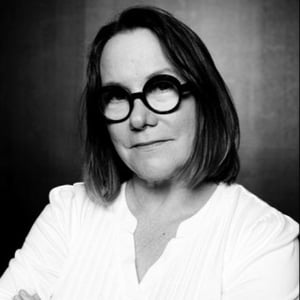
Independent Analyst, None
Allison Hayward most recently served as the Head of Case Selection at the Oversight Board. Previously, she was a Commissioner at the California Fair Political Practices Commission, a Board Member at the Office of Congressional Ethics, and an Assistant Professor of Law at George Mason University School of Law. She also previously worked as Chief of Staff and Counsel in the office of Federal Election Commission Commissioner Bradley A. Smith and practiced election law in California and in Washington DC.
In 1994-1995, Professor Hayward was a judicial clerk for the Honorable Danny J. Boggs, United States Court of Appeal for the Sixth Circuit.
She is a member of the State Bar of California and the District of Columbia Bar.
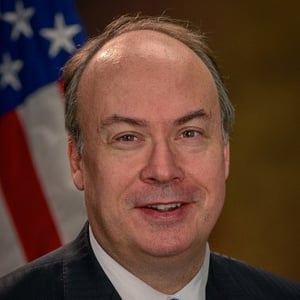
Assistant Attorney General, Environment and Natural Resources Division, U.S. Department of Justice
Jeffrey Bossert Clark was born in Philadelphia, Pennsylvania on April 17, 1967. He is a graduate of Harvard University (A.B. in economics and history, 1989), the University of Delaware (M.A. in urban affairs and public policy, 1993), and the Georgetown University Law Center (J.D., 1995).
Mr. Clark began his career working for the State of Delaware’s Department of Finance, Division of Revenue as an economics analyst in the field of tax policy. During his tenure from 1989 to 1992, he authored several white papers analyzing Delaware revenue sources. Delaware also selected Mr. Clark to submit an economic report and affidavit to the United States Supreme Court in the original jurisdiction case of Delaware v. New York, 507 U.S. 490 (1993).
He entered Georgetown’s law school in 1992 where he earned honors as an articles editor of the Georgetown Law Journal, an Olin Law & Economics Fellow, and a member of the Order of the Coif. From 1995 to 1996, Mr. Clark clerked for Judge Boggs of the U.S. Court of Appeals of the Sixth Circuit. Mr. Clark then joined the law firm of Kirkland & Ellis as an associate from 1996-2001. He worked as an appellate litigator on numerous Supreme Court and other appellate cases and developed expertise in administrative law, statutory interpretation, as well as antitrust, labor, environmental, and telecommunications law.
Mr. Clark went on to serve in ENRD from 2001-2005 as a Deputy Assistant Attorney General selected by Attorney General Ashcroft and Assistant Attorney General Tom Sansonetti. In that capacity, he supervised ENRD’s Appellate and Indian Resources Sections. He reviewed, edited, and contributed to virtually every brief that ENRD filed in the Courts of Appeals, including several cases of exceptional significance that he personally briefed and argued. During his service in the early 2000s, Mr. Clark argued and won numerous cases in multiple U.S. Courts of Appeals and worked on all Supreme Court cases arising out of ENRD’s work.
In 2005, Mr. Clark returned to Kirkland & Ellis LLP as a partner, where he litigated until his return to ENRD in 2018. There he worked on numerous multi-billion-dollar matters and continued to argue many appellate cases. His practice operated at all levels — appellate litigation, trial court litigation, agency proceedings, and regulatory and litigation counseling. He has been named a Super Lawyer for multiple years running, highlighted in the Legal 500, named to the “Legal Who’s Who for Environmental Law” in Corporate Responsibility Magazine, rated A.V. preeminent by Martindale Hubbell, and named a member of the National Association of Distinguished Counsel’s Nation’s One Percent. He also was named one of America’s Top 100 High Stakes Litigators.
President Trump nominated Mr. Clark to be the Assistant Attorney General of the Environment and Natural Resources Division (ENRD) on June 7, 2017. He was confirmed by the U.S. Senate on October 11, 2018 and sworn into office on November 1, 2018, followed by an investiture ceremony on November 15, 2018.
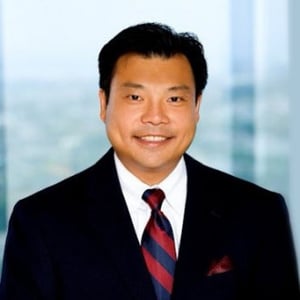
Attorney and Legal Commentator
John Shu is an attorney and legal commentator. His focus areas include constitutional law, securities & corporate law, antitrust law, administrative law, politics, and international affairs. Mr. Shu has lectured and published on a wide variety of issues.
Mr. Shu served President George H.W. Bush and President George W. Bush. He also served Judge Stanley Sporkin, U.S. District Court for the District of Columbia, who was Director of Enforcement at the U.S. Securities & Exchange Commission and General Counsel at the Central Intelligence Agency, and Judge Paul Roney, U.S. Court of Appeals for the Eleventh Circuit, who was Presiding Judge of the Foreign Intelligence Surveillance Court of Review.
Mr. Shu is a member of the National Committee on U.S. - China Relations, the Pacific Council on International Policy, and the Foreign Policy Association.
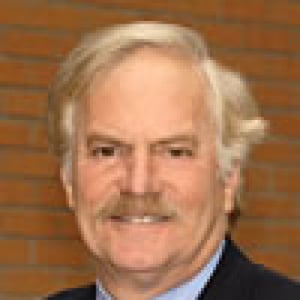
Professor of Environmental Practice and Director, California Env, UC Davis School of Law
Richard M. Frank is a Professor of Environmental Practice and Director of the California Environmental Law and Policy Center (CELPC). Formerly the executive director of the Center for Law, Energy, & the Environment (CLEE) at UC Berkeley School of Law, Frank returned to UC Davis School of Law in January 2010. In addition to leading the CELPC, he teaches classroom courses in the environmental law curriculum.
Before coming to CLEE and UC Berkeley, Professor Frank practiced law with federal and state agencies for 32 years, most of that time with the California Department of Justice. Immediately before joining Berkeley Law, he served as California's Chief Deputy Attorney General for Legal Affairs.
In 2006, Governor Schwarzenegger appointed Frank to the Delta Vision Task Force, an advisory body asked to develop policy recommendations for the Governor and Legislature, addressing environmental problems confronting the California Delta. He served in that capacity in 2007-08. In May 2009, the Chair of the California Air Resources Board appointed Frank Vice Chair of the Economic Allocation & Advisory Committee, an advisory body formed to assist the Air Resources Board in implementing California's landmark Global Warming Solutions Act (AB 32).
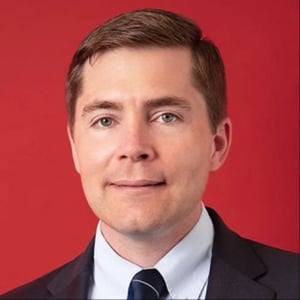
Senior Attorney, Pacific Legal Foundation
Damien Schiff is a senior attorney at Pacific Legal Foundation. He leads its environmental practice group, a unique initiative that draws broadly from PLF’s expertise and success in property rights and separation of powers litigation. Over the years, Damien has represented hundreds of landowners and property rights advocates to defend their liberties against heavy-handed and unwarranted environmental and land-use regulation. His litigation experience includes Sackett v. U.S. Environmental Protection Agency, a groundbreaking decision in which the U.S. Supreme Court upheld the right of landowners to challenge Clean Water Act compliance orders issued by EPA, and Contoski v. Norton, PLF’s successful effort to force the federal government to make good on its promise to delist the bald eagle from the Endangered Species Act.
Besides litigation, Damien has written academic articles on a variety of subjects, including the Endangered Species Act, the Clean Water Act, greenhouse gas torts, the duty to rescue, and international water law. He has appeared on a variety of television and radio programs and has been quoted in The New York Times, The Wall Street Journal, Harper’s Magazine, and The Economist, among other publications.
He obtained his law degree magna cum laude from the University of San Diego School of Law, and his undergraduate degree magna cum laude from Georgetown University. While at USD, he was a research assistant for Professor Bernard Siegan, a leading constitutional theorist and advocate for property rights and economic liberty. Immediately prior to joining PLF, Damien clerked for Judge (and former PLF attorney) Victor Wolski of the United States Court of Federal Claims. Damien credits the mentoring and examples of Professor Siegan and Judge Wolski for his decision to pursue a career in liberty-based public interest litigation.
Damien lives in Sacramento with his wife, two young sons, four chickens, and a cat named Princess. In his off hours he enjoys stamp collecting, Gregorian chant, and martinis—preferably at the same time.
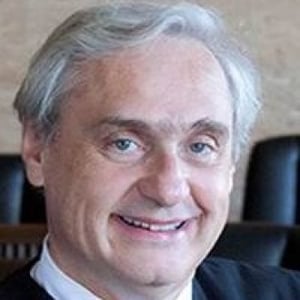
Former Judge, United States Court of Appeals, Ninth Circuit
Judge Kozinski served as a United States Circuit Judge for the Ninth Circuit from November 1985 until December 2017. He served as Chief Judge from 2007 to 2014. He graduated from UCLA, receiving an A.B. degree in 1972, and from UCLA Law School, receiving a J.D. degree in 1975.
Prior to his appointment to the appellate bench, Judge Kozinski served as Chief Judge of the United States Claims Court, 1982-85; Special Counsel, Merit Systems Protection Board, 1981-82; Assistant Counsel, Office of Counsel to the President, 1981; Deputy Legal Counsel, Office of President-Elect Reagan, 1980-81; Attorney, Covington & Burling, 1979-81; Attorney, Forry Golbert Singer & Gelles, 1977-79; Law Clerk to Chief Justice Warren E. Burger, 1976-77; and Law Clerk to Circuit Judge Anthony M. Kennedy, 1975-76.
Judge Kozinski is married to Marcy Jane Tiffany and has three children: Yale, Wyatt and Clayton, and three grandchildren: Quinn, Owen and Anna.
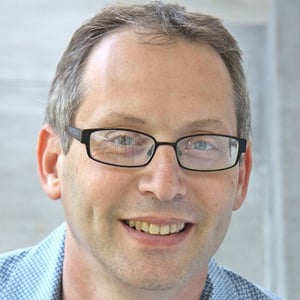
Chancellor's Professor of Law and Political Science, University of California, Irvine School of Law
Professor Richard L. Hasen is Chancellor’s Professor of Law and Political Science at the University of California, Irvine. Hasen is a nationally recognized expert in election law and campaign finance regulation, and is co-author of a leading casebook on election law.
From 2001-2010, he served (with Dan Lowenstein) as founding co-editor of the quarterly peer-reviewed publication, Election Law Journal. He is the author of over 100 articles on election law issues, published in numerous journals including the Harvard Law Review, Stanford Law Review and Supreme Court Review. He was elected to The American Law Institute in 2009 and served as an Adviser on ALI’s law reform project, Principles of Election Law: Resolution of Election Disputes.
Professor Hasen was named one of the 100 most influential lawyers in America by The National Law Journal in 2013, and one of the Top 100 Lawyers in California in 2005 and 2016 by the Los Angeles and San Francisco Daily Journal.
His op-eds and commentaries have appeared in many publications, including The New York Times, The Washington Post, Politico, and Slate. Hasen also writes the often-quoted Election Law Blog, which the ABA Journal named to its “Blawg 100 Hall of Fame” in 2015. His newest book, The Justice of Contradictions: Antonin Scalia and the Politics of Disruption, will be published in 2018 by Yale University Press.
Professor Hasen holds a B.A. degree (with highest honors) from UC Berkeley, and a J.D., M.A., and Ph.D. (Political Science) from UCLA. After law school, Hasen clerked for the Honorable David R. Thompson of the United States Court of Appeals for the Ninth Circuit, and then worked as a civil appellate lawyer at the Encino firm Horvitz and Levy.
From 1994-1997, Hasen taught at the Chicago-Kent College of Law and from 1998-2011 he taught at Loyola Law School, Los Angeles, where he was named the William H. Hannon Distinguished Professor of Law in 2005. He joined the UC Irvine School of Law faculty in July 2011, and is a faculty member of the UC Irvine Jack W. Peltason Center for the Study of Democracy.
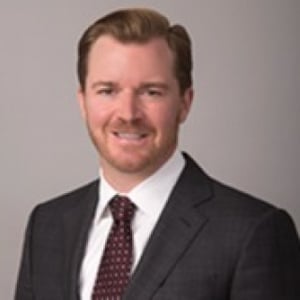
Partner, Gibson, Dunn & Crutcher LLP
Matthew D. McGill is a partner in the Washington, D.C. office of Gibson, Dunn & Crutcher and Co-Chair of the firm’s Judgment and Arbitral Award Enforcement and Betting and Gaming practice groups. He also is a member of the firm’s Appellate and Constitutional Law and Sports Law practice groups.
A three-time “Litigator of the Week” (The AmLaw Litigation Daily) Mr. McGill has been ranked by Chambers USA in Nationwide Appellate Law and recognized by The National Law Journal as a “Litigation Trailblazer” for his pioneering work enforcing judgments against foreign sovereigns. In 2020, he successfully negotiated a $335 million resolution of terrorism claims against the Republic of Sudan arising from the 1998 bombings of the U.S. Embassies in Kenya and Tanzania. Previously, he successfully resolved NML Capital’s multi-billion dollar claims against the Republic of Argentina after what the Financial Times called “the trial of the century in sovereign debt restructuring.” He currently represents clients in public enforcement matters against the governments of the Democratic Republic of Congo, Iran, Pakistan, Spain, and Venezuela.
An accomplished appellate advocate, Mr. McGill has participated in 23 cases before the Supreme Court of the United States, prevailing in 17, including several high-profile triumphs over foreign sovereigns:
Opati v. Republic of Sudan (2020) – Mr. McGill successfully argued before the Supreme Court on behalf of victims of the 1998 bombings of the U.S. Embassies in Kenya and Tanzania and secured a ruling that “unanimously reinstated as much as $4.3 billion in punitive damages awarded against Sudan” (New York Times) setting the stage for the resolution of the Embassy bombing claims and the United States’ delisting of Sudan as a state-sponsor of terrorism.
Puerto Rico v. Franklin California Tax-Free Trust (2016) – Arguing before the Supreme Court on behalf of creditors that found themselves on the leading edge of Puerto Rico’s debt crisis, Mr. McGill successfully defended an injunction invalidating Puerto Rico’s emergency municipal bankruptcy legislation. The ruling protected bondholders against the “chance that the territory could write its own bankruptcy plan” (Wall Street Journal) and ensured that Congress would retain control over Puerto Rico’s fiscal rescue.
Bank Markazi v. Peterson (2016) – In this important separation-of-powers case, Mr. McGill represented victims of the 1983 Beirut Marine Corps Barracks Bombing who hold judgments against Iran. Ruling in favor of the Beirut Marines, the Supreme Court rejected arguments from Iran’s central bank that Congress had impermissibly invaded the province of the Judicial Branch by authorizing victims of terrorism to seize certain central bank assets. The ruling allowed nearly $2 billion to be distributed to Iran’s victims.
Argentina v. NML Capital, Ltd. (2014) – The Supreme Court’s decision in this case confirmed the availability of broad discovery to enforce judgments against foreign sovereigns, empowering creditors to seek information concerning the debtor nation’s assets anywhere in the world.
At the intersection of sports and gaming, Mr. McGill led the effort of the Governor of New Jersey to legalize sports wagering in the Garden State, culminating in the Supreme Court’s “historic decision” (Sports Illustrated) in Murphy v. NCAA that struck down the federal law that had prohibited states other than Nevada from legalizing sports betting. By establishing that the federal government has no power to “dictate[] what a state legislature may and may not do,” this “landmark ruling” (USA Today) safeguards the power of States to govern themselves and cleared the path for States across the country to legalize sports wagering.
Later, when the U.S. government announced in 2019 that it was abandoning its longstanding position that the Wire Act of 1961 prohibits only certain forms of sports wagering, Mr. McGill led the legal challenge to the new government policy. Representing the technology provider for the internet-based operations of the New Hampshire Lottery, Mr. McGill secured a judgment that the Wire Act covered only sports betting, and successfully defended that judgment on appeal. The ruling safeguarded “the entire online gambling industry as well as multi-state lotteries such as Powerball” (Am Law Litigation Daily) from an arbitrary change in government policy. For his work toward legalizing sports wagering and confining the Wire Act to its intended scope, Mr. McGill has been recognized by Law360 as a Sports Law “MVP” and “2020 Sports & Entertainment Trailblazer” by The National Law Journal.
Mr. McGill also maintains an active pro bono practice. He currently represents three adoptive couples in a constitutional challenge to the Indian Child Welfare Act, and he represents persons born in American Samoa in their constitutional challenge to a federal statute that designates them “non-citizen nationals.”
Prior to joining Gibson Dunn, Mr. McGill served as a Bristow Fellow in the Office of the Solicitor General at the U.S. Department of Justice. He clerked for the Hon. Joseph M. McLaughlin of the U.S. Court of Appeals for the Second Circuit and the Hon. John G. Roberts, Jr. of the U.S. Court of Appeals for the D.C. Circuit.
Mr. McGill earned a Bachelor of Arts degree, magna cum laude, from Dartmouth College in 1996. In 2000, he graduated from Stanford Law School, where he was elected to the Order of the Coif.
Mr. McGill is licensed to practice in New York and the District of Columbia and he has been admitted to practice before the Supreme Court of the United States, the United States Courts of Appeals for the First, Second, Third, Fourth, Fifth, Ninth, Tenth, Eleventh, District of Columbia, and Federal Circuits, and the United States District Courts for the District of Columbia and the Southern District of New York.
Death Penalty Policy Director of the ACLU of Northern California
Natasha Minsker is the Death Penalty Policy Director of the ACLU of Northern California. In this position, Ms. Minsker uses a multi-disciplinary approach to promote the goal of reforming capital sentencing procedures and the eventually ending the death penalty in California. Previously, Ms. Minsker spent five years at the Alameda County Public Defender’s Office, the first year as a research attorney in the Capital Defense Unit and the remaining four years as a Deputy Public Defender, handling all types of misdemeanor, felony, and juvenile cases. Ms. Minsker also served as staff attorney to the Judicial Council of California’s Task Force on Criminal Jury Instructions, helping the committee research and draft more than 700 new criminal jury instructions. She clerked for the Honorable Martha Vazquez, Chief Judge of the Federal District Court of New Mexico, and is a graduate of Stanford Law School.
The ACLU of Northern California is the largest of the ACLU affiliates, representing more than 55,000 members.
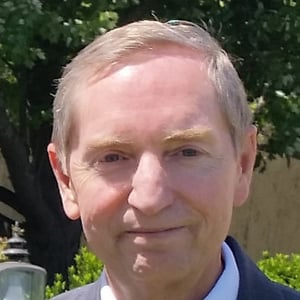
Legal Director & General Counsel, Criminal Justice Legal Foundation
Kent S. Scheidegger has been the Legal Director of the Criminal Justice Legal Foundation since December 1986. He also served as Chairman of the Criminal Law Practice Group of the Federalist Society 2003 to 2005. His articles on criminal and constitutional law have been published in law reviews, national legal publications, and congressional reports. Legal arguments authored by Mr. Scheidegger have been cited and incorporated in several precedent-setting United States Supreme Court decisions.
After receiving a degree in physics with honors from New Mexico State University in 1976, Mr. Scheidegger served for six years in the United States Air Force as a Nuclear Research Officer. He took his law degree with distinction from the University of the Pacific, McGeorge School of Law in 1982 and practiced civil law in Northern California. He was general counsel of California Cooler, Inc. from 1984 until 1986, when he joined the Foundation.

Solicitor General Kagan’s Confirmation Hearing
Paul E. Mirengoff, Carrie Campbell Severino, Adam Winkler, Richard W. Garnett
UPDATED: 11 AM, July 8, 2010 On May 10, 2010 President Obama nominated Solicitor General Elena...
Fish, Farmers, and the Constitution
Annual Banquet
Los Angeles, CaliforniaJudicial Activism
Randy E. Barnett, Erwin Chemerinsky, Pamela S. Karlan, Edward Whelan, John C. Eastman
With the nomination of Elena Kagan to the U.S. Supreme Court, there is a great...
Embryonic Stem Cell Research
O. Carter Snead
Brought to you by the Religious Liberties Practice Group The Federalist Society takes no position on particular...
DISCLOSE Act – The Legislative “Fix” to Citizens United
Allison R. Hayward
Brought to you by the Free Speech & Election Law Practice Group The Federalist Society takes...
EPA’s Endangerment Rule
Jeffrey Bossert Clark
Brought to you by the Environmental Law & Property Rights Practice GroupThe Federalist Society takes no...
Financial Reform – The Senate Version
John Shu
Brought to you by the Financial Services & E-Commerce Practice GroupThe Federalist Society takes no position...
Citizens United and Its Effect on the Electoral Process
Los AngelesHow to Fix California's Death Penalty?