
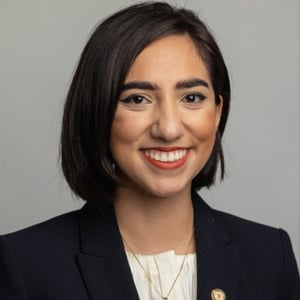
Litigation Fellow, Institute for Justice
Tahmineh Dehbozorgi is a Litigation Fellow at the Institute for Justice. Prior to joining IJ, Tahmineh served as a summer associate at AT&T Global Public Policy, where she focused on cybersecurity and consumer privacy regulatory matters. She also gained valuable legal experience as a law clerk at the Federal Communications Commission, where she worked on communications law and regulatory processes. She also served as a law clerk for the New Civil Liberties Alliance, where she concentrated on administrative law and impact litigation.
Tahmineh earned her J.D. from The George Washington University Law School, with a concentration in National Security and Cybersecurity Law. While at GW Law, she served as a Research Assistant to Professor Robert J. Cottrol and contributed to the book “To Trust the People with Arms: The Supreme Court and the Second Amendment.” Tahmineh also earned the silver medal at the 30th Annual National Telecommunications and Technology Moot Court Competition in 2023. In 2024, she received the President’s Volunteer Service Award from President Joseph R. Biden for her exemplary pro bono work. Tahmineh received her Bachelor of Arts in political science with a concentration in international relations magna cum laude from the University of California, Los Angeles. In 2020, she was awarded UCLA Chancellor’s Service Award.
Tahmineh spent her childhood in Iran. On 4th of July 2015, she left everything behind and came to the United States to seek freedom. Her upbringing ignites an unyielding passion to defend civil liberties and separation of powers.
In addition to her legal career, Tahmineh is a multilingual author with a background in public relations and media. Her writings have appeared in prominent outlets such as Fox News, National Review, RealClear Defense, and the Orange County Register, etc. Outside of her professional endeavors, Tahmineh is a classical musician and has been a member of The George Washington University Chamber Ensemble and UCLA Chorale.
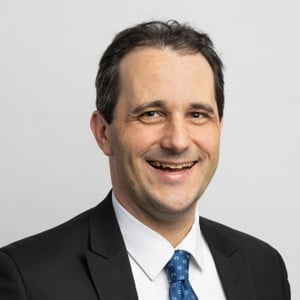
Director, Center for Judicial Engagement, Institute for Justice
Anthony Sanders is the Director of the Center for Judicial Engagement (CJE) at the Institute for Justice and a senior attorney. He joined IJ in 2010. As CJE’s director, he educates the public about the proper role of judges in enforcing constitutional limits on the size and scope of government. As a senior attorney he litigates cutting-edge constitutional cases protecting economic liberty, private property, freedom of speech and other individual liberties in both federal and state courts across the country.
One area of Anthony’s expertise is on using state constitutions to protect individual rights. He is the author of the book, published by University of Michigan Press, Baby Ninth Amendments: How Americans Embraced Unenumerated Rights and Why It Matters. He has also written several law review articles on state constitutional law, unenumerated rights, judicial review, economic liberty, property rights, international law, and other subjects. His work has appeared in publications such as the Iowa Law Review, Minnesota Law Review, American University Law Review, and Rutgers Law Review, and he has published opinion pieces in leading media outlets across the country. Further, he frequently speaks to various audiences on these matters and others, including judicial engagement, free speech, civil forfeiture, and the continuing importance of Magna Carta. Additionally, he hosts the weekly Short Circuit podcast, which often records live in front of law student audiences.
Anthony has litigated several cases in various state courts on state constitutional protections, as well as in federal courts on matters such as economic liberty, free speech, administrative law, and fines and fees abuse. Prior to joining IJ, Anthony served as a law clerk to Justice W. William Leaphart on the Montana Supreme Court. Anthony also worked for several years in private practice in Chicago where he was an active member of the Chicago Bar Association and chaired its Civil Rights Committee.
Anthony received his law degree cum laude from the University of Minnesota Law School in 2004, where he served as an articles submission editor for the Minnesota Law Review. He received his undergraduate degree from Hamline University in St. Paul, Minnesota, and his master’s degree from the University of Wisconsin-Madison. A dual U.S. and U.K. citizen, Anthony grew up on the islands of Vashon in Washington State, and Alderney in the British Channel Islands.
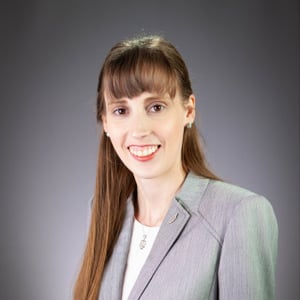
Legal Counsel, Alliance Defending Freedom
Julia Payne serves as legal counsel for Alliance Defending Freedom’s Center for Life. In this role, she defends the sanctity of life by litigating both beginning and end of life issues.
Before joining ADF, Payne worked at the Office of the Indiana Attorney General as a deputy attorney general for five years. While at the AG’s office, she managed all of Indiana’s pro-life litigation and also worked on cases concerning immigration, religious liberty, federalism, the Commerce Clause, criminal procedure, federal habeas corpus procedures, civil asset forfeiture, local and special laws, and the common law powers of the attorney general. She has argued cases before the U.S. Court of Appeals for the 7th Circuit, the Southern District of Indiana, and Indiana state courts.
Payne graduated cum laude from Indiana University Maurer School of Law in 2017, where she served as an editor on the Indiana Law Journal and won best brief in the Sherman Minton Moot Court Competition. During law school, Payne interned as a clerk for Indiana Solicitor General Tom Fisher and as a Blackstone Fellow with ADF’s Center for Academic Freedom in Atlanta. She also served as president of the Christian Legal Society and as an officer for the Advocates for Life and the Federalist Society.
Before law school, Payne graduated summa cum laude from Western Kentucky University with a B.A. in History and a B.A. in Spanish. As an undergraduate, Payne studied abroad in both Spain and China. On campus, she served on the Student Government Association Judicial Council, led the music ministry for the Catholic Campus Center, and was an active member of Omega Phi Alpha Service Sorority. Payne was also a founding member of the Hilltoppers for Life, which helped spur her interest in First Amendment and pro-life issues. Payne is a member of the bars of the Indiana Supreme Court, the Northern and Southern Districts of Indiana, and the Seventh Circuit.
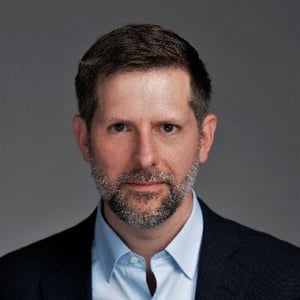
Head of AI Policy, Abundance Institute
Neil Chilson is the Head of AI Policy at the Abundance Institute. Prior to this position, he served as a Senior Research Fellow at the Center for Growth and Opportunity. Chilson is a lawyer, computer scientist, and author of the book “Getting Out of Control: Emergent Leadership in a Complex World.”
Chilson was previously the senior research fellow for Technology and Innovation at Stand Together, where he guided efforts to understand and promote the legal and cultural paradigms that best enable people to discover, innovate, and improve all our lives.
Before Stand Together, Chilson was the Chief Technologist at the Federal Trade Commission, where he focused on the economics of privacy and blockchain-related issues. Previously, he was an attorney advisor to Acting FTC Chairman Maureen K. Ohlhausen. In both roles he advised Chairman Ohlhausen and worked with staff on nearly every major technology-related case, report, workshop, or other FTC proceeding since January 2014. Neil joined the FTC from telecom firm Wilkinson Barker Knauer. Neil is frequently quoted by the press and his work has appeared in numerous news outlets, including The Wall Street Journal, The Washington Post, USAToday, and Newsweek. Neil has a J.D. from The George Washington Law School, a M.S. in computer science from University of Illinois, Urbana-Champaign, and a B.S. in computer science from Harding University.
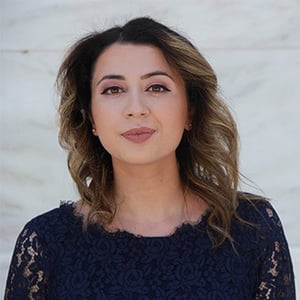
Senior Legal Fellow, The Future of Free Speech, Vanderbilt University
Ashkhen Kazaryan is a renowned expert in First Amendment law and technology policy, specializing in digital free speech, artificial intelligence, and the intersection of constitutional rights with emerging technologies. As a Senior Legal Fellow at the Future of Free Speech at Vanderbilt University, she leads initiatives to protect free expression and shape policies that uphold the First Amendment in the digital age.
Previously, Ashkhen was the lead for North and Latin America on the content regulation team at Meta, where she also served as the company’s policy lead on Section 230. She has also been a Senior Fellow at Stand Together and the Director of Civil Liberties at TechFreedom, where she worked extensively on platform liability, free speech, and internet governance. She is currently Fellow for the First Amendment at the Freedom Forum.
Ashkhen earned her specialist in law degree summa cum laude from Lomonosov Moscow State University in 2012 and later received a master of law degree from Yale Law School in 2016. During her time at Yale, she contributed as an articles editor for the Yale Journal of Law and Feminism, a senior editor for the Yale Law and Policy Review, and an editor for the Yale Journal of Law and Technology, while also serving as co-chair of the Public Interest Fellowship.
Nonresident Senior Fellow, Brookings Institute, Professor of Electrical Engineering and Law, UCLA
John Villasenor is a professor of electrical engineering, law, public policy, and management at UCLA, and is the faculty co-director of the UCLA Institute for Technology, Law, and Policy. He is also a nonresident senior fellow at the Brookings Institution and a member of the Council on Foreign Relations.
Professor Villasenor’s work addresses the intersection of technology, law, and policy, with a focus on topics including digital communications, artificial intelligence, cybersecurity, and privacy. He has published in many academic journals as well as in the Atlantic, Billboard, the Chronicle of Higher Education, Fast Company, Forbes, the Los Angeles Times, the New York Times, Scientific American, Slate, the Washington Post.
He has also provided congressional testimony on multiple occasions. Prior to joining the faculty at UCLA, Professor Villasenor was with the NASA Jet Propulsion Laboratory, where he developed methods of imaging the earth from space. He holds a B.S. degree from the University of Virginia, and an M.S. and Ph.D. from Stanford University.
Head of AI Policy, Abundance Institute
Neil Chilson is the Head of AI Policy at the Abundance Institute. Prior to this position, he served as a Senior Research Fellow at the Center for Growth and Opportunity. Chilson is a lawyer, computer scientist, and author of the book “Getting Out of Control: Emergent Leadership in a Complex World.”
Chilson was previously the senior research fellow for Technology and Innovation at Stand Together, where he guided efforts to understand and promote the legal and cultural paradigms that best enable people to discover, innovate, and improve all our lives.
Before Stand Together, Chilson was the Chief Technologist at the Federal Trade Commission, where he focused on the economics of privacy and blockchain-related issues. Previously, he was an attorney advisor to Acting FTC Chairman Maureen K. Ohlhausen. In both roles he advised Chairman Ohlhausen and worked with staff on nearly every major technology-related case, report, workshop, or other FTC proceeding since January 2014. Neil joined the FTC from telecom firm Wilkinson Barker Knauer. Neil is frequently quoted by the press and his work has appeared in numerous news outlets, including The Wall Street Journal, The Washington Post, USAToday, and Newsweek. Neil has a J.D. from The George Washington Law School, a M.S. in computer science from University of Illinois, Urbana-Champaign, and a B.S. in computer science from Harding University.
Senior Legal Fellow, The Future of Free Speech, Vanderbilt University
Ashkhen Kazaryan is a renowned expert in First Amendment law and technology policy, specializing in digital free speech, artificial intelligence, and the intersection of constitutional rights with emerging technologies. As a Senior Legal Fellow at the Future of Free Speech at Vanderbilt University, she leads initiatives to protect free expression and shape policies that uphold the First Amendment in the digital age.
Previously, Ashkhen was the lead for North and Latin America on the content regulation team at Meta, where she also served as the company’s policy lead on Section 230. She has also been a Senior Fellow at Stand Together and the Director of Civil Liberties at TechFreedom, where she worked extensively on platform liability, free speech, and internet governance. She is currently Fellow for the First Amendment at the Freedom Forum.
Ashkhen earned her specialist in law degree summa cum laude from Lomonosov Moscow State University in 2012 and later received a master of law degree from Yale Law School in 2016. During her time at Yale, she contributed as an articles editor for the Yale Journal of Law and Feminism, a senior editor for the Yale Law and Policy Review, and an editor for the Yale Journal of Law and Technology, while also serving as co-chair of the Public Interest Fellowship.
Nonresident Senior Fellow, Brookings Institute, Professor of Electrical Engineering and Law, UCLA
John Villasenor is a professor of electrical engineering, law, public policy, and management at UCLA, and is the faculty co-director of the UCLA Institute for Technology, Law, and Policy. He is also a nonresident senior fellow at the Brookings Institution and a member of the Council on Foreign Relations.
Professor Villasenor’s work addresses the intersection of technology, law, and policy, with a focus on topics including digital communications, artificial intelligence, cybersecurity, and privacy. He has published in many academic journals as well as in the Atlantic, Billboard, the Chronicle of Higher Education, Fast Company, Forbes, the Los Angeles Times, the New York Times, Scientific American, Slate, the Washington Post.
He has also provided congressional testimony on multiple occasions. Prior to joining the faculty at UCLA, Professor Villasenor was with the NASA Jet Propulsion Laboratory, where he developed methods of imaging the earth from space. He holds a B.S. degree from the University of Virginia, and an M.S. and Ph.D. from Stanford University.
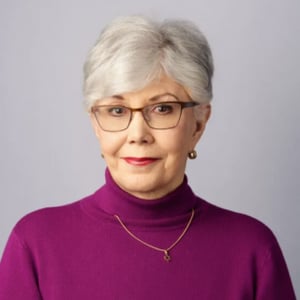
Chairman, Center for Equal Opportunity
Linda Chavez is Chairman of the Center for Equal Opportunity. She has published opinions and columns in newspapers across the country and appears regularly on cable news. Chavez is the author of the three books: Out of the Barrio: Toward a New Politics of Hispanic Assimilation, An Unlikely Conservative: The Transformation of an Ex-Liberal, and Betrayal: How Union Bosses Shake Down Their Members and Corrupt American Politics. She has been honored by the Library of Congress as a "Living Legend" and as nominee for Secretary of Labor by President George W. Bush.
Chavez has held many appointed positions and has served on numerous corporate and nonprofit boards. Among her appointed positions has been Chairman, National Commission on Migrant Education (1988-1992); White House Director of Public Liaison (1985); Staff Director of the U.S. Commission on Civil Rights (1983-1985); and member of the Administrative Conference of the United States (1984-1986). Chavez was also the Republican nominee for U.S. Senator from Maryland in 1986 and was elected by the United Nations' Human Rights Commission to serve a four-year term as U.S. Expert to the U.N. Sub-commission on the Prevention of Discrimination and Protection of Minorities.
Chavez earned her BA from the University of Colorado.
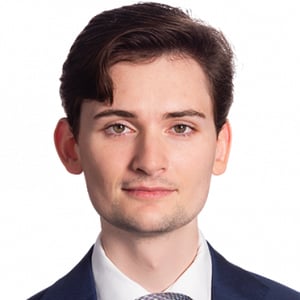
Deputy Assistant Attorney General, Office of Legal Policy, Department of Justice
GianCarlo Canaparo serves as Deputy Assistant Attorney General in the Office of Legal Policy at the Department of Justice. There, he oversees the Office's regulatory work and is the Department's liaison to the Office of Information and Regulatory Affairs. He also assists the White House in the process of selecting nominees for federal judgeships and advises Department leadership on policy and legal matters.
Before joining the Department, Canaparo was a senior legal fellow at The Heritage Foundation’s Edwin Meese III Center for Legal and Judicial Studies where he researched constitutional law, administrative law, and civil rights.
Canaparo’s scholarship has appeared in various law reviews including the Harvard Journal of Law and Public Policy, the Notre Dame Law Review, the Georgetown Journal of Law and Public Policy, the Texas Review of Law and Politics, and the Administrative Law Review. His research has been cited by Justice Neil Gorsuch and featured in the Wall Street Journal and Washington Post. His analysis has appeared in Law & Liberty, Civitas, Fox News, The National Review, Law 360, FedSoc Blog, and other outlets.
Canaparo co-hosted The Heritage Foundation’s SCOTUS 101 podcast, which follows the Supreme Court’s arguments and opinions and features interviews with judges, advocates, and scholars.
After graduating Georgetown law, Canaparo spent three years at the law firm of Skadden, Arps, Slate, Meagher & Flom and two years as a federal law clerk. He earned his bachelor’s degree in economics from the University of California at Davis.
Canaparo is a classical pianist and organist.
Executive Director & Secretary, American Civil Rights Project
Dan Morenoff is the executive director at the American Civil Rights Project and an adjunct fellow at the Manhattan Institute.
His work focuses on protecting and, where necessary, restoring the primacy of all Americans' shared civil rights against the identitarian alternative.
Before practicing law, Morenoff served on the legislative staff of Sen. Phil Gramm (R-TX). Morenoff holds a B.A. from Columbia College of Columbia University in the City of New York and a J.D. from the University of Chicago Law School. He has also served as an officer or director of several community organizations in Dallas, Texas.

Ohio Supreme Court Rules Police Can Extend Traffic Stops to Verify Driver’s License
Tahmineh Dehbozorgi
The Ohio Supreme Court’s decision in State v. Dunlap arose from a routine traffic stop...
No Standing in Challenge to Legislature’s Appropriation of Federal Funds to Private Schools Says Mississippi Supreme Court
Anthony Sanders
Midsouth Association of Independent Schools v. Parents for Public Schools was a challenge to...
Montana Supreme Court Strikes Down Parental Consent Abortion Law
Julia Payne Koon
Twenty-seven states require parental consent for a minor to have an abortion.[1] And fifteen...
Topics
Asking the Right Questions About AI
Many lawmakers are asking the wrong questions about AI. Their first question is, “What harm...
Topics
Expression Over Radio Waves Is Not Exempt from the First Amendment
In his first week on the job, newly minted FCC Chairman Brendan Carr reinstated previously...
Topics
Delaying a Special Election in New York State
New York Congresswoman Elise Stefanik is likely to win Senate approval to be the United...
Topics
Title IX Dear Colleague Letter from Education Department Puts Controversial Issue to Rest, For Now
American educational institutions finally have clarity on whether they are required to open sex-segregated facilities,...
Stargate and DeepSeek: The International and Technological Implications of the AI “Arms Race”
Neil Chilson, Ashkhen Kazaryan, John Villasenor
On January 22, 2025, newly-elected President Trump announced a widespread project to invest $500 billion...
Stargate and DeepSeek: The International and Technological Implications of the AI “Arms Race”
Neil Chilson, Ashkhen Kazaryan, John Villasenor
On January 22, 2025, newly-elected President Trump announced a widespread project to invest $500 billion...
Explainer Episode 84 - How Far Do the Executive Orders Go Towards Ending DEI?
Linda L. Chavez, GianCarlo Canaparo, Dan Morenoff
Linda Chavez, Chairman for the Center for Equal Opportunity, moderates a discussion between the Heritage...