In an effort to pack the courts following the election of 1800, William Marbury was appointed as a justice of the peace in the District of Columbia. When his commission was not delivered, however, he chose to sue for a writ of mandamus in the Supreme Court.
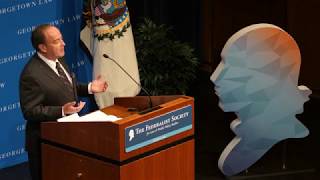
Was the Supreme Court the correct venue for Marbury? Prof. Gary Lawson of the Boston University School of Law explores jurisdiction and judicial review in Marbury v. Madison.
*******
As always, the Federalist Society takes no position on particular legal or public policy issues; all expressions of opinion are those of the speaker.
Learn more about Gary Lawson:
https://www.bu.edu/law/profile/gary-s-lawson/
*******
Related Links & Differing Views:
Duke Law Journal: “A Critical Guide to Marbury v. Madison”
https://scholarship.law.duke.edu/cgi/viewcontent.cgi?article=1488&context=faculty_scholarship
National Constitution Center: “Marbury v. Madison and the independent Supreme Court”
https://constitutioncenter.org/blog/marbury-v-madison-and-the-independent-supreme-court
Michigan Law Review: “The Irrepressible Myth of Marbury”
https://repository.law.umich.edu/cgi/viewcontent.cgi?article=1764&context=mlr
Engage: “The Unbearable Rightness of Marbury v. Madison: Its Real Lessons and Irrepressible Myths”
https://fedsoc.org/commentary/publications/the-unbearable-rightness-of-marbury-v-madison-its-real-lessons-and-irrepressible-myths