SCOTUS Accepts Opportunity to Curb State Court Intrusion into National Defense Contractor Activity
Note from the Editor: The Federalist Society takes no positions on particular legal and public policy matters. Any expressions of opinion are those of the author. We welcome responses to the views presented here. To join the debate, please email us at info@fedsoc.org.
A slew of more than forty lawsuits brought by local parishes in myriad Louisiana state courts seek to create retroactive liability for federal contractors. The case stems from energy producers, who lawfully worked in Louisiana to fulfill federal contracts by producing crude oil and other materials necessary to win World War II. Despite the federal nature of these lawsuits, defendants’ attempts to date to get these cases removed to federal court have so far failed.
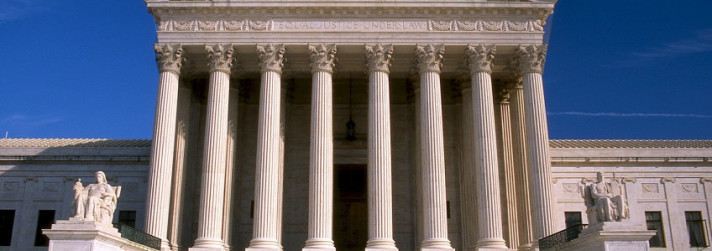
On June 16, the U.S. Supreme Court granted cert in the case Chevron v. Plaquemines Parish, agreeing to decide next term whether these defendants are entitled to a federal forum to resolve the nature of their federal rights and immunities as federal contractors. If they hold otherwise, it will mean that creative plaintiff parishes and the opportunistic trial lawyers pushing their claims are allowed to force these defendants to face dozens of different lawsuits in multiple state courts instead, threatening the rule of law, energy independence, and national security.
The plaintiffs in these cases allege that the energy company defendants are responsible for coastal land loss resulting from their energy refinement, production, and distribution activities. The lawsuits seek damages and vague, unspecified climate remediation funding.
Louisiana state courts have been among the most receptive in the country to frivolous lawsuits and novel liability-enhancing lawsuits, meriting the state “judicial hellhole” designation from the American Tort Reform Association (ATRA). So it is no wonder that the plaintiff parishes want to seek home court advantage in state courts and have fought every attempt by the defendants to seek a fairer and more appropriate forum in federal court.
Many of the energy production-related activities—such as dredging and maintaining a network of canals—now targeted as alleged wrongs were not just conceived by, authorized by, and paid for by state, local, and federal authorities, they were also applauded as vital to the nation’s security. Often, the energy producers conducting activities on Louisiana coastlands were direct federal contractors vitally supporting the military capabilities of the United States during World War II, especially in the provision of refined aviation gas. Indeed, these are military capabilities that, among other things, preserved our peaceful world—including protecting the survival of the system of laws in the United States. And the efforts to win peace made it possible for these plaintiffs to enjoy American freedoms and for our courts to maintain their status as the fairest in the world.
When it decides the newly accepted case next year, the U.S. Supreme Court should allow these cases to be removed to federal court. That is where they belong. The cases involve federal priorities set by federal contracts and ask for a court judgment on whether actions undertaken at least in part to fulfill federal contracts and paid for by the federal government should now create retroactive private liability borne entirely by the private contractor. The federal government’s Petroleum Administration for War (PAW) sought out the oil industry as a partner in serving wartime priorities, especially in refining oil for aviation-grade fuel, or avgas for short. The oil companies were hardly independent decisionmakers in this context. The PAW exercised deep and pervasive control at every step of the crude oil production and distribution that the federal government demanded under these contracts. The PAW managed, along with other federal agencies, a tightly controlled regulatory framework, effectively dictating where and how and at what levels the oil companies operated, including along the coastal areas now the subject of the current parish lawsuits.
And the oil companies themselves were only small players in the overall contracting related to the aviation-grade fuel they refined. Under what became known as a “Four Party Purchase Agreement,” PAW negotiated contracts, the Defense Supplies Corporation (DSC), another arm of the federal government, signed and agreed to them, and the DSC ultimately transferred the fuel to the Army and Navy at a uniform sales price set by PAW. One might say that the oil companies were mere cogs in the wartime oil refining regime, yet the plaintiffs would have state courts hold that these bit players have the sole responsibility to pay for any alleged harms done during the operations conducted under the oversight of the federal government.
In light of these facts, the liability of oil companies who were acting at the direction of federal authorities in relation to many of the acts alleged to be wrongs in these lawsuits is not an issue on which Louisiana state courts should get the initial, let alone the final say. The federal-officer removal statute, 28 U.S.C. §1442, permits this kind of removal of state-filed claims to federal court when contractors are “acting under” the authority of a federal government contract. And, as Congress amended the federal-officer removal statute in 2011, any lawsuit challenging actions taken under federal direction or suits “relating to” such actions can be removed.
On the merits, these cases lack legal foundation, offend due process by seeking to impose retroactive liability for lawful conduct, and seek to set aside the requirement that plaintiffs must prove causation and traceability for alleged injuries in a way that defies fundamental fairness.
The suit, of course, also interferes with the Trump Administration’s priorities set forth in the “Unleashing American Energy” Executive Order “to encourage energy exploration and production on Federal lands and waters, including on the Outer Continental Shelf, in order to meet the needs of our citizens and solidify the United States as a global energy leader long into the future.” And, in times of unrest in foreign oil producing nations, America’s energy independence becomes even more salient for national security and consumer welfare. The U.S. Supreme Court’s intervention to permit removal of these cases to federal court is the only logical and legally appropriate next step in this ongoing saga.
Donald J. Kochan is Professor of Law and the Executive Director of the Law & Economics Center at George Mason University’s Antonin Scalia Law School.