Facts of the Case
In 2002, Congress passed the Bipartisan Campaign Reform Act (BCRA), which established two sets of limits to campaign contributions. The base limit placed restrictions on how much money a contributor—defined broadly as individuals, partnerships, and other organizations—may give to specified categories of recipients. The aggregate limit restricted how much money an individual may donate in a two-year election cycle. The limits were periodically recalibrated to factor in inflation.
Shaun McCutcheon is an Alabama resident who is eligible to vote. In the 2011-2012 election cycle, he donated to the Republican National Committee, other Republican committees, as well as individual candidates. He wished to donate more in amounts that would be permissible under the base limit but would violate the aggregate limit. McCutcheon and the other plaintiffs sued the Federal Election Commission, arguing that the aggregate limit violated the First Amendment by failing to serve a "cognizable government interest" and being prohibitively low. The district court held that the aggregate limit served government interests by preventing corruption or the appearance of corruption and was set at a reasonable limit.
Questions
Is the two-year aggregate campaign contribution limit constitutional under the First Amendment?
Conclusions
-
No. Chief Justice John G. Roberts, Jr. delivered the opinion for the four-justice plurality. The plurality held that the aggregate limit did little to address the concerns that the Bipartisan Campaign Reform Act was meant to address and at the same time limited participation in the democratic process. Because the aggregate limit fails to meet the stated objective of preventing corruption, it does not survive the "rigorous" standard of review laid out by previous precedent dealing with campaign contributions from a First Amendment perspective and is therefore unconstitutional. The aggregate limit also prevents a donor from contributing beyond a specific amount to more than a certain number of candidates, which may force him to choose which interests he can seek to advance in a given election. The plurality held that the collective interest in combating corruption can only be pursued as long as it does not unnecessarily curtail an individual's freedom of speech, and in this case the aggregate limit is not sufficiently closely tailored to accomplish this goal. The plurality also noted that there are many other means by which the government may fight election corruption without setting an aggregate limit on campaign contributions.
Justice Clarence Thomas wrote an opinion concurring in the judgment in which he argued that the Court's decision in Buckley v. Valeo, a previous case dealing with limits on campaign contributions, should be overruled because it denigrates the core values of the First Amendment. Because the reasoning in Buckley v. Valeo could not sufficiently justify using a standard lower than strict scrutiny to examine limits on campaign contributions, Justice Thomas wrote that Buckley should be overruled and the BCRA should be subject to strict scrutiny.
In his dissent, Justice Stephen G. Breyer wrote that the plurality's opinion misconstrues the nature of competing constitutional issues and destroys campaign finance laws, which causes great harm to the democratic process. Justice Breyer argued that the plurality's opinion was based on a definition of corruption that is too narrow to be effective. He went on to state the reasoning that the aggregate limit is faulty is because there is no substantial mismatch between Congress' goal of combating corruption and the means established to achieve it. Justice Ruth Bader Ginsburg, Justice Sonia Sotomayor, and Justice Elena Kagan joined in the dissent.
From the Courthouse Steps: National Republican Senatorial Committee v. Federal Election Commission
In National Republican Senatorial Committee v. Federal Election Commission, the Supreme Court held 6-3 that...
Courthouse Steps Oral Argument: NRSC v. FEC
In National Republican Senatorial Committee (NRSC) v. Federal Election Commission (FEC) the Court is set to...
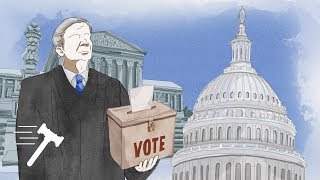
Buckley v. Valeo [SCOTUSbrief]
Short video featuring Michael Dimino
In the wake of the Watergate scandal, Congress passed several amendments to the Federal Election...
Stare Decisis Panel
2019 Kentucky Chapters Conference
On October 7, 2019, The Federalist Society held a panel on Stare Decisis at its...
Is It Transparency or Is It Censorship? Washington Post v. McManus
In Washington Post v. McManus, various newspapers brought suit to strike down a new Maryland law...
Panel Three: Election Issues Roundtable
2019 Texas Chapters Conference
On September 14, 2019, The Federalist Society held a roundtable on election issues during its...
Panel Two: Discussion on Nationwide Injunctions
2019 Texas Chapters Conference
On September 14, 2019, The Federalist Society held a panel on Nationwide Injunctions during its...
Docket Watch: Lair v. Mangan
Is the Supreme Court of the United States set to expand First Amendment protection for...
Panel 2: Campaign Finance and Free Speech
2017 National Student Symposium
Congress' passage of the Bipartisan Campaign Reform Act of 2002 did not end the debate...
The Legacy of Justice Scalia
2017 Annual Florida Chapters Conference
This panel, The Legacy of Justice Scalia, was held on February 3, 2017, at the...
Supreme Court Litigation in the Obamacare Cases
Georgetown Student Chapter
On September 27, 2016, the Georgetown Student Chapter of the Federalist Society, in conjunction with...
Supreme Court Rules on Honest-Services Fraud: Robert F. McDonnell v. United States - Podcast
Criminal Law & Procedure and Free Speech & Election Law Practice Groups Podcast
On June 27, 2016, the United States Supreme Court issued a unanimous opinion in Robert...
Supreme Court to Consider Honest-Services Fraud: Oral Arguments Heard in Robert F. McDonnell v. United States - Podcast
Criminal Law & Procedure and Free Speech & Election Law Practice Groups Podcast
On Wednesday, April 27, the United States Supreme Court heard oral arguments in Robert F....

Without Justice Scalia, "Corruption" Cases May Get Hazier
Stephen Klein writes for Pillar of Law: After the unfortunate passing of Justice Antonin Scalia...
Supreme Court to Consider Honest-Services Fraud: Robert F. McDonnell v. United States - Podcast
Criminal Law & Procedure Practice Group Podcast
On January 15, 2015, the U.S. Supreme Court granted certiorari in Robert F. McDonnell v....
Showcase Panel III: ROUNDTABLE: Can Changes in Incentives Significantly Address Congressional Dysfunction?
2015 National Lawyers Convention
Over the years, and especially recently, it appears as though members of Congress primarily need...
Political Contribution Limits, Labor Unions, and Businesses - Podcast
Litigation and Free Speech & Election Law Practice Groups Podcast
The laws of six states prohibit businesses—but not unions or other groups—from contributing to political...
2014 Annual Supreme Court Round Up
Washington, DC Lawyers Chapter
On July 18, 2014, Thomas Hungar of Gibson Dunn & Crutcher LLP and Noel Francisco of Jones Day delivered the...
Amending the Bill of Rights - Podcast
Federalism & Separation of Powers Practice Group Podcast
There is a recent, concerted effort to ratify an amendment to the U.S. Constitution to...
The Story of Shaun McCutcheon's Campaign Finance Case in the High Court - Podcast
Free Speech & Election Law Practice Group Podcast
“There is no right more basic in our democracy than the right to participate in...
The First Amendment and Campaign Finance: Assessing the Recently-Decided McCutcheon v. FEC Case - Podcast
Free Speech & Election Law Practice Group Podcast
Stating that “There is no right more basic in our democracy than the right to...
FDA's Proposed Ban of Trans Fat in Processed Food - Podcast
Administrative Law & Regulation Practice Group Podcast
The Food and Drug Administration (FDA) has taken the first step to effectively ban trans...
McCutcheon v. FEC - Post-Decision SCOTUScast
SCOTUScast 4-7-14 featuring Derek Muller
On April 2, 2014, the Supreme Court issued its decision in McCutcheon v. Federal Election...
Unionizing Domestic Workers? - Harris v. Quinn - Podcast
Labor & Employment Law Practice Group Courthouse Steps Podcast
On January 21, 2014, the Supreme Court heard Harris v. Quinn, which considers (1) whether...
McCutcheon v. FEC - Post-Argument SCOTUScast
SCOTUScast 10-18-13 featuring Derek Muller
On October 8, 2013, the Supreme Court heard oral argument in McCutcheon v. Federal Election...
Courthouse Steps: McCutcheon v. FEC Oral Arguments - Podcast
Free Speech & Election Law Practice Group Podcast
On Tuesday, October 8, the Supreme Court heard argument in McCutcheon v. FEC on the constitutionality of...
DeLay v. Texas: Prosecutorial Overreach? - Podcast
Criminal Law & Procedure and Free Speech & Election Law Practice Group Podcast
Former House Majority Leader Tom DeLay has been involved in a lengthy legal battle over...

Supreme Court Preview: What Is in Store for October Term 2013?
Co-sponsored by the Practice Groups and the Faculty Division
October 7th will mark the first day of the 2013 Supreme Court term. Thus far,...
Supreme Court Preview: What Is in Store for October Term 2013?
Co-sponsored by the Practice Groups and the Faculty Division
October 7th will mark the first day of the 2013 Supreme Court term. Thus far,...
2013 Annual Supreme Court Round Up
Washington, DC Lawyers Chapter
On July 8, 2013, Miguel Estrada of Gibson Dunn & Crutcher LLP delivered the Annual Supreme...
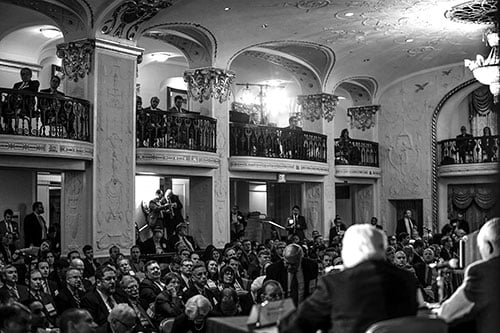
Lunch with Shaun McCutcheon
Ten22 1022 Second StreetSacramento, California 95814

FEC v. McCutcheon
Gibson Dunn & Crutcher 555 Mission StreetSan Francisco, California 94105

Financing Political Campaigns - Recent Legal Developments
The Coral Gables Country Club 990 Alhambra CircleCoral Gables, Florida 33134
McCutcheon v. FEC
Room 310 of BK Roberts HallTallahassee, Florida 32306-1601