Facts of the Case
Ernest E. Mandel was a Belgian professional journalist and editor-in-chief of La Guache, a Belgian Left Socialist weekly publication. He described himself as a revolutionary Marxist, advocating the economic, governmental, and international doctrines of world Communism. Previously, the United States twice allowed Mandel to temporarily visit the United States -- once as a working journalist in 1962 and once as a lecturer in 1968. Both times and without Mandel’s knowledge, the State Department found him ineligible, but the attorney general used his discretionary power under the Immigration and Nationality Act of 1952 to admit Mandel temporarily.
The Graduate Student Association at Stanford University invited Mandel to the United States for six days to participate in a conference. On September 8, 1969, Mandel applied to the American Counsel in Brussels for a nonimmigrant visa to enter the United States. Other persons invited Mandel to additional events, and Mandel filed a second visa application in October detailing a more extensive itinerary. On October 23, the Consul at Brussels informed Mandel that the State Department -- headed by Secretary of State William P. Rogers -- refused his first application. The State Department later recommended to Attorney General Richard G. Kleindienst that Mandel’s ineligibility be waived with respect to his October application. In a letter dated February 13, 1970, however, the Immigration and Naturalization Service stated that Mandel’s 1968 activities far exceeded the scope of that visa and concluded that the Attorney General should not waive Mandel’s ineligibility. Mandel’s address to the conference was delivered by telephone.
Mandel, along with various United States citizens who invited Mandel to speaking engagements, sought declaratory and injunctive relief. A three-judge district court panel held in a 2-1 decision that citizens of the United States have a First Amendment right to have Mandel enter the country and to hear him speak. The court entered a declaratory judgment ruling that the portions of the statute delegating the waiver power to the attorney general were invalid as applied to Mandel; it also enjoined Rogers and Kleindienst from denying Mandel admission to the United States.
Questions
Did Attorney General Kleindienst violate the First Amendment rights of the scholars and students who invited Mandel to the United States by refusing to allow Mandel to enter the country?
Is the statute giving Kleindienst this discretionary power unconstitutional on its face?
Conclusions
-
No and no. In a 6-3 decision written by Justice Harry A. Blackmun, the Court held that the First Amendment did not obligate Kleindienst to grant a waiver to Mandel. Justice Blackmun acknowledged that the First Amendment protected the scholars and students’ right to listen to and engage with Mandel in person --and that Mandel’s participation via telephone was not a good replacement-- but held that the implication of First Amendment rights was not dispositive here.
Justice Blackmun noted Congress’ longstanding power to exclude aliens from the United States, and to set the terms and conditions of their entry. Through the Immigration and Nationality Act, Congress legitimately delegated to the executive the authority to waive a finding of inadmissibility. He described the historical pattern of increasing federal control on the admissibility of aliens, particularly regarding individuals with Communist affiliation or views. Justice Blackmun held that the Court would not intervene so long as the executive used its waiver power on the basis of a facially legitimate and bona fide reason. This test did not balance the First Amendment interests of persons seeking to communicate with the applicant.
Justice William Douglas dissented. He argued that Kleindienst had no clear interest in preventing Mandel from entering the country, given that Mandel posed no threat to national security. He described Kleindienst’s use of his delegated authority as an act of censorship, an unacceptable executive interpretation of congressional intent.
Justices Thurgood Marshall and William Brennan also dissented, in an opinion written by Justice Marshall. He pointed to the Court’s longstanding protection of the right to receive information and ideas, arguing that the government had no power to interrupt the process of free discussion. Justice Marshall questioned the precedential validity of the majority’s “facially legitimate and bona fide reason” test, as well as the truthfulness of the Kleindienst’s stated reasons for excluding Mandel.
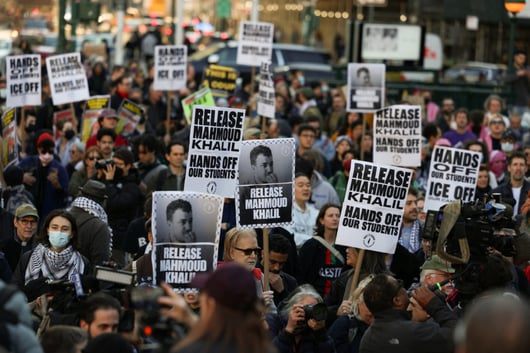
The Case of Mahmoud Khalil: Free Speech or National Security?
Mahmoud Khalil, a Palestinian green card holder, was detained by ICE on March 8 and...
Courthouse Steps: Trump v. Hawaii Decided
International & National Security Law and Religious Liberties Practice Group Teleforum
Trump v. Hawaii is the latest iteration of Hawaii’s challenge to President Trump’s Executive Order suspending...
The President's Immigration Travel Ban: What Trump v. Hawaii Has to Say About Stating a Claim Under the Establishment Clause
It is little appreciated that the United States Supreme Court’s decision today in Trump v. Hawaii,...
Litigation and Regulatory Reform
Sixth Annual Executive Branch Review Conference
The Sixth Annual Executive Branch Review Conference is scheduled for Tuesday, April 17 at the...

Courthouse Steps: Trump v. Hawaii
International & National Security Law Practice Group Teleforum
On April 25, the Supreme Court will hear oral argument in Trump v. Hawaii, the...
Supreme Court Preview: What Is in Store for October Term 2017?
Co-Sponsored by the Faculty Division and the Practice Groups
October 2nd will mark the first day of oral arguments for the 2017 Supreme Court...
Immigration Moratorium in the Supreme Court - Podcast
International & National Security Law Practice Group Podcast
On Monday, June 26, the Supreme Court granted certiorari in Trump v. International Refugee Assistance...
Immigration Cases in the Supreme Court - Podcast
International & National Security Law Practice Group Podcast
On June 15, 2015, the U.S. Supreme Court issued ruling in two important immigration cases:...
Supreme Court October Term 2014 Preview - Podcast
Practice Groups Courthouse Steps Podcast
A panel of notable constitutional experts discussed the likely highlights, including the denial of cert...