Facts of the Case
The Free Enterprise Fund, a non-profit organization, brought suit challenging the constitutionality of Title I of the Sarbanes-Oxley Act. It alleged that the creation of the Public Company Oversight Board (the Board) by the Act violated the Appointments Clause because it deprived the President from exercising adequate control over the Board. However, the Board itself was under the direct supervision of the Securities and Exchange Commission (SEC), all of whose commissioners are appointed by and can be removed by the President.
The U.S. Court of Appeals for the D.C. Circuit held that the creation of the Public Company Accounting Oversight Board did not violate either the Appointments Clause or the separation of powers principle. It reasoned that the Board's members were inferior officers under the supervision of the SEC and thus were not obligated to be appointed by the President. Also, the court noted that the President's ability to remove members of the SEC, who in turn could remove members of the Board, preserved the Constitution's separation of powers.
Questions
1) Does the Sarbanes-Oxley Act violate the separation of powers doctrine by giving broad powers to the Board while simultaneously preventing the President of the power to appoint or remove Board members?
2) Did the court of appeals correctly hold that the Board members were inferior officers under the direct supervision of the SEC even though the SEC cannot supervise those members individually and can only remove them for just cause?
3) Does the Sarbanes-Oxley Act violate the Appointments Clause even if the Board's members are inferior because the SEC is not an official department or because the commissioners are not the head of the SEC?
Conclusions
-
Yes. Yes. Not answered. The Supreme Court held that the "for-cause" limitation on the removal of Board members is unconstitutional because it contravenes the Constitution's separation of powers. With Chief Justice John G. Roberts, Jr., writing for the majority, the Court reasoned because the Act protects Board members from removal except for good cause, but withdraws from the President any decision on whether good cause exists, the Act deprives the President the power to hold Board members accountable. Such an arrangement contradicts Article II's vesting of the executive power in the president. The Court further held that the unconstitutionality of the removal provision did not make unconstitutional the entire Board. The Court concluded that the Board may continue to function as before, but its members may be removed at will by the Commission. Lastly, the Court held that the Board's appointment is consistent with the Appointments Clause of the Constitution. The Court reasoned that Board members are inferior officers, and, thus, their appointment may permissibly be vested in the "Head of the Department." Here, the Commission constitutes the "Head of the Department."
Justice Stephen G. Breyer, joined by Justices John Paul Stevens, Ruth Bader Ginsburg, and Sonia Sotomayor, dissented. He agreed that the members of the Board are inferior officers. However, he disagreed that the Act unconstitutionally interferes with the President's executive power.
Why the Firing of Gwynne Wilcox Could Be an Inflection Point for the NLRB—and Administrative Government
Earlier this week, President Donald Trump fired Gwynne Wilcox, one of the three remaining members...
Fifth Circuit Rules USF Contribution Scheme Violates Legislative Vesting Clause
On July 24, the U.S. Court of Appeals for the Fifth Circuit issued an en...
SEC v. Cochran - Post-Argument SCOTUScast
Margaret Little
On November 7, 2022, the U.S. Supreme Court heard oral argument in Michelle Cochran v. U.S....

Courthouse Steps Oral Argument: SEC v. Cochran
On November 7, 2022, the U.S. Supreme Court will hear oral argument in Michelle Cochran...
Courthouse Steps Oral Argument: SEC v. Cochran
On November 7, 2022, the U.S. Supreme Court will hear oral argument in Michelle Cochran...

Groundhog Day at the Supreme Court: SEC v. Cochran
Well, it’s Groundhog Day at the Securities and Exchange Commission. Again. At least, that’s what...
How Fifth Circuit Affirmed George Washington’s Vision of Fundamental Justice
The recent ruling by the U.S. Court of Appeals for the Fifth Circuit in Jarkesy v. SEC is...
The End of Independent Agencies? Restoring Presidential Control of the Executive Branch
Federalist Society Review, Volume 22
On the day that President Joe Biden took office, among his first official acts was...
The Take Care Act
Yesterday, Senator Lee introduced a nine-page bill that would, following the next presidential election, eliminate...
Independent Agencies: How Independent is Too Independent?
2018 National Lawyers Convention
Justice Scalia put it bluntly in Morrison v. Olson: “There are now no lines.” Morrison,...
Independent Agencies: How Independent is Too Independent?
2018 National Lawyers Convention
Justice Scalia put it bluntly in Morrison v. Olson: “There are now no lines.” Morrison,...
![Click to play: Humphrey's Executor & Executive Appointments [No. 86]](https://img.youtube.com/vi/4a8DciMjOFQ/mqdefault.jpg)
Humphrey's Executor & Executive Appointments [No. 86]
Short video featuring Gregory Jacob
In 1935, the Supreme Court decided a landmark case which established that the dismissal of...
The Constitutionality of Independent Agencies: The CFPB - Podcast
Litigation Practice Group Podcast
In April, the mortgage lender PHH Corporation challenged the constitutionality of the Consumer Financial Protection...
Countdown to the National Lawyers Convention: Administrative Law Judges and the SEC
Corporations, Securities, and Antitrust Practice Group Panel Preview
The Securities and Exchange Commission's growing tendency to resort to enforcement before its administrative law...
Agency Taxation
Engage Volume 16, Issue 2
In recent years Congress has delegated its taxing and appropriating powers to regulatory agencies under...
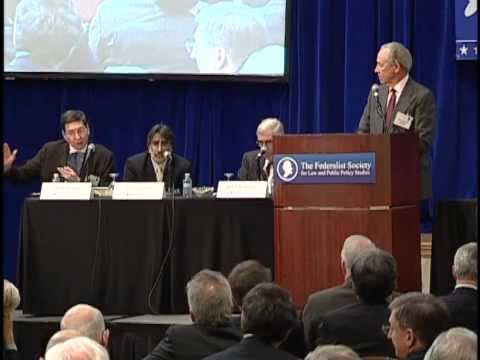
Showcase Panel II: Separation of Powers
2012 National Lawyers Convention
The present Supreme Court was also closely divided in the recent separation of powers case,...
Showcase Panel II: Separation of Powers
2012 National Lawyers Convention
The present Supreme Court was also closely divided in the recent separation of powers case,...
The States and the NLRB: A Study in Comparative Sovereignty
Engage Volume 12, Issue 3, November 2011
Under a system of government that diffuses power and makes institutional “[a]mbition . . ....
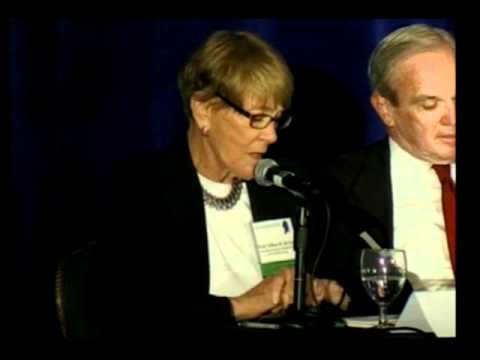
Showcase Panel IV: Ideas for Structural Change: Term Limits, Reviving the Right to Civil Jury Trial, Moving Administrative Law Judges to Article III, and Others
2010 National Lawyers Convention
Are there structural ways that are practically plausible to limit or reduce the power of...
Showcase Panel IV: Ideas for Structural Change: Term Limits, Reviving the Right to Civil Jury Trial, Moving Administrative Law Judges to Article III, and Others
2010 National Lawyers Convention
Are there structural ways that are practically plausible to limit or reduce the power of...
Free Enterprise Fund v. Public Company Accounting Oversight Board - Post-Decision SCOTUScast
SCOTUScast 07-13-10 featuring Steven G. Calabresi
On June 28, 2010, the Supreme Court announced its decision in Free Enterprise Fund v....
The Pay Czar & the Appointments Clause – a Forum
Online Debate
Last updated at 10 AM on Monday, January 4, 2010 Under the statute authorizing the Troubled Assets Relief...
SCOTUScast 6-15-09 featuring Steven Calabresi
Free Enterprise Fund v. Public Company Accounting Oversight Board
On Wednesday, May 20, the Supreme Court granted certiorari in Free Enterprise Fund v. Public...

Independent Agencies: How Independent is Too Independent?
2018 National Lawyers Convention
The Mayflower Hotel - East Room1127 Connecticut Avenue, NW
Washington, DC 20036

Showcase Panel II: Separation of Powers
2012 National Lawyers Convention
The Mayflower Hotel1127 Connecticut Avenue, NW
Washington, DC 20036
Showcase Panel IV: Ideas for Structural Change: Term Limits, Reviving the Right to Civil Jury Trial, Moving Administrative Law Judges to Article III, and Others
2010 National Lawyers Convention
The Mayflower Hotel1127 Connecticut Avenue, NW
Washington, DC 20036