

Commissioner, U.S. Equal Employment Opportunity Commission
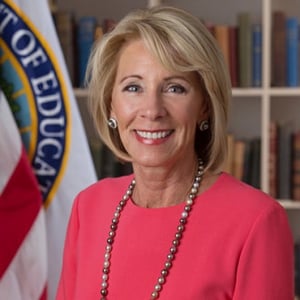
Former United States Secretary of Education
Betsy DeVos is the former U.S. secretary of education from 2017-2021. She was confirmed by the U.S. Senate on February 7, 2017 after being nominated by President Donald J. Trump.
Secretary DeVos has been involved in education policy for nearly three decades as an advocate for children and a voice for parents. She is especially passionate about reforms that help underserved children gain access to a quality education.
DeVos' interest in education was sparked at an early age by her mother, a public school teacher. It grew when she sent her own children to school and was confronted with the reality that not every child in America is granted an equal opportunity to receive a great education. DeVos saw firsthand the work leaders in her hometown were doing to increase educational opportunities for students and choices for parents, and she has been involved in the fight to provide better educational options across the nation ever since.
For 15 years, DeVos served as an in-school mentor for at-risk children in the Grand Rapids (Michigan) Public Schools. Her interactions there with students, families and teachers, according to DeVos, "changed my life and my perspective about education forever."
A leader in the movement to empower parents, DeVos has worked to support the creation of new educational choices for students in 25 states and the District of Columbia.
As secretary, DeVos will work with President Trump to advance equal opportunities for quality education for all students. DeVos firmly believes that neither the ZIP code in which a child lives nor a child's household income should be the principal determinant of his or her opportunity to receive a world-class education. As secretary, she will advocate for returning control of education to states and localities, giving parents greater power to choose the educational settings that are best for their children and ensuring that higher education puts students on the path to successful careers.
Prior to her confirmation, DeVos served as chairman of The Windquest Group, an enterprise and investment management firm. In addition to her leadership in the education arena, DeVos has also served on the boards of numerous national and local charitable and civic organizations, including the Kennedy Center for the Performing Arts, Kids Hope USA, ArtPrize, Mars Hill Bible Church and the Kendall College of Art and Design.
DeVos is a graduate of Calvin College in Grand Rapids, Michigan, where she earned a Bachelor of Arts degree. She is married to entrepreneur, philanthropist and community activist Dick DeVos, and together they have four children and six grandchildren.
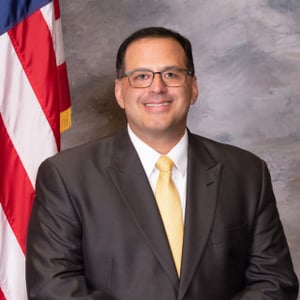
United States District Judge, Middle District of Florida
John L. Badalamenti is a United States District Judge for the Middle District of Florida and a former judge on Florida’s Second District Court of Appeal. He earned a Bachelor of Arts in Criminology and Law with Highest Honors and a Master of Arts Degree in Sociology from the University of Florida, and a Juris Doctor with Honors from the University of Florida Levin College of Law, where he served as an editor for the University of Florida Journal of Law and Public Policy.
After law school, he accepted an appointment to the United States Attorney General’s Honors Program, serving as legal counsel to the Federal Bureau of Prisons in Atlanta. Judge Badalamenti served as a law clerk to both the Honorable Frank Mays Hull and the late Honorable Paul H. Roney of the U.S. Court of Appeals for the Eleventh Circuit. He served for nearly a decade as an Assistant Federal Public Defender in Tampa. He represented clients in the federal trial and appellate courts and presented oral argument for the prevailing petitioner in Yates v. United States, 574 U.S. 528 (2015).
Judge Badalamenti serves as an Adjunct Professor of Law at the University of Florida Levin College of Law, where he teaches an originalism seminar.
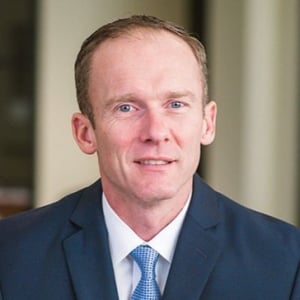
Partner, Southbank Legal
Jesse is a trial lawyer who focuses on white-collar criminal defense, internal investigations, and complex commercial litigation around the country. Jesse founded SouthBank Legal’s white-collar practice and represents companies and individuals at all stages of investigation, litigation, and appeal. Jesse’s clients have included multiple Fortune 500 companies and corporate executives. He has tried several dozen federal cases to jury verdict and has handled numerous appeals, including successful arguments in state and federal appellate courts.
Previously, Jesse practiced at AmLaw 100 firms in Indiana and Washington, D.C., and as an Assistant United States Attorney in the Northern District of Indiana. During his 13 years as a federal prosecutor, Jesse led investigations into a wide variety of white-collar cases, including commercial fraud, complex tax violations, fraud involving Reports of Foreign Bank and Financial Accounts (FBARs), tax-preparer fraud, securities fraud, student loan fraud, insurance fraud, mail and wire fraud, bankruptcy fraud, fraud by government contractors, and public corruption. Jesse held a Top Secret security clearance and received awards for his service from multiple federal agencies.
Jesse has served as an adjunct professor at the Notre Dame Law School, where he has taught in the areas of trial skills and criminal law. He also has coached high school mock trial, and his teams have won state tournaments and competed in the national competition. Jesse is a member of the Edward Bennett Williams American Inn of Court, an invitation-only professional organization focusing on white-collar practice.
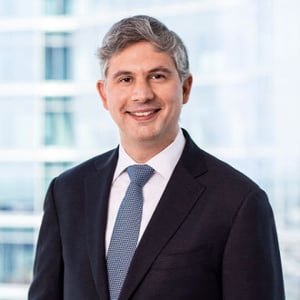
Partner, Keller Postman
Ashley Keller is one of the founding Partners of Keller Postman LLC. An experienced trial and appellate lawyer, Ashley helps set strategic direction across virtually all of the firm’s cases. He represents clients in a wide variety of practice areas and types of claims, including product-liability, antitrust, class action, and arbitration matters.
Ashley is one of the leaders of Keller Postman’s national product-liability practice. He leverages his ability to detangle complex concepts and develop novel legal theories to support individual client matters and as counsel on numerous product-liability multidistrict litigation matters. He chairs the plaintiffs’ Law & Briefing Committee in the Zantac (Ranitidine) Product Liability MDL in the U.S. District Court for the Southern District of Florida.
Ashley also litigates complex antitrust and class action matters. Among his notable cases, Ashley represents numerous States in antitrust litigation against Google for monopolizing products and services used by advertisers and publishers in online-display advertising.
Ashley also has played a central role in developing the firm’s pioneering arbitration practice, which includes pursuing individual arbitrations for clients whose claims are subject to arbitration clauses with class-action waivers. In part through managing the complexity of pursuing these individual claims simultaneously, the firm has secured millions in settlements for more than 500,000 employees and consumers.
Before launching Keller Postman, Ashley co-founded the litigation finance firm Gerchen Keller Capital, which grew to more than $1.3 billion in assets under management and was the world’s largest private investment manager focused on legal and regulatory risk prior to being acquired by Burford Capital in 2016.
Previously, Ashley was a partner at Bartlit Beck Herman Palenchar & Scott LLP, The American Lawyer’s litigation boutique of the year. While there, he handled various trial and appellate matters involving multi-billion-dollar securities and patent cases, contract disputes, mass torts, and class actions.
Ashley also worked as an analyst at Alyeska Investment Group, a Chicago-based market-neutral hedge fund, where he focused on investments in companies facing litigation and other complicated regulatory matters.
Ashley was named a 2021 Plaintiffs’ Lawyers Trailblazer by the National Law Journal. He is also listed on Lawdragon’s 500 Leading Lawyers in America, Lawdragon’s 500 Leading Plaintiff Consumer Lawyers, Lawdragon’s Leading Plaintiff Financial Lawyers, National Trial Lawyers’ Top 100, and Illinois Super Lawyers.
Ashley was a law clerk for Justice Anthony M. Kennedy at the Supreme Court of the United States and Judge Richard Posner at the U.S. Court of Appeals for the Seventh Circuit. He graduated magna cum laude from Harvard College, received his M.B.A. from the University of Chicago Booth School of Business and received his J.D. from the University of Chicago Law School, where he graduated first in his class.
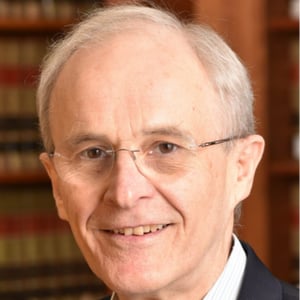
Levin, Mabie & Levin Professor of Law, University of Florida Levin College of Law
Professor Lynn M. LoPucki comes to UF in August 2022 from the UCLA School of Law where he taught Secured Transactions and Business Associations for twenty-two years. His Stakeholder Takeover Project is an effort to provide corporate stakeholders with the information they need to control corporations through markets. For example, the Project website ranks the S&P 500 companies by their greenhouse gas emissions. The UC Davis Law Review published the first Project article, Repurposing the Corporation Through Stakeholder Markets, in February 2022 and will publish the second, Corporate Greenhouse Gas Disclosures, in November.
Professor LoPucki has published more than seventy-five articles in highly regarded law reviews, including the Yale Law Journal, Stanford Law Review, University of Chicago Law Review, University of Michigan Law Review, University of Pennsylvania Law Review, Virginia Law Review, Cornell Law Review, Duke Law Journal, and Northwestern University Law Review. He co-authors three Aspen Casebooks: Business Associations: A Systems Approach (2020) (with Andrew Verstein); Secured Transactions: A Systems Approach (9th edition with Elizabeth Warren and Robert M. Lawless), and Commercial Transactions: A Systems Approach (7th edition with Elizabeth Warren, Daniel L. Keating, Ronald Mann, and Robert M. Lawless).
Since 1994, the Florida-UCLA-LoPucki Bankruptcy Research Database has collected large, public company bankruptcy data and disseminated it to the public and to bankruptcy researchers throughout the world. Those data provided the foundation for Professor LoPucki’s books, Courting Failure: How Competition for Big Cases is Corrupting the Bankruptcy Courts (University of Michigan Press 2005) and Professional Fees in Corporate Bankruptcies: Data, Analysis, and Evaluation (Oxford University Press, 2011) (with Joseph Doherty).

Senior Vice President, General Counsel and Corporate Secretary, Lockheed Martin Corporation
Kevin O’Connor is the senior vice president, general counsel and corporate secretary for Lockheed Martin Corporation. He is responsible for the Corporation’s legal affairs and law department, including serving as counsel to its senior leadership and Board of Directors.
Prior to joining Lockheed Martin, O’Connor was the senior vice president and chief legal officer for Carrier. He has had a distinguished career in both the private and public sectors. Prior to joining Carrier, Kevin served as chief legal officer for Point72, as vice president of global ethics and compliance at United Technologies (now RTX), and as a partner in two law firms. His public service career includes service as the Associate Attorney General of the United States, the United States Attorney for Connecticut, Chief of Staff to the United States Attorney General and Senior Counsel at the United States Securities & Exchange Commission Division of Enforcement.
Kevin began his legal career as a law clerk to the Honorable William H. Timbers of the United States Court of Appeals for the Second Circuit. O’Connor earned a bachelor’s degree from the University of Notre Dame and a Juris Doctor from the University of Connecticut School of Law. He currently serves on the Board of Trustees of the University of Connecticut and as an independent director of Encompass Health Corporation.

University Professor of Law and Executive Director, Liberty & Law Center, Antonin Scalia Law School, George Mason University
David Bernstein holds a University Professorship chair at the Antonin Scalia Law School, where he has been teaching since 1995. He has also been a visiting professor at the University of Michigan, Georgetown University, William & Mary, Brooklyn Law School, the University of Turin, and Hebrew University. Professor Bernstein teaches Constitutional Law, Evidence, and Products Liability.
A prolific author, Professor Bernstein often challenges the conventional wisdom with prodigious research and sharp, original analysis. He is the author of five books, and coauthor of two more. Professor Bernstein’s book Rehabilitating Lochner was praised across the political spectrum as “intellectual history in its highest form,” a “fresh perspective and a cogent analysis,” “delightful and informative,” “sharp and iconoclastic,” and “a terrific work of historical revisionism.” Columnist George Will praised Bernstein’s most recent book, Classified, The Untold Story of Racial Classification in America, as “perhaps the most consequential American book of 2022.”
Professor Bernstein has also written dozens of articles and essays published in major law reviews, including the California Law Review, Columbia Law Review, Michigan Law Review, and Yale Law Journal. An article he coauthored, Defending Daubert: It’s Time to Amend Federal Rule of Evidence 702, directly inspired a pending amendment to Rule 702.
Professor Bernstein blogs at the Instapundit.com, the Times of Israel, and the Volokh Conspiracy. He is a graduate of the Yale Law School, where he was senior editor of the Yale Law Journal and a John M. Olin Fellow in Law, Economics, and Public Policy.
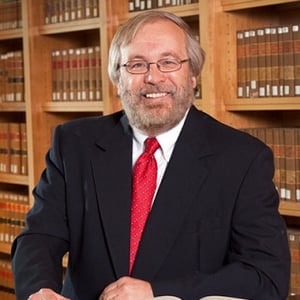
Welpton & Wise Professor of Law, University of Nebraska College of Law
Professor Rick Duncan is the Welpton & Wise Professor of Law at the University Of Nebraska College Of Law. He is a graduate of the Cornell Law School and served as an editor of the Cornell Law Review. He teaches Constitutional Law with a special emphasis on the law of religious freedom, free speech, and federalism. Duncan has written numerous books, articles, and commentaries on a wide variety of legal topics. His recent publications include an article on Justice Scalia’s legacy, another on Kermit Gosnell and Roe v. Wade, a piece on the Electoral College and Federalism, a 2019 piece on Masterpiece Cakeshop and the First Amendment, and three recent articles on the “no compelled speech” doctrine as a First Amendment defense against authoritarianism and tyranny. His most recent article, on School Choice and the First Amendment, will be published in 2023 in Case Western Law Review. He is also the co-author of a book on Secured Transactions under Article 9 of the UCC. He served as Chairman of the Nebraska Advisory Committee to the U.S. Commission on Civil Rights during the Reagan Administration. He also loves to speak at Federalist Society meetings around the country on life, liberty, and the pursuit of federalism.
Duncan has five children, five grandchildren, and a wonderful wife who help him pursue happiness. He loves lifting weights (particularly going heavy on the incline bench press), attending Broadway musicals and plays, including Hamilton: An American Musical which he has seen 12 times (possibly a Nebraska record). He regularly reads both the Bible and the New York Times because it is important to keep up with what both sides have to say. He loves following major league baseball, especially the San Diego Padres. And his favorite legal aphorism is “first come rights then comes government to secure those rights.”

Senior DIrector, Brennan Center for Justice
Lauren-Brooke Eisen is director of the Brennan Center’s Justice Program where she leads the organization’s work to end mass incarceration. Her team focuses on exposing the profound social and economic hardships that impact those who encounter the justice system while creating policies that ultimately shrink its size and scope.
Eisen has authored several nationally recognized reports and articles on how to reduce America’s reliance on incarceration. Her work has been featured in media outlets across the country, including the New York Times, USA Today, Time, U.S. News & World Report, the Daily News, and the Marshall Project and has appeared on MSNBC, CNN, CBS News, NBC News, Fox News, National Public Radio, as well as many other television and radio news programs.
Eisen is the author of Inside Private Prisons: An American Dilemma in the Age of Mass Incarceration (Columbia University Press, 2017) and a Pulitzer Center on Crisis Reporting journalism grantee. She co-chaired Manhattan DA-elect Alvin Bragg’s transition team to ensure they have the tools to enact innovative reforms in the criminal legal system and has served on the Advisory Council of the New York City Bar’s Task Force on Mass Incarceration and the transition committee for Brooklyn District Attorney Eric Gonzalez. In 2020, Eisen became a founding member of the Council on Criminal Justice, which works to advance understanding of the criminal justice policy choices facing the nation and build consensus for solutions that enhance safety and justice for all. Eisen taught an undergraduate seminar on mass incarceration at Yale University and served as an adjunct instructor at John Jay College of Criminal Justice.
Before joining the Brennan Center, Eisen was a senior program associate at the Vera Institute of Justice, where she worked on the sentencing and corrections team to implement policies in multiple states to improve public safety while reducing prison populations. She also previously served as an assistant district attorney in New York City, where she worked in the Appeals Bureau, the Criminal Court Bureau, and the Sex Crimes Special Victims Bureau. Before entering law school, Eisen worked as a beat reporter for a daily newspaper in Laredo, Texas, covering criminal justice and immigration. Eisen holds an AB from Princeton University and a JD from the Georgetown University Law Center.
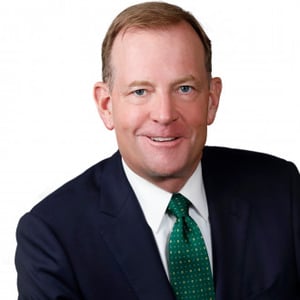
Partner, King & Spalding LLP
Former U.S. Attorney for the Eastern District of California, a 34-county district with an area that stretches from the Oregon border to Bakersfield, Greg Scott is an experienced trial lawyer who represents major companies facing government investigations and litigation, with a focus in the healthcare, retail, and construction industries. He has extensive knowledge on matters involving consumer protection, construction disputes, the Foreign Corrupt Practices Act (FCPA) and the False Claims Act (FCA).
Greg represents corporations under investigation by state district attorneys concerning potential violations of consumer protection laws, as well as corporations operating senior assisted livingfacilities under investigation by the state attorney general regarding potential violations of elder abuse laws. In addition, he represents construction companies under investigation by state district attorneys when employees are involved in serious accidents at worksites.
A retired Lieutenant Colonel after serving more than 20 years in the California Army National Guard & United States Army Reserve, Greg went on to become a deputy district attorney in Contra Costa County and twice-elected District Attorney of Shasta County. He also served as an Adjunct Professor of National Security Law at the University of the Pacific, McGeorge School of Law following his first term as U.S. Attorney for the E.D. of California. Between his two terms as U.S. Attorney for the E.D. of California, Greg was the vice chair of the white-collar defense and corporate investigations practice at an AmLaw 50 firm.

Senior Legal Fellow and Manager, National Security Law Program, The Heritage Foundation
Charles “Cully” Stimson is a widely recognized expert in national security, homeland security, crime control, drug policy and immigration. A senior legal fellow at The Heritage Foundation since 2007, Stimson became Manager of the National Security Law Program in Heritage’s Institute for Constitutional Government in April 2013 after serving as Heritage’s chief of staff for a year.
Stimson writes and lectures on policy issues such as the law of armed conflict, terrorist detainee policy and interrogations, the Geneva Conventions, military commissions, the Patriot Act and FISA, criminal law and the death penalty, immigration and the war on drugs. As chief of staff to then-Heritage President Edwin J. Feulner, he was a key adviser on public policy matters as well as manager of Feulner’s office staff and Heritage’s day-to-day operations.
Stimson’s many research papers, op-eds and articles include special reports such as “Adult Time for Adult Crime,” a comprehensive study on the constitutionality of life sentences for teen-age murderers, and Sexual Assault in the Military: Understanding the Problem and How to Fix It, a ground-breaking paper detailing the inner workings of the military justice system compared to its civilian counterpart. His work on criminal and immigration law has been cited in briefs before the U.S. Supreme Court.
He testifies before the U.S. Senate and House on national security issues, and recently testified before the Senate Armed Services Committee on the Law of Armed Conflict, Law of War, and the 2001 Authorization for Use of Military Force.
Before joining the think tank in 2007, Stimson served as Deputy Assistant Secretary of Defense for Detainee Affairs. He advised then-Secretaries of Defense Donald Rumsfeld and Robert Gates and coordinated the Pentagon’s global detention policy and operations, including at Guantanamo Bay and in Iraq and Afghanistan. He was chairman of detainee-related panels such as the Defense Senior Leadership Oversight Committee, and the Special Detainee Follow Up Group. He represented the United States before the U.N. in Geneva, Switzerland in May 2006 where he led the DOD delegation in defense of the United States’ Second Period Report on the Convention Against Torture.
An accomplished trial lawyer, Stimson worked as a prosecutor at the local, state and federal levels, where he concentrated on violent crimes such as homicide, sexual assault and domestic violence. A third generation naval officer, Cully also served as a military prosecutor, defense counsel, and recently served as Deputy Chief Judge of the Navy-Marine Corps Trial Judiciary. He continues to serve, with the rank of Captain, as the Commanding Officer of the Preliminary Hearing Unit.
Stimson’s thousands of media interviews and appearances include Fox News Channel, MSNBC, CNN, BBC, NPR and C-SPAN. He has been quoted by most major newspapers, including The Washington Post, Wall Street Journal, New York Times, Los Angeles Times, and London Times.
A businessman and educator by training, Stimson is Vice Chairman of his family’s commercial real estate company in Seattle. Before 9/11, he was a Vice President at a New York-based global financial services and insurance brokerage firm where ran the private equity mergers and acquisitions D.C. operation.
Stimson holds a law degree from the George Mason University School of Law, where he later taught as an Adjunct Professor of Law. He is a graduate of Kenyon College, where he was Captain of the men’s varsity soccer team and an All-Conference player. He also studied at Harvard and Exeter universities. An avid soccer player and triathlete, he serves as Chairman of the Board of the United States Soccer Foundation, the charitable giving arm of U.S. Soccer.
United States District Judge, Middle District of Florida
John L. Badalamenti is a United States District Judge for the Middle District of Florida and a former judge on Florida’s Second District Court of Appeal. He earned a Bachelor of Arts in Criminology and Law with Highest Honors and a Master of Arts Degree in Sociology from the University of Florida, and a Juris Doctor with Honors from the University of Florida Levin College of Law, where he served as an editor for the University of Florida Journal of Law and Public Policy.
After law school, he accepted an appointment to the United States Attorney General’s Honors Program, serving as legal counsel to the Federal Bureau of Prisons in Atlanta. Judge Badalamenti served as a law clerk to both the Honorable Frank Mays Hull and the late Honorable Paul H. Roney of the U.S. Court of Appeals for the Eleventh Circuit. He served for nearly a decade as an Assistant Federal Public Defender in Tampa. He represented clients in the federal trial and appellate courts and presented oral argument for the prevailing petitioner in Yates v. United States, 574 U.S. 528 (2015).
Judge Badalamenti serves as an Adjunct Professor of Law at the University of Florida Levin College of Law, where he teaches an originalism seminar.
Partner, Southbank Legal
Jesse is a trial lawyer who focuses on white-collar criminal defense, internal investigations, and complex commercial litigation around the country. Jesse founded SouthBank Legal’s white-collar practice and represents companies and individuals at all stages of investigation, litigation, and appeal. Jesse’s clients have included multiple Fortune 500 companies and corporate executives. He has tried several dozen federal cases to jury verdict and has handled numerous appeals, including successful arguments in state and federal appellate courts.
Previously, Jesse practiced at AmLaw 100 firms in Indiana and Washington, D.C., and as an Assistant United States Attorney in the Northern District of Indiana. During his 13 years as a federal prosecutor, Jesse led investigations into a wide variety of white-collar cases, including commercial fraud, complex tax violations, fraud involving Reports of Foreign Bank and Financial Accounts (FBARs), tax-preparer fraud, securities fraud, student loan fraud, insurance fraud, mail and wire fraud, bankruptcy fraud, fraud by government contractors, and public corruption. Jesse held a Top Secret security clearance and received awards for his service from multiple federal agencies.
Jesse has served as an adjunct professor at the Notre Dame Law School, where he has taught in the areas of trial skills and criminal law. He also has coached high school mock trial, and his teams have won state tournaments and competed in the national competition. Jesse is a member of the Edward Bennett Williams American Inn of Court, an invitation-only professional organization focusing on white-collar practice.
Partner, Keller Postman
Ashley Keller is one of the founding Partners of Keller Postman LLC. An experienced trial and appellate lawyer, Ashley helps set strategic direction across virtually all of the firm’s cases. He represents clients in a wide variety of practice areas and types of claims, including product-liability, antitrust, class action, and arbitration matters.
Ashley is one of the leaders of Keller Postman’s national product-liability practice. He leverages his ability to detangle complex concepts and develop novel legal theories to support individual client matters and as counsel on numerous product-liability multidistrict litigation matters. He chairs the plaintiffs’ Law & Briefing Committee in the Zantac (Ranitidine) Product Liability MDL in the U.S. District Court for the Southern District of Florida.
Ashley also litigates complex antitrust and class action matters. Among his notable cases, Ashley represents numerous States in antitrust litigation against Google for monopolizing products and services used by advertisers and publishers in online-display advertising.
Ashley also has played a central role in developing the firm’s pioneering arbitration practice, which includes pursuing individual arbitrations for clients whose claims are subject to arbitration clauses with class-action waivers. In part through managing the complexity of pursuing these individual claims simultaneously, the firm has secured millions in settlements for more than 500,000 employees and consumers.
Before launching Keller Postman, Ashley co-founded the litigation finance firm Gerchen Keller Capital, which grew to more than $1.3 billion in assets under management and was the world’s largest private investment manager focused on legal and regulatory risk prior to being acquired by Burford Capital in 2016.
Previously, Ashley was a partner at Bartlit Beck Herman Palenchar & Scott LLP, The American Lawyer’s litigation boutique of the year. While there, he handled various trial and appellate matters involving multi-billion-dollar securities and patent cases, contract disputes, mass torts, and class actions.
Ashley also worked as an analyst at Alyeska Investment Group, a Chicago-based market-neutral hedge fund, where he focused on investments in companies facing litigation and other complicated regulatory matters.
Ashley was named a 2021 Plaintiffs’ Lawyers Trailblazer by the National Law Journal. He is also listed on Lawdragon’s 500 Leading Lawyers in America, Lawdragon’s 500 Leading Plaintiff Consumer Lawyers, Lawdragon’s Leading Plaintiff Financial Lawyers, National Trial Lawyers’ Top 100, and Illinois Super Lawyers.
Ashley was a law clerk for Justice Anthony M. Kennedy at the Supreme Court of the United States and Judge Richard Posner at the U.S. Court of Appeals for the Seventh Circuit. He graduated magna cum laude from Harvard College, received his M.B.A. from the University of Chicago Booth School of Business and received his J.D. from the University of Chicago Law School, where he graduated first in his class.
Levin, Mabie & Levin Professor of Law, University of Florida Levin College of Law
Professor Lynn M. LoPucki comes to UF in August 2022 from the UCLA School of Law where he taught Secured Transactions and Business Associations for twenty-two years. His Stakeholder Takeover Project is an effort to provide corporate stakeholders with the information they need to control corporations through markets. For example, the Project website ranks the S&P 500 companies by their greenhouse gas emissions. The UC Davis Law Review published the first Project article, Repurposing the Corporation Through Stakeholder Markets, in February 2022 and will publish the second, Corporate Greenhouse Gas Disclosures, in November.
Professor LoPucki has published more than seventy-five articles in highly regarded law reviews, including the Yale Law Journal, Stanford Law Review, University of Chicago Law Review, University of Michigan Law Review, University of Pennsylvania Law Review, Virginia Law Review, Cornell Law Review, Duke Law Journal, and Northwestern University Law Review. He co-authors three Aspen Casebooks: Business Associations: A Systems Approach (2020) (with Andrew Verstein); Secured Transactions: A Systems Approach (9th edition with Elizabeth Warren and Robert M. Lawless), and Commercial Transactions: A Systems Approach (7th edition with Elizabeth Warren, Daniel L. Keating, Ronald Mann, and Robert M. Lawless).
Since 1994, the Florida-UCLA-LoPucki Bankruptcy Research Database has collected large, public company bankruptcy data and disseminated it to the public and to bankruptcy researchers throughout the world. Those data provided the foundation for Professor LoPucki’s books, Courting Failure: How Competition for Big Cases is Corrupting the Bankruptcy Courts (University of Michigan Press 2005) and Professional Fees in Corporate Bankruptcies: Data, Analysis, and Evaluation (Oxford University Press, 2011) (with Joseph Doherty).
Senior Vice President, General Counsel and Corporate Secretary, Lockheed Martin Corporation
Kevin O’Connor is the senior vice president, general counsel and corporate secretary for Lockheed Martin Corporation. He is responsible for the Corporation’s legal affairs and law department, including serving as counsel to its senior leadership and Board of Directors.
Prior to joining Lockheed Martin, O’Connor was the senior vice president and chief legal officer for Carrier. He has had a distinguished career in both the private and public sectors. Prior to joining Carrier, Kevin served as chief legal officer for Point72, as vice president of global ethics and compliance at United Technologies (now RTX), and as a partner in two law firms. His public service career includes service as the Associate Attorney General of the United States, the United States Attorney for Connecticut, Chief of Staff to the United States Attorney General and Senior Counsel at the United States Securities & Exchange Commission Division of Enforcement.
Kevin began his legal career as a law clerk to the Honorable William H. Timbers of the United States Court of Appeals for the Second Circuit. O’Connor earned a bachelor’s degree from the University of Notre Dame and a Juris Doctor from the University of Connecticut School of Law. He currently serves on the Board of Trustees of the University of Connecticut and as an independent director of Encompass Health Corporation.

Thomas M. Siebel Senior Fellow, The Hoover Institution, Stanford University; Gary T. Schwartz Distinguished Professor of Law Emeritus, UCLA School of Law
Eugene Volokh is the Thomas M. Siebel Senior Fellow at the Hoover Institution (Stanford), as well as the Gary T. Schwartz Distinguished Professor of Law Emeritus and Distinguished Research Professor at UCLA School of Law. He recently retired from teaching at UCLA, after 30 years there, and is now focusing on research.
Volokh is the author of the textbooks The First Amendment and Related Statutes (8th ed. 2023), and Academic Legal Writing (5th ed. 2016), as well as over 100 academic law journal articles, mostly on First Amendment law. He is a member of The American Law Institute; the editor-in-chief of the Journal of Free Speech Law; and the creator and coauthor of The Volokh Conspiracy, a leading legal blog founded in 2002 (hosted at the Washington Post from 2014 to 2017 and now at Reason Magazine).
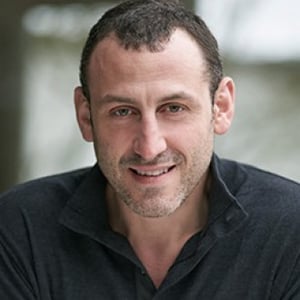
Professor of Law, Northwestern University Pritzker School of Law
Joshua Kleinfeld teaches and writes about political, legal, and moral philosophy, criminal law, and criminal procedure. He also practices law in Northwestern's Juvenile Criminal Defense Clinic. He is a full professor with tenure at the Northwestern Pritzker School of the Law and (by courtesy) in Northwestern’s philosophy department. In 2017-18, he was a visiting professor at Harvard and Stanford Law Schools. He is the recipient of the Bator Award, given annually to one American law professor under the age of 40 who has demonstrated "excellence in legal scholarship, a commitment to teaching, a concern for students, and who has made a significant public impact."
In philosophy, Kleinfeld's research focuses on the idea of "embodied ethical life," as developed in the socio-theoretic tradition of Hegel, Weber, and Durkheim. This tradition aims to understand and critique social life by bringing to light the normative ideas implicit in social practices and institutions. In law, this means that the most interesting philosophical concepts are often those reflected or actualized in legal practice – in the law as judges and lawyers think of it and wield it.
In criminal law and procedure, Kleinfeld has developed a theory known as "reconstructivism," which holds that the chief office of criminal law is not to dole out retributive justice, nor to optimize crime and cost control, but to reconstruct a violated normative order in the wake of a crime. This work, which draws on the thought of Hegel, Durkheim, Jean Hampton, and Antony Duff, develops an alternative to retributive and utilitarian theories of criminal law by focusing on the distinctive social function and sense of justice at work in the criminal system.
Kleinfeld is also involved in practical criminal justice reform. In this vein, he defends children accused of homicide in the Northwestern Juvenile Criminal Defense clinic and assists in litigation efforts meant to reform American criminal law through the courts. He has also developed a view of criminal justice reform known as "democratization," which holds that the root of the American criminal justice crisis is a set of bureaucratic attitudes, structures, and incentives divorced from the American public’s concerns and sense of justice, and that the primary solution is to make criminal justice more community-focused and responsive to lay influences. Working with others, he has developed a number of policy proposals meant to reform American criminal justice in a democratic direction.
Kleinfeld holds a JD from Yale Law School, a PhD in philosophy from the Goethe University of Frankfurt (supervised by Axel Honneth, Klaus Günther, and Rainer Forst), and a BA in philosophy from Yale College. He clerked for Judge J. Harvie Wilkinson on the United States Court of Appeals for the Fourth Circuit; Judge Janice Rogers Brown on the United States Court of Appeals for the D.C. Circuit; and President (chief justice) Aharon Barak of the Supreme Court of Israel. He worked as an Associate at Debevoise & Plimpton LLP in Frankfurt, Germany, in the area of corporate criminal law. Before law school, he worked as a Senior Research Analyst at the White House’s Council on Bioethics.

Luncheon Remarks
Ninth Annual Florida Chapters Conference
Lake Buena Vista, FLPanel One: The ESG Movement and Business Regulation: Go Woke, Go Broke?
John L. Badalamenti, Jesse M. Barrett, Ashley Keller, Lynn M. LoPucki, Kevin O'Connor
In recent years, the push for consideration of "Environmental, Social, Governance" criteria ("ESG") in government/regulatory...
Panel One: The ESG Movement and Business Regulation: Go Woke, Go Broke?
Ninth Annual Florida Chapters Conference
Lake Buena Vista, FLClassified: The Untold Story of Racial Classification in America
Nebraska Student Chapter
Lincoln, NETopics
The Chief Justice at His Best and Worst
Sometimes Chief Justice John Roberts writes beautifully. When he does, his writing is understated; he...
Topics
Adams v. School Board of St. Johns County, Florida: The Eleventh Circuit Creates a Circuit Split on Transgender Rights Under Title IX
On December 31, 2022, the U.S. Court of Appeals for the Eleventh Circuit issued a...
Topics
“Disclosing Foreign Influence in Lobbying Act” Reintroduced by Bi-Partisan Group of Senators
A bipartisan group of senators led by Sen. Chuck Grassley (R-Iowa) reintroduced legislation last week...
Open Minds with Prof. Eugene Volokh & Prof. Joshua Kleinfeld, Part III
Eugene Volokh, Joshua Kleinfeld
Finally, we turn to the present moment and consider the current challenges to American free...
Panel 3: Progressive Prosecutors: Decarceration, “Harm of Policing” and Bail Reform
2023 Western Chapters Conference
Simi Valley, CATopics
Ensuring the Perpetuation of Our Political Institutions
In the late 1830s, increasingly bitter disputes over slavery were turning violent and sometimes deadly....