
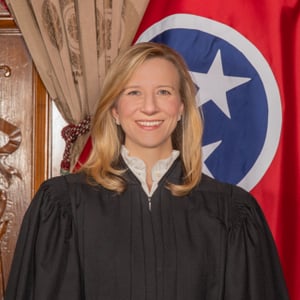
Justice, Supreme Court of Tennessee
Justice Sarah Campbell was confirmed to the Tennessee Supreme Court in 2022. She previously served as an Associate Solicitor General in the Tennessee Attorney General’s Office and as an associate at the law firm of Williams & Connolly LLP in Washington, DC. Justice Campbell earned her law degree from Duke University School of Law, a Master of Public Policy degree from Duke University, and her undergraduate degree from the University of Tennessee, where she received the Torchbearer Award. She served as a law clerk for Justice Samuel A. Alito, Jr. on the United States Supreme Court and Judge William H. Pryor Jr. on the U.S. Court of Appeals for the Eleventh Circuit.
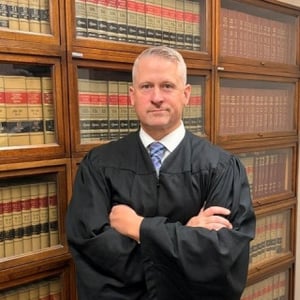
Judge, United States District Court, Northern District of Texas
Matthew J. Kacsmaryk serves as United States District Judge for the Northern District of Texas.
He previously served as (1) an Associate in the Dallas office of Baker Botts LLP, (2) an Assistant United States Attorney, and (3) Deputy General Counsel to FLI.
He is an Honors graduate of the University of Texas Law School.
In 2013, he earned the Attorney General’s Award for Excellence in Furthering the Interest of U.S. National Security.
In 2026, he was named Jurist of the Year by the Texas Review of Law & Politics, the conservative law review at the University of Texas.

Chief Judge, United States Court of Appeals, Eleventh Circuit
William H. Pryor Jr. serves as Chief Circuit Judge on the United States Court of Appeals for the Eleventh Circuit.
In 2013–18, he served on the United States Sentencing Commission and, in 2017–18, served as Acting Chair.
He has taught as a visiting professor at the University of Alabama School of Law and previously taught as an adjunct professor at the Cumberland School of Law of Samford University.
He served as the 45th Attorney General of Alabama from 1997 to 2004. When he took office, he was the youngest attorney general in the nation. In his reelection, he received the highest percentage of votes of any statewide candidate.
He graduated magna cum laude from Tulane Law School where he finished first in the common-law curriculum and was editor in chief of the Tulane Law Review. He then served as a law clerk for Judge John Minor Wisdom of the U.S. Court of Appeals for the Fifth Circuit.
He is a member of The American Law Institute and an Adviser for the RESTATEMENT OF THE LAW THIRD, CONFLICT OF LAWS. He is a coauthor with Bryan Garner, Justices Gorsuch and Kavanaugh, and several other judges of a treatise, THE LAW OF JUDICIAL PRECEDENT. He has published in the Yale Law Journal, Columbia Law Review, Virginia Law Review, Notre Dame Law Review, Harvard Journal of Law & Public Policy, Yale Law & Policy Review, George Mason Law Review, Florida Law Review, Alabama Law Review, Case Western Reserve Law Review, and Tulane Law Review. He has published op-eds in The Wall Street Journal, The New York Times, National Review, and USA Today. He has debated at National Lawyers’ Conventions of the Federalist Society (including on National Public Radio) and at the Oxford Union in the United Kingdom. And he is listed among several “widely admired judicial writers” in Bryan Garner’s The Redbook: A Manual on Legal Style.
He is a member of the Tulane Law School Hall of Fame and has received the Defender of the Constitution Award from the Heritage Foundation, the Jurist of the Year Award from the Texas Review of Law & Politics, and the St. Thomas More Award from the St. Thomas More Society of Atlanta. Judge Pryor is also a proud member of the National Society of the Sons of the American Revolution.

Judge, United States Court of Appeals, Eighth Circuit
David Stras became a judge on the United States Court of Appeals for the Eighth Circuit on January 31, 2018. Before serving on the Eighth Circuit, Judge Stras was an Associate Justice of the Minnesota Supreme Court, a position he occupied from July 1, 2010 until his appointment to the Eighth Circuit.
Prior to becoming a judge, Stras was a member of the faculty of the University of Minnesota Law School from 2004 through 2010. He taught and wrote in the areas of federal courts and jurisdiction, constitutional law, criminal law, and law and politics.
Judge Stras received his Bachelor of Arts degree, with highest distinction, in 1995 and his Master of Business Administration in 1999, both from the University of Kansas. He also received his law degree from the University of Kansas School of Law in 1999, where he served as Editor-in-Chief of the Criminal Procedure Edition of the Kansas Law Review.
Following law school, Stras clerked for The Honorable Melvin Brunetti of the United States Court of Appeals for the Ninth Circuit and then for The Honorable J. Michael Luttig of the United States Court of Appeals for the Fourth Circuit.
From 2001 to 2002, he practiced white-collar criminal and appellate litigation with the Washington, D.C., office of Sidley Austin Brown & Wood. Following his year in practice, he clerked for The Honorable Clarence Thomas of the Supreme Court of the United States.
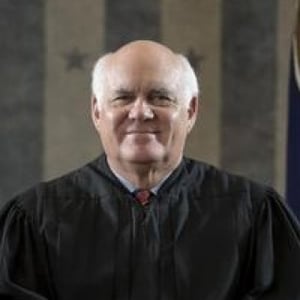
District Judge W. Keith Watkins was appointed by President George W.
Bush to a vacancy in the Middle District of Alabama on December 27,
2005. Judge Watkins was elevated to Chief District Judge on May 18, 2011,
and he served as Chief Judge until January 31, 2019. He assumed senior
status in 2019 and is still active with the court. A native of Troy, Alabama,
Judge Watkins practiced law in Tuscaloosa for two years and in Troy for 28
years, with a broad general practice. He is a graduate of Auburn University
and The University of Alabama School of Law. Among other positions in the
bar, Judge Watkins is a Fellow in the Alabama Law Foundation and served
as the Bar Commissioner for the Twelfth Judicial Circuit and as a member
of the Alabama State Bar Task Force for Alternative Dispute Resolution. He
served as the mediator in over 200 civil cases in state and federal courts in
Alabama and Georgia prior to taking the bench. Judge Watkins serves on
the board of the Rosa Parks Museum and is chair of the board of The
American Village. He is a former board member of the Federal Judges
Association and The Frank M. Johnson, Jr. Institute. He also served on the
Federal-State Jurisdiction Committee, a national committee of the
Administrative Office of Courts, and on three panels of the Eleventh Circuit
Court of Appeals. Judge Watkins and his wife Teresa have two grown
children and seven grandchildren. Known for his various and sometimes
cryptic sayings (shared liberally with his children, grandchildren, and law
clerks), two favorites are: “Live your life so that opportunities seek you”;
and “Don’t leave this earth without anyone knowing you were ever here.”
Education
Auburn University, B.S., 1973
The University of Alabama School of Law, J.D., 1976
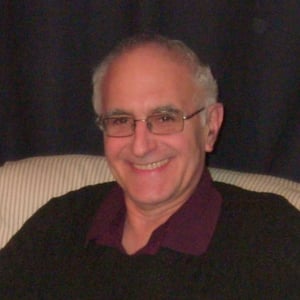
Nancy Reeves Dreux Professor of Political Science, The University of Notre Dame
Michael Zuckert (B.A., Cornell University; PhD, University of Chicago, 1974) is Nancy Reeves Dreux Professor, and Department Chair of Political Science at University of Notre Dame. Professor Zuckert teaches graduate and undergraduate courses in Political Philosophy and Theory, American Political Thought, American Constitutional Law, American Constitutional History, Constitutional Theory, and Philosophy of Law. His advising specialties are graduate programs in political science.
Professor Zuckert has published extensively on a variety of topics, including George Orwell, Plato, Shakespeare, and contemporary liberal theory. He is currently finishing a book called Completing the Constitution: The Post-Civil War Amendments and is co-authoring another book on Machiavelli and Shakespeare. He has been commissioned to write the volume on John Rawls for a series on Twentieth Century Political Philosophy. He co-authored and co-produced public radio series Mr. Adams and Mr. Jefferson: A Nine Part Drama for the Radio. He also was senior scholar for Liberty! (1997), a six hour public television series on the American Revolution, and served as senior advisor on the PBS series on Benjamin Franklin (2002) and Alexander Hamilton (2007). He is currently head of the new Tocqueville Center for the Study of Religion in American Public Life.
Zuckert has received grants from NEH, the Woodrow Wilson Center, Earhart Foundation and NSF, and has taught at Carleton College, Cornell University, Claremont Men’s College, Fordham University, the University of Minnesota, the University of Michigan at Ann Arbor, and the University of Chicago.
Erin Gaide is an Assistant Attorney General in the Kansas Office of the Attorney General, where she is a member of the Special Litigation & Constitutional Issues Division. Before beginning with the Kansas Attorney General, Erin clerked for the Honorable Allison H. Eid of the U.S. Court of Appeals for the Tenth Circuit.
Erin earned her J.D., magna cum laude, from the College of Law William & Mary, where she was elected to the Order of the Coif. She earned her B.A., cum laude, in International Studies from the Ohio State University.

In Memoriam: Professor John S. Baker Jr. (1946–2025)
It is with deep sadness that we share the passing on September 6, 2025, of...
Panel 2: Benchmarking Liberty: America 250
Birmingham, ALForgotten Founders — Rediscovering the Patriots Who Shaped America
Every American knows the names Washington, Jefferson, and Franklin. But what about the other patriots...
Topics
What Will the New Lockean Revolution of Limiting the Power of the Regulatory State Mean for Businesses?
A new Lockean revolution is going on in the Supreme Court. In recent years, the...
Topics
The Shot Heard Round The World
In May of 1773, to rescue the nearly bankrupt East India Company, the British Parliament...
Is Voting in Kansas a Fundamental Right? Kansas Supreme Court Weighs In
Erin Steinhilber
Those who do not spend their days thinking about election law may be surprised to...
Reading the Declaration of Independence in 2276?
Tufts Student Chapter
Medford, MATopics
Delaying a Special Election in New York State
New York Congresswoman Elise Stefanik is likely to win Senate approval to be the United...
Topics
Roosevelt’s Four Freedoms Include Two That Are Real
Franklin Roosevelt delivered his eighth State of The Union Address in January of 1941. The...
Topics
Best of 2024: Most Read Posts and Editor’s Picks
The Federalist Society has been honored to publish 240 fantastic blog posts from many talented...