

President, Harned Strategies LLC
Karen Harned is President at Harned Strategies LLC. Previously, she served as Executive Director of the National Federation of Independent Business Small Business Legal Center, a post she held from 2002-2022. Prior to joining the Legal Center, Ms. Harned was an attorney at a Washington, D.C. law firm specializing in food and drug law, where she represented several small and large businesses and their respective trade associations before Congress and federal agencies. She also served as Assistant Press Secretary to U.S. Senator Don Nickles of Oklahoma from August of 1989 to March of 1993. Ms. Harned received her B.A. from the University of Oklahoma in 1989 and her J.D. from The George Washington University National Law Center in 1995. She is admitted to practice in the District of Columbia.
As Executive Director of the NFIB Small Business Legal Center, Ms. Harned commented regularly on small business cases before federal and state courts, as well as the U.S. Supreme Court. She has appeared on Fox News, Fox Business, NBC Nightly News, CNN, CNBC and MSNBC, as well as National Public Radio, CBS Radio, and radio outlets across the country. Her opinion editorials and articles regarding healthcare, lawsuit abuse, regulation, and other issues important to small business have been published in newspapers and other publications nationwide.
Ms. Harned has testified before Congress on the small business impact of regulation and the civil justice system. Additionally, she has conducted numerous webinars and legal compliance seminars for small business owners across the country on issues relating to employment law, including unionization and immigration.
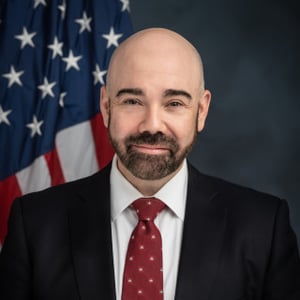
Assistant Secretary for Fair Housing and Equal Opportunity, United States Department of Housing and Urban Development
Craig Trainor is Assistant Secretary for Fair Housing and Equal Opportunity at the United States Department of Housing and Urban Development. President Trump nominated Mr. Trainor for this position on February 11, 2025, and the United States Senate confirmed him on October 7, 2025.
A “Day One” Trump-Vance Administration official, he previously served as Acting Assistant Secretary for Civil Rights and Principal Deputy Assistant Secretary for Civil Rights at the United States Department of Education, where he spearheaded the Department’s efforts to reorient America’s civil rights regime from an unjust spoils system to one that protects the rights of all Americans. Mr. Trainor’s February 14, 2025, “Dear Colleague” letter is widely considered the Trump Administration’s blueprint for enforcing civil rights laws and restoring the Constitution’s promise of equal protection.
Prior to serving in the Trump-Vance Administration, he was Senior Special Counsel with the United States House of Representatives Committee on the Judiciary under Chairman Jim Jordan (R-OH), and Senior Litigation Counsel with the America First Policy Institute under the Honorable Pam Bondi.
For over ten years, Mr. Trainor was a criminal defense and civil rights lawyer in New York City, litigating cases in New York state court and the United States District Court for the Southern and Eastern Districts of New York.
Prior to founding his law practice, he served as a New York City prosecutor, an associate attorney at a white collar criminal defense firm, and a law clerk to Chief Judge Frederick J. Scullin, Jr., United States District Court for the Northern District of New York.
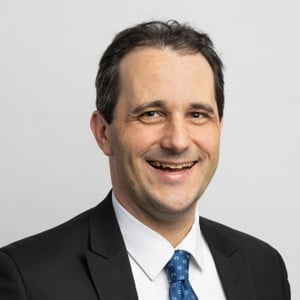
Director, Center for Judicial Engagement, Institute for Justice
Anthony Sanders is the Director of the Center for Judicial Engagement (CJE) at the Institute for Justice and a senior attorney. He joined IJ in 2010. As CJE’s director, he educates the public about the proper role of judges in enforcing constitutional limits on the size and scope of government. As a senior attorney he litigates cutting-edge constitutional cases protecting economic liberty, private property, freedom of speech and other individual liberties in both federal and state courts across the country.
One area of Anthony’s expertise is on using state constitutions to protect individual rights. He is the author of the book, published by University of Michigan Press, Baby Ninth Amendments: How Americans Embraced Unenumerated Rights and Why It Matters. He has also written several law review articles on state constitutional law, unenumerated rights, judicial review, economic liberty, property rights, international law, and other subjects. His work has appeared in publications such as the Iowa Law Review, Minnesota Law Review, American University Law Review, and Rutgers Law Review, and he has published opinion pieces in leading media outlets across the country. Further, he frequently speaks to various audiences on these matters and others, including judicial engagement, free speech, civil forfeiture, and the continuing importance of Magna Carta. Additionally, he hosts the weekly Short Circuit podcast, which often records live in front of law student audiences.
Anthony has litigated several cases in various state courts on state constitutional protections, as well as in federal courts on matters such as economic liberty, free speech, administrative law, and fines and fees abuse. Prior to joining IJ, Anthony served as a law clerk to Justice W. William Leaphart on the Montana Supreme Court. Anthony also worked for several years in private practice in Chicago where he was an active member of the Chicago Bar Association and chaired its Civil Rights Committee.
Anthony received his law degree cum laude from the University of Minnesota Law School in 2004, where he served as an articles submission editor for the Minnesota Law Review. He received his undergraduate degree from Hamline University in St. Paul, Minnesota, and his master’s degree from the University of Wisconsin-Madison. A dual U.S. and U.K. citizen, Anthony grew up on the islands of Vashon in Washington State, and Alderney in the British Channel Islands.
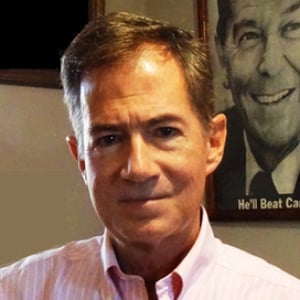
Former General Counsel of the U.S. Immigration and Naturalization, Former United States Ambassador to East Timor
Grover Joseph Rees is a Louisiana native whose family has lived in the Breaux Bridge/Lafayette area since the 1700s.
His first job after college was as an assistant to Congressman Dave Treen (R-LA3), who had just been elected as the first Republican Congressman from Louisiana since Reconstruction.
Rees graduated with honors from LSU Law School, where he served as Editor-in-Chief of the Louisiana Law Review. While in law school he worked on Ronald Reagan’s 1976 presidential campaign and was a Reagan delegate from Louisiana to the Republican National Convention. He also served as a member of the Lafayette Parish Republican Executive Committee and as a board member of Acadiana Right to Life.
In 1979, when Congressman Treen ran successfully for Governor, he asked Rees to write his authorized biography. The book, Dave Treen of Louisiana, was read and discussed widely during the campaign and after Treen’s election.
In 1985-86 Rees served as Special Counsel for Judicial Selection in President Reagan’s Justice Department, working closely with Attorney General Ed Meese to reorganize the judicial selection process to make it more philosophically oriented. These efforts resulted in the appointment of over 100 federal judges and were widely credited with transforming the federal judiciary.
From 1986 through 1991 Rees served as Chief Justice of the High Court of American Samoa, an Article I federal judicial position.
From 1991 through 1993 he was General Counsel of the U.S. Immigration and Naturalization Service.
In 1995 Rees went to work for the new Republican Congress as staff director and chief counsel of the Subcommittee on International Operations and Human Rights. He worked with subcommittee chairman Chris Smith (R.-N.J.) to cut U.S. funding for the International Planned Parenthood Federation and other organizations that perform and promote abortions overseas. Rees also worked on the drafting and enactment of the International Religious Freedom Act, the Trafficking Victims Protection Act, and other legislation that has helped to bring U.S. foreign policy into closer alignment not only with our national interests but also with our values.
In 2001-2002 Rees worked for Congressman Henry Hyde (R.-Ill.), who was then serving as Chairman of the House International Relations Committee.
From 2002 until 2006 Rees served as the first United States Ambassador to newly independent East Timor.
From 2006 until 2009 Ambassador Rees was the United States Special Representative for Social Issues, responsible for representing the United States on issues relating to vulnerable persons and the family within the United Nations system.
Ambassador Rees retired from government service in January 2009 and returned to Lafayette. He is married to Lan Dai Nguyen Rees and is a member of St. Genevieve’s Catholic parish in Lafayette. He was recently elected to serve as a member of the Louisiana Republican State Central Committee.
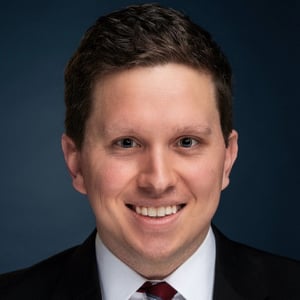
Deputy Counsel, Wisconsin Institute for Law & Liberty (WILL)
Anthony LoCoco is deputy counsel at the Wisconsin Institute for Law & Liberty, where he litigates in defense of individual liberties and the rule of law. Before joining WILL, Anthony served as law clerk to the Honorable Annette Kingsland Ziegler of the Wisconsin Supreme Court for two terms. He is an officer in the Milwaukee Chapter of The Federalist Society.
Anthony is a graduate of Harvard Law School and holds a B.A., summa cum laude, in economics from the University of Dallas. He resides outside Milwaukee with his wife and three children.

Attorney, Institute for Justice
Anya Bidwell (née Cherkasova) leads IJ’s Project on Immunity and Accountability (“PIA”). Through this project, Anya works to promote judicial engagement and ensure that government officials are held to account when they violate individuals’ constitutional rights. Anya also serves as an adviser on the American Law Institute’s Restatement of the Law, Constitutional Torts project.
One of Anya’s PIA cases—Gonzalez v. Trevino—was heard by the United States Supreme Court on March 20, 2024. She argued the case for the petitioner, with the goal of convincing the Justices that retaliatory arrests not involving on-the-spot decisions by police officers should be actionable under the First Amendment regardless of probable cause. The decision is expected in June.
This was Anya’s third appearance before the U.S. Supreme Court. She second-chaired Brownback v. King (an excessive force case) and Tennessee Wine & Spirits Retailers Association v. Thomas (a commerce clause case) in November 2020 and January 2019 respectfully.
Before joining IJ, Anya worked for a top national law firm, handling cases in trial and appellate courts. She earned her J.D. with honors from the University of Texas. Two years prior to entering law school, Anya received a master’s degree in Global Policy Studies, also from the University of Texas, and wrote a thesis on asymmetric warfare.
Anya spent her childhood in Ukraine and Kyrgyzstan. At 16, she left her family behind and came to America on a university scholarship. Her upbringing motivated her to study law and become an advocate for a strong, independent judiciary.
Anya’s work has been featured in numerous publications, including the Washington Post, the Wall Street Journal, the New York Times, USA Today, and the Guardian. She is also the host of live recordings of our Short Circuit podcast and a co-producer of our documentary-style podcast Bound by Oath.
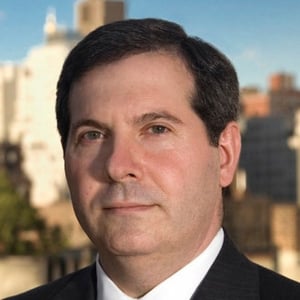
Partner, DeMarco Law, PLLC
Joseph V. DeMarco is a partner at DeMarco Law, PLLC where he focuses on counseling clients on complex issues involving information privacy and security, theft of intellectual property, computer intrusions, on-line fraud, and the lawful use of new technology. His years of experience in private practice and in government handling the most difficult cybercrime investigations handled by the United States Attorney’s Office have made him one of the nation’s most sought-after lawyers on Internet crime and the law relating to emerging technologies. In addition to his counsel practice, Mr. DeMarco serves as an Arbitrator, resolving complex commercial and high-technology disputes between businesses. He is on the National Panel of Neutrals of the American Arbitration Association (AAA) and Federal Arbitration, Inc. (FedArb).
From 1997 to 2007, Mr. DeMarco served an Assistant United States Attorney for the Southern District of New York, where he founded and headed the Computer Hacking and Intellectual Property (CHIPs) Program, a group of five prosecutors dedicated to investigating and prosecuting violations of federal cybercrime laws and intellectual property offenses. Under his leadership, CHIPs prosecutions grew from a trickle in 1997 to a top priority of the United States Attorney’s Office, encompassing all forms of criminal activity affecting e-commerce and critical infrastructures including computer hacking crimes; transmission of Internet worms and viruses; electronic theft of trade secrets; illegal use of “spyware”; web-based frauds; unlawful Internet gambling; and criminal copyright and trademark infringement offenses. As a recognized thought leader in the field, Mr. DeMarco was frequently asked to counsel prosecutors and law enforcement agents regarding novel investigative and surveillance techniques and methodologies, and regularly provided advice to the United States Attorney concerning the Office’s most sensitive computer-related investigations. In 2001, Mr. DeMarco also served as a visiting Trial Attorney at the Department of Justice Computer Crimes and Intellectual Property Section in Washington, D.C., where he focused his work on Internet privacy, gaming, and theft of intellectual property.
Since 2002, Mr. DeMarco has served as an Adjunct Professor at Columbia Law School, where he teaches the upper-class Internet and Computer Crimes seminar. He has been invited to speak throughout the world on cybercrime, e-commerce, and IP enforcement. He has lectured on the subject of cybercrime at Harvard Law School, the Practicing Law Institute, the National Advocacy Center, and at the FBI Academy in Quantico, Virginia, and has served as an instructor on cybercrime to judges attending the New York State Judicial Institute.
Prior to joining the United States Attorney’s Office, Mr. DeMarco was a litigation associate at Cravath, Swaine & Moore in New York City, where he concentrated his work on intellectual property, antitrust, and securities law issues for various high-technology clients. Prior to that, Mr. DeMarco served as law clerk to the Honorable J. Daniel Mahoney, United States Circuit Judge for the Second Circuit Court of Appeals.
Mr. DeMarco holds a J.D. magna cum laude from New York University School of Law. At NYU he was a member of the NYU Law Review. He received his B.S.F.S. summa cum laude from the Edmund A. Walsh School of Foreign Service at Georgetown University.
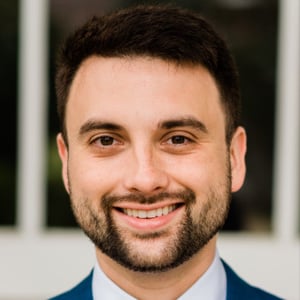
Roberto is a 2018 graduate of the University of Chicago Law School.

BP P.L.C. v. Mayor and City Council of Baltimore - Post-Decision SCOTUScast
Karen Harned
On May 17, 2021 the Supreme Court decided BP P.L.C. v. Mayor and City Council...
In the Rush to Reform, Prudence Is Among the Highest Duties: How to Responsibly Reform Cash Bail
Craig Trainor
Over the last two decades, the politics of American criminal law has made strange bedfellows....
Which Rights Are We Mediating?
Anthony Sanders
A review of How Rights Went Wrong: Why Our Obsession With Rights Is Tearing America...
Sanchez v. Mayorkas - Post-Argument SCOTUScast
Grover Joseph Rees
On April 19, 2021 the Supreme Court heard oral argument in Sanchez v. Mayorkas. The question...
State Court Docket Watch: State of Wisconsin v. Halverson
Anthony LoCoco
Note from the Editor: The Federalist Society takes no positions on particular legal and public...
State Court Docket Watch: Hamen v. Hamlin County
Anya Bidwell
Note from the Editor: The Federalist Society takes no positions on particular legal and public...
State Court Docket Watch: State of Oregon v. Pittman
Joseph V. DeMarco
Note from the Editor: The Federalist Society takes no positions on particular legal and public policy...
Topics
Anti-Slavery’s Sword: Section 1983 at 150
Outrages. The word radical republicans used to describe the Klan-inspired violence raging in the South....
Negative Legislation
Roberto J. Borgert
Modern commentators have spilled much ink on the undemocratic nature of congressional delegations to executive...
Topics
The FCC's Legal Authority to Regulate Platforms as Common Carriers
In the net neutrality debate, there have been a wide array of articles outlining the...