




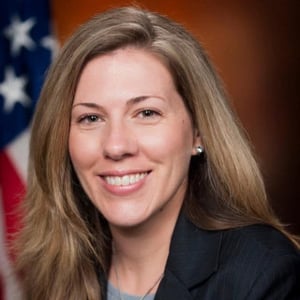









At Stanford Law School, O’Connell teaches Administrative Law, Advanced Administrative Law, and Constitutional Law. The class of 2020 chose her to receive the Hurlbut Award, which is given to one professor “who strives to make teaching an art.” She co-chaired the steering committee for Stanford University’s Faculty Women’s Forum, which works to enable all women faculty to thrive, from August 2022 to January 2024 and jointly conducted two surveys on COVID’s impacts on faculty for FWF. Prior to joining Stanford University in 2018, O’Connell was the George Johnson Professor of Law at the University of California, Berkeley. While there, she received the Distinguished Teaching Award (the campus’s most prestigious honor for teaching) in 2016 and Berkeley Law’s Rutter Award for Teaching Distinction in 2012. From April 2013 to July 2015, she served as associate dean for faculty development and research under three different deans. In 2013-2014, O’Connell was co-president of the Society for Empirical Legal Studies (co-organizing the 2014 Conference on Empirical Legal Studies).
Before joining the Berkeley Law faculty in 2004, O’Connell clerked for Justice Ruth Bader Ginsburg of the U.S. Supreme Court during the October 2003 term. From 2001 to 2003, she was a trial attorney for the Federal Programs Branch of the U.S. Department of Justice’s Civil Division, receiving commendations for her work. She clerked for Judge Stephen F. Williams of the U.S. Court of Appeals for the D.C. Circuit from 2000 to 2001. A Truman Scholar, O’Connell worked for a number of federal agencies in earlier years, including the Department of Defense (Offices of the General Counsel and Inspector General), Federal Trade Commission (Bureau of Competition), Department of Justice (Office of Legal Counsel), and U.S. Army (RDE). She is a member of the New York bar and served as a volunteer for the Biden-Harris Campaign’s policy team.

A Seat at the Sitting - April 2025
Thomas Berry, Brian T. Fitzpatrick, Sarah Parshall Perry, Elle Rogers Bernstein, Gregory Sisk, Francesca Ugolini
Each month, a panel of constitutional experts convenes to discuss the Court’s upcoming docket sitting...
Can the Federal Government Ban At-Home Distilling?
Thomas Berry, Theodore Cooperstein, Michael D. Pepson, Eric J. Segall
After the U.S. Supreme Court in Morrison v. Olson (1988) and U.S. v. Lopez (1995)...
Daniel Webster Debate Series: Should Americans Embrace Common-Good Constitutionalism?
Thomas Berry, Josh Hammer, William H. Pryor
The Federalist Society's Georgetown Law Chapter'sDaniel Webster Debate Series presents Daniel Webster Debate Series:Should...
Courthouse Steps Decision: NRA v. Vullo
Thomas Berry, Robert Corn-Revere, Vera Eidelman, Casey Mattox, John J. Vecchione
On May 30, 2024, the Supreme Court issued its decision in National Rifle Association of...
Dress Codes and Sex Discrimination
Colorado Lawyers Chapter
Denver, CORedistricting: Discussing the John R. Lewis Voting Rights Advancement Act
Mark Braden, Maya Noronha, Jeffrey M. Wice
This webinar addresses the impact that changes proposed in HR 4, the John R. Lewis...
Deep Dive Episode 186 – Teaching About Race in the Curriculum
John Agresto, Linda L. Chavez, Peter Wood
This episode features a panel discussion on Critical Race Theory, the 1619 Project and the current...
Deep Dive Episode 186 – Teaching About Race in the Curriculum
Regulatory Transparency Project's Fourth Branch Podcast
TeleforumThe Federal Vacancies Reform Act and Implications for Presidential Transitions
Stephen Migala, Anne Joseph O'Connell, Thomas Berry, Brian C. Johnson
The Federal Vacancies Reform Act (FVRA) is a federal statute permitting the President to appoint...
Police Unions, Practically Speaking
Daniel DiSalvo, Larry H. James
In the current scholarship surrounding law enforcement issues, there are two diverging sides in which...