
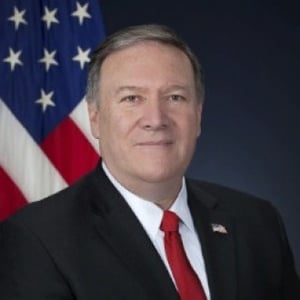
U.S. Secretary of State
Michael R. Pompeo was sworn in as Secretary of State on April 26, 2018. He previously served as Director of the Central Intelligence Agency from January 2017 to April 2018.
Prior to joining the Trump Administration, Mr. Pompeo was serving in his fourth term as congressman from Kansas’ 4th District. He served on the House Intelligence Committee, as well as the Energy and Commerce Committee and House Select Benghazi Committee.
Prior to his service in Congress, Mr. Pompeo founded Thayer Aerospace, where he served as CEO for more than a decade. He later became President of Sentry International, an oilfield equipment manufacturing, distribution, and service company.
Mr. Pompeo graduated first in his class at the United States Military Academy at West Point in 1986 and served as a cavalry officer patrolling the Iron Curtain before the fall of the Berlin Wall. He also served with the 2nd Squadron, 7th Cavalry in the US Army’s Fourth Infantry Division.
After leaving active duty, Mr. Pompeo graduated from Harvard Law School, having been an editor of the Harvard Law Review.

Judge, United States Court of Appeals, District of Columbia Circuit
Judge Katsas was appointed to the D.C. Circuit in December 2017. He graduated from Princeton University and Harvard Law School, where he was an executive editor on the Harvard Law Review. Between 1989 and 1992, he served as a law clerk to Judge Edward Becker on the Third Circuit, to then-Judge Clarence Thomas on the D.C. Circuit, and to Justice Thomas on the Supreme Court. Between 1992 and 2001, he was an associate and then partner in the Washington office of Jones Day, where he specialized in appellate and complex civil litigation. Between 2001 and 2009, he served in many senior positions in the Department of Justice, including as Assistant Attorney General for the Civil Division and as Acting Associate Attorney General. In 2009, he returned to Jones Day. From January to December 2017, he served as Deputy Assistant to the President and Deputy Counsel to the President.
Before joining the bench, Judge Katsas argued more than 75 appeals, including three cases in the Supreme Court, 13 cases in the D.C. Circuit, and cases in every other federal court of appeals. By appointment of the Chief Justice, he served on the Advisory Committee on Appellate Rules from 2013 to 2017. In 2016, he was elected to membership in the American Academy of Appellate Lawyers.
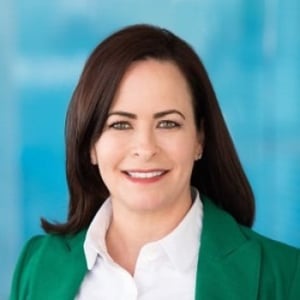
Executive Vice President, Policy, Business Roundtable
Ambassador Kristen Silverberg is Executive Vice President, Policy at Business Roundtable, where she leads the Policy team. She previously served as a Managing Director at the Institute of International Finance. She served in the George W. Bush Administration as U.S. Ambassador to the European Union from 2008 to 2009 and as Assistant Secretary of State for International Organization Affairs from 2005 to 2008. Prior to her time at the State Department, she held a number of senior positions at the White House including Deputy Domestic Policy Advisor.
Ambassador Silverberg served in 2003 in Baghdad, Iraq for which she received the Secretary of Defense Medal for Outstanding Public Service. She formerly practiced law at Williams and Connolly, LLP in Washington, DC and served as a law clerk to Supreme Court Justice Clarence Thomas and Judge David Sentelle of the U.S. Court of Appeals. She attended Harvard College and the University of Texas School of Law, where she graduated with High Honors.
Ambassador Silverberg serves on the Board of Directors of the CDC Foundation, the Board of Directors of the International Republican Institute, the Board of Directors of Vorbeck Materials, the Advisory Board of the Texas National Security Review, the National Advisory Council of the Aspen Institute Future of Work Initiative, and was recognized by the World Economic Forum as a Young Global Leader.

Emanuel S. Heller Professor of Law, University of California at Berkeley; Thomas Smith Senior Research Fellow, The Civitas Institute, University of Texas at Austin
John Yoo is the Emanuel Heller Professor of Law at the University of California at Berkeley. He is also the Thomas Smith Senior Research Fellow, Civitas Institute, at the University of Texas at Austin. He is also a Nonresident Senior Fellow at the American Enterprise Institute.
His most recent book, The Politically Incorrect Guide to the Supreme Court, co-authored with Robert Delahunty, was published in 2023. Professor Yoo’s other books include Defender-in-Chief: Trump’s Fight for Presidential Power; Striking Power: How Cyber, Robots, and Space Weapons Change the Rules for War; Point of Attack: Preventive War, International Law, and Global Welfare; and Crisis and Command: A History of Executive Power from George Washington to George Bush.
He is a co-author of volumes 1 and 2 of R. Rossum, G. Tarr, V. Munoz & J. Yoo American Constitution Law (Routledge, 2026), and a co-editor of the eight-volume series on the 250th anniversary of the American Revolution, We Hold These Truths, with Yuval Levin and Adam White of the American Enterprise Institute.
Professor Yoo has published more than 100 articles in academic journals on subjects including national security, constitutional law, international law, and the Supreme Court. He also regularly contributes to the editorial pages of the Wall Street Journal, New York Times, Washington Post, Los Angeles Times, and National Review, among others.
Professor Yoo has served in all three branches of government. He was an official in the U.S. Department of Justice, where he worked on national security and terrorism issues after the 9/11 attacks. He served as general counsel of the U.S. Senate Judiciary Committee. He has been a law clerk for Supreme Court Justice Clarence Thomas and federal appeals Judge Laurence Silberman. He has been a visiting professor at the University of Texas at Austin’s School of Civic Leadership, Seoul National University, the Interdisciplinary Center Herzliya, Keio University, Trento University, the University of Chicago, and the Free University of Amsterdam.
Professor Yoo supervises the Public Law and Policy Program and the California Constitution Center. He also serves on the boards of Founding Forward, the Washington Legal Foundation, the Pacific Legal Foundation, the Ulysses Grant Institute, the Federalist Society’s Separation of Powers and Federalism Division, the Universidad Cientifica del Sur Law School, and the Asia-Pacific Law Institute at Seoul National University. He is a winner of the Federalist Society’s Paul Bator award and the Heritage Foundation’s Edwin Meese III Originalism Lectureship.
Professor Yoo graduated from Yale Law School and summa cum laude from Harvard College.
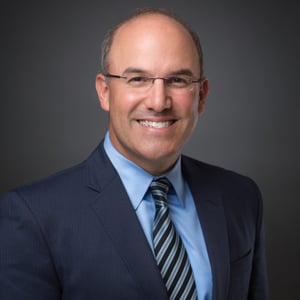
K2 Integrity, Global Co-Managing Partner and Chief Strategy Officer
The Honorable Juan Zarate is the global co-managing partner and chief strategy officer for the global consulting firm, K2 Integrity. He is also the co-founder and Chair of the Board of Consilient, an innovative new fintech.
He is the chairman and co-founder of the Center on Economic and Financial Power (CEFP) at the Foundation for Defense of Democracies, senior adviser at the Center for Strategic and International Studies(CSIS), and a senior fellow at West Point’s Combating Terrorism Center. He was a visiting lecturer in law at the Harvard Law School for eight years and is a published author, including his books “Treasury’s War” (2013) and “Forging Democracy” (1994).
Mr. Zarate sits on the boards of various organizations, including Northwestern Mutual, Cambridge Quantum Computing North America Holdings, Guardian Space Technologies Systems, and the Director’s Advisory Board for the National Counterterrorism Center (NCTC). Since 2014, Mr. Zarate has served as an independent advisor to Coinbase, the largest virtual asset service provider in the United States. With two appointments by Pope Francis,Mr. Zarate sat on the board of the Vatican’s Financial Information Authority for over five years; the Boston Dynamics board for over three years; and for seven years, he was the U.S. advisor on HSBC’s Financial System Vulnerabilities Committee (overseeing remediation of the bank’s anti-money laundering system and adherence with the U.S.DOJ deferred prosecution agreement) and remains an advisor to HSBC’s Group Risk Committee.
Mr. Zarate served as the deputy assistant to the president and deputy national security adviser for combating terrorism (“counterterrorism czar”) from 2005 to 2009, where he was responsible for developing and implementing the U.S. counterterrorism strategy and policies related to transnational security threats, including hostage-taking, piracy, anti-money laundering, kleptocracy, transnational organized crime, and international energy infrastructure protection,. He was responsible for conceiving and leading major initiatives in the post 9/11 period, including the establishment of the Global Initiative to Combat Nuclear Terrorism (GICNT).
He was the first ever assistant secretary of the treasury for terrorist financing and financial crimes. In this role, he led the post-9/11 anti-money laundering and sanctions regime expansion in the United States; helped develop the international standards for AML/CFT and proliferation finance; supervised the Financial Crimes Enforcement Network (FINCEN), the Office of Foreign Assets Control (OFAC), and the Treasury’s Executive Office for Asset Forfeiture (TEOAF); drove the innovative use of the Treasury’s national security–related powers and ultimately the establishment of the Office of Terrorism and Financial Intelligence (TFI). He has also led some of the largest asset recovery ventures in history, including the return of over $3 billion in Iraqi assets.
Mr. Zarate is a former federal terrorism prosecutor, prior to 9/11, serving on the prosecution teams in the East Africa bombings and USS Cole cases, among others. He is a magna cum laude graduate of Harvard College, a cum laude graduate of the Harvard Law School, and a Rotary Fellow at the Universidad de Salamanca. At Harvard College, he won the John P. Reardon Award, as the best male student athlete.
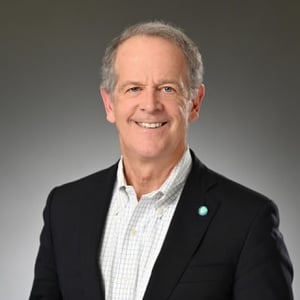
Visiting Professor of Public and International Affairs, Charles and Marie Robertson Visiting Professor, Princeton School of Public and International Affairs
Martin S. Flaherty is a longtime is Visiting Professor at the Princeton School of Public and International Affairs, where he was Fellow in the Program in Law and Public Affairs. He is also Leitner Family Professor of International Human Rights Law and Founding Co-Director of the Leitner Center for International Law and Justice at Fordham Law School. Professor Flaherty also currently teaches at Columbia Law School and Barnard College. Previously he has taught at China University of Political Science and Law and the National Judges College in Beijing, Sungkyunkwan University in Seoul, Queen’s University Belfast. Professor Flaherty earlier served as a law clerk for Justice Byron R. White of the U.S. Supreme Court and Chief Judge John Gibbons of the U.S. Court of Appeals for the Third Circuit.
Flaherty received a J.D. from Columbia Law School, where he was Book Reviews and Articles Editor of the Columbia Law Review, an M.A. and M.Phil., with distinction, from Yale (in history), and B.A. summa cum laude from Princeton. For the Leitner Center, Human Rights First, and the New York City Bar Association, he has led or participated in human rights missions to Northern Ireland, Turkey, Hong Kong, Mexico, Malaysia, Kenya, Romania and China. Professor Flaherty is currently the President of the American Association of the International Commission of Jurists, https://www.aaicj.org, a member of the Council on Foreign Relations, and a legal expert advisor at the Sixth Committee of the United Nations General Assembly.
Flaherty’s scholarly publications focus upon international human rights, foreign affairs, and constitutional law and history, and appear in such journals as the Columbia Law Review, the Yale Law Journal, the Michigan Law Review, the University of Chicago Law Review, Constitutional Commentary, the Harvard Journal of Law and Policy, and the Harvard Human Rights Journal. He has written, appeared, or been quoted in The New York Times, The Washington Post, The New Yorker, The Boston Globe, The Daily News, Newsday, the PBS Newshour, CNN, MSNBC, and NPR. He is also the author of the Restoring the Global Judiciary: Why the Supreme Court Should Rule in Foreign Affairs (Princeton University Press, 2019).

Richard and Frances Mallery Professor of Law and Faculty Director, Constitutional Law Center, Stanford Law School
Michael W. McConnell is the Richard and Frances Mallery Professor and Faculty Director of the Constitutional Law Center at Stanford Law School, and a Senior Fellow at the Hoover Institution. From 2002 to 2009, he served as a Circuit Judge on the United States Court of Appeals for the Tenth Circuit. He was nominated by President George W. Bush, a Republican, and confirmed by a Democratic Senate by unanimous consent. McConnell has previously held chaired professorships at the University of Chicago and the University of Utah, and visiting professorships at Harvard and NYU. He teaches courses on constitutional law, constitutional history, First Amendment, and interpretive theory. He has published widely in the fields of constitutional law and theory, especially church and state, equal protection, and separation of powers. His book, “The President Who Would Not Be King: Executive Power Under the Constitution,” was published by Princeton University Press in 2020, based on the Tanner Lectures in Human Values, which he delivered at Princeton in 2019. His latest book, co-authored with Nathan Chapman, “Agreeing to Disagree: How the Establishment Clause Protects Religious Diversity and Freedom of Conscience,” was published by Oxford University Press in mid-2023. McConnell has argued sixteen cases in the United States Supreme Court, most recently Carney v. Adams (2020). defending a provision of the Delaware Constitution requiring political balance on that state’s courts. More recently, he was co-counsel in Gonzalez v. Google. He earned his B.A. from Michigan State University and his J.D. from the University of Chicago, and has received honorary degrees from Notre Dame University and Michigan State. He served as law clerk to Supreme Court Justice William J. Brennan, Jr. and D.C. Circuit Chief Judge J. Skelly Wright. He has been Assistant General Counsel of the Office of Management & Budget, Assistant to the Solicitor General of the Department of Justice, and a member of the President’s Intelligence Oversight Board. He is Senior of Counsel to the law firm Wilson, Sonsini, Goodrich & Rosati, and is co-chair of Meta’s Oversight Review Board.

James Monroe Distinguished Professor of Law and Albert Clark Tate, Jr., Professor of Law, University of Virginia School of Law
Professor Saikrishna Prakash’s scholarship focuses on separation of powers, particularly executive powers. He teaches Constitutional Law, Foreign Relations Law and Presidential Powers at the Law School.
Prakash’s most recent book, “The Living Presidency: An Originalist Argument Against Its Ever-Expanding Powers,” was published by Harvard Belknap Press in 2020. He also authored “Imperial from the Beginning: The Constitution of the Original Executive” (Yale University Press, 2015). The former book focuses on the modern presidency while the latter considers the presidency of the Founders.
Prakash has authored over 75 law review articles. Among them are “Of Synchronicity and Supreme Law” in the Harvard Law Review, “The Indefensible Duty to Defend” in the Columbia Law Review, and “50 States, 50 Attorneys General and 50 Approaches to the Duty to Defend” and “The Executive Power Over Foreign Affairs” in the Yale Law Journal.
Prakash has published op-eds in The New York Times, The Wall Street Journal and the Los Angeles Times. At the request of Democrats and Republicans, he has testified before Congress on matters of presidential removal, the Mueller Report and how Congress might better check the presidency. He is currently a Miller Center Senior Fellow. In 2015, he received the Roger Traynor award for faculty scholarship. In the same year, he received an honorable mention from the American Society of Legal Writers for his book “Imperial from the Beginning.” He has given named lectures at William & Mary Law School, Princeton University and Toledo Law School, and keynote addresses at several conferences.
Prakash majored in economics and political science at Stanford University. At Yale Law School, he served as senior editor of the Yale Law Journal and received the John M. Olin Fellowship in Law, Economics and Public Policy. He subsequently clerked for Judge Laurence H. Silberman of the U.S. Court of Appeals for the District of Columbia Circuit and for Justice Clarence Thomas of the U.S. Supreme Court. After practicing in New York for two years, he served as a visiting professor at the University of Illinois College of Law and as an associate professor at Boston University School of Law. He then spent several years at the University of San Diego School of Law as the Herzog Research Professor of Law. Prakash has been a visiting professor at Northwestern University and the University of Chicago. He also has served as a James Madison Fellow at Princeton University and Visiting Research Fellow at the Hoover Institution of War & Peace at Stanford University.

Judge, United States Court of Appeals, Sixth Circuit
Amul R. Thapar serves as a judge on the United States Court of Appeals for the Sixth Circuit. His judicial career began in 2007 when President George W. Bush nominated him to serve on the Eastern District of Kentucky, making him the first South Asian Article III judge in American history. In 2017, he became President Donald J. Trump’s first appellate court nominee.
Before joining the bench, Judge Thapar served as the United States Attorney for the Eastern District of Kentucky. While United States Attorney, Judge Thapar worked on the Attorney General’s Advisory Committee (“AGAC”) and chaired the AGAC’s Controlled Substances and Asset Forfeiture subcommittee. He also served on the Terrorism and National Security subcommittee, the Violent Crime subcommittee, and the Child Exploitation working group.
Judge Thapar has worked in private practice, at Williams & Connolly in Washington, D.C., and Squire, Sanders & Dempsey in Cincinnati, Ohio. He also served as an Assistant United States Attorney in both the Southern District of Ohio and the District of Columbia.
Judge Thapar received his undergraduate degree from Boston College and his law degree from the University of California, Berkeley. After graduating, Judge Thapar worked as a law clerk to the Honorable S. Arthur Spiegel of the United States District Court for the Southern District of Ohio, and the Honorable Nathaniel R. Jones of the United States Court of Appeals for the Sixth Circuit.
Judge Thapar has also published in the Yale Law Journal, Michigan Law Review, and Catholic University Law Review. He teaches courses on originalism, the Federalists and Anti-Federalists, and legal writing at Notre Dame Law School, the University of Virginia School of Law, and Vanderbilt Law School.
Emanuel S. Heller Professor of Law, University of California at Berkeley; Thomas Smith Senior Research Fellow, The Civitas Institute, University of Texas at Austin
John Yoo is the Emanuel Heller Professor of Law at the University of California at Berkeley. He is also the Thomas Smith Senior Research Fellow, Civitas Institute, at the University of Texas at Austin. He is also a Nonresident Senior Fellow at the American Enterprise Institute.
His most recent book, The Politically Incorrect Guide to the Supreme Court, co-authored with Robert Delahunty, was published in 2023. Professor Yoo’s other books include Defender-in-Chief: Trump’s Fight for Presidential Power; Striking Power: How Cyber, Robots, and Space Weapons Change the Rules for War; Point of Attack: Preventive War, International Law, and Global Welfare; and Crisis and Command: A History of Executive Power from George Washington to George Bush.
He is a co-author of volumes 1 and 2 of R. Rossum, G. Tarr, V. Munoz & J. Yoo American Constitution Law (Routledge, 2026), and a co-editor of the eight-volume series on the 250th anniversary of the American Revolution, We Hold These Truths, with Yuval Levin and Adam White of the American Enterprise Institute.
Professor Yoo has published more than 100 articles in academic journals on subjects including national security, constitutional law, international law, and the Supreme Court. He also regularly contributes to the editorial pages of the Wall Street Journal, New York Times, Washington Post, Los Angeles Times, and National Review, among others.
Professor Yoo has served in all three branches of government. He was an official in the U.S. Department of Justice, where he worked on national security and terrorism issues after the 9/11 attacks. He served as general counsel of the U.S. Senate Judiciary Committee. He has been a law clerk for Supreme Court Justice Clarence Thomas and federal appeals Judge Laurence Silberman. He has been a visiting professor at the University of Texas at Austin’s School of Civic Leadership, Seoul National University, the Interdisciplinary Center Herzliya, Keio University, Trento University, the University of Chicago, and the Free University of Amsterdam.
Professor Yoo supervises the Public Law and Policy Program and the California Constitution Center. He also serves on the boards of Founding Forward, the Washington Legal Foundation, the Pacific Legal Foundation, the Ulysses Grant Institute, the Federalist Society’s Separation of Powers and Federalism Division, the Universidad Cientifica del Sur Law School, and the Asia-Pacific Law Institute at Seoul National University. He is a winner of the Federalist Society’s Paul Bator award and the Heritage Foundation’s Edwin Meese III Originalism Lectureship.
Professor Yoo graduated from Yale Law School and summa cum laude from Harvard College.
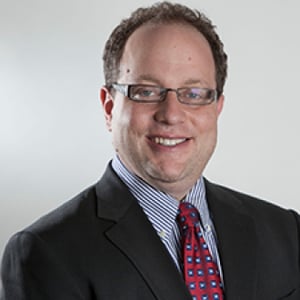
Director of Asian Studies and Resident Fellow, American Enterprise Institute
Dan Blumenthal is the director of Asian Studies at the American Enterprise Institute, where he focuses on East Asian security issues and Sino-American relations. Mr. Blumenthal has both served in and advised the U.S. government on China issues for over a decade. From 2001 to 2004, he served as senior director for China, Taiwan, and Mongolia at the Department of Defense. Additionally, he served as a commissioner on the congressionally-mandated U.S.-China Economic and Security Review Commission since 2006-2012, and held the position of vice chairman in 2007. He has also served on the Academic Advisory Board of the congressional U.S.-China Working Group. Mr. Blumenthal is the co-author of “An Awkward Embrace: The United States and China in the 21st Century” (AEI Press, November 2012).
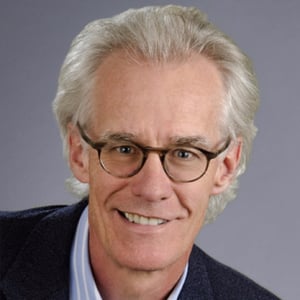
Lawrence and Sallye Krause Professor of Korea-Pacific Studies; Director, Korea-Pacific Program, School of Global Policy & Strategy, UC San Diego
Stephan Haggard is the Lawrence and Sallye Krause Professor of Korea-Pacific Studies, director of the Korea-Pacific Program, and distinguished professor of political science at GPS. He is a go-to expert on current developments in the Asia-Pacific region, particularly the Korean peninsula, and on the politics of economic reform and globalization.
Prof. Haggard has written extensively on the political economy of North Korea with Marcus Noland, including “Famine in North Korea: Markets, Aid, and Reform” (2007) and “Witness to Transformation: Refugee Insights into North Korea” (2011) and co-authors the "North Korea: Witness to Transformation" blog at the Peterson Institute for International Economics. Prof. Haggard is the current editor of the Journal of East Asian Studies and a member of the Council on Foreign Relations.
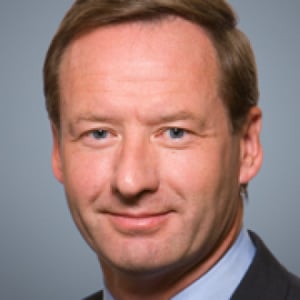
Senior Research Fellow, Northeast Asia, The Heritage Foundation
Bruce Klingner specializes in Korean and Japanese affairs as the senior research fellow for Northeast Asia at The Heritage Foundation's Asian Studies Center.
Mr. Klingner’s analysis and writing about North Korea, South Korea and Japan, as well as related issues, are informed by his 20 years of service at the Central Intelligence Agency and the Defense Intelligence Agency.
Mr. Klingner, who joined Heritage in 2007, has testified before the House Foreign Affairs Committee, the Senate Select Committee on Intelligence and the House Permanent Select Committee on Intelligence.
He is a frequent commentator in U.S. and foreign media. His articles and commentary have appeared in major American and foreign publications and he is a regular guest on broadcast and cable news outlets. He is a regular contributor to the international and security sections of The Daily Signal.
From 1996 to 2001, Mr. Klingner was CIA’s deputy division chief for Korea, responsible for the analysis of political, military, economic and leadership issues for the president of the United States and other senior U.S. policymakers. In 1993-1994, he was the chief of CIA's Korea branch, which analyzed military developments during a nuclear crisis with North Korea.
Mr. Klingner is a distinguished graduate of the National War College, where he received a master's degree in national security strategy in 2002. He also holds a master's degree in strategic intelligence from the Defense Intelligence College and a bachelor's degree in political science from Middlebury College in Vermont.
He is active in Korean martial arts, attaining third-degree black belt in taekwondo and first-degree black belt in hapkido and teuk kong moo sool.

Maurice A. Deane Distinguished Professor of Constitutional Law and Faculty Director of International Programs, Hofstra University School of Law
Professor Ku’s primary research interest is the relationship of international law to constitutional law. He has also conducted academic research on a wide range of topics including international dispute resolution, international criminal law, and China’s relationship with international law. He teaches courses such as U.S. constitutional law, U.S. foreign affairs law, transnational law, and international trade and business law. Since 2014, he has served as the faculty director of international programs, overseeing Hofstra Law’s study abroad, exchange and LL.M. programs. Professor Ku also teaches Constitutional Law in our online degree programs: Master of Laws in American Law and Master of Arts in American Legal Studies. He has also been selected as the John DeWitt Gregory Research Scholar and as a Hofstra Law Research Fellow. He is a member of the American Law Institute.
He is the co-author, with John Yoo, of Taming Globalization: International Law, the U.S. Constitution, and the New World Order (Oxford University Press 2012). He also has published more than 40 law review articles, book chapters and symposia essays. He has given dozens of academic lectures and workshops at major universities and conferences in the United States, Europe and Asia.
He co-founded the leading international law weblog Opinio Juris, which is read daily by thousands worldwide. His essays and op-eds have been published in major news publications such as the Wall Street Journal, the Los Angeles Times, and the NYTimes.com. He has been frequently interviewed for television news programs and quoted in print and electronic media. He has also signed or submitted amicus briefs to national and international courts and served as an expert witness in both domestic and international proceedings.
Before joining the Hofstra Law faculty, Professor Ku served as a law clerk to the Honorable Jerry E. Smith of the U.S. Court of Appeals for the Fifth Circuit and as an Olin Fellow and Lecturer in Law at the University of Virginia Law School. Professor Ku also practiced as an associate at the New York City law firm of Debevoise & Plimpton, specializing in litigation and arbitration arising out of international disputes. He has been a visiting professor at the College of William & Mary Marshall- Wythe School of Law in Williamsburg, Virginia; a Fulbright Distinguished Lecturer in Law at East China University of Political Science and Law in Shanghai, China; and a Taiwan Fellow at National Taiwan University in Taipei, Taiwan. He is a member of the New York Bar and a graduate of Yale College and Yale Law School.
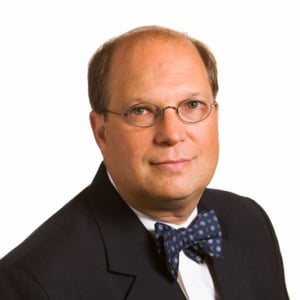
Professorial Lecturer in Law, The George Washington University
Paul Rosenzweig is an accomplished writer and speaker with a national reputation in cyber security and homeland security. He is the founder of Red Branch Consulting PLLC, a homeland security consulting company. He is also a Senior Advisor to The Chertoff Group. Mr. Rosenzweig formerly served as Deputy Assistant Secretary for Policy in the Department of Homeland Security.
He is a Professorial Lecturer in Law at George Washington University, and a Senior Fellow in the Tech, Law & Security Program at the American University, Washington College of Law. He serves as an advisor to and former member of the American Bar Association Standing Committee on Law and National Security, and a Contributing Editor of the Lawfare blog. He is a member of the ABA Cybersecurity Legal Task Force and of the United States Court of Appeals for the District of Columbia Circuit Advisory Committee on Admissions and Grievances. He serves, as well, as a Hearing Committee Member of the District of Columbia Board of Professional Responsibility. In 2011 he was a Carnegie Fellow in National Security Journalism at the Medill School of Journalism, Northwestern University.
Mr. Rosenzweig is a cum laude graduate of the University of Chicago Law School. He has an M.S. in Chemical Oceanography from the Scripps Institution of Oceanography, University of California at San Diego and a B.A from Haverford College. Following graduation from law school he served as a law clerk to the Honorable R. Lanier Anderson, III of the United States Court of Appeals for the Eleventh Circuit.
He is the author of Cyber Warfare: How Conflicts in Cyberspace are Challenging America and Changing the World and of three video lecture series from The Great Courses, Thinking About Cybersecurity: From Cyber Crime to Cyber Warfare; The Surveillance State: Big Data, Freedom, and You; and Investigating American Presidents.
He is the co-author (with James Jay Carafano) of Winning the Long War: Lessons from the Cold War for Defeating Terrorism and Preserving Freedom and co-editor (with Jill D. Rhodes and Robert S. Litt) of the Cybersecurity Handbook (3rd ed.). He is also co-editor (with Timothy McNulty and Ellen Shearer) of two books, Whistleblowers, Leaks and the Media: The First Amendment and National Security, and National Security Law in the News: A Guide for Journalists, Scholars, and Policymakers. Mr. Rosenzweig is a member of the Literary Society of Washington.
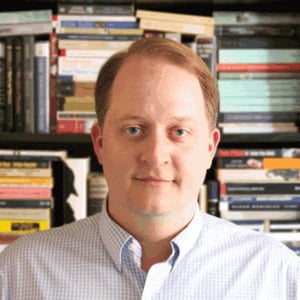
Senior Correspondent, The Daily Beast, and ASU Future of War Fel, New America
Shane Harris is an author and journalist who has written extensively about intelligence and national security. His new book, @War: The Rise of the Military Internet Complex, explores the frontlines of America's new cyber war (Eamon Dolan/Houghton Mifflin Harcourt, 2014). Mr. Harris' first book, The Watchers: The Rise of America's Surveillance, tells the story of five men who played central roles in the creation of a vast national security apparatus and the rise of surveillance in America (Penguin Press, 2010). The Watchers won the New York Public Library's Helen Bernstein Book Award for Excellence in Journalism, and the Economist named it one of the best books of 2010. Mr. Harris is the winner of the 2010 Gerald R. Ford Prize for Distinguished Reporting on National Defense. He has four times been named a finalist for the Livingston Awards for Young Journalists, which honor the best journalists in America under the age of 35.
Mr. Harris is currently a senior correspondent at The Daily Beast, where he covers national security, intelligence, and cyber security. He is also an ASU Future of War Fellow at New America. His work has appeared in The New York Times, The Wall Street Journal, Slate, TheAtlantic.com, National Journal, The Washington Post, The Bulletin of the Atomic Scientists, and the U.S. Naval Institute's Proceedings. He has provided analysis and commentary for CNN, NPR, the BBC, The History Channel, National Geographic, several foreign media organizations and many local public radio stations.
Prior to joining The Daily Beast, Mr. Harris was a senior writer at Foreign Policy magazine and, before that, at the Washingtonian magazine, where he was part of the team that won the publication its 2011 award for Excellence in Writing from the City and Regional Magazine Association. In 2012, Washingtonian won the coveted General Excellence award for the print magazine and web site, where Mr. Harris wrote a blog on national security called ADead Drop.
From 2005 to 2010, Mr. Harris was a staff correspondent for National Journal, where he wrote about intelligence and homeland security. Before that post, he was the technology editor and a staff correspondent at Government Executive magazine. Mr. Harris also was the managing editor for Movieline magazine in Los Angeles. He began his journalism career in 1999, as the research coordinator and a writer for Governing magazine in Washington.
Mr. Harris graduated from Wake Forest University with a B.A. in Politics in 1998. He is also a fiction writer. While living in Los Angeles, he helped found and served as the artistic director of a sketch comedy troupe. Mr. Harris is a Sundance Film Festival screenwriting finalist.

Topics
Annual Threat Assessment of the U.S. Intelligence Community
On April 9, 2021, the Office of the Director of National Intelligence released the Annual...
Capital Conversations: Michael R. Pompeo, U.S. Secretary of State
Michael R. Pompeo
Join us as Mike Pompeo, the U.S. Secretary of State, discusses the priorities and work...
Economic Law & Policy as a Tool of National Security
Gregory G. Katsas, Kristen Silverberg, John C. Yoo, Juan C. Zarate
On November 15, 2019, the Federalist Society's International & National Security Law Practice Group hosted...
The Executive Power: Prerogative Versus Delegated Powers – A King Minus Powers Given to Congress or Subservient to the Legislature?
Martin Flaherty, Michael W. McConnell, Saikrishna Prakash, Amul R. Thapar, John C. Yoo
What role for the executive was envisioned by the Framers and Founding generation? How did...
North Korea Conundrum: Sanctions, Leverage, Balancing Power and Rumors of War
Daniel Blumenthal, Stephen Haggard, Bruce Klingner, Julian Ku
President Trump is pivoting off of the prior administration's "strategic patience" approach to North Korea...
@War: The Rise of the Military-Internet Complex - Podcast
Paul Rosenzweig, Shane Harris
The United States military currently views cyberspace as the “fifth domain” of warfare (alongside land,...