

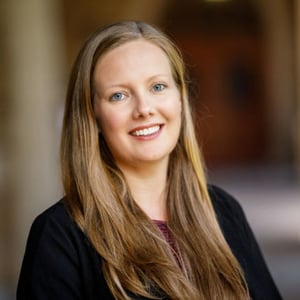
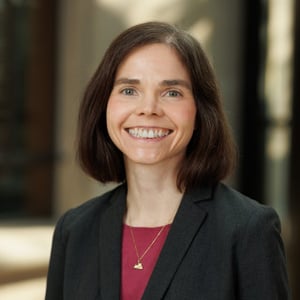
Tara Leigh Grove is the Vinson & Elkins Chair in Law at the University of Texas School of Law. Grove graduated summa cum laude from Duke University and magna cum laude from Harvard Law School, where she served as the Supreme Court Chair of the Harvard Law Review. Grove clerked for Judge Emilio Garza on the U.S. Court of Appeals for the Fifth Circuit, and then spent four years as an attorney for the U.S. Department of Justice, Civil Division, Appellate Staff, where she argued fifteen cases in the courts of appeals.
Grove’s research focuses on the federal judiciary, interpretive theory, and the constitutional separation of powers. She has published with such prestigious law journals as the Harvard Law Review, the Yale Law Journal, the Columbia Law Review, the University of Pennsylvania Law Review, the New York University Law Review, the University of Chicago Law Review, the Virginia Law Review, the Texas Law Review, the Cornell Law Review, the Northwestern University Law Review, and the Vanderbilt Law Review. Grove has received awards for both her research and her teaching.
In 2021, Grove served on the Presidential Commission on the Supreme Court of the United States, a bipartisan commission created by President Biden and charged with examining proposals for Supreme Court reform. Since 2022, Grove has worked on the Princeton Initiative on Reclaiming the Constitutional Powers of Congress, which brings together former members of Congress, political scientists, and law professors. Grove serves as the Co-Chair of the section on the Appointments Process for the Princeton Initiative. Grove is a co-author of Low & Jeffries' Federal Courts and the Law of Federal-State Relations, a leading federal courts casebook, and she has served as the Chair of the Federal Courts Section of the Association of American Law Schools. Grove has been a visiting professor at both Harvard Law School and Northwestern Pritzker School of Law.

25th Annual Federalist Society Faculty Conference
Washington, DCThe Administrative State, Its Supporters and Its Discontents
Steven Gill Bradbury, Emily Bremer, Ronald M. Levin, Steven J. Menashi, Andrew Tutt
The administrative state - the agencies comprising the Executive Branch of the U.S. federal government...
The Administrative State, Its Supporters and Its Discontents
Steven Gill Bradbury, Emily Bremer, Ronald M. Levin, Steven J. Menashi, Andrew Tutt
The administrative state - the agencies comprising the Executive Branch of the U.S. federal government...
Showcase Panel II: Whither Precedent?
Tara Leigh Grove, Randy J. Kozel, Gary Lawson, John O. McGinnis, William H. Pryor
No one maintains that the Court has always and forever been originalist in its orientation....
The Administrative State, Its Supporters and Its Discontents
2023 National Lawyers Convention
Washington, DCShowcase Panel II: Whither Precedent?
2023 National Lawyers Convention
Washington, DCTalks with Authors: What It Means to Be Human
William L. Saunders, O. Carter Snead
In What It Means to Be Human - The Case for the Body in Public...
Talks with Authors: What It Means to Be Human
William L. Saunders, O. Carter Snead
In What It Means to Be Human - The Case for the Body in Public...
Talks with Authors: What It Means to Be Human
Topics
Cultivating Controversy: Proposed ABA Standard Would Link Freedom of Expression to Law School Accreditation
What opinions belong on law school campuses? Given that hundreds of aspiring lawyers flock to...