
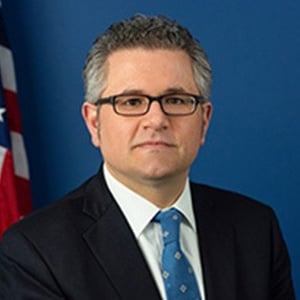
Director, Federal Housing Finance Agency
Mark Calabria is the Director of the Federal Housing Finance Agency.
He was formerly the chief economist for Vice President Mike Pence. Prior to that, he served as Director of Financial Regulation Studies at the Cato Institute. Before joining Cato in 2009, he spent six years as a member of the senior professional staff of the U.S. Senate Committee on Banking, Housing and Urban Affairs. In that position, Calabria handled issues related to housing, mortgage finance, economics, banking and insurance for Ranking Member Richard Shelby (R-AL). Prior to his service on Capitol Hill, Calabria served as Deputy Assistant Secretary for Regulatory Affairs at the U.S. Department of Housing and Urban Development, and also held a variety of positions at Harvard University’s Joint Center for Housing Studies, the National Association of Home Builders and the National Association of Realtors. Calabria has also been a Research Associate with the U.S. Census Bureau’s Center for Economic Studies.
He has extensive experience evaluating the impacts of legislative and regulatory proposals on financial and real estate markets, with particular emphasis on how policy changes in Washington affect low and moderate income households.
He holds a doctorate in economics from George Mason University.
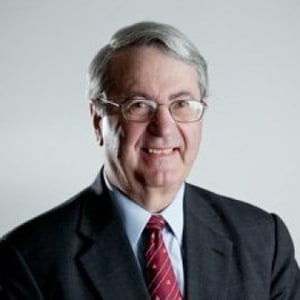
Resident Fellow and Director, AEI Housing Center, American Enterprise Institute
Edward J. Pinto is a resident fellow and the director of the AEI Housing Center at the American Enterprise Institute (AEI). He is currently researching how to increase the entry-level housing supply for first-time buyers and renters who earn hourly wages, as well as examining the current house price boom that began in 2012. This continues his previous work on the role of federal housing policy in the 2008 mortgage and financial crisis.
Along with AEI Resident Scholar Stephen Oliner, Mr. Pinto created the Wealth Building Home Mortgage, a new approach to home finance designed to provide a more reliable and effective way of building wealth than is available under existing policies. This mortgage allows home buyers to maintain a buying power similar to a 30-year loan. It is aimed at a broad range of homebuyers, including low-income, minority, and first-time buyers.
Before joining AEI, Mr. Pinto was an executive vice president and chief credit officer for Fannie Mae until the late 1980s. Today, he is frequently interviewed on radio and television and often testifies before Congress. His writings have been published in trade publications and the popular press, including in the American Banker, The Hill, RealClearPolitics, and The Wall Street Journal. In addition, as the director of the AEI Housing Center, he oversees the monthly publication of the AEI Housing Market Indicators, which has replaced AEI’s monthly Housing Risk Watch and AEI’s FHA Watch.
Mr. Pinto has a JD from Indiana University Maurer School of Law and a BA from the University of Illinois at Urbana-Champaign.

Senior Fellow, Mises Institute
Alex J. Pollock is a Senior Fellow with the Mises Institute, providing thought and policy leadership on financial issues and the study of financial systems. His work includes cycles of booms and busts, financial crises with their political responses, housing finance, government-sponsored enterprises, risk and uncertainty, central banking, banking and financial regulation, corporate governance, retirement finance, student loans, and the politics of finance.
He previously served as the Principal Deputy Director of the Office of Financial Research in the U.S. Treasury Department 2019-2021. He was a Distinguished Senior Fellow with the R Street Institute 2015-2019 and 2021, and a resident fellow at the American Enterprise Institute, 2004-2015. Among the many aspects of his AEI work, he developed the One Page Mortgage Form to give borrowers in clear form the key information they need in order to know what they are committing themselves to. He was President and CEO of the Federal Home Loan Bank of Chicago from 1991 to 2004. There he invented the Mortgage Partnership Finance program, which successfully created front-end mortgage credit risk sharing beginning in 1997. His decades of banking experience include being a Visiting Scholar at the Federal Reserve Bank of St. Louis, 1991.
Pollock was a director of the CME Group 2004-2019 and of Ascendium Education Group 1989-2019. He is a director and past-chairman of the Great Books Foundation and a past president of the International Union for Housing Finance.
He is the co-author of Surprised Again! - The COVID Crisis and the New Market Bubble (2022), and the author of Finance and Philosophy—Why We’re Always Surprised (2018) and Boom and Bust: Financial Cycles and Human Prosperity (2011), as well as numerous articles and Congressional testimony.
Pollock is a graduate of Williams College, the University of Chicago, and Princeton University.
His work is available on alexjpollock.com.

Senior Fellow, Arthur F. Burns Fellow in Financial Policy Studies, American Enterprise Institute
Peter J. Wallison holds the Arthur F. Burns Chair in Financial Policy Studies and is co-director of AEI’s program on Financial Policy Studies. Prior to joining AEI, he practiced banking, corporate and financial law at Gibson, Dunn & Crutcher in Washington, D.C., and New York. Mr. Wallison has held a number of government positions. From June 1981 to January 1985, he was General Counsel of the United States Treasury Department, where he had a significant role in the development of the Reagan Administration's proposals for deregulation in the financial services industry. During 1986 and 1987, Mr. Wallison was White House counsel to President Ronald Reagan, and between 1972 and 1976, he served first as Special Assistant to New York's Gov. Nelson A. Rockefeller and, subsequently, as counsel to Mr. Rockefeller as vice president of the United States.
Mr. Wallison was admitted to practice before the courts of New York and the District of Columbia, and is retired from practice in New York. He continues to be a member of the District of Columbia Bar Association. He received his undergraduate degree from Harvard College in 1963 and law degree from Harvard Law School in 1966.
Mr. Wallison is the author of Ronald Reagan: The Power of Conviction and the Success of His Presidency, published in December 2002 by Westview Press. On campaign finance, he is the author (with Joel Gora) of Better Parties, Better Government, (AEI Press 2009). On financial or regulatory matters, he is the author of Back From the Brink, a proposal for a private deposit insurance system, and co-author of Nationalizing Mortgage Risk: The Growth of Fannie Mae and Freddie Mac; The GAAP Gap: Corporate Disclosure in the Internet Age; Competitive Equity: A Better Way to Organize Mutual Funds; Bad History, Worse Policy: How a False Narrative about the Financial Crisis Led to the Dodd-Frank Act (AEI Press 2013); and Hidden In Plain Sight: What Caused the World’s Worst Financial Crisis and Why it Could Happen Again (Encounter Books 2015). His most recent book is Judicial Fortitude: The Last Chance to Rein in the Administrative State, published by Encounter Books in October 2018.
He testifies frequently before committees of Congress, and is a frequent contributor to the op-ed pages of the Wall Street Journal and other print and online journals. He has also been a speaker at many conferences on financial services, housing, the causes of the financial crisis, the Dodd-Frank Act, accounting, and corporate governance, and was a member of the Shadow Financial Regulatory Committee between 1995 and 2015. He was a member of the SEC Advisory Committee on Improvements to Financial Reporting (2008), co-Chair of the Pew Financial Reform Task Force (2009), and a member of the congressionally- appointed Financial Crisis Inquiry Commission (2009-2011). In May 2011, for his work in financial policy, Mr. Wallison received an honorary doctorate in Humane Letters from the University of Colorado.

Wayne A. Abernathy, Wild Bells
Wayne A. Abernathy is a former U.S. Treasury Assistant Secretary for Financial Institutions under President George W. Bush, receiving the Alexander Hamilton Award in recognition of his service. In that office he was also a member of the Board of Directors of the Securities Investor Protection Corporation. Prior to his work at the Treasury, Mr. Abernathy served as Staff Director of the Senate Banking Committee, under Chairman Phil Gramm.
Following his service at the Treasury, Mr. Abernathy worked for 15 years on the staff of the American Bankers Association, as Executive Vice President for Financial Institutions Policy and Regulatory Affairs.
Previous experience with the Senate Banking Committee includes serving as Staff Director of the Subcommittee on Securities during 1995-1998. From 1989 until 1994, Mr. Abernathy was a Republican economist for the committee. He previously worked as a senior legislative assistant for Senator Gramm during 1987-1989 and as an economist for the Banking Committee’s Subcommittee on International Finance and Monetary Policy during 1981-1986, under Chairman Jake Garn.
Mr. Abernathy earned his bachelor’s degree in International Studies from The Johns Hopkins University in 1978. In 1980, he received a master’s degree in International Studies from the School of Advanced International Studies of The Johns Hopkins University.
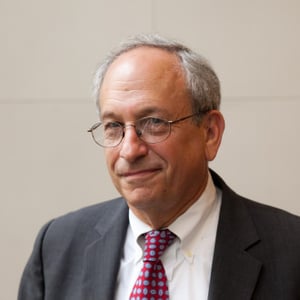
Robert V. Roosa Chair in International Economics; Senior Fellow - Economic Studies, The Brookings Institution
Donald Kohn holds the Robert V. Roosa Chair in International Economics and is a senior fellow in the Economic Studies program at the Brookings Institution. He also currently serves as an external member of the Financial Policy Committee at the Bank of England. Kohn is a 40-year veteran of the Federal Reserve system, serving as member and then vice chair of the Board of Governors from 2002-2010. Kohn is an expert on monetary policy, financial regulation, and macroeconomics and has written extensively on these issues. Prior to taking office as a member of the Board of Governors he served in a number of staff roles at the Board, including secretary of the Federal Open Market Committee (1987-2002) and director of the Division of Monetary Affairs (1987-2001). He has also served as chairman of the Committee on the Global Financial System (CGFS), a central bank panel that monitors and examines broad issues related to financial markets and systems. He advised Federal Reserve Chairman Ben Bernanke throughout the 2008-2009 financial crisis and served as a key adviser to former Fed Chairman Alan Greenspan. He was awarded the Distinguished Achievement Award from The Money Marketeers of New York University (2002), lifetime achievement awards from The Clearing House (2012) and Central Banking magazine (2017), the Distinguished Alumni Award from the College of Wooster (1998), and the Honorary Degree, Doctor of Laws, from the College of Wooster (2006). In 2016, he was made honorary Commander of the British Empire. Kohn was born in November 1942 in Philadelphia. He received a B.A. in economics in 1964 from the College of Wooster and a Ph.D. in economics in 1971 from the University of Michigan. He is married and has two adult children and four grandchildren.

Judge, United States Court of Appeals, Third Circuit
Judge Paul Matey was appointed to the United States Court of Appeals for the Third Circuit in 2019 by President Trump.
Before his judicial service, Judge Matey was a partner at Lowenstein Sandler in New Jersey where he practiced complex commercial litigation and criminal defense. Earlier, Judge Matey was the Senior Vice President, General Counsel and Secretary for University Hospital Newark, an academic medical center and teaching hospital.
He also served as the Deputy Chief Counsel to Governor Chris Christie, and as an Assistant United States Attorney in the District of New Jersey, where he was awarded the Justice Department’s Director’s Award for Superior Performance. He also practiced at the Washington D.C. firm of Kellogg, Hansen, Todd, Figel & Frederick, and served as a law clerk to judges on the United States Court of Appeals for the Third Circuit and the United States District Court for the District of New Jersey.
He earned his bachelor’s degree from the University of Scranton, a Jesuit University, in 1993, and his juris doctorate, summa cum laude, from Seton Hall University School of Law in 2001, where he served as Editor-in-Chief of the Seton Hall Law Review.
In 2019, Judge Matey was elected to membership in the American Law Institute and, since 2020, has lectured on administrative law and the American legal history at Seton Hall.
Senior Fellow, Mises Institute
Alex J. Pollock is a Senior Fellow with the Mises Institute, providing thought and policy leadership on financial issues and the study of financial systems. His work includes cycles of booms and busts, financial crises with their political responses, housing finance, government-sponsored enterprises, risk and uncertainty, central banking, banking and financial regulation, corporate governance, retirement finance, student loans, and the politics of finance.
He previously served as the Principal Deputy Director of the Office of Financial Research in the U.S. Treasury Department 2019-2021. He was a Distinguished Senior Fellow with the R Street Institute 2015-2019 and 2021, and a resident fellow at the American Enterprise Institute, 2004-2015. Among the many aspects of his AEI work, he developed the One Page Mortgage Form to give borrowers in clear form the key information they need in order to know what they are committing themselves to. He was President and CEO of the Federal Home Loan Bank of Chicago from 1991 to 2004. There he invented the Mortgage Partnership Finance program, which successfully created front-end mortgage credit risk sharing beginning in 1997. His decades of banking experience include being a Visiting Scholar at the Federal Reserve Bank of St. Louis, 1991.
Pollock was a director of the CME Group 2004-2019 and of Ascendium Education Group 1989-2019. He is a director and past-chairman of the Great Books Foundation and a past president of the International Union for Housing Finance.
He is the co-author of Surprised Again! - The COVID Crisis and the New Market Bubble (2022), and the author of Finance and Philosophy—Why We’re Always Surprised (2018) and Boom and Bust: Financial Cycles and Human Prosperity (2011), as well as numerous articles and Congressional testimony.
Pollock is a graduate of Williams College, the University of Chicago, and Princeton University.
His work is available on alexjpollock.com.
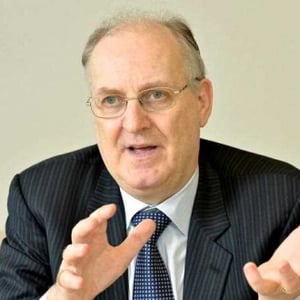
Senior Fellow, Mossavar-Rahmani Center for Business and Government, Harvard Kennedy School
Paul Sheard is Senior Fellow of the Mossavar-Rahmani Center for Business and Government at Harvard Kennedy School. Previously, he was Vice Chairman of S&P Global, after serving as Executive Vice President and Chief Economist. Earlier, he held chief economist positions at Standard & Poor’s Ratings Services, Nomura Securities and Lehman Brothers, and was Head of Japan Equity Investments at Baring Asset Management. Sheard was on the faculty of the Australian National University (ANU) and of Osaka University, and was a visiting assistant professor at Stanford University and foreign visiting scholar at the Bank of Japan.
Sheard is a member of the World Economic Forum’s Global Future Council on the New Economic Agenda (2018-2020) and was a member of the WEF’s Global Agenda Council on the International Monetary System (2010-2012). He was appointed twice, by Prime Minister Hashimoto and by Prime Minister Obuchi, to serve on committees of the Japanese Government’s Economic Deliberation Council. He is on the board of the Foreign Policy Association and is a member of the Bretton Woods Committee, the Council on Foreign Relations, and the Economic Club of New York. Sheard served as a non-executive director of ORIX Corporation (2003-2010). He speaks regularly at conferences around the world, and his views on the global economy and policy are frequently cited in the international press.
Author or editor of several books and numerous academic articles, Sheard’s book in Japanese, Mein Banku Shihon Shugi no Kiki (The Crisis of Main Bank Capitalism), won the Suntory-Gakugei Prize in the Economics–Politics Division. Sheard received a BA (Hons) from Monash University and a Master of Economics and Ph.D. from the ANU. In 2019, he received a Doctor of Laws honoris causa from Monash University.
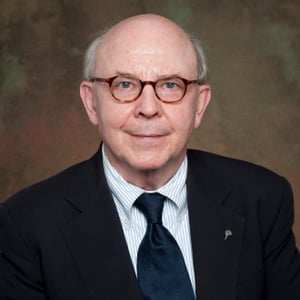
Professor Emeritus of Economics, New York University Stern School of Business
Richard Sylla is Professor Emeritus of Economics at the Stern School of Business, New York University, where from 1990 to 2015 he was Henry Kaufman Professor of the History of Financial Institutions and Markets. Sylla is also a Research Associate of the National Bureau of Economic Research, a Fellow of the Cliometric Society, and a Fellow of the American Academy of Arts & Sciences.
Professor Sylla received the B.A., the M.A., and the Ph.D. from Harvard University, where he was elected to Phi Beta Kappa. His research focus is on the financial history of the United States in comparative contexts. He is the author of Alexander Hamilton: The Illustrated Biography (2016) and The American Capital Market, 1846-1914 (1975); co-author of Alexander Hamilton on Finance, Credit, and Debt (2018), The Evolution of the American Economy (1993; 1st ed., 1980) and A History of Interest Rates, (4th ed., 2005; 3rd ed. Rev., 1996; 3rd ed., 1991); and co-editor of Patterns of European Industrialization—The Nineteenth Century (1991), The State, the Financial System, and Economic Modernization (1999); Founding Choices: American Economic Policy in the 1790s (2011); and Genealogy of American Finance (2015), as well as articles, essays, and reviews in business, economic, and financial history.
Sylla is a former editor of The Journal of Economic History. During 1998-2000, Sylla served as chairman of the board of trustees of the Cliometric Society, an association of quantitative economic historians. In 2000-2001, he was president of the Economic History Association, the professional organization of economic historians in the United States. In 2005-2006, he served as president of the Business History Conference (BHC), the leading professional association of business historians; BHC presented its Lifetime Achievement Award to him in 2011. Currently, Sylla serves as chairman of the board of trustees of the Museum of American Finance, a Smithsonian affiliate museum located at 48 Wall Street in New York.
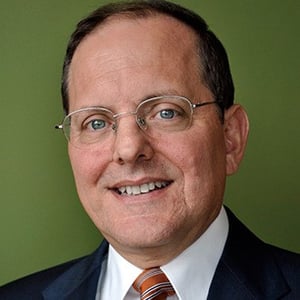
President, Housing Policy Council
Ed DeMarco is President of the Housing Policy Council. Prior to joining HPC in June 2017, DeMarco was a senior fellow in residence at the Milken Institute’s Center for Financial Markets.
From 2009 to 2014, DeMarco was acting director of the Federal Housing Finance Agency (FHFA), where he served as the conservator for Fannie Mae and Freddie Mac and regulator of those companies and the Federal Home Loan Banks. He was named HousingWire Magazine’s Person of the Year in 2012 for his impact on housing finance. DeMarco was chief operating officer and senior deputy director of the FHFA and its predecessor agency from 2006 to 2009.
DeMarco’s career in public service includes positions at the Social Security Administration, the Treasury Department, and GAO. He earned a B.A. in economics from the University of Notre Dame and a Ph.D. in economics from the University of Maryland.
Senior Fellow, Mises Institute
Alex J. Pollock is a Senior Fellow with the Mises Institute, providing thought and policy leadership on financial issues and the study of financial systems. His work includes cycles of booms and busts, financial crises with their political responses, housing finance, government-sponsored enterprises, risk and uncertainty, central banking, banking and financial regulation, corporate governance, retirement finance, student loans, and the politics of finance.
He previously served as the Principal Deputy Director of the Office of Financial Research in the U.S. Treasury Department 2019-2021. He was a Distinguished Senior Fellow with the R Street Institute 2015-2019 and 2021, and a resident fellow at the American Enterprise Institute, 2004-2015. Among the many aspects of his AEI work, he developed the One Page Mortgage Form to give borrowers in clear form the key information they need in order to know what they are committing themselves to. He was President and CEO of the Federal Home Loan Bank of Chicago from 1991 to 2004. There he invented the Mortgage Partnership Finance program, which successfully created front-end mortgage credit risk sharing beginning in 1997. His decades of banking experience include being a Visiting Scholar at the Federal Reserve Bank of St. Louis, 1991.
Pollock was a director of the CME Group 2004-2019 and of Ascendium Education Group 1989-2019. He is a director and past-chairman of the Great Books Foundation and a past president of the International Union for Housing Finance.
He is the co-author of Surprised Again! - The COVID Crisis and the New Market Bubble (2022), and the author of Finance and Philosophy—Why We’re Always Surprised (2018) and Boom and Bust: Financial Cycles and Human Prosperity (2011), as well as numerous articles and Congressional testimony.
Pollock is a graduate of Williams College, the University of Chicago, and Princeton University.
His work is available on alexjpollock.com.

Laurence A. Tisch Professor of Law and Director, Classical Liberal Institute, New York University School of Law; Senior Fellow, The Civitas Institute, University of Texas at Austin
Richard A. Epstein is the inaugural Laurence A. Tisch Professor of Law at NYU School of Law. Prior to his joining the faculty, he was a visiting law professor at NYU from 2007 through 2009. He served as the Peter and Kirstin Bedford Senior Fellow at the Hoover Institution from 2000 to 2024. Since 2024 to the present he is a senior lecturer at the Civitas Institute at the University of Texas—Austin. Epstein is also the James Parker Hall Distinguished Service Professor of Law Emeritus and a senior lecturer at the University of Chicago. His initial law school appointment was at the University of Southern California from 1968 to 1972. Epstein received an LL.D., h.c. from the University of Ghent, 2003. He has been a member of the American Academy of Arts and Sciences since 1985 and was a Senior Fellow of the Center for Clinical Medical Ethics at the University of Chicago Division of Biological Sciences, also from 1983. to 2022 He served as editor of the Journal of Legal Studies from 1981 to 1991, and of the Journal of Law and Economics from 1991-2001. From 2001 to 2010 he was a director of the John M. Olin Program in Law and Economics at the University of Chicago.
His newest book, The Myth of Birthright Citizenship: What the Fourteenth Amendment Really Says was published in 2026 (Encounter Books). Prior to that he has published many books including, The Dubious Morality of the Modern Administrative State (Roman & Littlefield 2020).Earlier he published th Classical Liberal Constitution: The Uncertain Quest for Limited Government (Harvard 2014) iHis previous books include Design for Liberty: Private Property, Public Administration and the Rule of Law (Harvard 2011); The Case Against the Employee Free Choice Act (Hoover 2009); Supreme Neglect: How to Revive the Constitutional Protection of Property Rights (Oxford 2008); Antitrust Decrees in Theory and Practice: Why Less is More (AEI 2007); Overdose: How Excessive Government Regulation Stifles Pharmaceutical Innovation (Yale University Press. 2006); How Progressives Rewrote the Constitution (Cato 2006); Cases and Materials on Torts (Aspen Law & Business; 8th ed. 2004); Skepticism and Freedom: A Modern Case for Classical Liberalism (University of Chicago, 2003); Torts (Aspen Law & Business 1999); Principles for a Free Society: Reconciling Individual Liberty with the Common Good (Perseus Books, 1998): Mortal Peril: Our Inalienable Rights to Health Care (Addison-Wesley, 1997); Simple Rules for a Complex World (Harvard, 1995); Bargaining With the State (Princeton, 1993); Forbidden Grounds: The Case Against Employment Discrimination Laws (Harvard , 1992); Takings: Private Property and the Power of Eminent Domain (Harvard, 1985); and Modern Products Liability Law (Greenwood Press, 1980). He has also edited(with Catherine M. Sharkey) Cases and Materials on the Law of Torts (10th edition 2012).
Professor Epstein has written numerous articles on a wide range of legal and interdisciplinary subjects. He has taught courses in administrative law, antitrust law, civil procedure, communications, constitutional law, contracts, corporations, criminal law, employment discrimination law, environmental law, food and drug law health law and policy, legal history, labor law, property, real estate development and finance, jurisprudence, labor law; land use planning, patents, individual, estate and corporate taxation, Roman Law; torts, and workers' compensation.
Professor Epstein also writes a regular column for Civitas Institute, which also sponsors his podcast, The Libertarian with Charles C.W. Cooke, and Law Talk, with Cooke and John Yoo. He also does a podcast with John Batchelor. And appears regularly on the Freedom File with Judge Andrew Napolitano.

Executive Vice President, The Federalist Society
Dean Reuter is Executive Vice President at the Federalist Society for Law and Public Policy Studies. He has served in two federal government agency Offices of the Inspector General, as Counsel to the Inspector General and Deputy Inspector General, responsible for policing the use of federal funds granted and contracted through those agencies. As such, he helped conduct and oversee criminal investigations across the country. He is the principal author of the non-fiction book, The Hidden Nazi: The Untold Story of America's Deal with the Devil, and editor of Liberty’s Nemesis: The Unchecked Expansion of the State and Confronting Terror: 9/11 and the Future of American National Security. He was appointed by the President and served as Vice-Chairman of the Board of Directors of the Corporation for National and Community Service, and recently served as an appointee on the U.S. Commission on Presidential Scholars. He is a graduate of Hood College (BA with Honors) and the University of Maryland School of Law.
Senior Fellow, Arthur F. Burns Fellow in Financial Policy Studies, American Enterprise Institute
Peter J. Wallison holds the Arthur F. Burns Chair in Financial Policy Studies and is co-director of AEI’s program on Financial Policy Studies. Prior to joining AEI, he practiced banking, corporate and financial law at Gibson, Dunn & Crutcher in Washington, D.C., and New York. Mr. Wallison has held a number of government positions. From June 1981 to January 1985, he was General Counsel of the United States Treasury Department, where he had a significant role in the development of the Reagan Administration's proposals for deregulation in the financial services industry. During 1986 and 1987, Mr. Wallison was White House counsel to President Ronald Reagan, and between 1972 and 1976, he served first as Special Assistant to New York's Gov. Nelson A. Rockefeller and, subsequently, as counsel to Mr. Rockefeller as vice president of the United States.
Mr. Wallison was admitted to practice before the courts of New York and the District of Columbia, and is retired from practice in New York. He continues to be a member of the District of Columbia Bar Association. He received his undergraduate degree from Harvard College in 1963 and law degree from Harvard Law School in 1966.
Mr. Wallison is the author of Ronald Reagan: The Power of Conviction and the Success of His Presidency, published in December 2002 by Westview Press. On campaign finance, he is the author (with Joel Gora) of Better Parties, Better Government, (AEI Press 2009). On financial or regulatory matters, he is the author of Back From the Brink, a proposal for a private deposit insurance system, and co-author of Nationalizing Mortgage Risk: The Growth of Fannie Mae and Freddie Mac; The GAAP Gap: Corporate Disclosure in the Internet Age; Competitive Equity: A Better Way to Organize Mutual Funds; Bad History, Worse Policy: How a False Narrative about the Financial Crisis Led to the Dodd-Frank Act (AEI Press 2013); and Hidden In Plain Sight: What Caused the World’s Worst Financial Crisis and Why it Could Happen Again (Encounter Books 2015). His most recent book is Judicial Fortitude: The Last Chance to Rein in the Administrative State, published by Encounter Books in October 2018.
He testifies frequently before committees of Congress, and is a frequent contributor to the op-ed pages of the Wall Street Journal and other print and online journals. He has also been a speaker at many conferences on financial services, housing, the causes of the financial crisis, the Dodd-Frank Act, accounting, and corporate governance, and was a member of the Shadow Financial Regulatory Committee between 1995 and 2015. He was a member of the SEC Advisory Committee on Improvements to Financial Reporting (2008), co-Chair of the Pew Financial Reform Task Force (2009), and a member of the congressionally- appointed Financial Crisis Inquiry Commission (2009-2011). In May 2011, for his work in financial policy, Mr. Wallison received an honorary doctorate in Humane Letters from the University of Colorado.
Executive Vice President, The Federalist Society
Dean Reuter is Executive Vice President at the Federalist Society for Law and Public Policy Studies. He has served in two federal government agency Offices of the Inspector General, as Counsel to the Inspector General and Deputy Inspector General, responsible for policing the use of federal funds granted and contracted through those agencies. As such, he helped conduct and oversee criminal investigations across the country. He is the principal author of the non-fiction book, The Hidden Nazi: The Untold Story of America's Deal with the Devil, and editor of Liberty’s Nemesis: The Unchecked Expansion of the State and Confronting Terror: 9/11 and the Future of American National Security. He was appointed by the President and served as Vice-Chairman of the Board of Directors of the Corporation for National and Community Service, and recently served as an appointee on the U.S. Commission on Presidential Scholars. He is a graduate of Hood College (BA with Honors) and the University of Maryland School of Law.

Harry Kalven, Jr. Professor of Law & Faculty Director, Constitutional Law Institute, University of Chicago Law School
William Baude is a Professor of Law and the Faculty Director of the Constitutional Law Institute at the University of Chicago Law School, where he teaches federal courts, constitutional law, and conflict of laws. His current research interests include different aspects of the Fourteenth Amendment (particularly both Section One and Section Three) and the nature of judicial discretion.
Among his other activities Baude is: the co-editor of two textbooks, The Constitution of the United States and Hart & Wechsler's Federal Courts in the Federal System; an Affiliated Scholar at the Center for the Study of Constitutional Originalism; a founding member of the Academic Freedom Alliance; a member of the American Law Institute; an occasional blogger at The Volokh Conspiracy; and a podcaster on Divided Argument. He also recently served on the Presidential Commission on the Supreme Court of the United States.
Professor Baude received his BS in Mathematics from the University of Chicago and his JD from Yale Law School. He then clerked for then-Judge Michael McConnell on the United States Court of Appeals, and Chief Justice John Roberts on the United States Supreme Court. Before joining the Chicago faculty, he was a fellow at the Stanford Constitutional Law Center, and a lawyer in Washington, DC.
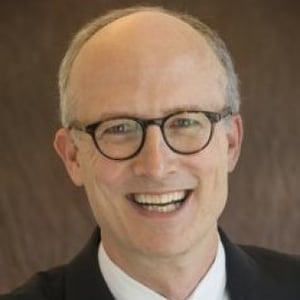
Michael J. Marks Professor of Law, University of Chicago Law School
M. Todd Henderson is the Michael J. Marks Professor of Law at the University of Chicago Law School. Professor Henderson’s research interests include corporations, securities regulation, and law and economics. He has taught classes ranging from Banking Regulation to Torts to American Indian Law.
Professor Henderson received an engineering degree cum laude from Princeton University in 1993. He worked for several years designing and building dams in California before matriculating at the Law School. While at the Law School, Todd was an editor of the Law Review and captained the Law School's all-University champion intramural football team. He graduated magna cum laude in 1998 and was elected to the Order of the Coif. Following law school, Todd served as clerk to the Hon. Dennis Jacobs of the US Court of Appeals for the Second Circuit. He then practiced appellate litigation at Kirkland & Ellis in Washington, DC, and was an engagement manager at McKinsey & Company in Boston, where he specialized in counseling telecommunications and high-tech clients on business and regulatory strategy.
D'Alemberte Professor, Florida State University College of Law
Professor Markel's scholarship develops a new theory of retributive justice for liberal democracies, and applies that theory in particular to topics such as the proper scope of mercy, the death penalty, punitive damages, shaming punishments, and transitional justice in states recovering from mass atrocities.
His work has been published in leading law reviews, and he also has written for or appeared as a commentator in a wide variety of national and international mass media. Raised in Toronto, he studied politics and philosophy as an undergraduate at Harvard. He then did graduate work in political philosophy at the Hebrew University of Jerusalem and the University of Cambridge, before returning to Harvard for his law degree, where he was an Olin Fellow and on law review. Upon graduation from law school, Professor Markel was a research fellow at the Berkman Center at Harvard Law School, a clerk for Judge Michael Daly Hawkins on the U.S. Court of Appeals for the Ninth Circuit, and an associate at Kellogg, Huber, Hansen, Todd, Evans & Figel in Washington, D.C., where he practiced white-collar criminal defense and civil litigation in trial and appellate courts. He teaches primarily in the area of criminal law.

Professor of Law, Georgetown University Law Center
Nicholas Quinn Rosenkranz teaches constitutional law and federal jurisdiction, and he writes articles for the Harvard Law Review and the Stanford Law Review.
He is currently developing a new theory of constitutional interpretation and judicial review. The first installment, entitledThe Subjects of the Constitution, was published in the Stanford Law Review in May of 2010, and it is among the most downloaded articles about constitutional interpretation, judicial review, and/or federal courts in the history of SSRN. The second installment, The Objects of the Constitution, was published in May of 2011, also in the Stanford Law Review. And the comprehensive version is forthcoming as a book by Oxford University Press.
Rosenkranz has served and advised the federal government in a variety of capacities. He clerked for Judge Frank H. Easterbrook on the U.S. Court of Appeals for the Seventh Circuit (1999-2000) and for Justice Anthony M. Kennedy at the U.S. Supreme Court (October Term 2001). He served as an Attorney-Advisor at the Office of Legal Counsel in the U.S. Department of Justice (November 2002 - July 2004). He often testifies before Congress as a constitutional expert—most recently before the House Financial Services Oversight Subcommittee, regarding the Obama Administration's use of bank settlement agreements to circumvent the Appropriations Clause. He has also filed briefs and presented oral argument before the U.S. Supreme Court. His most recent Supreme Court brief, in Los Angeles v. Patel, was cited by Justice Alito in dissent.
Rosenkranz is a member of the New York Bar and the U.S. Supreme Court Bar. He is a Senior Fellow at the Cato Institute. He serves on the Board of Directors of the Foundation for Individual Rights in Education (FIRE). He is a founding member of Heterodox Academy and a member of its Executive Committee. He also serves on the Board of Directors of the Federalist Society and as the faculty advisor to the Georgetown chapter.
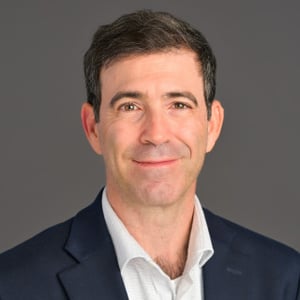
DeMuth Chair of Business Law, University of Colorado Law School
Andrew A. Schwartz joined the Colorado Law faculty in 2008 and was promoted to full professor in 2017. He teaches and publishes on corporate, securities and contract law, and has become an internationally recognized expert on investment crowdfunding. In 2017, Professor Schwartz served as a Fulbright Research Scholar and visiting professor at the University of Auckland Law School in New Zealand.
Professor Schwartz earned an Sc.B. in Civil Engineering from Brown University and a J.D. from Columbia University, where he served on the Columbia Law Review and was named a James Kent Scholar (top honors) all three years. Before entering academia, he clerked for Judge William A. Fletcher of the U.S. Court of Appeals for the Ninth Circuit and Judge Naomi Reice Buchwald of the U.S. District Court for the Southern District of New York. Following his clerkships, Professor Schwartz practiced corporate law in New York at Wachtell, Lipton, Rosen & Katz.
Professor Schwartz is the author of one book, Investment Crowdfunding, forthcoming from the Oxford University Press, as well as more than forty scholarly publications. His major articles have appeared in leading flagship law reviews including the UCLA Law Review, Minnesota Law Review, and Notre Dame Law Review, top specialty journals such as the Yale Journal on Regulation and Harvard Business Law Review, and peer-reviewed journals like the New Zealand Law Review.
Professor Schwartz has won numerous national awards for his scholarship, including the AALS Scholarly Paper Competition and the Federalist Society Young Legal Scholars Paper Competition. At Colorado Law, Professor Schwartz has received the Provost's Award for Faculty Achievement, the Gilbert Goldstein Faculty Fellowship, and the Outstanding New Faculty Award. His research is frequently cited and relied upon by courts and commentators across the country and around the world, including numerous citations by the Delaware Court of Chancery, the nation's leading venue for corporate law.
Associate Professor of Law, New York Law School
Houman B. Shadab is an internationally recognized expert in financial law and regulation whose research focuses on hedge funds and credit derivatives. Professor Shadab is an Associate Director of the Center on Financial Services Law and teaches Contracts, Corporations, and a seminar on financial regulatory policy. He also serves as the Editor-in-Chief of the Journal of Taxation and Regulation of Financial Institutions. His blog is Lawbitrage.
Professor Shadab has testified before Congress on the compensation of public company executives and also on the role of hedge funds in the financial crisis at a hearing that included George Soros, John Paulson, and other leading figures from the hedge fund industry. Professor Shadab is often invited to speak at academic meetings and those for high level market practitioners and policymakers. In May of 2010, he delivered a keynote presentation on financial complexity at a forum for investors in Switzerland and joined a group of speakers that included former British Prime Minister Tony Blair and leading economists from major financial institutions. He will be speaking in October 2011 on Dodd-Frank and regulatory arbitrage at the 17th annual Risk USA conference in New York City.
Professor Shadab is the author of several academic articles published in journals such as the New York University Journal of Legislation and Public Policy and the Berkeley Business Law Journal. He is frequently asked to contribute to authoritative works and is currently writing or recently published book chapters on hedge fund lending, credit default swaps, and short selling for books to be published by Oxford University Press, Elsevier, and Wiley Finance. Governmental authorities worldwide have cited Professor Shadab's research, including the Delaware Court of Chancery, the U.S. Congressional Oversight Panel, the U.K. House of Lords, the European Parliament, the Reserve Bank of India, and the Secretary General of Japan's Securities and Exchange Surveillance Commission.
Professor Shadab has been quoted in numerous media publications including the New York Times, the Financial Times, and the Washington Post, and has appeared on Bloomberg Television. He serves on the Advisory Board of the NY Business Law Journal and the U.K.-based Hedge Fund Society, and is an affiliated Scholar with George Washington University's Regulatory Studies Center. Professor Shadab is also a member of the New York and California bars and previously practiced law with Ropes & Gray in New York City and Latham & Watkins in Los Angeles.

Thomas M. Siebel Senior Fellow, The Hoover Institution, Stanford University; Gary T. Schwartz Distinguished Professor of Law Emeritus, UCLA School of Law
Eugene Volokh is the Thomas M. Siebel Senior Fellow at the Hoover Institution (Stanford), as well as the Gary T. Schwartz Distinguished Professor of Law Emeritus and Distinguished Research Professor at UCLA School of Law. He recently retired from teaching at UCLA, after 30 years there, and is now focusing on research.
Volokh is the author of the textbooks The First Amendment and Related Statutes (8th ed. 2023), and Academic Legal Writing (5th ed. 2016), as well as over 100 academic law journal articles, mostly on First Amendment law. He is a member of The American Law Institute; the editor-in-chief of the Journal of Free Speech Law; and the creator and coauthor of The Volokh Conspiracy, a leading legal blog founded in 2002 (hosted at the Washington Post from 2014 to 2017 and now at Reason Magazine).
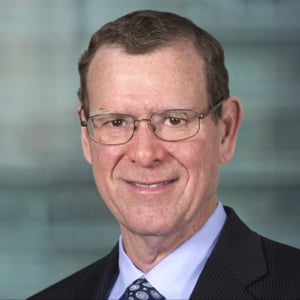
Executive in Residence, Wake Forest University School of Business
John Allison is an Executive in Residence at the Wake Forest School of Business. He is a member of the Cato Institute’s Board of Directors and Chairman of the Executive Advisory Council of the Cato Institute’s Center for Monetary and Financial Alternatives. Allison was president and CEO of the Cato Institute from October 2012 to April 2015. Prior to joining Cato, Allison was chairman and CEO of BB&T Corporation, the 10th-largest financial services holding company headquartered in the United States. During his tenure as CEO from 1989 to 2008, BB&T grew from $4.5 billion to $152 billion in assets. He was recognized by theHarvard Business Reviewas one of the top 100 most successful CEOs in the world over the last decade.
Allison has received the Corning Award for Distinguished Leadership, been inducted into the North Carolina Business Hall of Fame, and received the Lifetime Achievement Award from theAmerican Banker. He is the author of The Financial Crisis and the Free Market Cure: Why Pure Capitalism Is the World Economy’s Only Hope and The Leadership Crisis and the Free Market Cure: Why the Future of Business Depends on the Return to Life, Liberty, and the Pursuit of Happiness. In addition, he is a former Distinguished Professor of Practice at Wake Forest University School of Business, and serves on the Board of Visitors at the business schools at Wake Forest, Duke, and the University of North Carolina–Chapel Hill.
Allison is a Phi Beta Kappa graduate of the University of North Carolina–Chapel Hill. He received his master’s degree in management from Duke University and is also a graduate of the Stonier Graduate School of Banking. Allison is the recipient of six honorary doctorate degrees.
Associate Professor of Economics and Law, University of Missouri at Kansas City (UMKC) School of Law
Senior Fellow, Mises Institute
Alex J. Pollock is a Senior Fellow with the Mises Institute, providing thought and policy leadership on financial issues and the study of financial systems. His work includes cycles of booms and busts, financial crises with their political responses, housing finance, government-sponsored enterprises, risk and uncertainty, central banking, banking and financial regulation, corporate governance, retirement finance, student loans, and the politics of finance.
He previously served as the Principal Deputy Director of the Office of Financial Research in the U.S. Treasury Department 2019-2021. He was a Distinguished Senior Fellow with the R Street Institute 2015-2019 and 2021, and a resident fellow at the American Enterprise Institute, 2004-2015. Among the many aspects of his AEI work, he developed the One Page Mortgage Form to give borrowers in clear form the key information they need in order to know what they are committing themselves to. He was President and CEO of the Federal Home Loan Bank of Chicago from 1991 to 2004. There he invented the Mortgage Partnership Finance program, which successfully created front-end mortgage credit risk sharing beginning in 1997. His decades of banking experience include being a Visiting Scholar at the Federal Reserve Bank of St. Louis, 1991.
Pollock was a director of the CME Group 2004-2019 and of Ascendium Education Group 1989-2019. He is a director and past-chairman of the Great Books Foundation and a past president of the International Union for Housing Finance.
He is the co-author of Surprised Again! - The COVID Crisis and the New Market Bubble (2022), and the author of Finance and Philosophy—Why We’re Always Surprised (2018) and Boom and Bust: Financial Cycles and Human Prosperity (2011), as well as numerous articles and Congressional testimony.
Pollock is a graduate of Williams College, the University of Chicago, and Princeton University.
His work is available on alexjpollock.com.
Founder & Chief Executive Officer, Whitebox Advisors

Judge, United States Court of Appeals, Fifth Circuit
Judge Smith was appointed U.S. Circuit Judge for the Fifth Circuit by President Reagan and entered on duty in January 1988. He attended public schools in Lubbock, Texas, and graduated from Yale University, receiving a B.A. in 1969 and a J.D. in 1972.
Judge Smith was a Law Clerk to U.S. District Judge Halbert Woodward, Northern District of Texas, 1972-1973; with the Houston law firm of Fulbright & Jaworski as an Associate, 1973-1981, and as Partner, 1981-1984; and as City Attorney, City of Houston, 1984-1988. He was Chairman, Civil Service Commission, City of Houston, 1982-1984; and a Director, Harris County Housing Authority, 1978-1980.
Judge Smith lives in Houston and is married to Mary Jane Smith and has four children: Ruth Ann, Clark, J.J., and Brandon. He formerly was Chair of the Advisory Committee on Federal Rules of Evidence of the Judicial Conference of the United States. He assists LexisNexis/Matthew Bender & Co. in periodic revisions of several chapters of Moore’s Federal Practice.
President, Canfield & Associates, Inc.
Anne Canfield is President of Canfield & Associates, Inc., a firm she formed in October 1996. Canfield & Associates, Inc. is a consulting firm providing strategic planning, policy advice, and representational services to major corporations on federal and state legislative and regulatory issues in the financial services, health care, tax, trade and budget policy areas. Ms. Canfield’s affiliated firm, Canfield Press, LLC, publishes The GSE Report, a publication that tracks and analyzes activities of the government-sponsored enterprises including Fannie Mae, Freddie Mac, the Federal Home Loans Banks, Ginnie Mae, Farmer Mac, the Postal Service, TVA, and assistance plans implemented by international governments to stabilize their financial systems. The GSE Report is distributed worldwide to public policy officials, academics, analysts, industry participants, and the media. Ms. Canfield’s firm also publishes the – Roadmap to Financial and Housing Market Stabilization Plans, a weekly publication that tracks the efforts of both the U.S.and worldwide governments to stabilize the financial system; Roadmap to the Dodd-Frank Act, a publication that tracks the requirements of the Act and the federal government’s agencies efforts to implement it; Roadmap to GSE Reform, a newer publication that tracks and compares the legislative initiatives that are being considered on Capitol Hill; The Mortgage Report, a quarterly publication that provides a comprehensive review of the legislative, regulatory and litigation challenges facing the mortgage industry; and the Washington Roundup, a weekly publication that summarizes the U.S. Government’s legislative and regulatory activities in key policy areas which are of interest to the firm’s clients. Prior to forming Canfield & Associates, Inc. Ms. Canfield was a Principal in the firm of McClure, Gerard & Neuenschwander, Inc. (MGN). Ms. Canfield joined MGN following ten years at GE/GE Capital Services. In that position, she developed and implemented corporate policy and legislative and regulatory strategies both domestically and abroad. Before joining GE Capital, Ms. Canfield had over eleven years of experience on Capitol Hill, working as a senior staff advisor for three Members of the U.S. House of Representatives, and then as the senior advisor and Senate Finance Committee aide to a member of the Senate Finance Committee. Ms. Canfield received degrees from Northwestern University and the University of Paris, Paris, France.

Judge, United States Court of Appeals, Fifth Circuit
Edith Jones graduated from Alamo Heights High School, where she was a National Merit Scholar. In 1971, she received her B.A. in Economics from Cornell University, graduating with honors. In 1974, she was awarded her J.D. at the University of Texas Law School, where she was a law review editor and received the Order of the Coif.
Judge Jones was the first female partner at Andrews, Kurth, Campbell & Jones (now Hunton Andrews Kurth) where she practiced various types of litigation and bankruptcy cases. Judge Jones went on the federal bench on June 1, 1985.
Judge Jones served as a former member of the National Bankruptcy Review Commission, and as a member of the Judicial Conference Commission on Bankruptcy Rules. Judge Jones served on the White House Fellows Commission. Judge Jones served on the board of the Sam Houston Area Council of the Boy Scouts of America. She has been a member of the Garland Walker Inn of Court in Houston for more than 20 years and its President for at least ten years. Judge Jones is also on the Board of the Calvin Coolidge Presidential Foundation.
Senior Fellow, Mises Institute
Alex J. Pollock is a Senior Fellow with the Mises Institute, providing thought and policy leadership on financial issues and the study of financial systems. His work includes cycles of booms and busts, financial crises with their political responses, housing finance, government-sponsored enterprises, risk and uncertainty, central banking, banking and financial regulation, corporate governance, retirement finance, student loans, and the politics of finance.
He previously served as the Principal Deputy Director of the Office of Financial Research in the U.S. Treasury Department 2019-2021. He was a Distinguished Senior Fellow with the R Street Institute 2015-2019 and 2021, and a resident fellow at the American Enterprise Institute, 2004-2015. Among the many aspects of his AEI work, he developed the One Page Mortgage Form to give borrowers in clear form the key information they need in order to know what they are committing themselves to. He was President and CEO of the Federal Home Loan Bank of Chicago from 1991 to 2004. There he invented the Mortgage Partnership Finance program, which successfully created front-end mortgage credit risk sharing beginning in 1997. His decades of banking experience include being a Visiting Scholar at the Federal Reserve Bank of St. Louis, 1991.
Pollock was a director of the CME Group 2004-2019 and of Ascendium Education Group 1989-2019. He is a director and past-chairman of the Great Books Foundation and a past president of the International Union for Housing Finance.
He is the co-author of Surprised Again! - The COVID Crisis and the New Market Bubble (2022), and the author of Finance and Philosophy—Why We’re Always Surprised (2018) and Boom and Bust: Financial Cycles and Human Prosperity (2011), as well as numerous articles and Congressional testimony.
Pollock is a graduate of Williams College, the University of Chicago, and Princeton University.
His work is available on alexjpollock.com.

Topics
Not Another Free Lunch
This post originally appeared at Law & Liberty. Once again, we have efforts to release...
What's Next for Fannie, Freddie, and Housing Finance Reform?
Mark Calabria, Edward Pinto, Alex J. Pollock, Peter J. Wallison
On December 10, 2019, the Regulatory Transparency Project hosted an event at the National Press...
Money and the Constitution
Wayne A. Abernathy, Donald Kohn, Paul B. Matey, Alex J. Pollock, Paul Sheard, Richard E. Sylla
On November 15, 2019, the Federalist Society's Financial Services & E-Commerce Practice Group hosted a...
What Should the FHFA's 2019 Agenda Be?
Ed DeMarco, Alex J. Pollock
January 7, 2019 starts a new leadership era for the Federal Housing Finance Agency, as...
City of Richmond: The Next Kelo? - Podcast
Richard A. Epstein, Dean Reuter
Last week, a lawsuit was filed in an attempt to halt a plan by the...
Bad History, Worse Policy - Podcast
Peter J. Wallison, Dean Reuter
Did the government-constructed narratives surrounding the collapse of Fannie Mae and Freddie Mac and the...
Young Legal Scholars Paper Presentations
William Baude, Todd Henderson, Dan Markel, Nicholas Quinn Rosenkranz, Andrew A. Schwartz, Houman B. Shadab, Eugene Volokh
On January 6, 2012, at the 14th Annual Faculty Conference in Washington, DC, the Federalist...
Financial Services: Re-Privatization of the Financial Sector
John A. Allison, William K. Black, Alex J. Pollock, Andrew J. Redleaf, Jerry E. Smith
Beginning in 2008 the U.S. government began taking unprecedented emergency steps to intervene in the...
Panel I: Subprime Lending
Jennifer E. Bethel, Margaret Burns, Allen Ferrell, Allen Fishbein
Problems in the subprime lending industry have led to widespread calls for substantial new regulations...
Borrowing in America: Home Mortgages, Foreclosures and Predatory Lending
Anne Canfield, Allen Fishbein, Edith H. Jones, Alex J. Pollock, Montrice Yakimov
The Federalist Society's Financial Services & E-Commerce Practice Group presented this panel discussion at the 2007...