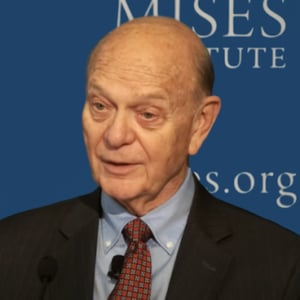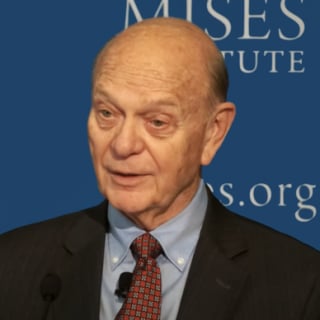
Alex J. Pollock is a Senior Fellow with the Mises Institute, providing thought and policy leadership on financial issues and the study of financial systems. His work includes cycles of booms and busts, financial crises with their political responses, housing finance, government-sponsored enterprises, risk and uncertainty, central banking, banking and financial regulation, corporate governance, retirement finance, student loans, and the politics of finance.
He previously served as the Principal Deputy Director of the Office of Financial Research in the U.S. Treasury Department 2019-2021. He was a Distinguished Senior Fellow with the R Street Institute 2015-2019 and 2021, and a resident fellow at the American Enterprise Institute, 2004-2015. Among the many aspects of his AEI work, he developed the One Page Mortgage Form to give borrowers in clear form the key information they need in order to know what they are committing themselves to. He was President and CEO of the Federal Home Loan Bank of Chicago from 1991 to 2004. There he invented the Mortgage Partnership Finance program, which successfully created front-end mortgage credit risk sharing beginning in 1997. His decades of banking experience include being a Visiting Scholar at the Federal Reserve Bank of St. Louis, 1991.
Pollock was a director of the CME Group 2004-2019 and of Ascendium Education Group 1989-2019. He is a director and past-chairman of the Great Books Foundation and a past president of the International Union for Housing Finance.
He is the co-author of Surprised Again! - The COVID Crisis and the New Market Bubble (2022), and the author of Finance and Philosophy—Why We’re Always Surprised (2018) and Boom and Bust: Financial Cycles and Human Prosperity (2011), as well as numerous articles and Congressional testimony.
Pollock is a graduate of Williams College, the University of Chicago, and Princeton University.
His work is available on alexjpollock.com.
*****
A person listed on this page has spoken or otherwise participated in Federalist Society events, publications, or multimedia presentations. A person's appearance on this list does not imply any other endorsement or relationship between the person and the Federalist Society. In most cases, the biographical information on a person's bio page is provided directly by the person, and the Federalist Society does not edit or otherwise endorse that information. The Federalist Society takes no position on particular legal or public policy issues. All expressions of opinion by a speaker or author are those of the individual.

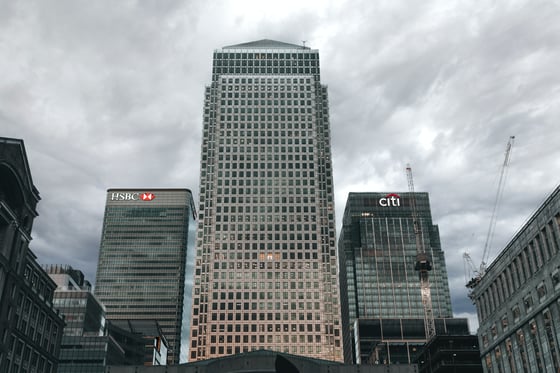
How Risky Are the Banks Now? What Regulatory Reforms Make Sense?
A Regulatory Transparency Project Webinar
Teleforum
The CLARITY Act and Fed Master Accounts: Defining Crypto's Place in the U.S. Financial System
Join us for a timely discussion on two developments shaping the future of digital assets...
The CLARITY Act and Fed Master Accounts: Defining Crypto's Place in the U.S. Financial System
Join us for a timely discussion on two developments shaping the future of digital assets...
The GENIUS Act in Practice: Key Questions for Stablecoin Regulation
The GENIUS Act of 2025 was a watershed moment in the legal framework for stablecoins,...
The GENIUS Act in Practice: Key Questions for Stablecoin Regulation
The GENIUS Act of 2025 was a watershed moment in the legal framework for stablecoins,...
From Whom Is the Fed Independent? To Whom Is It Accountable?
The Federal Reserve and its supporters constantly declare that the Fed is and should be...