




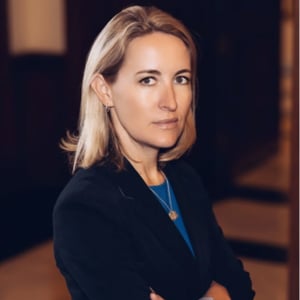














Tara Leigh Grove is the Vinson & Elkins Chair in Law at the University of Texas School of Law. Grove graduated summa cum laude from Duke University and magna cum laude from Harvard Law School, where she served as the Supreme Court Chair of the Harvard Law Review. Grove clerked for Judge Emilio Garza on the U.S. Court of Appeals for the Fifth Circuit, and then spent four years as an attorney for the U.S. Department of Justice, Civil Division, Appellate Staff, where she argued fifteen cases in the courts of appeals.
Grove’s research focuses on the federal judiciary, interpretive theory, and the constitutional separation of powers. She has published with such prestigious law journals as the Harvard Law Review, the Yale Law Journal, the Columbia Law Review, the University of Pennsylvania Law Review, the New York University Law Review, the University of Chicago Law Review, the Virginia Law Review, the Texas Law Review, the Cornell Law Review, the Northwestern University Law Review, and the Vanderbilt Law Review. Grove has received awards for both her research and her teaching.
In 2021, Grove served on the Presidential Commission on the Supreme Court of the United States, a bipartisan commission created by President Biden and charged with examining proposals for Supreme Court reform. Since 2022, Grove has worked on the Princeton Initiative on Reclaiming the Constitutional Powers of Congress, which brings together former members of Congress, political scientists, and law professors. Grove serves as the Co-Chair of the section on the Appointments Process for the Princeton Initiative. Grove is a co-author of Low & Jeffries' Federal Courts and the Law of Federal-State Relations, a leading federal courts casebook, and she has served as the Chair of the Federal Courts Section of the Association of American Law Schools. Grove has been a visiting professor at both Harvard Law School and Northwestern Pritzker School of Law.






Pardon Me: When Congressional Witnesses Plead the Fifth
John G. Malcolm, Clark Neily, G. Zachary Terwilliger
Congressional committees frequently use their subpoena power to compel witnesses to appear before them and...
Checking the Executive: The Importance of Congressional Oversight
Michael D. Bopp, Machalagh Carr, W. Neil Eggleston, Amanda H. Neely
The Constitution does not explicitly grant Congress the authority to conduct inquiries or investigations of...
17th Annual Barbara K. Olson Memorial Lecture
Donald F. McGahn, Eugene B. Meyer
On September 11, 2001, at the age of 45 and at the height of her...
Federalism & Separation of Powers: Justice Scalia on Federalism and Separation of Powers
John S. Baker, Ron DeSantis, Roger Pilon, William H. Pryor, Luther Johnson Strange, Jonathan R. Turley
Justice Scalia often said that, while he always tried to get the Bill of Rights...
Who is Winning The Intimidation Game?
Kimberley A. Strassel
Everyone is interested in free, fair and open elections. For decades, the country has debated...
Battle Against IRS's Tea Party Targeting Will Go Another Round in District Court
By now, the timeline is familiar. On January 21, 2010, the United States Supreme Court...
True the Vote v. IRS - Podcast
John C. Eastman
True the Vote, a Texas-based vote monitoring organization intent on policing and preventing voter fraud,...
Plenary Panel: Congressional Oversight
Jonathan H. Adler, Michael D. Bopp, Todd F. Gaziano, Sally Katzen, Adam White
After delegating significant power to the administrative state, is Congress properly discharging its oversight role?...
Welcome & Opening Address by Mitch McConnell
Mitch McConnell, Dean Reuter
The theme of the Third Annual Executive Branch Review Conference, what role does and should Congress...
Welcome & Panel I: The Executive Power to Not Enforce the Law
Tara Leigh Grove, John C. Harrison, Gillian E. Metzger, Lee Liberman Otis, Zachary Price, Daniel B. Rodriguez, Nicholas Quinn Rosenkranz
This panel was part of the 17th Annual Federalist Society Faculty Conference held on January...