
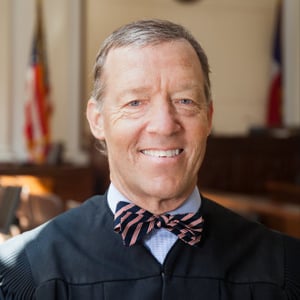
Federal Judge, Western District of Texas, Waco Division
Judge Alan Albright is the federal district judge for the Western District of Texas, Waco Division. Judge Albright was nominated by President Trump on January 24, 2018 and confirmed on September 6, 2018. He was sworn in on September 18, 2018.
Prior to taking the bench, Judge Albright was a partner in the Austin office of Bracewell LLP. He practiced IP litigation and handled trials in both federal court and the ITC. Before practicing law in Austin, he earned a BA in Political Science from Trinity University in San Antonio and a J.D. from The University of Texas School of Law in Austin, where he was a member of the Texas Law Review. Following law school, Judge Albright clerked for The Honorable James R. Nowlin in Austin, Texas. Judge Albright later served as a United States Magistrate Judge from 1992–99. He has also taught as an adjunct professor of law at The University of Texas School of Law. Judge Albright was recently inducted into the American College of Trial Lawyers. He has two sons and he is an avid runner and cyclist.

Partner, Jackson Walker
Arthur offers clients a winning combination of trial and appellate experience gained as a federal prosecutor and more than 20 years of experience in handling patent, copyright, trademark, and trade secrets litigation.
While his practice concentrates on intellectual property litigation, Arthur also has significant experience in internal investigations, False Claims Act suits, partnership and breach of fiduciary duty, breach of contract, and employment litigation. Arthur also has represented clients testifying before Congressional committees.
Arthur writes and speaks frequently on topics ranging from the case against Boston bomber Dzhokhar Tsarnaev to patent litigation reform.
Prior to joining Michael Best, Arthur served as an Assistant United States Attorney in the Southern District of New York, where he was the lead prosecutor in criminal trials, including federal intellectual property crimes. He also argued numerous appeals.
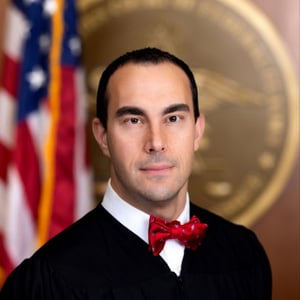
U.S. Court of Federal Claims and Jurist-In-Residence Professor of Law, The University of Akron School of Law
Judge Ryan T. Holte was sworn in as a judge on the United States Court of Federal Claims in July 2019. Prior to confirmation he served as the David L. Brennan Professor of Law and Director of the Center for Intellectual Property Law and Technology at The University of Akron School of Law (2017-2019) and an assistant professor of law at Southern Illinois University School of Law (2013-2017). Judge Holte has written and presented widely on patent law subjects and empirical legal studies of Federal Circuit and district court patent law cases. His most recent articles were published in the Iowa Law Review (2019), George Mason Law Review (2018), and Washington Law Review (2017).
In practice, Judge Holte served for six years as general counsel and partner of an electrical engineering technology company and is co-inventor of multiple patents related to Systems and Methods for Countering Satellite-Navigated Munitions. Prior to entering academia, Judge Holte practiced as a litigation attorney at the Federal Trade Commission and an associate in the Intellectual Property Practice Group at Jones Day. Prior to practice, he served as a law clerk to Judge Stanley F. Birch, Jr. on the United States Court of Appeals for the Eleventh Circuit and as a law clerk to Judge Loren A. Smith on the United States Court of Federal Claims.
Judge Holte received his JD from the University of California Davis School of Law and his BS, magna cum laude, in engineering from the California Maritime Academy where he was a First Class graduate of the Corps of Cadets Third Engineering Division and sailed as a U.S. Merchant Marine oiler.
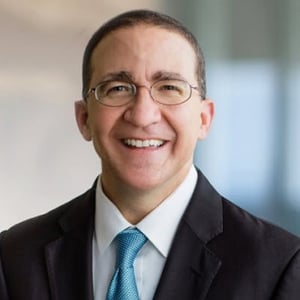
Chair, Supreme Court and Appellate Practice, Alexander Dubose Jefferson
Daniel L. Geyser is Chair of the firm’s U.S. Supreme Court and Federal Appellate Practice. He focuses on complex and high-stakes appellate litigation, representing clients in the Supreme Court of the United States and in courts of appeals nationwide. He was named one of Law360’s 2019 “Appellate MVPs,” an honor awarded to only four lawyers in the United States.
Dan is widely regarded as one of the nation’s leading Supreme Court and appellate lawyers. The Legal 500 reports that Dan is “recognized by peers and clients alike as ‘an extraordinary oral advocate and brief writer,’” “stand[ing] out for his sheer brainpower and creative thinking”; clients say “Geyser’s intellect and analysis are peerless”; “‘[h]is legal analysis is brilliant and on point, and his written and oral advocacy is very strong and powerful.’” Chambers USA describes Dan as a “‘superb lawyer with impeccable judgment and a wonderful manner in oral arguments,’” adding he has “‘that rare ability to make clients and legal counsel at ease, even under difficult circumstances. He instills confidence.’”
Dan is among an elite group of lawyers who regularly handles significant cases in the U.S. Supreme Court. He has argued eleven U.S. Supreme Court cases in private practice, more than any other active Texas lawyer. He recently had three cert. petitions granted in a 12-month period (a feat matched by few global firms), and personally handled over 5% of the Court’s merits docket in OT 2018. He has been named to the National Law Journal’s “Appellate Hot List,” earned weekly honors as a Law360 “Legal Lion,” achieved national appellate rankings in Chambers & Partners and The Legal 500, and was listed among the “veritable who’s who of the Supreme Court bar” (Empirical SCOTUS). His petitions are regularly featured among the “Petitions of the Week” on SCOTUSblog, and he was named OT 2017’s “top performing” brief-writer among the Court’s repeat players (based on a 2018 empirical study using brief-analyzing software). He is a three-time winner of the National Association of Attorneys General’s Best Brief Award for excellence in brief-writing before the Supreme Court.
Dan routinely matches up against the top litigators in the country. He has convinced the Supreme Court to grant review over the opposition of elite appellate groups at multiple Am Law 20 firms, and his recent wins have come against superstars at Am Law 10 firms and the Solicitor General’s Office. In the past half-decade, Dan is among the top five lawyers nationwide for total Supreme Court arguments in private practice, notching “rare victor[ies]” (SCOTUSblog) and “huge win[s]” (Reuters) in cases that industry experts said could not be won. And Dan is already set to argue another major case in the Supreme Court’s upcoming Term, a closely watched battle involving the Federal Arbitration Act and federal jurisdiction; the case was one of Dan’s two cert. grants in 2021 alone.
Beyond the Supreme Court, Dan handles high-stakes matters in appellate courts nationwide, litigating cases in virtually every major area of federal law (especially securities, bankruptcy, patents, ERISA, and arbitration). For plaintiffs, he has crafted legal strategy in matters generating over a half-billion in recovery. For defendants, he has won appeals in 8- and 9-figure disputes. He has special expertise at the rehearing stage, and has argued before the en banc Ninth Circuit (winning 10-1). In addition to an active federal practice, Dan has handled landmark state-court appeals, including arguing seven times before the Texas Supreme Court.
Before joining ADJ, Dan ran his own award-winning appellate practice; served as the appellate chair of a prominent litigation boutique (also leading that firm to the National Law Journal’s “Appellate Hot List” and a Chambers USA national-appellate ranking); and was an appellate partner in one of the nation’s top litigation firms, building its appellate practice while focusing especially on complex patent appeals and bankruptcy cases.
From 2007-2011, Dan served in the Office of the Solicitor General of Texas, where he conducted and supervised appellate litigation for the State. In addition to handling his own docket, his experience in the office included advising other divisions on appellate and trial strategy, revising countless briefs in cases across all subject areas, and extensively preparing other attorneys (in moot courts and otherwise) for oral argument. In his last week on the job, Dan argued before the Texas Supreme Court in Severance v. Patterson, one of the State’s most important cases in recent memory—a constitutional attack on the public’s historic access to open beaches; he had earlier won “a rare motion to rehear the case” (Austin American-Statesman, 2011). The same week, Dan also won a major case in the U.S. Supreme Court, Sossamon v. Texas, involving Congress’s spending power and state sovereignty; Dan wrote the State’s briefs in that case and crafted its core legal theories and appellate strategy. He was also the principal writer of the State’s invitation brief in Rhine v. Deaton, a case marking the very first time the U.S. Supreme Court called for a state solicitor general to file a brief expressing the views of a State.
Dan graduated Phi Beta Kappa, with honors and distinction, from Stanford University, and with honors from Harvard Law School, where he was the Notes Chair of the Harvard Law Review, a best-brief winner and oralist on the championship team of Harvard’s moot-court competition, and a research assistant to Professor Laurence H. Tribe, working on his academic writing and appellate docket. After law school, Dan clerked for the Hon. Alex Kozinski of the U.S. Court of Appeals for the Ninth Circuit. He has received the State Bar of California’s Wiley W. Manuel Award for Pro Bono Legal Services and is a past appointee to the U.S. Court of Appeals for the Second Circuit Pro Bono Panel.

R. B. Price and Isabelle Wade & Paul C. Lyda Professor Emeritus of Law, University of Missouri School of Law
Carl H. Esbeck is R.B. Price Professor and Isabelle Wade & Paul C. Lyda Professor of Law emeritus at the University of Missouri. After attending Cornell University School of Law where he served as an editor on the Cornell Law Review, he held a judicial clerkship with the Honorable Howard C. Bratton, chief judge of the U.S. District Court in New Mexico.
Professor Esbeck publishes widely in the area of religious liberty and church-state relations. He is recognized as the progenitor of "Charitable Choice," an integral part of the 1996 Federal Welfare Reform Act, later made a part of the faith-based initiative and equal-treatment regulations under presidents George W. Bush and Barack Obama. In addition, he has taken the lead in recognizing that the modern Supreme Court has applied the Establishment Clause not as a personal right, but as a structural limit on the government's authority in disputes involving church governance. While on leave from 1999 to 2002, Professor Esbeck directed the Center for Law & Religious Freedom (CLRF) and later served as Senior Counsel to the Deputy Attorney General at the U.S. Department of Justice. While directing the CLRF, Professor Esbeck was a central part of the congressional advocacy behind the Religious Land Use and Institutionalized Persons Act of 2000 (RLUIPA). While at the Department of Justice one of his duties was to direct a task force to remove barriers to the equal-treatment of faith-based organizations applying for social service grants. He is the author of Disestablishment and Religious Dissent: Church-State Relations in the New American States, 1776 - 1833 (U. of MO Press, 2019).
Chair, Supreme Court and Appellate Practice, Alexander Dubose Jefferson
Daniel L. Geyser is Chair of the firm’s U.S. Supreme Court and Federal Appellate Practice. He focuses on complex and high-stakes appellate litigation, representing clients in the Supreme Court of the United States and in courts of appeals nationwide. He was named one of Law360’s 2019 “Appellate MVPs,” an honor awarded to only four lawyers in the United States.
Dan is widely regarded as one of the nation’s leading Supreme Court and appellate lawyers. The Legal 500 reports that Dan is “recognized by peers and clients alike as ‘an extraordinary oral advocate and brief writer,’” “stand[ing] out for his sheer brainpower and creative thinking”; clients say “Geyser’s intellect and analysis are peerless”; “‘[h]is legal analysis is brilliant and on point, and his written and oral advocacy is very strong and powerful.’” Chambers USA describes Dan as a “‘superb lawyer with impeccable judgment and a wonderful manner in oral arguments,’” adding he has “‘that rare ability to make clients and legal counsel at ease, even under difficult circumstances. He instills confidence.’”
Dan is among an elite group of lawyers who regularly handles significant cases in the U.S. Supreme Court. He has argued eleven U.S. Supreme Court cases in private practice, more than any other active Texas lawyer. He recently had three cert. petitions granted in a 12-month period (a feat matched by few global firms), and personally handled over 5% of the Court’s merits docket in OT 2018. He has been named to the National Law Journal’s “Appellate Hot List,” earned weekly honors as a Law360 “Legal Lion,” achieved national appellate rankings in Chambers & Partners and The Legal 500, and was listed among the “veritable who’s who of the Supreme Court bar” (Empirical SCOTUS). His petitions are regularly featured among the “Petitions of the Week” on SCOTUSblog, and he was named OT 2017’s “top performing” brief-writer among the Court’s repeat players (based on a 2018 empirical study using brief-analyzing software). He is a three-time winner of the National Association of Attorneys General’s Best Brief Award for excellence in brief-writing before the Supreme Court.
Dan routinely matches up against the top litigators in the country. He has convinced the Supreme Court to grant review over the opposition of elite appellate groups at multiple Am Law 20 firms, and his recent wins have come against superstars at Am Law 10 firms and the Solicitor General’s Office. In the past half-decade, Dan is among the top five lawyers nationwide for total Supreme Court arguments in private practice, notching “rare victor[ies]” (SCOTUSblog) and “huge win[s]” (Reuters) in cases that industry experts said could not be won. And Dan is already set to argue another major case in the Supreme Court’s upcoming Term, a closely watched battle involving the Federal Arbitration Act and federal jurisdiction; the case was one of Dan’s two cert. grants in 2021 alone.
Beyond the Supreme Court, Dan handles high-stakes matters in appellate courts nationwide, litigating cases in virtually every major area of federal law (especially securities, bankruptcy, patents, ERISA, and arbitration). For plaintiffs, he has crafted legal strategy in matters generating over a half-billion in recovery. For defendants, he has won appeals in 8- and 9-figure disputes. He has special expertise at the rehearing stage, and has argued before the en banc Ninth Circuit (winning 10-1). In addition to an active federal practice, Dan has handled landmark state-court appeals, including arguing seven times before the Texas Supreme Court.
Before joining ADJ, Dan ran his own award-winning appellate practice; served as the appellate chair of a prominent litigation boutique (also leading that firm to the National Law Journal’s “Appellate Hot List” and a Chambers USA national-appellate ranking); and was an appellate partner in one of the nation’s top litigation firms, building its appellate practice while focusing especially on complex patent appeals and bankruptcy cases.
From 2007-2011, Dan served in the Office of the Solicitor General of Texas, where he conducted and supervised appellate litigation for the State. In addition to handling his own docket, his experience in the office included advising other divisions on appellate and trial strategy, revising countless briefs in cases across all subject areas, and extensively preparing other attorneys (in moot courts and otherwise) for oral argument. In his last week on the job, Dan argued before the Texas Supreme Court in Severance v. Patterson, one of the State’s most important cases in recent memory—a constitutional attack on the public’s historic access to open beaches; he had earlier won “a rare motion to rehear the case” (Austin American-Statesman, 2011). The same week, Dan also won a major case in the U.S. Supreme Court, Sossamon v. Texas, involving Congress’s spending power and state sovereignty; Dan wrote the State’s briefs in that case and crafted its core legal theories and appellate strategy. He was also the principal writer of the State’s invitation brief in Rhine v. Deaton, a case marking the very first time the U.S. Supreme Court called for a state solicitor general to file a brief expressing the views of a State.
Dan graduated Phi Beta Kappa, with honors and distinction, from Stanford University, and with honors from Harvard Law School, where he was the Notes Chair of the Harvard Law Review, a best-brief winner and oralist on the championship team of Harvard’s moot-court competition, and a research assistant to Professor Laurence H. Tribe, working on his academic writing and appellate docket. After law school, Dan clerked for the Hon. Alex Kozinski of the U.S. Court of Appeals for the Ninth Circuit. He has received the State Bar of California’s Wiley W. Manuel Award for Pro Bono Legal Services and is a past appointee to the U.S. Court of Appeals for the Second Circuit Pro Bono Panel.
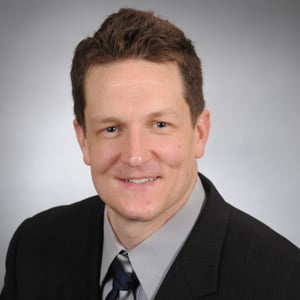
Mike Jayne is an attorney for the U.S. Department of Education. Previously, he worked for the Mercatus Center at George Mason University.

Patent Litigation in the Western District of Texas: An Afternoon Discussion with Judge Alan Albright and a New Take on Patent Case Procedures
TeleforumTopics
A Second Amendment Grade for President Trump So Far
In his most recent State of the Union address, President Donald Trump promised the American...
Remembering Judge Stephen Williams
The Federalist Society notes with great sadness the recent passing of Judge Stephen F. Williams of the...
After Espinoza, What’s Left of the Establishment Clause?
Carl H. Esbeck
Note from the Editor: The Federalist Society takes no positions on particular legal and public...
“Better Than Nothing”: Supreme Court in Mazars Devises a New Four-Factor Test for Congressional Subpoenas of a President’s Personal Documents
On July 9, 2020, the Supreme Court delivered its long-awaited opinions in two cases concerning...
Topics
Religious Liberty Challenge Rejected by the High Court
On Friday, in SOUTH BAY UNITED PENTECOSTAL CHURCH, ET AL.v. GAVIN NEWSOM, GOVERNOR OF CALIFORNIA, ET...
Courthouse Steps Decision Teleforum: Thryv, Inc. v. Click-To-Call Technologies, LP
Daniel L. Geyser
In Thryv, Inc. v. Click-To-Call Technologies, LP (Supreme Court, April 20, 2020), the Supreme Court held that...
Topics
West Virginia Supreme Court’s Decision Upholding Constitutionality of That State’s Right to Work Law Is the Latest in an Unbroken String of Final Decisions Rejecting Such Challenges
In his May 26, 2020, posting State Court Docket Watch: Morrisey v. West Virginia AFL-CIO,...
As Far As Reasonably Practicable: Reimagining the Role of Congress in Agency Rulemaking
Mike Jayne
Note from the Editor: The Federalist Society takes no positions on particular legal and public...
Courthouse Steps Decision Teleforum: Thryv, Inc. v. Click-To-Call Technologies, LP
Teleforum