
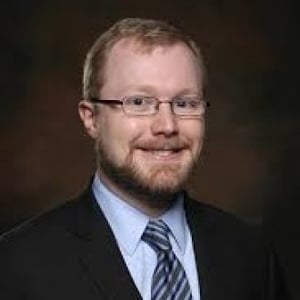
Senior Attorney, Institute for Justice
Paul Sherman is a senior attorney at the Institute for Justice.
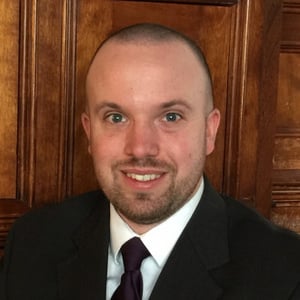
Deputy Counsel and Litigation Manager, Wisconsin Institute for Law & Liberty
Mr. Kamenick joined WILL at its founding in the summer of 2011. He graduated magna cum laude from Marquette Law School in 2009. During law school, he interned at the Internal Revenue Service, the U.S. District Court for the Eastern District of Wisconsin, and the Wisconsin Supreme Court. He also served as an editor of the Marquette Law Review and a volunteer tax preparer.
Prior to joining WILL, Mr. Kamenick worked as a law clerk for Justice Michael J. Gableman on the Wisconsin Supreme Court (2009-2010 term), as a tax consultant for Reinhart Boerner Van Deuren, s.c., and as a research assistant for Marquette Law School’s dean, Joseph Kearney. He is currently on the faculty of Wisconsin Lutheran College, teaching business law.
Mr. Kamenick lives in Saukville with his wife and two children. He enjoys giving back to his community, serving as a member of Saukville’s Public Safety Committee and a board member of Musical Masquers, a theater company based in West Bend. He also performs in community theater and his church’s handbell choirs.
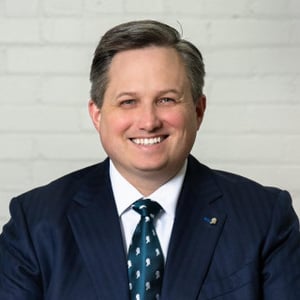
President and CEO, The Federalist Society
Sheldon Gilbert is the President and CEO of The Federalist Society. Gilbert has been involved in the conservative and libertarian legal movement since law school, and has served in prominent roles at both nonprofit organizations as well as corporate America.
A longtime constitutional litigator, Gilbert has represented clients through amicus and party briefs in nearly a hundred cases at the U.S. Supreme Court, at both the certiorari and merits stages. Most recently, Gilbert served as Senior Lead Counsel for Strategic Initiatives at Walmart, the world’s largest company, where he led teams providing legal advice related to government enforcement, internal investigations, government relations, public relations, and special projects at the center of law and policy.
Before joining Walmart, Gilbert served as Vice President for Content and Development and Senior Fellow for Constitutional Studies at the National Constitution Center, a congressionally chartered non-partisan center for constitutional education and debate, where he led both fundraising and programming efforts. While at the NCC, Gilbert helped ensure that the Center’s programming and exhibits incorporated constitutional perspectives from experts on both the right and the left, including the launch of the Center’s landmark permanent exhibit on the Civil War and the Reconstruction Amendments.
Prior to the National Constitution Center, Gilbert served as the director of the Institute for Justice’s Center for Judicial Engagement (CJE), where he educated the public about the role of the courts and the Constitution, where he frequently hosted discussions and debates on constitutional issues, and often spoke at Federalist Society lawyer and student chapters across the country.
He was also a litigator with the U.S. Chamber Litigation Center, the litigation arm of the U.S. Chamber of Commerce, where he represented the U.S. Chamber in over 400 cases in federal and state courts addressing a wide range of legal issues, from free speech to property rights.
Gilbert is a graduate of the George Washington University Law School where he helped found a first-of-its-kind National Religious Freedom Moot Court, which hosted law students from across the country to debate important, emerging religious liberty issues. After graduating from GWU, he also taught as a professorial lecturer at the school.
A graduate of the University of Utah, Gilbert is a child of the Mountain West, where he was born in a coal mining town in Utah and raised in Idaho near the Grand Tetons. Before going to law school, Gilbert’s diverse interests led him to work in a wide range of roles, from software development project management for a nonprofit, to working in his University’s radiobiology research lab, to volunteer service in Rio de Janeiro, Brazil for his church.
Gilbert is married with four children.
Frank Knaack is the Executive Director of Alabama Appleseed, where he serves as the organization’s chief strategic officer and voice for its mission, vision, values, and programs. Prior to joining Alabama Appleseed, Frank spent nearly eight years with the ACLU and its Virginia and Texas affiliates. Most recently, Frank served as the Director of Public Policy and Communications for the ACLU of Virginia, where he led the organization’s advocacy before state and local government bodies and oversaw the design and implementation of the organization’s communications strategy. Under his leadership the organization secured major public policy victories in the areas of criminal justice, death penalty, government surveillance, reproductive freedom, and immigrants’ rights. Prior to joining the ACLU of Virginia, Frank developed and managed the ACLU of Texas’ statewide campaigns and led the organization’s successful efforts at the Texas Legislature to pass legislation designed to dismantle the school-to-prison pipeline. Frank began his human rights advocacy career with the national ACLU, where he researched domestic human rights violations and coordinated national advocacy campaigns designed to hold the United States accountable to its international human rights treaty obligations. Frank has also served as a Palestine Works Fellow with Adalah.
Frank has been quoted on human rights issues in a variety of publications including The Washington Post, Slate, and the Associated Press. Frank received his M.A. in International Human Rights Law from The American University in Cairo and B.A. from the University of Vermont.
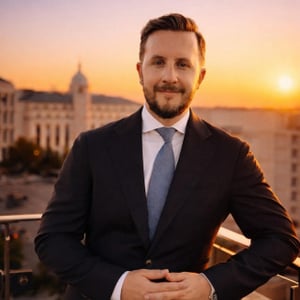
Former Special Assistant to the President for Domestic Policy, The White House
Jordan is an experienced litigator and public policy leader with significant experience in federal trial and appellate matters. He advises clients on complex federal litigation and appeals informed by senior service in the White House, federal judicial clerkships, and private practice.
Jordan previously served as a Special Assistant to the President on the White House Domestic Policy Council and as an advisor to the White House Office of American Innovation. In those roles, he helped shape federal policy on criminal justice, regulatory reform, and law enforcement matters. He played a central role in implementing the FIRST STEP Act, coordinated review of major executive actions, and oversaw clemency reviews with the Office of White House Counsel and the Department of Justice, working across federal agencies to execute complex policy initiatives.
Earlier, Jordan served as a Senior Policy Advisor at the U.S. Department of Labor, where he advised on workforce and reentry policy and provided legal review of significant departmental guidance and funding initiatives.
Prior to his federal service, Jordan worked with nonprofit policy organizations in Washington, D.C., including the Heritage Foundation and Americans for Prosperity, focusing on criminal justice reform and constitutional issues. He contributed to policy development efforts and provided testimony and legal briefings to state legislatures. For his accomplishments on these issues, he was named to Forbes 30-Under-30 in Law & Policy in 2018.
Jordan also had the privilege of serving as a judicial law clerk to the Hon. Barbara Lagoa of the United States Court of Appeals for the Eleventh Circuit and the Hon. Aileen M. Cannon of the United States District Court for the Southern District of Florida.
Following his service in the White House, Jordan practiced as a civil litigator in Miami, serving on multiple trial teams and representing clients in complex matters in federal and state courts, with regular appearances in both trial and appellate proceedings.
In 2023, Governor Ron DeSantis appointed Jordan to serve on the Judicial Nominating Commission for the Eleventh Judicial Circuit of Florida, where he currently serves as Vice Chair. In that role, he evaluates applicants for judicial office and participates in the recommendation of nominees to the Governor.
Jordan earned his B.A., summa cum laude, from Marshall University and his J.D. from Ohio Northern University Pettit College of Law.

Professor of Political Science, University of Pittsburgh
Chris W. Bonneau is Professor of Political Science at the University of Pittsburgh, where he has been since 2002. His research is primarily in the areas of judicial selection (specifically, judicial elections) and judicial decisionmaking. Professor Bonneau’s work has been supported by the National Science Foundation and he has published numerous articles, including in the American Journal of Political Science and Journal of Politics. He is also the coauthor of three books: Strategic Behavior and Policy Choice on the U.S. Supreme Court (2005), In Defense of Judicial Elections (2009), and the award-winning Voters’ Verdicts: Citizens, Campaigns, and Institutions in State Supreme Court Elections (2015).
Professor Bonneau teaches undergraduate classes in constitutional law, judicial politics, and research methods, as well as graduate classes in judicial politics and research design.

Coloradans for a Better Future v. Campaign Integrity Watchdog
Paul Sherman
In 2012, Colorado’s Republican voters faced a choice in the campaign for Colorado University’s Board...
Topics
Docket Watch: Coloradans for a Better Future v. Campaign Integrity Watchdog
In 2012, Colorado’s Republican voters faced a choice in the campaign for Colorado University’s Board...
Topics
The Issue of Occupational Speech in Masterpiece & NILF
It is not often that the Supreme Court takes two cases addressing an ever more...
Milewski v. Town of Dover
Thomas C. Kamenick
Government officials are prohibited from entering your home and searching it without your permission –...
Topics
Docket Watch: Milewski v. Town of Dover
Government officials are prohibited from entering your home and searching it without your permission –...
The Constitution in Crisis
Charlotte, NCBottleneckers: Discussion with Bob Robb & Dick Carpenter
Phoenix Lawyers Chapter
Phoenix, AZCivil Asset Forfeiture
Birmingham, ALPennsylvania Chapters Conference
Harrisburg, PATopics
Docket Watch: The Constitutionality of School Choice Tax Credits (Gaddy v. Georgia Department of Revenue)
The Georgia Supreme Court’s unanimous decision in Gaddy v. Georgia Department of Revenue continues the...