
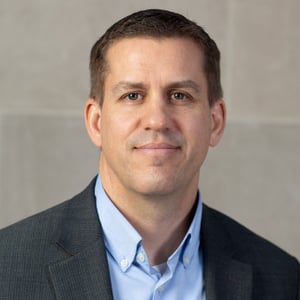
Clinical Professor, University of Texas at Austin School of Law
Steven T. Collis researches and teaches on religion and law and other First Amendment topics. He is the founding faculty director of the Bech-Loughlin First Amendment Center and of Texas's Law & Religion Clinic. On the topic of religious freedom law, he is a sought-after speaker to academic and lay audiences across the United States, including foreign diplomats from countries in Europe, the Middle East, Asia, and South America on behalf of the United States State Department. He has been interviewed by and quoted in various news and media outlets, including The Deseret News, Bloomberg, The Washington Times, Law360, The Salt Lake Tribune, PBS, The Denver Business Journal, Law Week Colorado, CBN News, and numerous podcasts and television shows. His scholarly work has appeared in The Michigan Law Review, The Nebraska Law Review, The University of Denver Law Review Online, and in his book Deep Conviction, which brings to life the history of free exercise law in the United States for lay audiences.
Prior to joining Texas, Steven was the Olin-Darling Research Fellow in the Constitutional Law Center at Stanford Law School.
Earlier in his career, he was an equity partner at Holland & Hart LLP, where he chaired the firm’s nationwide religious institutions and First Amendment practice group and was a member of the firm's complex civil litigation and employment practice groups. He also taught religious liberty law at the University of Denver Sturm College of Law and clerked for Chief Judge Timothy M. Tymkovich of the United States Court of Appeals for the Tenth Circuit.
Steven graduated magna cum laude from the University of Michigan Law School, where he was elected to the Order of the Coif and served as an editor on The Michigan Law Review and The Michigan Journal of Race and Law. He also holds an M.F.A. in creative writing from Virginia Commonwealth University, where he served as the associate editor of the literary journal Blackbird. He completed his undergraduate studies, with university honors, at Brigham Young University.

R. B. Price and Isabelle Wade & Paul C. Lyda Professor Emeritus of Law, University of Missouri School of Law
Carl H. Esbeck is R.B. Price Professor and Isabelle Wade & Paul C. Lyda Professor of Law emeritus at the University of Missouri. After attending Cornell University School of Law where he served as an editor on the Cornell Law Review, he held a judicial clerkship with the Honorable Howard C. Bratton, chief judge of the U.S. District Court in New Mexico.
Professor Esbeck publishes widely in the area of religious liberty and church-state relations. He is recognized as the progenitor of "Charitable Choice," an integral part of the 1996 Federal Welfare Reform Act, later made a part of the faith-based initiative and equal-treatment regulations under presidents George W. Bush and Barack Obama. In addition, he has taken the lead in recognizing that the modern Supreme Court has applied the Establishment Clause not as a personal right, but as a structural limit on the government's authority in disputes involving church governance. While on leave from 1999 to 2002, Professor Esbeck directed the Center for Law & Religious Freedom (CLRF) and later served as Senior Counsel to the Deputy Attorney General at the U.S. Department of Justice. While directing the CLRF, Professor Esbeck was a central part of the congressional advocacy behind the Religious Land Use and Institutionalized Persons Act of 2000 (RLUIPA). While at the Department of Justice one of his duties was to direct a task force to remove barriers to the equal-treatment of faith-based organizations applying for social service grants. He is the author of Disestablishment and Religious Dissent: Church-State Relations in the New American States, 1776 - 1833 (U. of MO Press, 2019).

Topics
Education Department Proposes Rescinding Religious Student Group Protections and Requests Info on Campus Free Speech Regulations
On February 22, 2023, the Department of Education (ED) published in the Federal Register a...
Topics
Apache Stronghold Pursues Claims That Conflict With Precedent
At the heart of our nation is a constitutional reverence that not only provides the...
Topics
DC Court of Appeals Holds That Judicial Intervention Is Inappropriate In a Religious Schism
The District of Columbia Court of Appeals recently declined to intervene in a religious dispute...
Topics
The Rise of the Undead Blaine Amendment
The Lemon test, a perennial ghoul of Establishment Clause jurisprudence, seems to have finally received...
Topics
Ninth Circuit to California School District: Stop Discriminating Against Religious Students
On Monday, August 29, the Ninth Circuit ruled in favor of the Fellowship of Christian...
Topics
35 Naval Special Warfare Soldiers Obtain Preliminary Injunction Against Vaccine Mandate Under the Free Exercise Clause and Religious Freedom Restoration Act
On January 3, Judge Reed O’Connor of the Northern District of Texas preliminarily enjoined Navy...
Topics
“Yet what should replace Smith?” How the question of what comes next exposed an ideological divide in the new SCOTUS majority.
When the Supreme Court handed down Fulton v. Philadelphia last summer, the 9–0 decision came...
Religious Exemptions: An Overview of the Current Legal Landscape & the Best Arguments For and Against
At the 2021 Nebraska State Bar Annual Meeting
Topics
The Search for a Workable Free Exercise Framework
Under Employment Division v. Smith, the Free Exercise Clause functions more like an antidiscrimination statute...
An Extended Essay on Church Autonomy
Carl H. Esbeck
The doctrine of church autonomy[1] is distinct from the two more familiar lines of cases...