
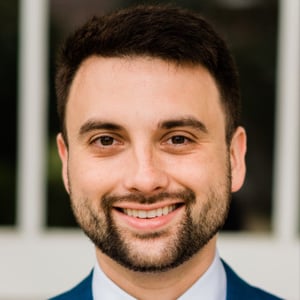
Roberto is a 2018 graduate of the University of Chicago Law School.
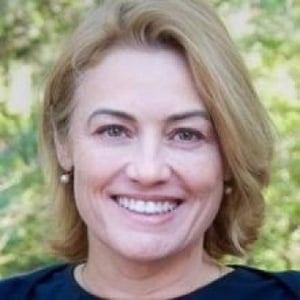
Professor of the Practice of Economics, Duke University
Michelle P. Connolly is Professor of the Practice in the Economics Department at Duke University. She was the Economics Director of Duke in New York: Financial Markets and Institutions Program for 2007-2009 and the Director of EcoTeach for several years. She currently serves as the Director of the Honors Program in Economics and a member of the Duke Alumni Association Board.
In 2011, Professor Connolly won the Howard D. Johnson Trinity College Teaching Prize and was named among the top five percent of Duke University Undergraduate Instructors in 2009, 2010 and 2011.
Professor Connolly previously served as Chief Economist of the Federal Communications Commission in 2006-2007 and 2008-2009, and as an Economist for the International Research Function for the Federal Reserve Bank of New York from 1996 to 1997. She graduated Phi Beta Kappa and Summa Cum Laude from Yale University in 1990, and went on to earn her M.A. and M.Phil in economics. Professor Connolly received her Ph.D. in economics from Yale University in 1996.
Professor Connolly’s research and teaching focus specifically on international trade, telecommunications policy, media policy, education, growth, and development. She has received funding for her research from the National Science Foundation, the Duke Arts and Sciences Research Council Grants, the Spencer Grant, and the Teagle Grant.
Professor Connolly has published in numerous journals, including the American Economic Review, the American Economic Journal: Macroeconomics, the Journal of Development Economics, the Journal of Economic History, the Journal of Economic Growth, the Review of Industrial Organization, and Current Issues in Economics and Finance.
In 2011, Professor Connolly testified before Congress and participated in a White House panel on Spectrum Issues. She has been presenting her work at university seminars and international conferences since 1996. Some of her appearances were at the ACLP Advanced Communications 2009 Summit, where she was a panelist and moderator, at the conference on “Wireless Technologies: Enabling Innovation and Economic Growth”, where she served as a keynote panelist, and at the Martin H. Crego Lecture in Economics, an all college Lecture at Vassar College. In 2013 Professor Connolly was awarded a National Science Foundation Secure and Trustworthy Cyberspace Grant, “Dollars for Hertz: Making Trustworthy Spectrum Sharing Technically and Economically Viable.”
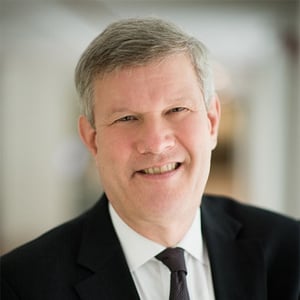
Senior Fellow and Director, Center for the Economics of the Internet, Hudson Institute
Harold Furchtgott-Roth is a senior fellow and director of the Center for the Economics of the Internet at Hudson Institute.
Mr. Furchtgott-Roth founded Furchtgott-Roth Economic Enterprises in 2003. He frequently comments on issues related to the communications sector of the economy. From 2001 to 2003, he was a visiting fellow at the American Enterprise Institute where he published A Tough Act to Follow, chronicling the difficulties implementing the Telecommunications Act of 1996.
From 1997 through 2001, Mr. Furchtgott-Roth served as a commissioner of the Federal Communications Commission. In that capacity, he served on the Joint Board on Universal Service. He is one of the few economists to have served as a federal regulatory commissioner, and the only one to have served on the Federal Communications Commission.
Before his appointment to the FCC, he was chief economist for the House Committee on Commerce and a principal staff member on the Telecommunications Act of 1996. Earlier in his career, he was a senior economist with Economists Incorporated and a research analyst with the Center for Naval Analyses.
Mr. Furchtgott-Roth is a member of the Washington Legal Foundation’s Legal Policy Advisory Board. He is the coauthor of three books: Cable TV: Regulation or Competition, with R.W. Crandall; Economics of A Disaster: The Exxon Valdez Oil Spill, with B.M. Owen et al; and International Trade in Computer Software, with S.E. Siwek.
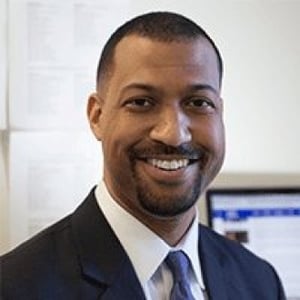
President & CEO, Public Knowledge
Chris Lewis has served as President and CEO at Public Knowledge since July 2019. Prior to being elevated to President and CEO, Chris served seven years as PK’s Vice President for Government Affairs, leading the organization’s day-to-day advocacy and political strategy on Capitol Hill and at government agencies. During that time he also served as a local elected official, serving two terms on the Alexandria City Public School Board in Virginia.
Before joining Public Knowledge, Chris worked in the Federal Communications Commission Office of Legislative Affairs, including as its Deputy Director. He is a former U.S. Senate staffer and an experienced political organizer and advocate in both the nonprofit world and political campaigns from local to the presidential level. Chris graduated from Harvard University with a Bachelors degree in Government and lives in Alexandria, VA where he continues to volunteer and advocate on local civic issues.
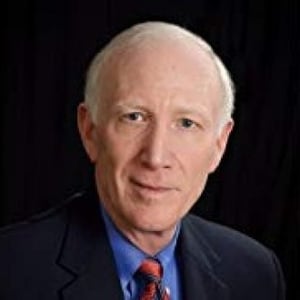
President, The Free State Foundation
Randolph J. May is Founder and President of The Free State Foundation. The Free State Foundation is an independent, non-profit free market-oriented think tank founded in 2006.
From October 1999-May 2006, May was a Senior Fellow and Director of Communications Policy Studies at The Progress & Freedom Foundation, a Washington, DC-based think tank. Prior to joining PFF, he practiced communications, administrative, and regulatory law as a partner at major national law firms. From 1978 to 1981, May served as Assistant General Counsel and Associate General Counsel at the Federal Communication Commission.
May has held numerous leadership positions in bar associations. He is a past Chair of the American Bar Association’s Section of Administrative Law and Regulatory Practice. He is a Fellow of the National Academy of Public Administration. Mr. May also has served as a Public Member of the Administrative Conference of the United States and currently is a Senior Fellow at ACUS.
Mr. May has published more than two hundred articles and essays on communications, administrative and constitutional law topics. He is author of A Call for a Radical New Communications Policy: Proposals for Free Market Reform, and co-author of #CommActUpdate: A Communications Law Fit for the Digital Age and The Constitutional Foundations of Intellectual Property. Mr. May is editor of two books, Communications Law and Policy in the Digital Age: The Next Five Years and New Directions in Communications Policy. In addition, he is the co-editor of two other books, Net Neutrality or Net Neutering: Should Broadband Internet Services Be Regulated? and Communications Deregulation and FCC Reform. In the past, Mr. May has written regular columns on legal and regulatory affairs for Legal Times and the National Law Journal, leading national legal periodicals.
He received his A.B. from Duke University and his J.D. from Duke Law School, where he serves as a member of the Board of Visitors.
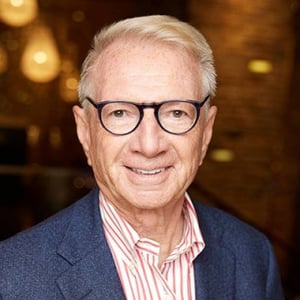
Senior Labor and Employment Counsel, CHRO Association
Roger King is a highly regarded labor relations attorney, whose career spans more than 40 years. Roger recently retired as a partner with Jones Day law firm. He now serves as Senior Labor and Employment counsel for the Association.
Roger specializes in labor and employment, healthcare, collective bargaining, contract administration and representation campaigns. Roger represented the winning side as co-counsel in the landmark U.S. Supreme Court case known as Noel Canning, which successfully challenged President Obama’s authority to make recess appointments to the National Labor Relations Board.
After graduating from Cornell University Law School, he was a Captain and Legal Services Officer in the United States Air Force, on the Staff of United States Senator Robert Taft, Jr. and, subsequently, was appointed as Professional Staff Counsel to the United States Senate Labor Committee.
Roger has testified before both the U.S. Senate and House Labor Committees, is a fellow of the College of Labor and Employment Lawyers, and serves on the Advocacy Committee of the American Society for Healthcare Human Resources Association (ASHHRA) and on the Executive Committee of the Ohio State Bar Association Labor and Employment Law Section Council.
He is a nationally recognized author/speaker on employment matters and has represented employers regarding labor and employment issues both before administrative agencies and in federal and state courts. He has represented the U.S. Chamber of Commerce, the Society for Human Resource Management (SHRM), the HR Policy Association (HRPA), the National Manufactures Association (NAM), the American Hospital Association (AHA), and the Coalition for a Democratic Workplace (CDW) in federal courts regarding numerous labor law issues.
Other clients Roger has represented include the Cleveland Clinic Foundation, Catholic Health Partners, MedStar Health, HCA, Texas Health Resources, Unity Point Health, UHS, Trinity Health, National Beef, General Cable, Orlando Health, ProMedica, Premier Health, Cedars-Sinai, Yale New Haven Health System, McLaren Health Care Corporation, Ohio, California and American Hospital Associations, Bon Secoure Health System, Kaleida Health, Sisters of Levenworth Health System, Lakeland Regional Medical Center, Clarion Clinic, Fisher-Titus Medical Center, Saint Joseph Health System, Benefis Healthcare, Community Health Systems, American Water Works, Macy’s Inc., Verizon and General Motors.
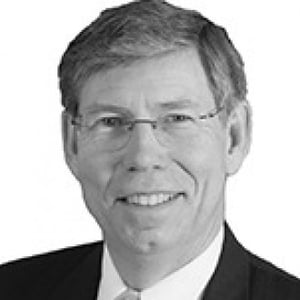
Partner, Dentons LLP
Former Florida Attorney General and Congressman Bill McCollum Co-Chairs Dentons' US State Attorney General Practice. His practice focuses on corporate compliance and investigations; complex state legal, regulatory and legislative matters; state anti-trust law enforcement; multi-state investigations and litigation; public policy; and advising and assisting companies with disruptive new technologies. He has represented and consulted for companies from a variety of industries with manufacturing and other business interests in Asia, Europe, the Middle East and Latin America
Bill served as the 36th Attorney General of Florida from 2007-2011. During his term of office he led the challenge by a large group of state attorneys general to the constitutionality of the Affordable Care Act, positioned Florida as a national leader in the fight against child pornography and internet child predators, and championed a wide range of consumer protection causes from claims coming out of the Deepwater Horizon oil spill to combatting mortgage fraud and Medicaid fraud. Since developing, advocating for and gaining enactment of a law in Florida capping contingency fees in state litigation outsourced to private attorneys, Bill has championed enactment of similar Transparency in Private Attorney Contracting legislation in many other states.
As a member of the Florida Cabinet, Bill was one of only four statewide elected officials who shared executive power over the state pension fund, the Financial Services Commission (insurance, banks and securities), the Division of Bond Finance, the Department of Revenue, the Land and Water Adjudicatory Commission, the Florida Highway Patrol and the Florida Department of Law Enforcement.
A Republican, Bill represented Florida’s 8th Congressional District in the US House of Representatives from 1981-2001, serving on the Judiciary, Banking and Financial Services and Intelligence Committees. He held a number of leadership positions including Chairman of the Judiciary Subcommittee on Crime; Chairman of the Subcommittee on Human Intelligence, Analysis and Counterintelligence; Vice Chairman of the Banking and Financial Services Committee; Ranking Member of the subcommittee overseeing the Federal Reserve; Founder and Chairman of the House Task Force on Terrorism; and served as Vice Chairman of the House Republican Conference for three terms. He was one of 15 Members selected to serve on the House Committee to Investigate the Iran-Contra Affair and was a House Manager for President Clinton’s impeachment trial.
Since 2013, Bill has served as Chairman of the Republican State Leadership Committee, a Section 527 organization dedicated to gaining and maintaining Republican control of state legislative bodies across the country and electing Republican lieutenant governors and secretaries of state.
Bill served on active duty in the US Navy from 1969-1972, and in 1992 retired from the Naval Reserve as a Commander, having served 23 years as an officer in the Judge Advocate General’s Corps (JAG). Prior to his election to Congress he was a litigation partner with the Orlando law firm Pitts, Eubanks & Ross. After retiring from Congress in 2001 until assuming office as Florida Attorney General in 2007 Bill was a partner with Baker & Hostetler, LLP. He was Chairman of Healthy Florida Foundation which in 2003 held a series of five professionally facilitated retreats with over 100 delegates representing a cross section of healthcare stakeholders who analyzed America’s health care delivery system, reached consensus and published 14 recommendations for reform. In 2005-2006, he served as a member of the State University System of Florida Board of Governors.
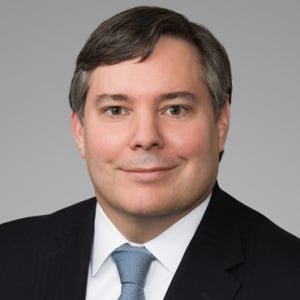
Partner, Kirkland & Ellis LLP
Mr. Doug Smith has litigated cases at both the trial and appellate stage in state and federal courts throughout the country, including commercial, mass tort, product liability, securities, bankruptcy, environmental, and intellectual property cases. He is a member of the American Law Institute and has published on a wide variety of legal topics.
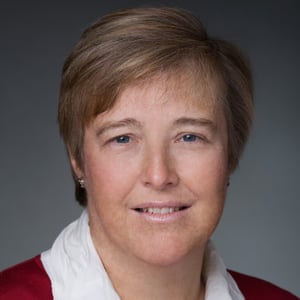
Senior Vice President, Government Affairs, T-Mobile
As Senior Vice President, Government Affairs for T-Mobile, Kathleen O’Brien Ham is the chief public policy advocate for the Un-carrier. Kathleen manages all public policy issues before federal and state governments impacting the company. Her team regularly engages Congress, the FCC, state agencies, and other governmental bodies on a wide range of regulatory and policy issues, including spectrum, consumer, public safety, and competition matters. She has led numerous successful efforts to gain additional radio spectrum for the company, including most recently, the acquisition of 600 MHz frequencies to expand T-Mobile’s coverage and deploy 5G technology. She has also testified before Congress numerous times in support of the company’s public policy positions.
Prior to joining T-Mobile, she worked for fourteen years at the FCC in several top policy positions, including Deputy Chief of the Wireless Telecommunications Bureau. She was the first Chief of the FCC’s Spectrum Auctions Program where she was responsible for the early landmark PCS spectrum auctions. She also served on the FCC’s Spectrum Management Task Force and was involved in the Intergovernmental Advisory Committee that negotiated the reallocation of third generation (3G) wireless spectrum from government to commercial use.
A graduate of Catholic University’s Columbus School of Law, she received her undergraduate degree from the University of Colorado, with a Bachelor of Science in Journalism. For several years, she taught telecommunications as an adjunct professor at Catholic University. She has received numerous industry honors and recognition, most recently being named as one of 50 of the Most Influential Women in Wireless to Watch in 2017 by Global Telecoms Business. The Hill named her as one of the Top Lobbyists in 2016. In 2014 the Competitive Carriers Association celebrated her contributions to the industry with an Outstanding Achievement Award for her work in support of spectrum auction rules that benefit smaller carriers and help promote competition in the wireless ecosystem. And, since 2010 she has been named four times as one of the Most Influential Women in Wireless by FierceWireless.

President & CEO, Center for Democracy & Technology
Nuala O’Connor is the President & CEO of the Center for Democracy & Technology, a global nonprofit committed to advancing our digital rights. She is a vocal advocate for harnessing the potential of the internet and emerging technologies to increase equality, amplify voices, and promote human rights. At CDT, Nuala leads a diverse team that is driving policy solutions that advance the rights of the individual in the digital age. Her experience working in the federal government, multinational corporations, tech start-ups, and noted law firms informs her innovative and collaborative leadership approach.
Nuala began her career in the private sector, working at the law firms of Venable, Hudson Cook, and Sidley. She entered the technology sector when she joined the start-up DoubleClick as Deputy General Counsel. While there, and in her later position as Vice President & Chief Privacy Officer of Email & Emerging Technologies, she worked on numerous class actions, a multistate settlement with state attorneys general, and an FTC investigation before helping to create the company’s privacy compliance department, which still serves as an influential model for companies in the technology sector and beyond. She later served as Global Privacy Leader at General Electric (GE) and was responsible for privacy policy and practices across GE’s numerous divisions. Her most recent corporate experience was at Amazon.com, where she served as Vice President, Compliance & Consumer Trust, and Associate General Counsel Data & Privacy Protection.
Between her stints in the private sector, Nuala served in various capacities within the federal government. At the U.S. Department of Commerce she worked on global technology policy, including internet governance and industry best practices, in her roles as Deputy Director of the Office of Policy & Strategic Planning, Chief Privacy Officer, and Chief Counsel for the Technology Administration. She later became the first statutorily appointed Chief Privacy Officer (CPO) in federal service when she was named as CPO at the Department of Homeland Security (DHS). At DHS she was responsible for groundbreaking policy creation and implementation regarding the use of personal information in national security and law enforcement. Under her leadership, the DHS Privacy Office issued a seminal report criticizing the use of private-sector data in national security efforts.
Nuala serves on several nonprofit boards, and is the recipient of the International Association of Privacy Professionals (IAPP) Vanguard Award, the Executive Women’s Forum’s Woman of Influence Award, and was named as “Geek of the Week” by the Minority Media & Telecom Council. She served as a member of the board of the IAPP for six years, including a term as chairman. Nuala has also been known to serve as a “class mom” on more than one occasion.
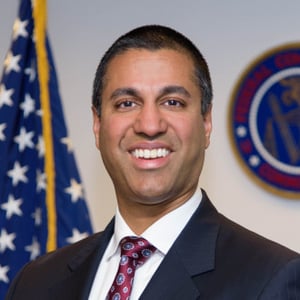
Nonresident Fellow, American Enterprise Institute
Ajit Pai, a former chairman of the Federal Communications Commission (FCC), is a nonresident fellow at the American Enterprise Institute, where he focuses on issues pertaining to technology and innovation, telecommunications regulatory policy, and market-based incentives for investment in broadband deployment. Concurrently, he is a partner at Searchlight Capital Partners, a global investment firm.
Mr. Pai’s distinguished career at the FCC includes two leadership roles following presidential appointments. He was appointed commissioner by President Barack Obama in 2012, designated chairman by President Donald Trump in 2017, and twice confirmed by the US Senate. While at the helm of the FCC, Mr. Pai had a transformative impact on the future of US technology and communications policy, implementing major initiatives to help close the digital divide; advance US leadership in 5G and other wireless technologies; promote innovation; protect consumers, public safety, and national security; and make the agency itself more open, transparent, and data-driven.
Earlier in his career, Mr. Pai served in various public-sector positions in the FCC’s Office of General Counsel, the US Department of Justice, the US Senate Judiciary Committee, and the US District Court for the Eastern District of Louisiana. He also worked as a partner at Jenner & Block and associate general counsel at Verizon Communications.
Mr. Pai graduated with honors from Harvard University, where he received a bachelor’s degree, and from the University of Chicago Law School, where he received a law degree and was an editor on the University of Chicago Law Review.

Judge, United States Court of Appeals, Fifth Circuit
Judge Smith was appointed U.S. Circuit Judge for the Fifth Circuit by President Reagan and entered on duty in January 1988. He attended public schools in Lubbock, Texas, and graduated from Yale University, receiving a B.A. in 1969 and a J.D. in 1972.
Judge Smith was a Law Clerk to U.S. District Judge Halbert Woodward, Northern District of Texas, 1972-1973; with the Houston law firm of Fulbright & Jaworski as an Associate, 1973-1981, and as Partner, 1981-1984; and as City Attorney, City of Houston, 1984-1988. He was Chairman, Civil Service Commission, City of Houston, 1982-1984; and a Director, Harris County Housing Authority, 1978-1980.
Judge Smith lives in Houston and is married to Mary Jane Smith and has four children: Ruth Ann, Clark, J.J., and Brandon. He formerly was Chair of the Advisory Committee on Federal Rules of Evidence of the Judicial Conference of the United States. He assists LexisNexis/Matthew Bender & Co. in periodic revisions of several chapters of Moore’s Federal Practice.
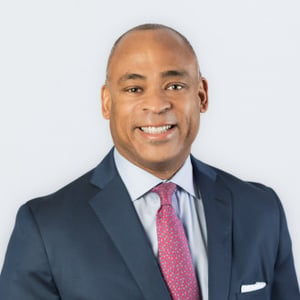
President & CEO, Internet Association
K. Dane Snowden is the President and CEO of Internet Association. Under his leadership, IA advocates for public policy that fosters innovation, promotes economic growth, and empowers people through a free and open internet.
Prior to joining IA, Dane served as Chief Operating Officer of The Internet & Television Association (NCTA). In this position, he led the Association’s day-to-day operations including its policy planning and strategic initiatives.
His past experience also includes a tenure at CTIA – The Wireless Association as Vice President of External and State Affairs where he focused on promoting policies to grow the wireless ecosystem. Dane’s government experience features his appointment as Chief of the Federal Communications Commission’s Consumer & Governmental Bureau where he was responsible for the development and execution of vision, strategic direction, telecommunication policy, and management of the Bureau’s activities and 300 employees. He began his career working in the private and non-profit sectors for MissionFish.com, America’s Promise- The Alliance for Youth, and the United Negro College Fund. He is a graduate of The College of William and Mary.
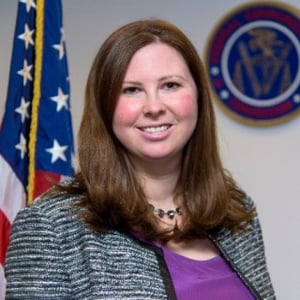
Legislative Director for Senator Marsha Blackburn, U.S. Senate
Jamie Susskind is the Legislative Director for Senator Marsha Blackburn (R-TN). Prior to becoming Legislative Director, she served for two years as the Senator’s Technology Policy Advisor. In that role, she advised on issues such as data privacy, cybersecurity, broadband, spectrum, content moderation, and antitrust, in addition to staffing the Senator on the Senate Commerce Subcommittee on Consumer Protection, Product Safety, and Data Security. Susskind previously worked on the Hill as Chief Counsel to Senator Deb Fischer (R-NE) and as an FCC Detailee for the Senate Committee on Commerce, Science, and Transportation. She also served as Chief of Staff to FCC Commissioner Brendan Carr and as Vice President of Policy and Regulatory Affairs at the Consumer Technology Association. A native Michigander, Susskind earned a Juris Doctor from the Antonin Scalia Law School and a Bachelor of Arts degree from the University of Michigan (Go Blue!).

Senior Fellow and Academic Director, Penn Carey Law School
Gus Hurwitz is a Senior Fellow and the Academic Director of the Center for Technology, Innovation & Competition and the University of Pennsylvania Carey Law School where he is working to develop academic and scholarly programs at the intersecution of law, technology, and policy.
He is also Director of Law & Economics Programs at the International Center for Law & Economics (ICLE), a think tank based in Portland, Oregon, where he directs its law and economics-focused research program and helps to translate academic research into applied policy issues.
Hurwitz's research focuses on the regulation of technology, including administrative and regulatory law, antitrust law, torts and products liability, and media law - alongside cognate fields. Inrecent years he has worked on an AI standardization initiative with Seoul National University, a UNICEF-organized study of broadband deployment to public schools in Rwanda, and a book on conglomerate and ecosystems theories of antitrust.
He has published over 30 articles and book chapters, two books (one on cybersecurity law & policy, one on media regulation in the digital era) and have two more in process, over 100 shorter writings (op-eds, shorter analyses, blog posts, &c), hosted over 100 podcast episodes, and regularly appear or am quoted in popular media (including the NY Times, Wall Street Journal, Washington Post, and Associated Press). His work has been cited by legislators, federal courts of appeals, and federal regulatory agencies.
He was previously a full professor and founding director of the Governance & Technology Center at the University of Nebraska, prior to which he was the inaugural research fellow at the Center for Technology, Innovation & Competition (CTIC). From 2007 to 2010, he was a trial attorney with the U.S. Department of Justice Antitrust Division in the Telecommunications and Media Enforcement Section.
He also is, or has been, affiliated with the Classical Liberal Institute at New York University School of Law, the National Security Institute at George Mason University, and the American Enterprise Institute (AEI).
Before attending law school, Hurwitz worked at Los Alamos National Lab and interned at the Naval Research Lab. During this time his work was recognized by the Federal Laboratory Consortium, Los Alamos National Lab, IEEE & ACM, Corporation for Education Network Initiatives in California, R&D Magazine, and even the Guinness Book of World Records.
A current list of Hurwitz’s publications is available on his website: GusHurwitz.net.

President and Founder, International Center for Law & Economics
Geoffrey A. Manne is the president and founder of the International Center for Law and Economics (ICLE), a nonprofit, nonpartisan research center based in Portland, Oregon. He is also a distinguished fellow at Northwestern Law School’s Searle Center on Law, Regulation, & Economic Growth. In April 2017 he was appointed by FCC Chairman Ajit Pai to the FCC’s Broadband Deployment Advisory Committee, and he recently served for two years on the FCC’s Consumer Advisory Committee.
Mr. Manne earned his JD and AB degrees from the University of Chicago and is an expert in the economic analysis of law, specializing in competition, telecommunications, consumer protection, intellectual property, and technology policy.
Prior to founding ICLE, Manne was a law professor at Lewis & Clark Law School. From 2006-2009, he took a leave from teaching to develop Microsoft’s law and economics academic outreach program. Manne has also served as a lecturer in law at the University of Chicago Law School and the University of Virginia School of Law. He practiced antitrust law and appellate litigation at Latham & Watkins, clerked for Hon. Morris S. Arnold on the 8th Circuit Court of Appeals, and worked as a research assistant for Judge Richard Posner. He was also once (very briefly) employed by the FTC.
Mr. Manne’s publications have appeared in numerous journals including the Journal of Competition Law and Economics, the Harvard Journal of Law and Technology, the Supreme Court Economic Review, and the Arizona Law Review, among others. With former FTC Commissioner, Joshua Wright, Manne is the editor of a volume from Cambridge University Press entitled, Competition Policy and Intellectual Property Law Under Uncertainty: Regulating Innovation. Manne has also testified on several occasions before Congress and at the FCC and FTC, and he regularly files written comments and amicus briefs on key antitrust, IP, and telecommunications issues. His analysis is frequently published in popular print and broadcasting outlets such as the Wall Street Journal, Wired, Foreign Affairs, NPR, and Bloomberg, among others.
Manne is a member of the American Law and Economics Association, the Canadian Law and Economics Association, and the Society for Institutional & Organizational Economics. He blogs at Truth on the Market (www.truthonthemarket.com) (of which he is also the co-founder), is a contributor at WIRED, and tweets at @geoffmanne. His scholarly publications are available at http://ssrn.com/author=175541.

Legal Fellow, Center for Constitutional Studies, Cato Institute
Brent Skorup is a legal fellow in the Cato Institute’s Robert A. Levy Center for Constitutional Studies.
Before joining Cato, he was a senior research fellow at the Mercatus Center at the George Mason University. His research areas include free speech, technology law, Fourth Amendment protections, regulation, and property law. Skorup has published pieces in economics and law journals and in popular media, including The Wall Street Journal, The New York Times, Bloomberg Law, Reuters, and Wired. He’s appeared as a TV and radio interview guest for news outlets like C‑SPAN, NPR, CBS News, ABC News, and CNBC Asia.
The Pennsylvania Supreme Court, a dissenting opinion at the Illinois Supreme Court, and the ALI's Restatement of the Law of Property have cited his legal research and he has testified as a technology and legal expert in legislative hearings in several states. Skorup has been appointed to several federal and state advisory bodies and he is currently a member of the Texas Advanced Air Mobility Advisory Committee.
Skorup has a BA in economics from Wheaton College and a law degree from the George Mason University School of Law, where he was articles editor for the Civil Rights Law Journal. He was a legal clerk at the FCC’s wireless bureau and Office of General Counsel and at the Energy and Commerce Committee in the U.S. House of Representatives.

Director of Research, Coin Center
Peter is Director of Research at Coin Center, the leading non-profit research and advocacy group focused on the public policy issues facing cryptocurrency technologies such as Bitcoin. He is a graduate of NYU Law, as well as a self-taught designer and coder.
He drafts the Center’s public regulatory comments, and helps shape its research agenda. He has testified before Congress, briefed staff and members of the EU parliament and educated policymakers and regulatory staff around the world on the subject of cryptocurrency regulation and decentralized computing systems. Previously, he was a Google Policy Fellow and collaborated with various digital rights organizations on projects related to privacy, surveillance, and digital copyright law.

Retired Partner, Kirkland & Ellis LLP
Mr. Jay Lefkowitz is a retired partner in Kirkland’s litigation practice and a member of the Firm’s Global Executive Management Committee. He is also an adjunct professor at Columbia Law School, where he teaches a seminar on Supreme Court advocacy. Mr. Lefkowitz has served as lead trial and appellate counsel in a wide variety of substantive areas, including shareholder disputes, antitrust, product liability, litigation against the FDA and False Claims Act matters. He has also conducted numerous internal investigations for public companies and audit committees.
In its 2013 release of “The 100 Most Influential Lawyers in America,” The National Law Journal describes Mr. Lefkowitz as “a leading voice on school choice issues” and “a no-nonsense appellate and antitrust lawyer for an array of blue-chip clients.” The Legal 500 U.S. noted that Mr. Lefkowitz “provides a depth of understanding and influence in some of the highest courts of our country,” and in Chambers USA, America’s Leading Lawyers for Business, clients say, “‘Jay is brilliant; there is no other way to put it.’” Mr. Lefkowitzwas also named a Law360 “MVP of the Year” in 2011 for his Appellate practice, and in 2012, 2013, 2014 and 2015 for his Life Sciences work. Mr. Lefkowitz is one of only three of the 189 MVPs named to the list five years in a row. The American Lawyer named him its “Lawyer of the Week” in December 2012 for his role in winning an antitrust lawsuit in the pharmaceutical industry.
Mr. Lefkowitz has taken on groundbreaking work for high-profile clients, representing more than a dozen major pharmaceutical, medical device and health care companies in important and frequently precedent-setting matters. Mr. Lefkowitz has won two landmark 5-4 decisions at the U.S. Supreme Court in favor of the pharmaceutical industry overturning the decision of three Circuit Courts of Appeal. In Pliva v. Mensing in 2011, on behalf of Teva and Actavis, Mr. Lefkowitz convinced the Court to reject the views of the FDA and the Solicitor General and establish that generic drug companies may no longer be sued for “failure to warn claims,” finding that federal law preempts state law under the Constitution’s supremacy clause. His victory in Mutual v. Bartlett in 2013, overturned a $21 million verdict on behalf of Sun Pharmaceuticals, and extended the Mensing ruling to cover design defect claims.
Senior Counsel, Compass Legal Group
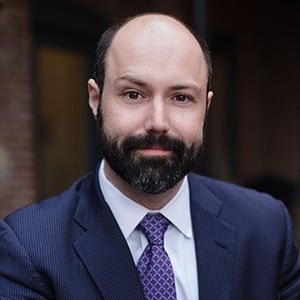
Andrew Kloster is Senior Counsel at the nonprofit Compass Legal Group. He is a long-time fixture of the conservative movement, advising clients on the new right on a wide variety of matters criminal, civil, political / electoral, and administrative. Recently, he served as Chief of Staff to the Wisconsin Office of Special Counsel investigation into election administration. Prior to that, he served in the Trump administration, including concurrently as Associate Director in the White House Office of Presidential Personnel and as Deputy General Counsel (and later, Acting General Counsel) in the United States Office of Personnel Management. He has also served in senior positions in regulatory and legal positions at the United States Department of Transportation and the Environmental Protection Agency, and was appointed by President Trump to serve a three-year term on the Council of the Administrative Conference of the United States. Previously, he worked at the Heritage Foundation, the Scalia Law School, and other movement groups. He is a graduate of the University of Miami and the New York University School of Law, and he served as a law clerk on the United States Court of Appeals for the Seventh Circuit.
Director, Center for American Freedom, America First Policy Institute
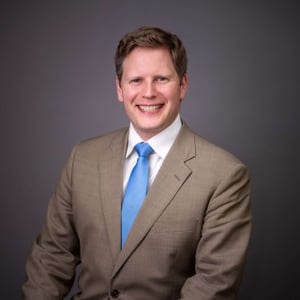
James Sherk was born in Ontario, Canada, and immigrated with his family to Midland, Michigan while in middle school. He serves as AFPI’s Director of the Center for American Freedom. Sherk previously served as Special Assistant to the President for Domestic Policy on the White House Domestic Policy Council under President Donald Trump. James served as the Administration’s top civil service reform and labor policy advisor from 2017 to 2021. At the White House, he was the principal author of and/or policy lead for approximately two dozen executive orders and presidential memoranda. Sherk also served as a member of the President’s Council on Improving Federal Civic Architecture. Prior to his White House service, Sherk was a Research Fellow at the Heritage Foundation, where he was a nationally recognized expert on the civil service and labor policy. Sherk received a Bachelor of Science in Mathematics and Economics from Hillsdale College and an Master of Arts in Economics from the University of Rochester. Sherk and his wife, Jill, live in Northern Virginia with three beloved children who teach their parents to ponder inscrutable questions like “how much drawing can go on the walls before we have to repaint them?”
Professor of Law, University of Louisville Brandeis School of Law
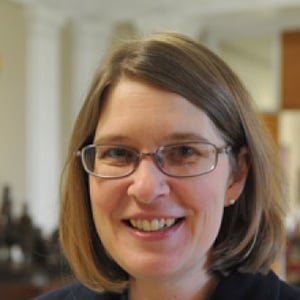
Ariana R. Levinson is a nationally acclaimed and internationally recognized labor and employment law scholar and focuses her teaching on practical legal skills. She has often presented her research, including at Berkeley Law School, Fordham Law School, University of Leeds, and Universidad Carlos II de Madrid. Levinson’s work has been published in the Columbia Business Law Review and the Cornell Journal of Law and Public Policy. She has a forthcoming student co-authored article in the Harvard Journal on Legislation and is working on a hornbook on arbitration.
Professor Levinson received a Corey Rosen Research Fellowship from the Rutgers School of Management and Labor Relations for the 2012-13 academic year, and a Michael W. Huber Fellowship for the 2013-14 academic year. In conjunction with the fellowships, she published "Founding Worker Cooperatives: Social Movement Theory and the Law" in the Nevada Law Journal and is working on a research project about the Cincinnati Union Co-op Initiative. Her article "What the Awards Tell Us about Labor Arbitration of Employment Discrimination Claims", published in the University of Michigan Journal of Law Reform was selected by blind review by Vanderbilt Law School faculty for presentation at the Branstetter New Voices in Civil Justice Workshop in May 2012.
In addition to writing about worker ownership and arbitration, Professor Levinson has also written a number of articles about workplace technology and privacy. Her most recent publications on this topic include a book chapter in the Research Handbook on Electronic Commerce Law.
Professor Levinson is the faculty liaison to the Peggy Browning Fund and a co-planner of the Warns-Render Labor and Employment Law Institute, an annual labor and employment law continuing legal education program. She coaches the mock arbitration team and advises the Wagner moot court team. She is a Reviewer for the American Business Law Journal. Professor Levinson is admitted to practice in Indiana and California.
Prior to teaching at Brandeis School of Law, Professor Levinson taught at USC Gould School of Law and at UCLA School of Law. She clerked for the Honorable John G. Davies (United States District Court, Central District of California) and for the Honorable Myra C. Selby (Supreme Court of Indiana) and practiced labor law, including serving as a fellow for the AFL-CIO's Legal Department.
She graduated magna cum laude from the University of Michigan Law School. During law school, she served as a contributing editor on the Michigan Law Review and was awarded the Robert S. Feldman Labor Law Award for the most outstanding work in that field. She also received a 2014-15 faculty favorite award from the University of Louisville Delphi Center for Teaching and Learning.
Vice President & Legal Director, National Right To Work Legal Defense Foundation
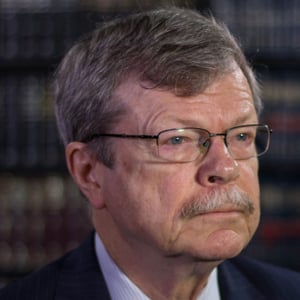
Raymond J. LaJeunesse, Jr., is Vice President and Legal Director of the National Right to Work Legal Defense Foundation, a non-profit legal aid organization. He was the first Staff Attorney employed by the Foundation and has more than forty-five years of experience helping workers in litigation in federal and state courts and administrative agencies over the abuses of compulsory unionism.
Mr. LaJeunesse has argued four cases in the United States Supreme Court. Those cases include Lehnert v. Ferris Faculty Ass’n, 500 U.S. 507 (1991), which limited the purposes for which compulsory union fees collected from public employees may lawfully be spent; Air Line Pilots Ass’n v. Miller, 523 U.S. 866 (1998), which established that unions cannot compel nonmembers to exhaust union-established remedies before going to court to challenge compulsory union fees; and Marquez v. Screen Actors Guild, 525 U.S. 33 (1998), in which the Court recognized that unions must notify employees that they can satisfy the “membership” requirement of “union shop” agreements by just paying fees for union bargaining activities and need not join and pay full dues to keep their jobs. He also was lead attorney in Hohe v. Casey, 956 F.2d 399 (3d Cir. 1992), in which more than $8.3 million in compulsory agency fees was recovered from the American Federation of State, County and Municipal Employees for a class of 57,000 nonmembers.
Mr. LaJeunesse is the author of several published articles about labor law, has testified before Congressional committees several times, and was an Advisor on the Transition Team for Labor- Related Agencies, Office of the President-Elect, in 1980-81 and a legislative aide to a member of the Virginia state legislature. He is a Vice Chairman of the Federalist Society’s Labor and Employment Law Practice Group and has spoken or debated at the Society’s National Lawyers Convention and at many Lawyers and Student Chapters on such topics as Right to Work laws, compulsory unionism arrangements, the misuse of union dues for politics, union organizing tactics (“card check” vs. secret-ballot elections), and the future of the union movement.

Negative Legislation
Roberto J. Borgert
Modern commentators have spilled much ink on the undemocratic nature of congressional delegations to executive...
The Telecommunications Act at 25 Years: A Panel Discussion
Michelle P. Connolly, Harold W. Furchtgott-Roth, Chris Lewis, Randolph May
On February 8, 1996, President Bill Clinton signed into law the landmark Telecommunications Act of...
COVID-19 Labor and Employment Teleforum Series #3
G. Roger King
Employers are increasingly being faced with difficult issues with respect to COVID-19, including challenging labor...
Climate Change Public Nuisance Lawsuits
Bill McCollum
On April 26, 2019, The Federalist Society's Palm Beach Lawyers Chapter hosted an event on...
Courthouse Steps Oral Argument: Merck Sharp & Dohme Corp. v. Albrecht
Douglas Geoffrey Smith
In Merck Sharp & Dohme Corp. v. Albrecht, the Supreme Court has been asked to...
The Current Landscape of Telecommunications Law
Kathleen Ham, Nuala O'Connor, Ajit V. Pai, Jerry E. Smith, K. Dane Snowden, Jamie Susskind
The Trump administration has emphasized the importance of ensuring existing regulations are not stifling innovation...
Net Neutrality and Federalism
Justin (Gus) Hurwitz, Geoffrey A. Manne, Brent Skorup
Despite the Federal Communication Commission’s decision in December 2017 to eliminate the common carrier regulations...
Fintech and Federal Alternatives to State Money Transmission Licensing
Peter Van Valkenburgh
Today's money transmitters are Internet businesses. The money is digital, it might even be cryptocurrency....
Update: In re Fosamax (Alendronate Sodium) Products Liability Litigation - Podcast
Jay Lefkowitz
In a recent decision, the Third Circuit held that hundreds of state-law claims alleging that...
Statewide vs. Local Right to Work Laws - Podcast
Andrew Kloster, James Sherk, Ariana R. Levinson, Raymond J. LaJeunesse
In 1957, an article in the Stanford Law Review asked the question: can counties and cities pass...