
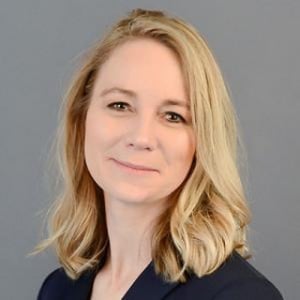
Supreme Court & Appellate Litigation Chair, Lex Politica; Of Counsel, Alliance Defending Freedom
Erin Morrow Hawley serves as Chair of Lex Politica's Supreme Court and Appellate Practice overseeing the firm’s strategic appellate litigation and critical motions practice in the trial courts. Erin is an experienced litigator who represents clients in constitutional, regulatory, and appellate matters in federal and state courts throughout the country.
Erin has represented dozens of clients before the Supreme Court of the United States, served as lead counsel in high-profile cases raising novel constitutional and statutory issues, and authored numerous successful petitions for certiorari and briefs in opposition. She has argued in state and federal appellate and trial courts throughout the country, including the Supreme Court of the United States. Erin represents diverse clients in high-stakes litigation from state governments to faith-based nonprofits to Fortune 100 companies. She possesses expertise on a wide range of subject matters including administrative law, the First Amendment, religious liberty, federal jurisdiction, federal preemption, equitable jurisdiction, tax law, the Affordable Care Act, and Title IX.
Erin represents clients in cases where public communications strategy is paramount. She is a sought-after speaker and writer, has testified multiple times before Congress, and is a frequent presenter on constitutional and administrative law issues, including at the Oxford Union, the National Federalist Society Convention, and university campuses across the country. She is a frequent commentator to media outlets, including Fox News, MSNBC, the Wall Street Journal, WORLD, USA Today, the Federalist, and the Hill.
Erin previously oversaw Alliance Defending Freedom’s--where she still serves as Of Counsel--litigation strategies to empower women and protect the dignity of life, defend pregnancy centers’ First Amendment rights from government overreach, and safeguard Americans’ freedoms from the ever-encroaching administrative state.

Laurence H. Silberman Chair in Constitutional Governance, American Enterprise Institute; Executive Director, Antonin Scalia Law School’s C. Boyden Gray Center for the Study of the Administrative State
Adam J. White is the Laurence H. Silberman Chair in Constitutional Governance and senior fellow at the American Enterprise Institute, where he focuses on the Supreme Court and the administrative state. He also directs the Antonin Scalia Law School’s C. Boyden Gray Center for the Study of the Administrative State.
He writes on regulation and constitutional government for a variety of publications. He practiced law in Washington, D.C., after clerking for the D.C. Circuit's Judge David Sentelle. He also has been chairman of the ABA's Administrative Law Section.
In 2021, he served on the Presidential Commission on the Supreme Court of the United States, where he criticized “Court packing” and other efforts to restructure the Supreme Court.
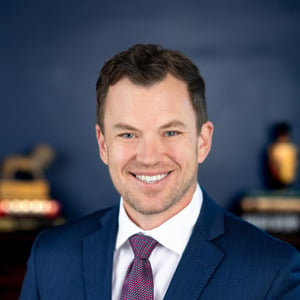
President and Co-Founder, America First Legal Foundation
Gene Hamilton is the President of America First Legal, which he co-founded, and where he was previously the Executive Director, Executive Vice President, and General Counsel. He most recently served as Deputy White House Counsel to President Donald Trump. Earlier in his career, Gene served as Counselor to Attorney General at the U.S. Department of Justice and as Senior Counselor to the Secretary of Homeland Security. He also served as General Counsel on the Senate Judiciary Committee and held several roles at the Department of Homeland Security, including with U.S. Immigration Enforcement, U.S. Customs and Border Protection and the Office of the General Counsel. He holds a B.A. from the University of Georgia and a J.D. from Washington and Lee University School of Law.
Partner, WilmerHale
Tom Saunders' practice focuses on appellate and government and public policy litigation with a particular emphasis on intellectual property. He has extensive experience representing clients in patent and copyright cases and has built a reputation as a leading advocate in high-stakes litigation before the Federal Circuit and Supreme Court. He returned to the firm in 2008 after completing a clerkship for the Honorable Ruth Bader Ginsburg of the United States Supreme Court.
Mr. Saunders also has significant experience in civil litigation involving the government and quasi-governmental entities. He regularly advises clients on constitutional matters, questions of public policy and strategy, and administrative law.
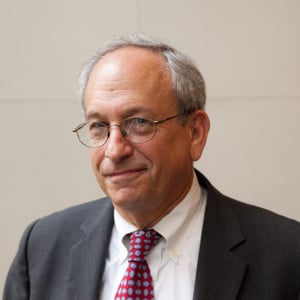
Robert V. Roosa Chair in International Economics, Senior Fellow – Economic Studies, Brookings Institution
Donald Kohn holds the Robert V. Roosa Chair in International Economics and is a senior fellow in the Economic Studies program at the Brookings Institution. Kohn is a 40-year veteran of the Federal Reserve system, serving as member and then vice chair of the Board of Governors from 2002-2010. He also served as an external member of the Financial Policy Committee at the Bank of England from 2011-2021. Kohn is an expert on monetary policy, financial regulation, and macroeconomics and has written extensively on these issues. Prior to taking office as a member of the Board of Governors he served in a number of staff roles at the Board, including secretary of the Federal Open Market Committee (1987-2002) and director of the Division of Monetary Affairs (1987-2001). He has also served as chairman of the Committee on the Global Financial System (CGFS), a central bank panel that monitors and examines broad issues related to financial markets and systems. He advised Federal Reserve Chairman Ben Bernanke throughout the 2008-2009 financial crisis and served as a key adviser to former Fed Chairman Alan Greenspan. He was awarded the Distinguished Achievement Award from The Money Marketeers of New York University (2002), lifetime achievement awards from The Clearing House (2012) and Central Banking magazine (2017), the Distinguished Alumni Award from the College of Wooster (1998), and the Honorary Degree, Doctor of Laws, from the College of Wooster (2006). In 2016, he was made honorary Commander of the British Empire. Kohn was born in November 1942 in Philadelphia. He received a B.A. in economics in 1964 from the College of Wooster and a Ph.D. in economics in 1971 from the University of Michigan. He is married and has two adult children and four grandchildren.
In addition to his Brookings position, Kohn serves on the board of Forbright Bank, consults on monetary policy for T. Rowe Price, chairs the Academic Advisory Committee at the Federal Reserve Bank of Dallas, and gives speeches to financial companies on the US economy and monetary policy under the aegis of the Washington Speakers Bureau.
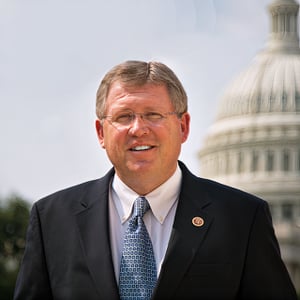
U.S. House of Representatives, Oklahoma
Congressman Frank Lucas is a fifth generation Oklahoman whose family has lived and farmed in Oklahoma for over 120 years. Born on January 6, 1960 in Cheyenne, Oklahoma, Lucas graduated from Oklahoma State University in 1982 with a degree in Agricultural Economics. He was first elected to the United States House of Representatives in a special election in 1994.
Lucas proudly represents Oklahoma’s Third Congressional District, which includes all or portions of 32 counties in northern and western Oklahoma, stretching from the Oklahoma Panhandle to parts of Tulsa, and from Mustang to Altus in the southwest. It takes up almost half the state’s land mass and is one of the largest agricultural regions in the nation. Lucas has been a crusader for the American farmer since being elected to Congress in 1994 and he has fought to protect Oklahoma values.
Prior to his service in Congress, Lucas served for five and a half years in the Oklahoma State House of Representatives, where he fought to defend the rights of private property owners and focused on promoting agriculture issues.
Frank and his wife Lynda have three children and five grandchildren. The Lucas family belongs to the First Baptist Church in Cheyenne.
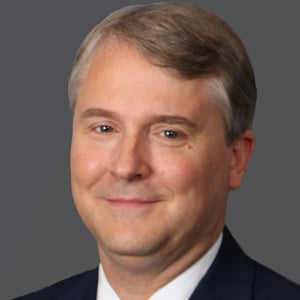
Partner, Mayer Brown
Andrew Olmem is a partner in Mayer Brown’s Washington DC office and a member of its Public Policy, Regulatory & Government Affairs, and Financial Services Regulatory & Enforcement practices. His practice focuses on complex financial services regulatory and public policy matters.
Andrew previously served as the Deputy Assistant to the President for Economic Policy and Deputy Director of the National Economic Council (NEC), where he oversaw the development and coordination of the administrations’ domestic economic policies, including for financial services, technology, telecom, energy, and infrastructure.
Earlier, he also served as the Republican Chief Counsel and Deputy Staff Director at the U.S. Senate Committee on Banking, Housing and Urban Affairs. Andrew began his legal career practicing corporate and securities law at Mayer Brown in New York City. Prior to attending law school, he served as an Assistant Economist at the Federal Reserve Bank of Richmond.

Senior Fellow, Mises Institute
Alex J. Pollock is a Senior Fellow with the Mises Institute, providing thought and policy leadership on financial issues and the study of financial systems. His work includes cycles of booms and busts, financial crises with their political responses, housing finance, government-sponsored enterprises, risk and uncertainty, central banking, banking and financial regulation, corporate governance, retirement finance, student loans, and the politics of finance.
He previously served as the Principal Deputy Director of the Office of Financial Research in the U.S. Treasury Department 2019-2021. He was a Distinguished Senior Fellow with the R Street Institute 2015-2019 and 2021, and a resident fellow at the American Enterprise Institute, 2004-2015. Among the many aspects of his AEI work, he developed the One Page Mortgage Form to give borrowers in clear form the key information they need in order to know what they are committing themselves to. He was President and CEO of the Federal Home Loan Bank of Chicago from 1991 to 2004. There he invented the Mortgage Partnership Finance program, which successfully created front-end mortgage credit risk sharing beginning in 1997. His decades of banking experience include being a Visiting Scholar at the Federal Reserve Bank of St. Louis, 1991.
Pollock was a director of the CME Group 2004-2019 and of Ascendium Education Group 1989-2019. He is a director and past-chairman of the Great Books Foundation and a past president of the International Union for Housing Finance.
He is the co-author of Surprised Again! - The COVID Crisis and the New Market Bubble (2022), and the author of Finance and Philosophy—Why We’re Always Surprised (2018) and Boom and Bust: Financial Cycles and Human Prosperity (2011), as well as numerous articles and Congressional testimony.
Pollock is a graduate of Williams College, the University of Chicago, and Princeton University.
His work is available on alexjpollock.com.

Associate Professor of Legal Studies & Business Ethics; Co-Director, Wharton Initiative on Financial Policy and Regulation, The Wharton School, University of Pennsylvania
Christina Parajon Skinner is an expert on financial regulation. Her research focuses on central banking, the debt markets, separation of powers, corporate governance, and law and macroeconomics. Professor Skinner’s work is international and comparative in scope, drawing on her experience as an academic and central bank lawyer in the United Kingdom. Her research has been published or is forthcoming in the Columbia Law Review, the Duke Law Journal, the Vanderbilt Law Review, and the Georgetown Law Journal, among other leading academic journals. Professor Skinner has also contributed to financial regulatory policy working groups, including those convened by the Federal Reserve Bank of New York, the Financial Stability Board, and the U.K. Banking Standards Board.
Prior to joining the faculty at Wharton, Professor Skinner served as legal counsel at the Bank of England, in the Financial Stability Division of the Bank’s Legal Directorate. Her work there focused principally on matters of bank resolution, financial market infrastructure, and macroprudential policy. Previously, Professor Skinner was an Academic Visitor at the University of Oxford, Faculty of Law and a Visiting Fellow at the London School of Economics, Law Department. From 2014-2016, she was a post-doctoral fellow and lecturer in Law at Columbia Law School.
Professor Skinner received her J.D. from Yale Law School, and an A.B. from the School of Public and International Affairs at Princeton University, with a concentration in international economics. She received certificates of proficiency in European Politics and Society, and Spanish Language and Culture.
She is married with five children.
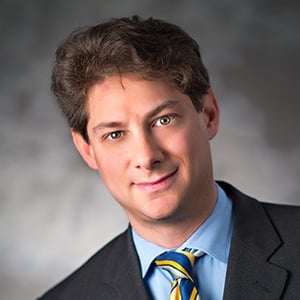
Fellow in Economic Studies and Policy Director, Center on Regulation and Markets, Brookings Institution
Aaron Klein is a fellow in Economic Studies at the Brookings Institution, where he also serves as policy director of the Center on Regulation and Markets. He focuses on financial regulation and technology, macroeconomics, and infrastructure finance and policy. Previously, Klein directed the Bipartisan Policy Center’s Financial Regulatory Reform Initiative. Klein served as Deputy Assistant Secretary for Economic Policy at the U.S. Treasury Department from 2009-2012. While at Treasury, Klein worked on multiple issues ranging from implementing aspects of the financial recovery program to developing new policy for financial regulation, housing finance, transportation and infrastructure, and Native American issues.
Prior to his appointment, he served as Chief Economist of the Senate Banking, Housing and Urban Affairs Committee for Chairmen Chris Dodd (D-CT) and Paul Sarbanes (D-MD). While working in the Senate Klein played a key role in a series of major legislation including, the Economic Emergency Stabilization Act of 2008 (better known as TARP), the Housing and Economic Recovery Act of 2008, the SAFETEA Act of 2005 that re-wrote America's surface transportation policy, the Check Truncation Act of 2003, the Terrorism Risk Insurance Act of 2002, and the Sarbanes-Oxley Act of 2002. A graduate of Dartmouth College and Princeton University, Klein lives in his hometown of Silver Spring, MD with his wife and two daughters.
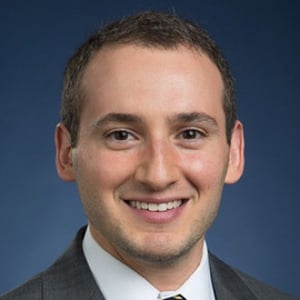
Assistant Professor of Business Law, Michigan Ross School of Law
Jeremy Kress is an Assistant Professor of Business Law at Michigan Ross and Co-Faculty Director of the University of Michigan’s Center on Finance, Law & Policy. His research focuses on bank regulation, systemic risk, and financial stability. Professor Kress' written work has appeared or is forthcoming in the Duke Law Journal, Northwestern University Law Review, Southern California Law Review, and Yale Journal on Regulation, among other journals.
Before entering academia, Professor Kress was an attorney in the banking regulation and policy group at the Federal Reserve Board of Governors in Washington, D.C. In that capacity, he drafted rules to implement the Dodd-Frank Act and Basel III, and he advised the Board on the legal permissibility of bank mergers and acquisitions.
Professor Kress has testified before Congress and serves as a member of the Federal Reserve Bank of New York’s Education and Industry Forum on Financial Services Culture. He frequently comments on financial regulatory matters in the press. Professor Kress has been featured in media outlets including the Wall Street Journal, New York Times, Financial Times, Washington Post, Bloomberg News, NPR's Marketplace, Politico, Yahoo Finance, and American Banker.
Professor Kress teaches Legal Issues in Finance & Banking at Michigan Ross, and he has taught Financial Regulation at Michigan Law School. He was named one of Poets & Quants’ “Top 50 Undergraduate Professors of 2020” and won Michigan Ross’ Neary Teaching Excellence Award in 2019.
Professor Kress graduated cum laude from Harvard Law School and from the Harvard Kennedy School, where he was a Presidential Scholar. He holds a BBA from Michigan Ross.

Judge, U.S. Court of Appeals for the Third Circuit
Hon. Jennifer Mascott served as Associate Professor of Law and Director of the Separation of Powers Institute at The Catholic University of America’s Columbus School of Law before her appointment to the federal bench. On July 16, 2025, President Donald J. Trump nominated her to the U.S. Court of Appeals for the Third Circuit (Delaware), and she was confirmed on October 9, 2025.
Prior to her confirmation, Judge Mascott wrote extensively in administrative and constitutional law, statutory interpretation, and the separation of powers. Her scholarship—published in leading journals including the Stanford Law Review, Notre Dame Law Review, and Supreme Court Review—was cited by the U.S. Supreme Court and multiple federal courts. She also contributed Supreme Court commentary for NBC Universal.
Before joining Catholic Law, she was an Assistant Professor and Co-Director of The C. Boyden Gray Center at George Mason University’s Antonin Scalia Law School. In 2022 she became co-author of Beermann, Cass & Diver’s Administrative Law: Cases and Materials (9th ed.). In 2023 she received the Justice Joseph Story Award for excellence in scholarship, teaching, and advancing the rule of law.
Judge Mascott also served as a Council Member of the ABA’s Administrative Law Section and as a Public Member of the Administrative Conference of the United States. She frequently testified before Congress on executive power, regulatory reform, and judicial jurisdiction, and participated in multiple Supreme Court confirmation hearings.
From 2019 to 2021, she took leave from academia to serve as Deputy Assistant Attorney General in the Department of Justice’s Office of Legal Counsel and later as Associate Deputy Attorney General, where she argued federal cases and assisted with Justice Amy Coney Barrett’s confirmation. Earlier in her career, she clerked for Justice Clarence Thomas and for then-Judge Brett M. Kavanaugh on the D.C. Circuit.
Judge Mascott earned her J.D. summa cum laude from the George Washington University Law School and her B.A. from the same institution.
Associate Professor of Legal Studies & Business Ethics; Co-Director, Wharton Initiative on Financial Policy and Regulation, The Wharton School, University of Pennsylvania
Christina Parajon Skinner is an expert on financial regulation. Her research focuses on central banking, the debt markets, separation of powers, corporate governance, and law and macroeconomics. Professor Skinner’s work is international and comparative in scope, drawing on her experience as an academic and central bank lawyer in the United Kingdom. Her research has been published or is forthcoming in the Columbia Law Review, the Duke Law Journal, the Vanderbilt Law Review, and the Georgetown Law Journal, among other leading academic journals. Professor Skinner has also contributed to financial regulatory policy working groups, including those convened by the Federal Reserve Bank of New York, the Financial Stability Board, and the U.K. Banking Standards Board.
Prior to joining the faculty at Wharton, Professor Skinner served as legal counsel at the Bank of England, in the Financial Stability Division of the Bank’s Legal Directorate. Her work there focused principally on matters of bank resolution, financial market infrastructure, and macroprudential policy. Previously, Professor Skinner was an Academic Visitor at the University of Oxford, Faculty of Law and a Visiting Fellow at the London School of Economics, Law Department. From 2014-2016, she was a post-doctoral fellow and lecturer in Law at Columbia Law School.
Professor Skinner received her J.D. from Yale Law School, and an A.B. from the School of Public and International Affairs at Princeton University, with a concentration in international economics. She received certificates of proficiency in European Politics and Society, and Spanish Language and Culture.
She is married with five children.

Julius E. Davis Professor of Law, University of Minnesota Law School
Ilan Wurman is the Julius E. Davis Professor of Law at the University of Minnesota, where he teaches administrative law and constitutional law. He previously taught at Arizona State University. He writes primarily on the Fourteenth Amendment, administrative law, separation of powers, and constitutionalism. His academic writing has appeared in the Yale Law Journal, the Stanford Law Review, the University of Chicago Law Review, the University of Pennsylvania Law Review, the Virginia Law Review, the Duke Law Journal, the Minnesota Law Review, the Notre Dame Law Review, and the Texas Law Review among other journals.
Professor Wurman is the author of the new book The Constitution of 1789: A New Introduction (Cambridge 2026). His previous books include A Debt Against the Living: An Introduction to Originalism (Cambridge 2017), and The Second Founding: An Introduction to the Fourteenth Amendment (Cambridge 2020). He is also the author of the casebook, Administrative Law Theory and Fundamentals: An Integrated Approach (Foundation Press 3d ed. 2025).
Professor Wurman practices law with the firm Tully Bailey. He has litigated a variety of administrative law and constitutional law cases, including cases involving COVID-19 restrictions, transmission lines, and Appointments Clause challenges. He also devised winning public nuisance theories to force city governments to address the increasingly challenging public camping crises throughout the country.

George Mason University Foundation Professor of Law, Antonin Scalia Law School, George Mason University
TODD J. ZYWICKI is George Mason University Foundation Professor of Law at Antonin Scalia Law School at George Mason University and Research Fellow of the George Mason Law and Economics Center. During the Fall 2023 semester he served as the Visiting Scholar in Conservative Thought and Policy for the Bruce Benson Center for the Study of Western Civilization at the University of Colorado-Boulder. From 2020-2021 he was Chair of the Consumer Financial Protection Bureau Taskforce on Federal Consumer Financial Law. In 2021 he was inducted to the American College of Consumer Financial Services Lawyers. He is also a Senior Fellow of the F.A. Hayek Program for the Advanced Study of Politics, Philosophy, and Economics at George Mason University and a former Senior Fellow of the Cato Institute. From 2015-2017 he was Executive Director of the George Mason Law and Economics Center. He served as Co-Editor of the Supreme Court Economic Review from 2006-2017. From 2003-2004, Professor Zywicki served as the Director of the Office of Policy Planning at the Federal Trade Commission. He has also taught at Vanderbilt University Law School, Georgetown University Law Center, Boston College Law School, Mississippi College School of Law, and China University of Political Science and Law.
Professor Zywicki clerked for Judge Jerry E. Smith of the U.S. Court of Appeals for the Fifth Circuit and worked as an associate at Alston & Bird in Atlanta, Georgia, where he practiced bankruptcy and commercial law. He received his J.D. from the University of Virginia, where he was executive editor of the Virginia Tax Review and John M. Olin Scholar in Law and Economics. Professor Zywicki also received an M.A. in Economics from Clemson University and an A.B. cum Laude with high honors in his major from Dartmouth College.
Professor Zywicki is also a Lone Mountain Fellow of the Property and Environment Research Center, a Fellow of the International Centre for Economic Research in Turin, Italy, and a former Senior Fellow of the Goldwater Institute. During the Fall 2008 Semester Professor Zywicki was the Searle Fellow of the George Mason University School of Law and was a 2008-09 W. Glenn Campbell and Rita Ricardo-Campbell National Fellow and the Arch W. Shaw National Fellow at the Hoover Institution on War, Revolution and Peace. He has lectured and consulted with government officials around the world, including Iceland, Italy, Japan, and Guatemala. In 2006 Professor Zywicki served as a Member of the United States Department of Justice Study Group on “Identifying Fraud, Abuse and Errors in the United States Bankruptcy System.”
Professor Zywicki is the author of more than 130 articles in leading law reviews and peer-reviewed economics journals. He is one of the Top 10 most-cited law professors in the field of Commercial Law and one of the Top 25 law professors on Twitter as measured by engagement levels. He is one of the Top 50 Most Downloaded Law Authors at the Social Science Research Network. He has testified multiple times before Congress on issues of consumer bankruptcy law and consumer credit and is a frequent commentator on legal issues in the print and broadcast media, including the Wall Street Journal, New York Times, The Washington Post, The Washington Times, Nightline, The Newshour with Jim Lehrer, Neil Cavuto Show, Fox & Friends, Smerconish, Fox News @ Night with Shannon Bream, Fox Business, CNN, CNBC, Bloomberg News, BBC, The Diane Rehm Show, Lou Dobbs Show, Jerry Doyle Show, and The Laura Ingraham Show.
Professor Zywicki is former Chairman and a current member of the Board of Directors of the Competitive Enterprise Institute, and is a member of the Board of Directors of the Institute for Humane Studies, Bill of Rights Institute, the Executive Committee for the Federalist Society's Financial Institutions and E-Commerce Practice Group, the Board of Trustees of the Foundation for Research on Economics and the Environment. He formerly served on the Governing Board and the Advisory Council for the Financial Services Research Program at George Washington University School of Business. He is currently the Chair of the Academic Advisory Council for the following organizations: The Bill of Rights Institute, the film “We the People in IMAX,” and the McCormick-Tribune Foundation “Freedom Museum” in Chicago, Illinois. He is a member of the Board of Visitors of Ralston College and was a member of the Board of Trustees of Yorktown University. From 2005-2009 he served as an elected Alumni Trustee of the Dartmouth College Board of Trustees.
President & Chief Executive Officer, Bank Policy Institute
Greg Baer is the President and Chief Executive Officer at the Bank Policy Institute. Previously, he served as President of The Clearing House Association and Executive Vice President and General Counsel of The Clearing House Payments Company, the largest private sector payments operator in the United States.
Prior to joining The Clearing House, Mr. Baer was Managing Director and Head of Regulatory Policy at JPMorgan Chase. He previously served as General Counsel for Corporate and Regulatory Law at JPMorgan Chase, supervising the company’s legal work with respect to financial reporting, global regulatory affairs, intellectual property, private equity and corporate M&A, and data protection and privacy.
Mr. Baer previously served as Deputy General Counsel for Corporate Law at Bank of America, and as a partner and co-head of the financial institutions group at Wilmer, Cutler, Pickering, Hale & Dorr. From 1999 to 2001, Mr. Baer served as Assistant Secretary for Financial Institutions at the U.S. Department of the Treasury, after serving as Deputy Assistant Secretary. Prior to working for the Treasury Department, Mr. Baer was managing senior counsel at the Board of Governors of the Federal Reserve System.
Mr. Baer received his J.D. cum laude from Harvard Law School in 1987, and served as managing editor of the Harvard Law Review. He received his A.B. with honors from the University of North Carolina at Chapel Hill in 1984.
Mr. Baer also serves as an adjunct professor at Georgetown University Law School, and is a member of the Economic Club of Washington. He currently serves on the board of Honors Carolina, and previously served on the boards of Enterprise Community Partners, the DC College Access Program, and the Appleseed Foundation. He is also the author of two books: The Great Mutual Fund Trap (Random House, 2002) and Life: The Odds (And How to Improve Them) (Penguin-Putnam, 2003).

Principal, Ely & Company, Inc.
Bert Ely has specialized in deposit insurance and banking structure issues since 1981. In 1986, he became an early predictor of the S&L crisis and a taxpayer bailout of the FSLIC. In 1991, he was the first person to correctly predict the non-crisis in commercial banking; in 1992, he predicted an eventual taxpayer bailout of the Japanese banking system.
Bert continuously monitors conditions in the banking and S&L industries, monetary policy, and the growing federalization of credit risk. He has helped to draft legislation to enact the cross-guarantee concept for privatizing banking regulation and its related deposit insurance and systemic risks. He has testified on numerous occasions before congressional committees on banking issues and he often speaks on these matters to bankers and others.
Bert first established his consulting practice in 1972. Before that, he was the chief financial officer of a public company, a consultant with Touche, Ross & Company, and an auditor with Ernst & Ernst. He received his MBA from the Harvard Business School in 1968 and his Bachelor's degree in economics in 1964 from Case Western Reserve University.
Senior Counsel, Willkie Farr & Gallagher LLP
J. Christopher “Chris” Giancarlo is senior counsel at Willkie Farr & Gallagher LLP, based in the firm’s New York office. Chris served as the thirteenth Chairman of the U.S. Commodity Futures Trading Commission (CFTC), where he oversaw regulation of the futures, options and swaps derivatives markets. Chris was also a successful entrepreneur helping GFI Group Inc. grow into a leading trading platform and technology vendor to global markets for OTC swaps and other derivatives and managing GFI’s successful private equity financing and IPO.
Chris is a renowned blockchain technology advocate and key contributor to the global discourse on cryptocurrencies and digital assets. During his tenure at the CFTC (2014-2019), Chris oversaw the first bitcoin futures products entering the marketplace and applied a “Do No Harm” regulatory approach towards blockchain technology.
Chris has testified often about financial and derivatives markets before the U.S. Congress and EU Parliament and is a frequent guest on broadcast radio and television, including BloombergTV, CNBC, Fox Business and the BBC, as well as podcasts such as “Unchained” and “CoinDesk.” Chris has written and spoken extensively on public policy, legal and other matters involving technology and the financial markets and has authored numerous white papers, articles and op-eds that have been published in The Wall Street Journal, Financial Times, Cato Journal, New York Law Journal, Les Echos and Coinbase.
Chris has over 45,000 followers on Twitter as @giancarloMKTS where he is known as “CryptoDad.”
Senior Fellow, Mises Institute
Alex J. Pollock is a Senior Fellow with the Mises Institute, providing thought and policy leadership on financial issues and the study of financial systems. His work includes cycles of booms and busts, financial crises with their political responses, housing finance, government-sponsored enterprises, risk and uncertainty, central banking, banking and financial regulation, corporate governance, retirement finance, student loans, and the politics of finance.
He previously served as the Principal Deputy Director of the Office of Financial Research in the U.S. Treasury Department 2019-2021. He was a Distinguished Senior Fellow with the R Street Institute 2015-2019 and 2021, and a resident fellow at the American Enterprise Institute, 2004-2015. Among the many aspects of his AEI work, he developed the One Page Mortgage Form to give borrowers in clear form the key information they need in order to know what they are committing themselves to. He was President and CEO of the Federal Home Loan Bank of Chicago from 1991 to 2004. There he invented the Mortgage Partnership Finance program, which successfully created front-end mortgage credit risk sharing beginning in 1997. His decades of banking experience include being a Visiting Scholar at the Federal Reserve Bank of St. Louis, 1991.
Pollock was a director of the CME Group 2004-2019 and of Ascendium Education Group 1989-2019. He is a director and past-chairman of the Great Books Foundation and a past president of the International Union for Housing Finance.
He is the co-author of Surprised Again! - The COVID Crisis and the New Market Bubble (2022), and the author of Finance and Philosophy—Why We’re Always Surprised (2018) and Boom and Bust: Financial Cycles and Human Prosperity (2011), as well as numerous articles and Congressional testimony.
Pollock is a graduate of Williams College, the University of Chicago, and Princeton University.
His work is available on alexjpollock.com.

Wayne A. Abernathy, Wild Bells
Wayne A. Abernathy is a former U.S. Treasury Assistant Secretary for Financial Institutions under President George W. Bush, receiving the Alexander Hamilton Award in recognition of his service. In that office he was also a member of the Board of Directors of the Securities Investor Protection Corporation. Prior to his work at the Treasury, Mr. Abernathy served as Staff Director of the Senate Banking Committee, under Chairman Phil Gramm.
Following his service at the Treasury, Mr. Abernathy worked for 15 years on the staff of the American Bankers Association, as Executive Vice President for Financial Institutions Policy and Regulatory Affairs.
Previous experience with the Senate Banking Committee includes serving as Staff Director of the Subcommittee on Securities during 1995-1998. From 1989 until 1994, Mr. Abernathy was a Republican economist for the committee. He previously worked as a senior legislative assistant for Senator Gramm during 1987-1989 and as an economist for the Banking Committee’s Subcommittee on International Finance and Monetary Policy during 1981-1986, under Chairman Jake Garn.
Mr. Abernathy earned his bachelor’s degree in International Studies from The Johns Hopkins University in 1978. In 1980, he received a master’s degree in International Studies from the School of Advanced International Studies of The Johns Hopkins University.
Robert V. Roosa Chair in International Economics; Senior Fellow - Economic Studies, The Brookings Institution
Donald Kohn holds the Robert V. Roosa Chair in International Economics and is a senior fellow in the Economic Studies program at the Brookings Institution. He also currently serves as an external member of the Financial Policy Committee at the Bank of England. Kohn is a 40-year veteran of the Federal Reserve system, serving as member and then vice chair of the Board of Governors from 2002-2010. Kohn is an expert on monetary policy, financial regulation, and macroeconomics and has written extensively on these issues. Prior to taking office as a member of the Board of Governors he served in a number of staff roles at the Board, including secretary of the Federal Open Market Committee (1987-2002) and director of the Division of Monetary Affairs (1987-2001). He has also served as chairman of the Committee on the Global Financial System (CGFS), a central bank panel that monitors and examines broad issues related to financial markets and systems. He advised Federal Reserve Chairman Ben Bernanke throughout the 2008-2009 financial crisis and served as a key adviser to former Fed Chairman Alan Greenspan. He was awarded the Distinguished Achievement Award from The Money Marketeers of New York University (2002), lifetime achievement awards from The Clearing House (2012) and Central Banking magazine (2017), the Distinguished Alumni Award from the College of Wooster (1998), and the Honorary Degree, Doctor of Laws, from the College of Wooster (2006). In 2016, he was made honorary Commander of the British Empire. Kohn was born in November 1942 in Philadelphia. He received a B.A. in economics in 1964 from the College of Wooster and a Ph.D. in economics in 1971 from the University of Michigan. He is married and has two adult children and four grandchildren.

Judge, United States Court of Appeals, Third Circuit
Judge Paul Matey was appointed to the United States Court of Appeals for the Third Circuit in 2019 by President Trump.
Before his judicial service, Judge Matey was a partner at Lowenstein Sandler in New Jersey where he practiced complex commercial litigation and criminal defense. Earlier, Judge Matey was the Senior Vice President, General Counsel and Secretary for University Hospital Newark, an academic medical center and teaching hospital.
He also served as the Deputy Chief Counsel to Governor Chris Christie, and as an Assistant United States Attorney in the District of New Jersey, where he was awarded the Justice Department’s Director’s Award for Superior Performance. He also practiced at the Washington D.C. firm of Kellogg, Hansen, Todd, Figel & Frederick, and served as a law clerk to judges on the United States Court of Appeals for the Third Circuit and the United States District Court for the District of New Jersey.
He earned his bachelor’s degree from the University of Scranton, a Jesuit University, in 1993, and his juris doctorate, summa cum laude, from Seton Hall University School of Law in 2001, where he served as Editor-in-Chief of the Seton Hall Law Review.
In 2019, Judge Matey was elected to membership in the American Law Institute and, since 2020, has lectured on administrative law and the American legal history at Seton Hall.
Senior Fellow, Mises Institute
Alex J. Pollock is a Senior Fellow with the Mises Institute, providing thought and policy leadership on financial issues and the study of financial systems. His work includes cycles of booms and busts, financial crises with their political responses, housing finance, government-sponsored enterprises, risk and uncertainty, central banking, banking and financial regulation, corporate governance, retirement finance, student loans, and the politics of finance.
He previously served as the Principal Deputy Director of the Office of Financial Research in the U.S. Treasury Department 2019-2021. He was a Distinguished Senior Fellow with the R Street Institute 2015-2019 and 2021, and a resident fellow at the American Enterprise Institute, 2004-2015. Among the many aspects of his AEI work, he developed the One Page Mortgage Form to give borrowers in clear form the key information they need in order to know what they are committing themselves to. He was President and CEO of the Federal Home Loan Bank of Chicago from 1991 to 2004. There he invented the Mortgage Partnership Finance program, which successfully created front-end mortgage credit risk sharing beginning in 1997. His decades of banking experience include being a Visiting Scholar at the Federal Reserve Bank of St. Louis, 1991.
Pollock was a director of the CME Group 2004-2019 and of Ascendium Education Group 1989-2019. He is a director and past-chairman of the Great Books Foundation and a past president of the International Union for Housing Finance.
He is the co-author of Surprised Again! - The COVID Crisis and the New Market Bubble (2022), and the author of Finance and Philosophy—Why We’re Always Surprised (2018) and Boom and Bust: Financial Cycles and Human Prosperity (2011), as well as numerous articles and Congressional testimony.
Pollock is a graduate of Williams College, the University of Chicago, and Princeton University.
His work is available on alexjpollock.com.
Senior Fellow, Mossavar-Rahmani Center for Business and Government, Harvard Kennedy School
Paul Sheard is Senior Fellow of the Mossavar-Rahmani Center for Business and Government at Harvard Kennedy School. Previously, he was Vice Chairman of S&P Global, after serving as Executive Vice President and Chief Economist. Earlier, he held chief economist positions at Standard & Poor’s Ratings Services, Nomura Securities and Lehman Brothers, and was Head of Japan Equity Investments at Baring Asset Management. Sheard was on the faculty of the Australian National University (ANU) and of Osaka University, and was a visiting assistant professor at Stanford University and foreign visiting scholar at the Bank of Japan.
Sheard is a member of the World Economic Forum’s Global Future Council on the New Economic Agenda (2018-2020) and was a member of the WEF’s Global Agenda Council on the International Monetary System (2010-2012). He was appointed twice, by Prime Minister Hashimoto and by Prime Minister Obuchi, to serve on committees of the Japanese Government’s Economic Deliberation Council. He is on the board of the Foreign Policy Association and is a member of the Bretton Woods Committee, the Council on Foreign Relations, and the Economic Club of New York. Sheard served as a non-executive director of ORIX Corporation (2003-2010). He speaks regularly at conferences around the world, and his views on the global economy and policy are frequently cited in the international press.
Author or editor of several books and numerous academic articles, Sheard’s book in Japanese, Mein Banku Shihon Shugi no Kiki (The Crisis of Main Bank Capitalism), won the Suntory-Gakugei Prize in the Economics–Politics Division. Sheard received a BA (Hons) from Monash University and a Master of Economics and Ph.D. from the ANU. In 2019, he received a Doctor of Laws honoris causa from Monash University.
Professor Emeritus of Economics, New York University Stern School of Business
Richard Sylla is Professor Emeritus of Economics at the Stern School of Business, New York University, where from 1990 to 2015 he was Henry Kaufman Professor of the History of Financial Institutions and Markets. Sylla is also a Research Associate of the National Bureau of Economic Research, a Fellow of the Cliometric Society, and a Fellow of the American Academy of Arts & Sciences.
Professor Sylla received the B.A., the M.A., and the Ph.D. from Harvard University, where he was elected to Phi Beta Kappa. His research focus is on the financial history of the United States in comparative contexts. He is the author of Alexander Hamilton: The Illustrated Biography (2016) and The American Capital Market, 1846-1914 (1975); co-author of Alexander Hamilton on Finance, Credit, and Debt (2018), The Evolution of the American Economy (1993; 1st ed., 1980) and A History of Interest Rates, (4th ed., 2005; 3rd ed. Rev., 1996; 3rd ed., 1991); and co-editor of Patterns of European Industrialization—The Nineteenth Century (1991), The State, the Financial System, and Economic Modernization (1999); Founding Choices: American Economic Policy in the 1790s (2011); and Genealogy of American Finance (2015), as well as articles, essays, and reviews in business, economic, and financial history.
Sylla is a former editor of The Journal of Economic History. During 1998-2000, Sylla served as chairman of the board of trustees of the Cliometric Society, an association of quantitative economic historians. In 2000-2001, he was president of the Economic History Association, the professional organization of economic historians in the United States. In 2005-2006, he served as president of the Business History Conference (BHC), the leading professional association of business historians; BHC presented its Lifetime Achievement Award to him in 2011. Currently, Sylla serves as chairman of the board of trustees of the Museum of American Finance, a Smithsonian affiliate museum located at 48 Wall Street in New York.
Partner, Cahill Gordon & Reindel LLP; Special Professor of Law, Maurice A. Dean School of Law, Hofstra University
Gary E. Kalbaugh is a nationally recognized leader in commodities, futures, and derivatives law.
Gary is a partner in the New York office of Cahill Gordon & Reindel LLP as well as a Special Professor of Law at the Maurice A. Deane School of Law at Hofstra University, where he teaches derivatives law and banking law.
A preeminent authority in the derivatives field, Gary is the author of the principal treatise Derivatives Law and Regulation (3rd ed. 2021) and serves as Editor-in-Chief of the Futures and Derivatives Law Report, the foremost industry publication. He is a past chair of the New York City Bar Association’s Committee on the Regulation of Futures and Derivatives and has over 15 years of experience as a professor teaching derivatives and banking law.
Gary is the leading derivatives lawyer in the digital assets space, and one of few to truly understand the technical side of emerging financial technology. He serves on the CFTC’s Future of Finance Subcommittee, reflecting his recognized leadership at the intersection of financial regulation and emerging technologies. A frequent speaker, writer, and commentator on derivatives, banking law, artificial intelligence, and digital assets regulation, he has served as conference co-chair for the American Bar Association’s “Artificial Intelligence and Derivatives Market” conference and regularly speaks at major industry conferences on cutting-edge issues in financial regulation and technology. Gary is sought after as a thought leader on the evolving landscape of digital asset regulation and the regulatory implications of AI in financial markets.
At ING, Gary served as Deputy General Counsel and Director, where he chaired swap dealer and security-based swap dealer regulatory committees and provided strategic leadership on U.S., European, and other regulations impacting the organization. He had global responsibility for U.S. derivatives regulatory issues and maintained strong relationships with regulators. Gary also co-developed ING legal’s global artificial intelligence training program and was responsible for U.S. regulatory issues relating to ING’s blockchain-based pilot programs and crypto initiatives.
Previously, Gary served as a lecturer-in-law at Columbia Law School and held senior roles at WestLB, where he was executive director, counsel, and chief U.S. data protection officer and chaired the global Dodd-Frank and underwriting committees. He began his career as an associate at a notable international firm.

Senior Adviser, Crito Capital
Dr. Oonagh McDonald, CBE is currently a senior adviser to Crito Capital, a private placement company based in New York.
A former British Member of Parliament, she became an international expert in financial regulation, after losing her seat in the General Election, 1987. She worked with the Asian Development Bank, advising regulatory authorities in a number of countries, including Sri Lanka and Indonesia. More recently, she has worked with USAID in Ukraine and Moldova. She has served as a non-executive director on the board of both financial services companies and regulatory authorities. In 1998, she was awarded the CBE (Commander of the British Empire), a national honor by the Queen for her work in financial regulation.
She is the author of numerous articles and seven books, of which the most recent are: “Holding bankers to account: A decade of market manipulation, regulatory failures and regulatory reforms” (Manchester University Press, 2019) and “Cryptocurrencies: Money, Trust and Regulation” (Agenda Publishing, 2021).
Senior Fellow, Mises Institute
Alex J. Pollock is a Senior Fellow with the Mises Institute, providing thought and policy leadership on financial issues and the study of financial systems. His work includes cycles of booms and busts, financial crises with their political responses, housing finance, government-sponsored enterprises, risk and uncertainty, central banking, banking and financial regulation, corporate governance, retirement finance, student loans, and the politics of finance.
He previously served as the Principal Deputy Director of the Office of Financial Research in the U.S. Treasury Department 2019-2021. He was a Distinguished Senior Fellow with the R Street Institute 2015-2019 and 2021, and a resident fellow at the American Enterprise Institute, 2004-2015. Among the many aspects of his AEI work, he developed the One Page Mortgage Form to give borrowers in clear form the key information they need in order to know what they are committing themselves to. He was President and CEO of the Federal Home Loan Bank of Chicago from 1991 to 2004. There he invented the Mortgage Partnership Finance program, which successfully created front-end mortgage credit risk sharing beginning in 1997. His decades of banking experience include being a Visiting Scholar at the Federal Reserve Bank of St. Louis, 1991.
Pollock was a director of the CME Group 2004-2019 and of Ascendium Education Group 1989-2019. He is a director and past-chairman of the Great Books Foundation and a past president of the International Union for Housing Finance.
He is the co-author of Surprised Again! - The COVID Crisis and the New Market Bubble (2022), and the author of Finance and Philosophy—Why We’re Always Surprised (2018) and Boom and Bust: Financial Cycles and Human Prosperity (2011), as well as numerous articles and Congressional testimony.
Pollock is a graduate of Williams College, the University of Chicago, and Princeton University.
His work is available on alexjpollock.com.
John Hampton Baumgartner, Jr. Professor of Real Property Law; Faculty Director, Georgetown Environmental Law and Policy Program; Faculty Director, Georgetown Climate Resource Center, Georgetown Law Center
Professor Byrne joined the Law Center faculty in 1985. After graduation from the University of Virginia law school, he served as a law clerk to Judge Frank Coffin and U.S. Supreme Court Justice Lewis Powell and then worked as an associate with the D.C. firm of Covington & Burling. He teaches and writes in the areas of Property, Land Use, Constitutional Law, and Higher Education Law and Policy. He served as Associate Dean for the JD Program from 1997 to 2000. He was John Carroll Research Professor in 1996-97.
Supreme Court Correspondent, The New York Times
Adam Liptak covers the Supreme Court for The New York Times. Liptak’s column on legal affairs, “Sidebar,” appears every other Tuesday.
A graduate of Yale College and Yale Law School, Liptak practiced law at a large New York City law firm and in the legal department of The New York Times Company before joining the paper’s news staff in 2002.
Liptak was a finalist for the Pulitzer Prize in explanatory reporting in 2009 for “American Exception,” a series of articles examining ways in which the American legal system differs from those of other developed nations. He received the 2010 Scripps Howard Award for Washington reporting for a five-part series on the Roberts Court.
He is the author of “To Have and Uphold: The Supreme Court and the Battle for Same-Sex Marriage.”
His journalism has appeared in The New Yorker, Vanity Fair, Business Week and Rolling Stone, and he has published articles in The Arizona Law Review, The Michigan Law Review and The New York University Annual Survey of American Law.
Liptak has taught courses at Yale, Columbia, the University of Chicago, Washington University in St. Louis, the University of Southern California and U.C.L.A. He is a member of the American Academy of Arts and Sciences.
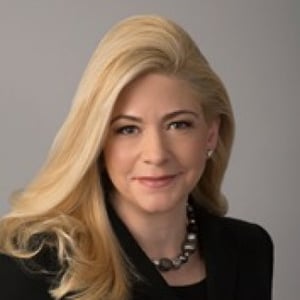
Partner, Gibson, Dunn & Crutcher LLP
Elizabeth Papez is a partner in the Washington, D.C. office of Gibson, Dunn & Crutcher LLP and a member of the firm’s litigation group. Her practice focuses on high-stakes class actions, complex commercial litigation, and related government investigations and appeals.
As a seasoned litigator and former U.S. Deputy Assistant Attorney General, Ms. Papez has substantial experience representing clients in the financial services, pharmaceutical, consumer, and product sectors. She regularly handles federal class actions, multidistrict litigation (MDLs) and other complex commercial disputes under federal and state antitrust statutes, banking and securities laws, and false claims acts, as well as parallel regulatory investigations with the U.S. Department of Justice (DOJ), the Securities and Exchange Commission (SEC), the Commodity Futures Trading Commission (CFTC), and the Food and Drug Administration (FDA).
Ms. Papez has been repeatedly recognized as one of Benchmark USA’s Top 250 Women in Litigation nationwide, which named her a “client favorite” who is “extremely smart and practical and very charismatic,” and is praised by peers as a “fierce, dynamic, bright, powerhouse of a litigator.” Ms. Papez is also recognized in The Legal 500 for her antitrust and appellate work, and by The Best Lawyers in America 2019 for her appellate practice.
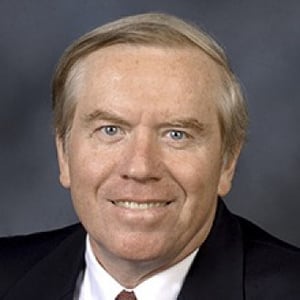
Edward J. Phelps Professor of Law and Economics and Kauffman Distinguished Research Scholar in Law, Economics, and Entrepreneurship, Yale Law School
Professor George L. Priest passed away on Dec. 17, 2024. Please read his obituary here.
George L. Priest is the Edward J. Phelps Professor of Law and Economics and Kauffman Distinguished Research Scholar in Law, Economics, and Entrepreneurship at Yale Law School. An internationally recognized expert, Professor Priest has focused his research over the past two decades on antitrust, the operation of private and public insurance, and the role of the legal system in promoting economic growth. He joined Yale Law School in 1981 and is co-director of the John M. Olin Center for Law, Economics and Public Policy, which facilitates the scholarly work of the Yale law and economics faculty and supports student interest and research in the field. Before coming to Yale, Professor Priest taught law at the University of Chicago, SUNY/Buffalo, and UCLA. His subject areas are antitrust; capitalism; regulated industries; torts; and insurance and public policy. Professor Priest holds a B.A. from Yale and a J.D. from the University of Chicago.
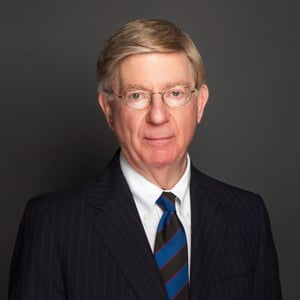
Syndicated Columnist, The Washington Post
George F. Will's newspaper column has been syndicated by The Washington Post since 1974. Today it appears twice weekly in more than 300 newspapers. In 1976 he became a regular contributing editor of Newsweek magazine, for which he provided a bimonthly essay until 2011. In 1977 he won a Pulitzer Prize for commentary in his newspaper columns.
In June 2019, Mr. Will released The Conservative Sensibility. Altogether nine collections of Mr. Will's Newsweek and Washington Post columns have been published, the most recent being his 16th book, American Happiness and Discontents: The Unruly Torrent, 2008-2020, published in 2021. Mr. Will has also published two other books on political theory, Statecraft as Soulcraft: What Government Does (1983) and Restoration: Congress, Term Limits and The Recovery of Deliberative Democracy (1992). In 1990, Mr. Will published Men At Work: The Craft of Baseball, which topped The New York Times bestseller list for two months. In 1998, Scribner published Bunts: Curt Flood, Camden Yards, Pete Rose and Other Reflections on Baseball, a best-selling collection of new and previously published writings by Mr. Will on baseball. Mr. Will's most recent book on baseball is A Nice Little Place on the North Side: Wrigley Field at One Hundred (2014). Mr. Will was a member of Major League Baseball's Blue Ribbon Panel, examining baseball economics, 1999-2000.
In 1981, Mr. Will became a founding panel member on ABC television’s "This Week" and spent over three decades providing regular commentary. Then followed three years with Fox News where he appeared regularly on "Special Report" and "Fox News Sunday," and four years with NBC/MSNBC.
Mr. Will was born in Champaign, Illinois, educated at Trinity College in Hartford, Connecticut, Oxford University and Princeton University, where he earned his Ph.D. and he later served as a trustee. He has taught political philosophy at Michigan State University, the University of Toronto, Harvard University, and Princeton. Mr. Will served as a staff member in the United States Senate from 1970 to 1972. From 1973 through 1976, he was the Washington editor of National Review magazine. Today, Mr. Will lives and works in the Washington, D.C., area.

From the Courthouse Steps: Trump v. Slaughter and Trump v. Cook
Erin M. Hawley, Adam White
In Trump v. Slaughter, the Supreme Court held 6-3 that the Federal Trade Commission's (FTC)...
Plenary Session 2: Unitary Executive & Administrative Agencies– Who’s in Charge?
Featuring: Mr. Samuel Adkisson, Associate Counsel to the President, White House Counsel's Office Hon. Daniel Burrows,...
Courthouse Steps Oral Argument: Trump v. Cook
Gene P. Hamilton, Thomas G. Saunders
On August 25, 2025, President Trump removed Federal Reserve Governor Lisa Cook from office, citing...
A 2025 Review of the Governance, Mission, and Independence of the Federal Reserve
Don Kohn, Frank Lucas, Andrew Olmem, Alex J. Pollock, Christina P. Skinner
The Federal Reserve’s governance has captured the attention of Congress, the Administration, and the media. President...
Independent Agencies and Financial Regulation
Aaron Klein, Jeremy Kress, Jenn L. Mascott, Christina P. Skinner, Ilan Wurman, Todd J. Zywicki
The constitutionality of independent agencies has long been a matter of controversy within the conservative...
Central Bank Digital Currency--Efficient Innovation or the End of the Private Banking System?
Greg Baer, Bert Ely, J. Christopher Giancarlo, Alex J. Pollock
Central Bank Digital Currencies (CBDC) are the subject of a global debate. In one version,...
Money and the Constitution
Wayne A. Abernathy, Donald Kohn, Paul B. Matey, Alex J. Pollock, Paul Sheard, Richard E. Sylla
On November 15, 2019, the Federalist Society's Financial Services & E-Commerce Practice Group hosted a...
LIBOR – Will a $200 Trillion Global Benchmark Disappear – or Not?
Gary Kalbaugh, Oonagh Ann McDonald, Alex J. Pollock
LIBOR is a hugely important interest rate benchmark, used globally and embedded in over $200...
Topics
What Does the Fed Know that Nobody Else Knows?
When it comes to the financial and economic future, everybody is myopic. Nobody can see...
Government Takings Litigation Update - Through the Lens of Love Terminal
J. Peter Byrne, Adam Liptak, Elizabeth P. Papez, George L. Priest, George F. Will
On April 25, 2019, the Federalist Society's Environmental Law & Property Rights Practice Group sponsored...