

Chief Judge, United States Court of Appeals, Eleventh Circuit
William H. Pryor Jr. serves as Chief Circuit Judge on the United States Court of Appeals for the Eleventh Circuit.
In 2013–18, he served on the United States Sentencing Commission and, in 2017–18, served as Acting Chair.
He has taught as a visiting professor at the University of Alabama School of Law and previously taught as an adjunct professor at the Cumberland School of Law of Samford University.
He served as the 45th Attorney General of Alabama from 1997 to 2004. When he took office, he was the youngest attorney general in the nation. In his reelection, he received the highest percentage of votes of any statewide candidate.
He graduated magna cum laude from Tulane Law School where he finished first in the common-law curriculum and was editor in chief of the Tulane Law Review. He then served as a law clerk for Judge John Minor Wisdom of the U.S. Court of Appeals for the Fifth Circuit.
He is a member of The American Law Institute and an Adviser for the RESTATEMENT OF THE LAW THIRD, CONFLICT OF LAWS. He is a coauthor with Bryan Garner, Justices Gorsuch and Kavanaugh, and several other judges of a treatise, THE LAW OF JUDICIAL PRECEDENT. He has published in the Yale Law Journal, Columbia Law Review, Virginia Law Review, Notre Dame Law Review, Harvard Journal of Law & Public Policy, Yale Law & Policy Review, George Mason Law Review, Florida Law Review, Alabama Law Review, Case Western Reserve Law Review, and Tulane Law Review. He has published op-eds in The Wall Street Journal, The New York Times, National Review, and USA Today. He has debated at National Lawyers’ Conventions of the Federalist Society (including on National Public Radio) and at the Oxford Union in the United Kingdom. And he is listed among several “widely admired judicial writers” in Bryan Garner’s The Redbook: A Manual on Legal Style.
He is a member of the Tulane Law School Hall of Fame and has received the Defender of the Constitution Award from the Heritage Foundation, the Jurist of the Year Award from the Texas Review of Law & Politics, and the St. Thomas More Award from the St. Thomas More Society of Atlanta. Judge Pryor is also a proud member of the National Society of the Sons of the American Revolution.
UC Foundation Assistant Professor, U.T. Chattanooga
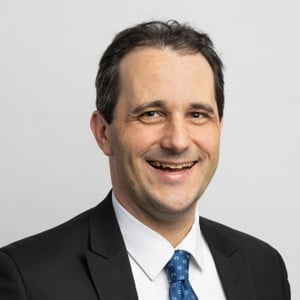
Director, Center for Judicial Engagement, Institute for Justice
Anthony Sanders is the Director of the Center for Judicial Engagement (CJE) at the Institute for Justice and a senior attorney. He joined IJ in 2010. As CJE’s director, he educates the public about the proper role of judges in enforcing constitutional limits on the size and scope of government. As a senior attorney he litigates cutting-edge constitutional cases protecting economic liberty, private property, freedom of speech and other individual liberties in both federal and state courts across the country.
One area of Anthony’s expertise is on using state constitutions to protect individual rights. He is the author of the book, published by University of Michigan Press, Baby Ninth Amendments: How Americans Embraced Unenumerated Rights and Why It Matters. He has also written several law review articles on state constitutional law, unenumerated rights, judicial review, economic liberty, property rights, international law, and other subjects. His work has appeared in publications such as the Iowa Law Review, Minnesota Law Review, American University Law Review, and Rutgers Law Review, and he has published opinion pieces in leading media outlets across the country. Further, he frequently speaks to various audiences on these matters and others, including judicial engagement, free speech, civil forfeiture, and the continuing importance of Magna Carta. Additionally, he hosts the weekly Short Circuit podcast, which often records live in front of law student audiences.
Anthony has litigated several cases in various state courts on state constitutional protections, as well as in federal courts on matters such as economic liberty, free speech, administrative law, and fines and fees abuse. Prior to joining IJ, Anthony served as a law clerk to Justice W. William Leaphart on the Montana Supreme Court. Anthony also worked for several years in private practice in Chicago where he was an active member of the Chicago Bar Association and chaired its Civil Rights Committee.
Anthony received his law degree cum laude from the University of Minnesota Law School in 2004, where he served as an articles submission editor for the Minnesota Law Review. He received his undergraduate degree from Hamline University in St. Paul, Minnesota, and his master’s degree from the University of Wisconsin-Madison. A dual U.S. and U.K. citizen, Anthony grew up on the islands of Vashon in Washington State, and Alderney in the British Channel Islands.
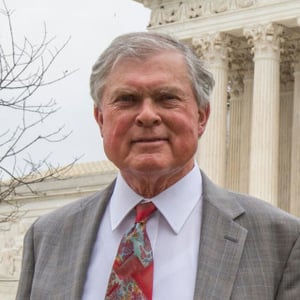
Senior Fellow, Independent Institute
Dr. Stephen P. Halbrook is a Senior Fellow at the Independent Institute. He has taught legal and political philosophy at George Mason University, Howard University, and Tuskegee Institute, and he received his J.D. from the Georgetown University Law Center and Ph.D. in social philosophy from Florida State University.
The winner of three cases before the U.S. Supreme Court (Printz v. United States, United States v. Thompson/Center Arms Company, and Castillo v. United States), he has testified before the Subcommittee on the Constitution of the Senate Judiciary Committee, Senate Subcommittee on the Constitution, Subcommittee on Crime of the House Judiciary Committee, Senate Governmental Affairs Committee, and House Committee on the District of Columbia.
A contributor to numerous scholarly volumes, he is the author of the books, Gun Control in Nazi-Occupied France: Tyranny and Resistance; Gun Control in the Third Reich: Disarming the Jews and “Enemies of the State”; The Founders’ Second Amendment: Origins of the Right to Bear Arms; That Every Man Be Armed: Evolution of a Constitutional Right; A Right to Bear Arms; Firearms Law Deskbook: Federal and State Criminal Practice; Securing Civil Rights: Freedmen, the Fourteenth Amendment, and the Right to Bear Arms; State and Federal Bills of Rights and Constitutional Guarantees; and Target Switzerland: Swiss Armed Neutrality in World War II. Dr. Halbrook’s scholarly articles have appeared in such journals as the Arizona Journal of International and Comparative Law, Drug Law Report, George Mason University Law Review, Journal of Air Law and Commerce, Journal of Law and Policy, Law & Contemporary Problems, National Law Journal, Northern Kentucky Law Review, St. John’s Journal of Legal Commentary; Seton Hall Constitutional Law Journal, Tennessee Law Review, University of Dayton Law Review, Valparaiso University Law Review, Vermont Law Review, and William & Mary Bill of Rights Journal.
Dr. Halbrook's popular articles have appeared in such publications as the Wall Street Journal, Newsday, San Francisco Chronicle, National Review, Investor’s Business Daily, Kansas City Star, Washington Examiner, Shreveport Times, Sacramento Bee, Providence Journal, Tampa Tribune, Pittsburgh Tribune-Review, History News Network, San Antonio Express-News, The Daily Caller, Detroit News, Honolulu Star Advertiser, Birmingham News, Environmental Forum, USA Today, and Washington Times. He has also appeared on numerous national TV/radio programs on CNN, Fox News Channel, Fox Business Network, Court TV, NewsMax TV, CBN, Voice of America, and C-SPAN.
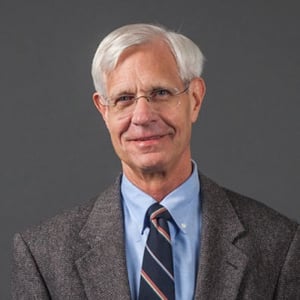
Distinguished University Professor, Antonin Scalia Law School, George Mason University
University Professor Nelson Lund is the author of Rousseau’s Rejuvenation of Political Philosophy: A New Introduction. He has also written widely in the field of constitutional law, including articles on constitutional interpretation, federalism, separation of powers, the Second Amendment, the Commerce Clause, the Speech or Debate Clause, the Equal Protection Clause, and the Uniformity Clause. In addition, he has published articles in the fields of employment discrimination and civil rights, the legal regulation of medical ethics, and the application of economic analysis to legal institutions and legal ethics.
Professor Lund graduated from St. John's College in Annapolis, Maryland, after which he received an MA in philosophy from the Catholic University of America and a PhD in political science from Harvard University. He left the faculty of the University of Chicago to attend its law school, where he served as executive editor of the University of Chicago Law Review and chapter chairman of the Federalist Society for Law and Public Policy Studies. After law school, he held positions at the United States Department of Justice in the Office of the Solicitor General and the Office of Legal Counsel. He also served as a law clerk to the Honorable Patrick E. Higginbotham of the United States Court of Appeals for the Fifth Circuit and to the Honorable Sandra Day O'Connor of the United States Supreme Court. Following his clerkship with Justice O'Connor, Professor Lund served in the White House as associate counsel to the president from 1989 to 1992.
Since joining the faculty at George Mason University's Antonin Scalia Law School, Professor Lund has taught Constitutional Law, Legislation, Federal Election Law, Employment Discrimination, State and Local Government, and seminars on the Second Amendment and on a variety of topics in Jurisprudence.

Laurence A. Tisch Professor of Law and Director, Classical Liberal Institute, New York University School of Law; Director, Classical Liberal Institute, Civitas Institute University of Texas at Austin
Richard A. Epstein is the Laurence A. Tisch Professor of Law, at New York University, a senior research fellow at the Civitas Institute at the University of Texas Austin, and a senior Lecturer, the University of Chicago. He received an LL.D., h.c . from the University of Ghent, 2003 , and an LLD h.c . from the University of Siegen in 2018 and the Bradley Prize in 2011. He has been a member of the American Academy of Arts and Sciences since 1985. He has edited both the Journal of Legal Studies (1981-1991) and the Journal of Law and Economics (1991-2001). He is also a founder and director of the Classical Liberal Institute at NYU Law School. His most recent book is The Classical Liberal Constitution: The Uncertain Quest for Limited Government (2014). His other books include Takings: Private Property and the Power of Eminent Domain ( 1985); Bargaining with the State (1993); Simple Rules for a Complex World (1995); Principles for a Free Society: Reconciling Individual Liberty and the Common Good (1998); Skepticism and Freedom: A Modern Theory of Classical Liberalism (2003); Design for Liberty: Private Property, Public Administration and the Rule of Law (2011), and most recently, The Myth of Birthright citizenship—and Beyond (2026). He has taught courses in , administrative law, antitrust, constitutional, contracts, environmental law, land use planning; real property, torts and water law. He has written and spoken extensively on a wide range of topics, and is writes a regular column for Defining Ideas.
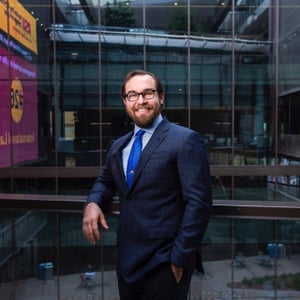
Symposium Chair, Arizona State Student Chapter
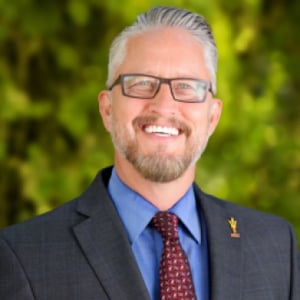
Dean, Arizona State University Sandra Day O'Connor College of Law
Douglas Sylvester is the 8th dean of the Sandra Day O’Connor College of Law at Arizona State University. Under his leadership, ASU Law reached historic heights ranked 27th in the nation (up from 40th in 2012, and 58th in 2008) and 9th among public law schools. From 2012-2017, the law school placed in the top 20 for employment (rising as high as #11 in 2014), hired more than 30 faculty members, and raised more than $70 million— twice the amount raised in the prior 45 years combined.
Professor Sylvester was also a driving force for the conceptualization and creation of the Beus Center for Law and Society in downtown Phoenix, which is now home to ASU Law and a number of other legal-related organizations including the innovative ASU Law Group and the Arizona Legal Center.
Before becoming dean, he served as associate dean for faculty research and development, responsible for building an environment that fosters faculty scholarship, organizing speaker series, mentoring junior faculty, and seeking innovative ways to increase the faculty's visibility.
In 2007, Professor Sylvester was appointed special consultant to a National Academy of Sciences panel charged with reforming the U.S. Census. He was the founding faculty director of the innovative Technology Ventures Clinic which introduces students to transactional legal practice in high-technology sectors. He also has been an expert witness in cases involving licensing, intellectual property and technology, and has advised numerous entrepreneurs in building their businesses.
Professor Sylvester has published, taught and lectured on issues of intellectual property law and commercialization, international law, emerging technologies and privacy. In 2006, he taught nanotechnology and the law, the first time such a course was offered in the country by full-time law faculty.
Prior to joining the ASU, Professor Sylvester was a Bigelow Fellow and lecturer-in-law at the University of Chicago and Northwestern University, an attorney in the Global e-Commerce Practice Group at Baker & McKenzie in Chicago, and a law clerk for U.S. District Judge C. Clyde Atkins in Florida.
Laurence A. Tisch Professor of Law and Director, Classical Liberal Institute, New York University School of Law; Director, Classical Liberal Institute, Civitas Institute University of Texas at Austin
Richard A. Epstein is the Laurence A. Tisch Professor of Law, at New York University, a senior research fellow at the Civitas Institute at the University of Texas Austin, and a senior Lecturer, the University of Chicago. He received an LL.D., h.c . from the University of Ghent, 2003 , and an LLD h.c . from the University of Siegen in 2018 and the Bradley Prize in 2011. He has been a member of the American Academy of Arts and Sciences since 1985. He has edited both the Journal of Legal Studies (1981-1991) and the Journal of Law and Economics (1991-2001). He is also a founder and director of the Classical Liberal Institute at NYU Law School. His most recent book is The Classical Liberal Constitution: The Uncertain Quest for Limited Government (2014). His other books include Takings: Private Property and the Power of Eminent Domain ( 1985); Bargaining with the State (1993); Simple Rules for a Complex World (1995); Principles for a Free Society: Reconciling Individual Liberty and the Common Good (1998); Skepticism and Freedom: A Modern Theory of Classical Liberalism (2003); Design for Liberty: Private Property, Public Administration and the Rule of Law (2011), and most recently, The Myth of Birthright citizenship—and Beyond (2026). He has taught courses in , administrative law, antitrust, constitutional, contracts, environmental law, land use planning; real property, torts and water law. He has written and spoken extensively on a wide range of topics, and is writes a regular column for Defining Ideas.
Symposium Chair, Arizona State Student Chapter
Dean, Arizona State University Sandra Day O'Connor College of Law
Douglas Sylvester is the 8th dean of the Sandra Day O’Connor College of Law at Arizona State University. Under his leadership, ASU Law reached historic heights ranked 27th in the nation (up from 40th in 2012, and 58th in 2008) and 9th among public law schools. From 2012-2017, the law school placed in the top 20 for employment (rising as high as #11 in 2014), hired more than 30 faculty members, and raised more than $70 million— twice the amount raised in the prior 45 years combined.
Professor Sylvester was also a driving force for the conceptualization and creation of the Beus Center for Law and Society in downtown Phoenix, which is now home to ASU Law and a number of other legal-related organizations including the innovative ASU Law Group and the Arizona Legal Center.
Before becoming dean, he served as associate dean for faculty research and development, responsible for building an environment that fosters faculty scholarship, organizing speaker series, mentoring junior faculty, and seeking innovative ways to increase the faculty's visibility.
In 2007, Professor Sylvester was appointed special consultant to a National Academy of Sciences panel charged with reforming the U.S. Census. He was the founding faculty director of the innovative Technology Ventures Clinic which introduces students to transactional legal practice in high-technology sectors. He also has been an expert witness in cases involving licensing, intellectual property and technology, and has advised numerous entrepreneurs in building their businesses.
Professor Sylvester has published, taught and lectured on issues of intellectual property law and commercialization, international law, emerging technologies and privacy. In 2006, he taught nanotechnology and the law, the first time such a course was offered in the country by full-time law faculty.
Prior to joining the ASU, Professor Sylvester was a Bigelow Fellow and lecturer-in-law at the University of Chicago and Northwestern University, an attorney in the Global e-Commerce Practice Group at Baker & McKenzie in Chicago, and a law clerk for U.S. District Judge C. Clyde Atkins in Florida.

Against Living Common Goodism
William H. Pryor
Today I want to discuss a new version of an old debate. In 1985, then-Attorney...
What Happened to Natural Law in American Jurisprudence?
Kody Cooper
A Review of The Decline of Natural Law: How American Lawyers Once Used Natural Law and...
Which Rights Are We Mediating?
Anthony Sanders
A review of How Rights Went Wrong: Why Our Obsession With Rights Is Tearing America...
Topics
Privileges or Immunities: More Than a Nullity, But Not Boundless
The Federalist Society is pleased to announce its Student Blog Initiative, a project of the...
To Bear Arms for Self-Defense: A “Right of the People” or a Privilege of the Few? Part 1
Stephen P. Halbrook
Note from the Editor: The Federalist Society takes no positions on particular legal and public...
The Mythical McCulloch
Nelson Lund
A Review of The Spirit of the Constitution: John Marshall and the 200-Year Odyssey of...
Opening Remarks and Welcome to Arizona
Richard A. Epstein, Grant H. Frazier, Douglas Sylvester
On March 15-16, 2019, the Federalist Society's student chapter at the ASU Sandra Day O'Connor...
Opening Remarks and Welcome to Arizona
2019 National Student Symposium
Phoenix, AZTopics
Article: Debating Birthright Citizenship - Two Perspectives
Below are selections from the Federalist Society's Journal, Engage: Volume 17, Issue 1, articulating the legal...
Topics
Administrative Law and Judicial Duty: Justice Thomas' Principled Stand Against Arbitrary Power
Few constitutional scholars would deny that the Supreme Court has made tragic—even shameful—errors in interpreting...