
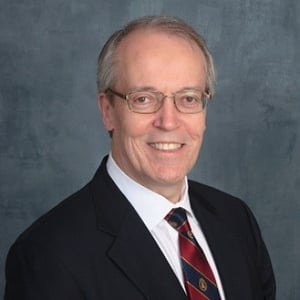
Professor of History, Western Connecticut State University
Kevin R. C. Gutzman is the New York Times best-selling author of five books, including the new Thomas Jefferson—Revolutionary: A Radical’s Struggle to Remake America, a History Book Club Selection. Gutzman is Professor and former Chairman in the Department of History at Western Connecticut State University and a faculty member at LibertyClassroom.com . He holds a bachelor's degree (With Honors and With Special Honors in History), a master of public affairs degree, and a law degree from the University of Texas at Austin, as well as an MA and a PhD in American history from the University of Virginia.
Dr. Gutzman's first book was the New York Times best-seller The Politically Incorrect Guide to the Constitution, which was a Main Selection of the Conservative Book Club. It is the only Jeffersonian account of American constitutional history. His second book, Virginia’s American Revolution: From Dominion to Republic, 1776-1840, explores the issue what the Revolutionaries made of the Revolution in Thomas Jefferson’s home state. After that, he co-authored Who Killed the Constitution? The Federal Government vs. American Liberty from World War I to Barack Obama with New York Times best-selling author Thomas E. Woods, Jr. His fourth book, James Madison and the Making of America, a Main Selection of the History Book Club, received positive reviews from The Wall Street Journal, The Journal of Southern History, The Washington Times, and numerous other publications. His latest book, Thomas Jefferson—Revolutionary: A Radical’s Struggle to Remake America, published on January 31, 2017, was a Selection of the History Book Club.
Gutzman's essay “Lincoln as Jeffersonian: The Colonization Chimera” appeared in Lincoln Emancipated: The President and the Politics of Race, and his “James Madison and Ratification: A Triumph Over Adversity” appeared in A Companion to James Madison and James Monroe. His scholarly articles have appeared in The Journal of Southern History, The Journal of the Early Republic, The Virginia Magazine of History and Biography, The Review of Politics, and The Journal of the Historical Society, among other publications. He has written a hundred book reviews for outlets scholarly and popular, and he has contributed three dozen essays to historical encyclopedias. Gutzman has written for numerous popular magazines and newspapers, including Canada’s National Post, the San Antonio Express-News, and the Richmond Times-Dispatch, among others.
Kevin R. C. Gutzman has appeared on hundreds of radio programs, such as NPR’s “Backstory With the American History Guys” and many of the most prominent commercial programs, terrestrial and satellite, as well as on national television programs including C-SPAN 2's “BookTV,” CNN's “Lou Dobbs Tonight,” Fox News's “The Glenn Beck Program” (both with Beck and with Judge Andrew Napolitano), and NewsMax TV, besides on the BBC and several local television broadcasts. He has been interviewed by reporters from major outlets such as the AP, The Washington Times, The Philadelphia Enquirer, The Washington Post, The Hartford Business Journal, The Houston Chronicle online, Investor's Business Daily, Money Magazine, Connecticut Magazine, and The New York Times, among others.
Gutzman was a featured expert in the documentary movies “John Marshall: Citizen, Statesman, Jurist” and “Nullification: The Rightful Remedy.”

Laurence A. Tisch Professor of Law and Director, Classical Liberal Institute, New York University School of Law; Director, Classical Liberal Institute, Civitas Institute University of Texas at Austin
Richard A. Epstein is the inaugural Laurence A. Tisch Professor of Law at NYU School of Law. Prior to his joining the faculty, he was a visiting law professor at NYU from 2007 through 2009. He served as the Peter and Kirstin Bedford Senior Fellow at the Hoover Institution from 2000 to 2024. Since 2024 to the present he is a senior lecturer at the Civitas Institute at the University of Texas—Austin. Epstein is also the James Parker Hall Distinguished Service Professor of Law Emeritus and a senior lecturer at the University of Chicago. His initial law school appointment was at the University of Southern California from 1968 to 1972. Epstein received an LL.D., h.c. from the University of Ghent, 2003. He has been a member of the American Academy of Arts and Sciences since 1985 and was a Senior Fellow of the Center for Clinical Medical Ethics at the University of Chicago Division of Biological Sciences, also from 1983. to 2022 He served as editor of the Journal of Legal Studies from 1981 to 1991, and of the Journal of Law and Economics from 1991-2001. From 2001 to 2010 he was a director of the John M. Olin Program in Law and Economics at the University of Chicago.
His newest book, The Myth of Birthright Citizenship: What the Fourteenth Amendment Really Says was published in 2026 (Encounter Books). Prior to that he has published many books including, The Dubious Morality of the Modern Administrative State (Roman & Littlefield 2020).Earlier he published th Classical Liberal Constitution: The Uncertain Quest for Limited Government (Harvard 2014) iHis previous books include Design for Liberty: Private Property, Public Administration and the Rule of Law (Harvard 2011); The Case Against the Employee Free Choice Act (Hoover 2009); Supreme Neglect: How to Revive the Constitutional Protection of Property Rights (Oxford 2008); Antitrust Decrees in Theory and Practice: Why Less is More (AEI 2007); Overdose: How Excessive Government Regulation Stifles Pharmaceutical Innovation (Yale University Press. 2006); How Progressives Rewrote the Constitution (Cato 2006); Cases and Materials on Torts (Aspen Law & Business; 8th ed. 2004); Skepticism and Freedom: A Modern Case for Classical Liberalism (University of Chicago, 2003); Torts (Aspen Law & Business 1999); Principles for a Free Society: Reconciling Individual Liberty with the Common Good (Perseus Books, 1998): Mortal Peril: Our Inalienable Rights to Health Care (Addison-Wesley, 1997); Simple Rules for a Complex World (Harvard, 1995); Bargaining With the State (Princeton, 1993); Forbidden Grounds: The Case Against Employment Discrimination Laws (Harvard , 1992); Takings: Private Property and the Power of Eminent Domain (Harvard, 1985); and Modern Products Liability Law (Greenwood Press, 1980). He has also edited(with Catherine M. Sharkey) Cases and Materials on the Law of Torts (10th edition 2012).
Professor Epstein has written numerous articles on a wide range of legal and interdisciplinary subjects. He has taught courses in administrative law, antitrust law, civil procedure, communications, constitutional law, contracts, corporations, criminal law, employment discrimination law, environmental law, food and drug law health law and policy, legal history, labor law, property, real estate development and finance, jurisprudence, labor law; land use planning, patents, individual, estate and corporate taxation, Roman Law; torts, and workers' compensation.
Professor Epstein also writes a regular column for Civitas Institute, which also sponsors his podcast, The Libertarian with Charles C.W. Cooke, and Law Talk, with Cooke and John Yoo. He also does a podcast with John Batchelor. And appears regularly on the Freedom File with Judge Andrew Napolitano.
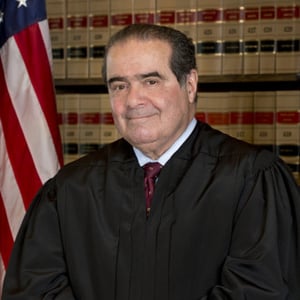
Associate Justice, United States Supreme Court
Antonin Scalia, Associate Justice, was born in Trenton, New Jersey, March 11, 1936. He married Maureen McCarthy and has nine children- Ann Forrest, Eugene, John Francis, Catherine Elisabeth, Mary Clare, Paul David, Matthew, Christopher James, and Margaret Jane. He received his A.B. from Georgetown University and the University of Fribourg, Switzerland, and his LL.B. from Harvard Law School, and was a Sheldon Fellow of Harvard University from 1960-1961. He was in private practice in Cleveland, Ohio from 1961-1967, a Professor of Law at the University of Virginia from 1967-1971, and a Professor of Law at the University of Chicago from 1977-1982, and a Visiting Professor of Law at Georgetown University and Stanford University. He was chairman of the American Bar Association's Section of Administrative Law, 1981-1982, and its Conference of Section Chairmen, 1982-1983. He served the federal government as General Counsel of the Office of Telecommunications Policy from 1971-1972, Chairman of the Administrative Conference of the United States from 1972-1974, and Assistant Attorney General for the Office of Legal Counsel from 1974-1977. He was appointed Judge of the United States Court of Appeals for the District of Columbia Circuit in 1982. President Reagan nominated him as an Associate Justice of the Supreme Court, and he took his seat September 26, 1986.

Topics
Hawkes v. Corps of Engineers Teleforum Preview
May the federal government destroy the value of your property and then prevent you from...
Whose Constitution? The Founders' or the Judges?
Topics
Should Congress Enact the Blue Lives Matter Act of 2016?
Recently, Representative Ken Buck introduced the Blue Lives Matter Act of 2016, which would amend...
The Constitutional Foundations of Intellectual Property: A Natural Rights Perspective
Richard A. Epstein
The Natural Law Approach To Copyrights and Patents One of the major unmarked developments in...
Topics
FDA's Amarin settlement fails to establish clear guidelines for speech
It’s a shame that in a nation that prizes free speech, the government routinely censors...
Topics
Law Enforcement Unchecked
It is an issue that affects millions of American motorists: Can border patrol agents detain...
A Tribute to Justice Scalia
Antonin Scalia
This video commemorates the life and work of Justice Antonin Scalia -- using the words...
Topics
Justice Scalia and the Proper Role of a Judge
With the passing of Justice Antonin Scalia, many Americans have begun to ask: What is...
Topics
Enough Is Enough: Justice Scalia, Auer Deference, and Judicial Duty
It is one of the most fundamental principles of Anglo-American law: No person may be...
Topics
Written Briefs and the Spoken Word at SCOTUS
Anyone who follows the actual work product of the Supreme Court knows that oral argument...