
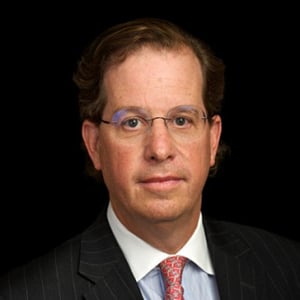
Managing Partner, Cooper & Kirk PLLC
David Thompson is the Managing Partner of Cooper & Kirk and joined the firm at its founding. Mr. Thompson has extensive trial and appellate experience in a wide range of matters and has secured victories worth billions of dollars. He has successfully challenged numerous laws on Second Amendment grounds. He has also litigated cases in over 30 federal district courts, argued in each of the 13 federal circuit courts of appeal, and argued before the U.S. Supreme Court, as well as many state courts. Mr. Thompson was awarded an A.B. degree, magna cum laude, from Harvard University in 1991, where he was elected to Phi Beta Kappa. In 1994, Mr. Thompson received a J.D. degree, cum laude, from Harvard Law School.
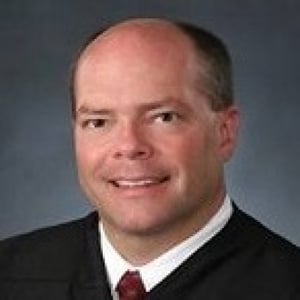
Ohio Fifth District Court of Appeals
Judge Craig Baldwin was appointed to the Fifth District Court of Appeals in 2013. He was elected to the position in 2014 and again in 2016. Prior to his time on the appellate court, Judge Baldwin served eight years as a judge in the Licking County Court of Common Pleas, Domestic Relations Division. An attorney since 1992, Judge Baldwin was a partner with the law firm of Jones, Norpell, List, Miller and Howarth. In 2001 he was appointed by the Licking County Commissioners as director of the Licking County Child Support Enforcement Agency until his election as judge in 2004. He was re-elected as judge in 2010.
Judge Baldwin obtained his Juris Doctor from Capital University, Bachelor of Arts degree from Ohio University and pursued graduate degree work in public administration at Ohio University.
Judge Baldwin has served by assignment on the Ohio Supreme Court. Judge Baldwin is a former chair of the Ohio Supreme Court’s Commission on the Rules of Superintendence, a member of the Licking County Bar, Stark County Bar and Ohio State Bar Associations. In 2012 he was appointed to the Ohio Supreme Court’s Task Force on the Funding of Ohio Courts. Judge Baldwin is also a frequent instructor at the Ohio Judicial College.
Judge Baldwin is a member of the Newark-Heath Rotary and a board member of the Licking Memorial Hospital. He is married and has two children.
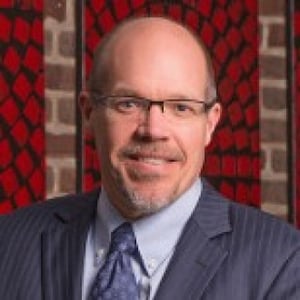
United States District Judge, Southern District of Ohio
Douglas R. Cole was nominated for the position in May 2019 by President Donald J. Trump and confirmed by the Senate in December 2019. Immediately before joining the bench, Judge Cole was a founding partner at Organ Cole, a litigation boutique in Columbus, Ohio.
Judge Cole received his J.D. from the University of Chicago Law School, where he graduated with High Honors and Order of the Coif, was an Olin Fellow in Law & Economics, and was a member of the editorial board of the University of Chicago Law Review. He clerked for Judge Frank H. Easterbrook on the United States Court of Appeals for the Seventh Circuit before joining Kirkland & Ellis in its Chicago office. He has served as a professor at the University of Oklahoma College of Law and at the Michael E. Moritz College of Law at The Ohio State University, where he taught in the fields of business law, law & economics, and intellectual property. From 2003-2006, he was the State Solicitor for the State of Ohio. In that capacity, he argued five cases at the United States Supreme Court, and multiple cases in the United States Court of Appeals for the Sixth Circuit and the Ohio Supreme Court. Before joining Organ Cole, Judge Cole was a litigation partner at the Columbus office of Jones Day, where he practiced in the Issues & Appeals group and the Intellectual Property group.
Judge Cole has undergraduate degrees in electrical engineering, mathematics, and physics, and worked as an electrical engineer before attending law school.
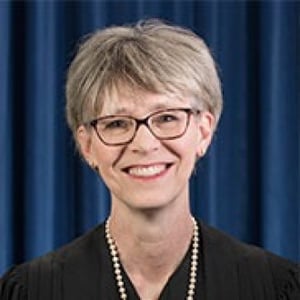
Associate Justice, Ohio Supreme Court
Mary DeGenaro became the 159th justice of the Ohio Supreme Court by gubernatorial appointment, effective Jan. 28, 2018.
Justice DeGenaro served nearly 17 years as a judge on the Seventh District Court of Appeals in Youngstown prior to her Supreme Court appointment. The appointed term ends Jan. 1, 2019 for a seat up for election in November 2018.
During her tenure on the Seventh District Court of Appeals, which began Feb. 9, 2001, she sat by assignment with the Ohio Supreme Court and other appellate districts.
Justice DeGenaro has served in many roles outside the courtroom. She was an adjunct faculty member for the political science department at Youngstown State University, where she earned her Bachelor of Arts degree. She received her law degree from the Cleveland-Marshall College of Law, where she interned with U.S. District Judge George White.
She also was vice president of the Ohio Women’s Bar Association at the time of her Supreme Court appointment.
Admitted to the Ohio bar in 1986, she also was admitted to practice in the federal courts, including the U.S. Supreme Court and the Sixth Circuit, U.S. Court of Appeals.
Prior to her judgeship, she served on the Poland Village Council.
Justice DeGenaro was appointed by the late Chief Justice Thomas J. Moyer to serve during 2002 and 2003 as a member of the Voter Education & Public Funding Working Group to further Judicial Impartiality: The Next Step Forum. This court-policy initiative addressed issues involving judicial races and preserving the integrity of Ohio’s judiciary.
In 2005, she began serving as a founding member of the Ohio State Bar Association’s Appellate Practice Specialty Certification Board, which administers the specialty bar examination and certification.
Involved in a variety of community organizations, Justice DeGenaro's service includes the board of trustees of the Public Library of Youngstown and Mahoning County and the Mahoning Valley Historical Society. Past service includes the external advisory committees for the Ohio Center for the Advancement of Women in Public Service at Cleveland State University, and Youngstown State University’s College of Liberal Arts and Social Sciences.
Outside of her judicial duties, Justice DeGenaro enjoys reading and beekeeping. She and her husband, Steve, reside in Poland, Ohio. They have two adult sons.
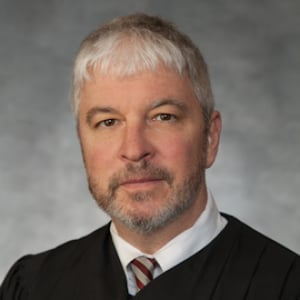
Cuyahoga County Common Pleas Court
Michael P. Donnelly is a judge on the Cuyahoga County Court of Common Pleas General Division in Cleveland, Ohio. He first joined the court on January 3, 2005. Donnelly won re-election to a third consecutive term in the general election on November 8, 2016. His current term expires January 2, 2023.
Donnelly received his undergraduate degree from John Carroll University and his J.D. from the Cleveland-Marshall College of Law. He was admitted to the Ohio Bar in 1992 and began working as an assistant prosecutor for Cuyahoga County. In 1997, he left that role to become an attorney at the firm of Davis & Young, where he worked until 1999. He then joined the firm of Climaco, Lefkowitz, Peca, Wilcox & Garofoli, working as a private practice attorney until his election to the common pleas bench in 2004.
In 2011, Donnelly participated in a program with the National Judicial College called "Innovative Leadership/Management Skills for Future Court Leaders". In 2012, Donnelly served as the Chair of Commission on Professionalism.
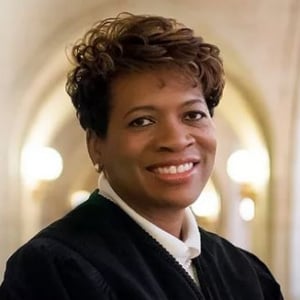
Ohio Eighth District Court of Appeals
Elected to the Ohio Court of Appeals – Eighth Appellate District in 2006 and twice reelected, Judge Melody Stewart has over 30 years of combined administrative, legal, and academic experience in a number of private and public settings. She has been an administrator for a healthcare management company, a music teacher, a civil defense litigator, and a law school administrator and professor. She served as the Administrative Judge for the Court of Appeals in 2013.
Judge Stewart earned a Bachelor of Music degree from the College-Conservatory of Music at the University of Cincinnati; her law degree as a Patricia Roberts Harris Fellow from the Cleveland-Marshall College of Law, Cleveland State University; and her Ph.D. as a Mandel Leadership Fellow at Case Western Reserve University’s Mandel School of Applied Social Sciences.
After practicing law as an assistant law director for the cities of Cleveland and East Cleveland, Judge Stewart worked as a lecturer, an adjunct instructor, and an assistant dean at Cleveland-Marshall College of Law before joining the faculty. Her primary teaching areas were ethics and professional responsibility, criminal law, criminal procedure, and legal research, writing, and advocacy. Additionally, she taught at the University of Toledo College of Law, at Ursuline College, and was Director of Student Services at Case Western Reserve University’s School of Law.
Judge Stewart has served on many boards of trustees and been a member of various professional, educational, civic, and community organizations. She also served as a commissioner and chair of the Board of Planning and Zoning for the city of Euclid. Recently Judge Stewart served as a member of the Ohio Criminal Justice Recodification Committee. She is currently a member of the board of the Ohio Supreme Court’s Judicial College and is chair of the Ohio Capital Case Attorney Fee Council. Judge Stewart is admitted to practice in the state and federal courts in Ohio, the District of Columbia, and the United States Supreme Court.

Laurence A. Tisch Professor of Law and Director, Classical Liberal Institute, New York University School of Law; Senior Fellow, The Civitas Institute, University of Texas at Austin
Richard A. Epstein is the inaugural Laurence A. Tisch Professor of Law at NYU School of Law. Prior to his joining the faculty, he was a visiting law professor at NYU from 2007 through 2009. He served as the Peter and Kirstin Bedford Senior Fellow at the Hoover Institution from 2000 to 2024. Since 2024 to the present he is a senior lecturer at the Civitas Institute at the University of Texas—Austin. Epstein is also the James Parker Hall Distinguished Service Professor of Law Emeritus and a senior lecturer at the University of Chicago. His initial law school appointment was at the University of Southern California from 1968 to 1972. Epstein received an LL.D., h.c. from the University of Ghent, 2003. He has been a member of the American Academy of Arts and Sciences since 1985 and was a Senior Fellow of the Center for Clinical Medical Ethics at the University of Chicago Division of Biological Sciences, also from 1983. to 2022 He served as editor of the Journal of Legal Studies from 1981 to 1991, and of the Journal of Law and Economics from 1991-2001. From 2001 to 2010 he was a director of the John M. Olin Program in Law and Economics at the University of Chicago.
His newest book, The Myth of Birthright Citizenship: What the Fourteenth Amendment Really Says was published in 2026 (Encounter Books). Prior to that he has published many books including, The Dubious Morality of the Modern Administrative State (Roman & Littlefield 2020).Earlier he published th Classical Liberal Constitution: The Uncertain Quest for Limited Government (Harvard 2014) iHis previous books include Design for Liberty: Private Property, Public Administration and the Rule of Law (Harvard 2011); The Case Against the Employee Free Choice Act (Hoover 2009); Supreme Neglect: How to Revive the Constitutional Protection of Property Rights (Oxford 2008); Antitrust Decrees in Theory and Practice: Why Less is More (AEI 2007); Overdose: How Excessive Government Regulation Stifles Pharmaceutical Innovation (Yale University Press. 2006); How Progressives Rewrote the Constitution (Cato 2006); Cases and Materials on Torts (Aspen Law & Business; 8th ed. 2004); Skepticism and Freedom: A Modern Case for Classical Liberalism (University of Chicago, 2003); Torts (Aspen Law & Business 1999); Principles for a Free Society: Reconciling Individual Liberty with the Common Good (Perseus Books, 1998): Mortal Peril: Our Inalienable Rights to Health Care (Addison-Wesley, 1997); Simple Rules for a Complex World (Harvard, 1995); Bargaining With the State (Princeton, 1993); Forbidden Grounds: The Case Against Employment Discrimination Laws (Harvard , 1992); Takings: Private Property and the Power of Eminent Domain (Harvard, 1985); and Modern Products Liability Law (Greenwood Press, 1980). He has also edited(with Catherine M. Sharkey) Cases and Materials on the Law of Torts (10th edition 2012).
Professor Epstein has written numerous articles on a wide range of legal and interdisciplinary subjects. He has taught courses in administrative law, antitrust law, civil procedure, communications, constitutional law, contracts, corporations, criminal law, employment discrimination law, environmental law, food and drug law health law and policy, legal history, labor law, property, real estate development and finance, jurisprudence, labor law; land use planning, patents, individual, estate and corporate taxation, Roman Law; torts, and workers' compensation.
Professor Epstein also writes a regular column for Civitas Institute, which also sponsors his podcast, The Libertarian with Charles C.W. Cooke, and Law Talk, with Cooke and John Yoo. He also does a podcast with John Batchelor. And appears regularly on the Freedom File with Judge Andrew Napolitano.

Topics
Fifth Circuit Rules USF Contribution Scheme Violates Legislative Vesting Clause
On July 24, the U.S. Court of Appeals for the Fifth Circuit issued an en...
Topics
Collins v. Mnuchin - Is the Federal Housing Finance Agency Constitutionally Structured?
The Fifth Circuit sat en banc last month for oral argument in Collins v. Mnuchin, 17-20364. The case addresses whether...
Litigation Update: Collins v. FHFA
David H. Thompson
On July 16, the Fifth Circuit Court of Appeals ruled that the Federal Housing Finance...
Analyzing Ohio's Judicial System and the Ohio Supreme Court
Craig R. Baldwin, Douglas R. Cole, Mary DeGenaro, Michael P. Donnelly, Melody Stewart
What methods of interpretation should Ohio courts use in constitutional matters and in cases involving...
Supreme Court Splits 4-4 on Major Union Case -- Friedrichs v. California Teachers Association - Podcast
Richard A. Epstein
On Tuesday, March 29, the U.S. Supreme Court announced a 4-4 decision in Friedrichs v....