

Counsel, Debevoise & Plimpton
Carter Burwell is a litigation counsel based in the Washington, D.C. office of Debevoise & Plimpton and a member of the firm’s White Collar & Regulatory Defense practice. His practice focuses on white collar criminal defense, government investigations and internal investigations, and national security matters.
Mr. Burwell joins Debevoise with more than 15 years of experience in senior roles across the federal government. Most recently, Mr. Burwell served as Counselor to the Secretary of the Treasury for Terrorism and Finance Intelligence, where he advised on matters involving financial sanctions and illicit finance, international corruption and human rights abuses and digital assets. At Treasury, Mr. Burwell worked directly with the National Security Council, other senior executive branch officials, foreign leaders and the private sector to develop and implement policies to protect domestic and international financial systems from national security threats. He also participated in the CFIUS review process and advanced anti-money laundering reforms under the Bank Secrecy Act.
Prior to his role at the Treasury Department, Mr. Burwell served as one of the top lawyers on the U.S. Senate Judiciary Committee, including as Chief Counsel to former Assistant Majority Leader and U.S. Senator John Cornyn and as Counsel to former Chairman and U.S. Senator Chuck Grassley. In the Senate, Mr. Burwell worked on bipartisan efforts to modernize national security and technology laws, reform the criminal justice system and conduct rigorous oversight of government officials and the private sector on matters of national consequence. Mr. Burwell also served as an Assistant U.S. Attorney in the Violent Crime and Terrorism Unit in the U.S. Attorney's Office in the Eastern District of New York (EDNY) and in the National Security and International Crimes Unit in the U.S. Attorney’s Office in the Eastern District of Virginia (EDVA). As a federal prosecutor at EDNY and EDVA, Mr. Burwell supervised and participated in a wide variety of investigations and prosecutions involving international and domestic terrorist groups, international cartels and racketeering organizations, as well as financial and cyber crimes. He successfully tried numerous cases to verdict and briefed and argued appeals in the U.S. Court of Appeals.
Earlier on in his career, Mr. Burwell served as a law clerk to U.S. District Court Judge Gleeson, now a Debevoise litigation partner, before going on to clerk on the U.S. Court of Appeals for the D.C. Circuit for the Hon. Judge Karen Henderson. Mr. Burwell was also a litigation associate at another international law firm.
He received his J.D. from the University Virginia School of Law in 2002, an M.Phil from the University of Cambridge in 1998, and his B.A. from Columbia College in 1996.
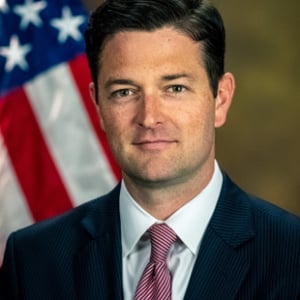
Senior Counsel and Director of Global Regulatory Matters, ConsenSys Software
Bill Hughes is senior counsel and director of global regulatory matters for ConsenSys Software, the leading Ethereum blockchain software company. Bill focuses on the diverse and ever evolving crypto global regulatory landscape, and the legal and public policy issues with which ConsenSys and the broader crypto ecosystem is grappling.
Bill joined ConsenSys after serving as an Associate Deputy Attorney General at the Department of Justice, where he managed, among other things, the Department’s work on prospective regulations, legislative proposals, and policies across a broad spectrum of legal and operational issues. He worked closely with the White House and other federal agencies on regulatory and policy initiatives and coordinated DOJ’s law enforcement response to COVID-19-related consumer fraud and money laundering. Bill also has served at the White House, where he oversaw various operational components. Bill began his career by clerking for a federal judge in New York and litigating with the firm of Sullivan & Cromwell LLP. Bill received his JD from the University of Virginia School of Law and his BA from Vanderbilt University.

Chairman, The Bitcoin Foundation
Brock Pierce is a blockchain pioneer, impact investor and philanthropist with an extensive track record of founding, advising and investing in disruptive businesses. He's been credited with pioneering the market for digital currency and has raised more than $5B for companies he has founded. Pierce is the Chairman of the Bitcoin Foundation and co-founder of EOS Alliance, Block.one, Blockchain Capital, Tether, Mastercoin (first ICO), and Lighthouse NFT, the first ground-up physical NFT smart gallery. In 2020, Pierce ran for President of the United States as an Independent, receiving the first-ever US presidential vote cast on the blockchain.
Block.one was co-founded by Pierce in 2017. Block.one has sold over $4B tokens in the EOS crowd sale making it the largest ever. Blockchain Capital was founded in 2013 and is the first sector-focused venture fund that invests solely in Blockchain technology companies. Pierce led the firm through the first ICO of a venture fund, which created the first security token, BCAP. Blockchain Capital has made more than 100 investments in the sector across its four funds. The firm was named the most active FinTech Venture Fund by Pitchbook. Tether, the first stable coin and asset-backed token, is the most traded cryptocurrency by volume.
Pierce is an early investor in Bitcoin and one of the largest investors in the Ethereum crowd sale. He is the founder of IMI Exchange, the world's leading digital currency marketplace for games, with annual sales exceeding $1B and investors such as Goldman Sachs (sold in 2016 for more than $100M). Pierce founded ZAM, one of the world's largest media properties for gamers, which was acquired by Tencent in 2012. He founded IGE, the pioneer of digital currency and virtual assets in online games, achieving revenues exceeding $100 million in 2006 and sold in 2007.
Pierce is also a co-founder of D10e, GoCoin, the first cryptocurrency platform ot fund a political campaign, Blade Payments, Five Delta (sold NASDAQ: SRAX), Xfire 2.0, Playsino, Evertune, and GamesTV. He serves as an advisor to a number of companies, including Airswap, Bancor, BitGo, BitGuild, Bloq, DNA, Element Group, Metronome, Shyft, tZERO, ODX and BlockV, the first NFT platform in the world. He is a General Partner in Space Fund and sits on the Board of Directors for Bitdigital, one of the largest cryptocurrency mining companies in the US.
Pierce is an active supporter of the American Civil Liberties Union (ACLU), the Foundation for Individual Rights in Education, the Center for Individual Rights, and the Brennan Center for Human Rights. Pierce is Chairman of the Integro Foundation, a Puerto Rico-based non-profit focused on helping Puerto Ricans and supporting environmental and humanitarian efforts throughout the Caribbean region. Pierce is also Vice Chair of the U.S. Marines Toys for Tots Foundation of New York, Long Island and Puerto Rico. In 2021, Pierce sponsored the NYPD Gaming Trucks Initiative, building inroads between police and the communities they serve. As co-founder of the United Council of Rising Nations, Pierce advises political and industry leaders around the world on the future of finance, technology, and sustainable development.
Pierce is a frequent lecturer at Singularity University and has spoken at the Milken Global Conference, Mobile World Congress, Wired, INK, Stanford University, USC, and UCLA. He has been featured in numerous publications including The New York Times, Forbes, Fortune, Bloomberg, Wired, Rolling Stone, Politico, New York Magazine, L’Officiel, VTDigger and the Vermont Business Magazine.

Nonresident Senior Fellow, American Enterprise Institute
Jim Harper is a nonresident senior fellow at the American Enterprise Institute (AEI), where he focuses on privacy issues, and select legal and constitutional law issues.
A lawyer by training, Mr. Harper has served as counsel for the Subcommittee on Commercial, and Administrative Law of the US House Committee on the Judiciary and as counsel for the Senate Committee on Government Affairs. More recently, he worked at the Competitive Enterprise Institute and the Cato Institute, where he wrote on the intersection of business, technology, and public policy, including privacy, surveillance, data security, telecommunications, and cryptocurrencies. He also served as global policy counsel for the Bitcoin Foundation. Mr. Harper was a founding member of the Department of Homeland Security’s Data Privacy and Integrity Advisory Committee. Early in his post-Hill career, he represented companies such as PayPal and Verisign before Congress.
Mr. Harper is the co-editor of “Terrorizing Ourselves: Why U.S. Counterterrorism Policy Is Failing and How to Fix It” (Cato Institute, 2010) and the author of “Identity Crisis: How Identification Is Overused and Misunderstood” (Cato Institute, 2006). He has written several amicus briefs in Fourth Amendment cases before the U.S. Supreme Court and has published scholarly articles in a variety of law journals. In the popular press, Mr. Harper has been published in The New York Times and The Wall Street Journal, among many other publications.
Mr. Harper has a law degree from the U.C. Hastings College of the Law, where he was editor-in-chief of the Hastings Constitutional Law Quarterly, and a BA from the University of California, Santa Barbara.
Co-founder, The Financial Integrity Network
Chip Poncy is a co-founder of the Financial Integrity Network (FIN), a strategic and technical advisory company focused on assisting key financial and jurisdictional stakeholders in combating and protecting against the full spectrum of illicit finance. Launched in 2014, FIN advises jurisdictional authorities, financial institutions, and vulnerable sectors, industries, and organizations in developing and implementing counter-illicit finance policies, requirements and best practices.
Prior to launching FIN, Mr. Poncy assisted one of the world’s largest banks in developing and implementing its enterprise-wide financial crimes compliance program in Latin America, including by serving in Mexico City as the bank’s interim Head of Financial Crimes Compliance for Mexico and the Latin American region.
From 2002-2013, Mr. Poncy served as the inaugural Director of the Office of Strategic Policy for Terrorist Financing and Financial Crimes (OSP) and a Senior Advisor at the U.S. Department of the Treasury. As the Director of OSP from 2005-2013, Mr. Poncy led an office of strategic policy advisors in creating policies and initiatives to combat the full spectrum of illicit finance, including money laundering, terrorist financing, WMD proliferation financing, and kleptocracy flows. As a Senior Advisor from 2002- 2005, Mr. Poncy assisted Treasury leadership in developing the U.S. Government’s post-9/11 strategy to combat terrorist financing. He also assisted senior leadership in creating and developing the Office of Terrorism and Financial Intelligence in the post-9/11 Government reorganization.
Mr. Poncy led the U.S. delegation to the Financial Action Task Force (FATF) from 2010-2013, co-chaired the policy working group of the FATF from 2007-2013, and managed U.S. participation on various G7, G8 and G20 illicit finance experts groups from 2008-2013. Key accomplishments in these roles included assisting in the revision and adoption of the FATF’s global standards and assessment processes for evaluating jurisdictions under the FATF global network, and facilitating the integration of counter-illicit finance into the broader global financial reform agenda since 2008.
Mr. Poncy began his career as an associate in the New York offices of the law firm White & Case and has served as general counsel to biotechnology and internet radio companies. He has co-pioneered a graduate course on national security and the international financial system as an adjunct associate professor at Georgetown University’s Edmund A. Walsh School of Foreign Service. Mr. Poncy graduated with honors from Harvard University (Bachelor of Arts in Government) and The Johns Hopkins School of Advanced International Studies (Masters of Arts in International Relations) and holds a Juris Doctor from the Georgetown University Law Center.

Fellow, National Security Institute, Antonin Scalia Law School, George Mason University
Vince Vitkowsky chaired the Executive Committee of the Federalist Society’s International and National Security Law and Policy Practice Group for over a decade. He is also a Fellow at the National Security Institute of George Mason University Law School. Vince spent 45 years in private practice, primarily in AmLaw 100/200 firms and their spin-offs. His practice included domestic and international commercial arbitration and litigation, as well as cyber risks and liabilities. Vince's current focus is on national security policy, artificial intelligence, cybersecurity, and counterterrorism. He has often written and spoken on national security and other public policy issues. Among other affiliations, Vince has been an Adjunct Fellow at the Center for Law and Counterterrorism of the Foundation for the Defense of Democracies, a member of the Executive Committee of the American Branch of the International Law Association, and Co-Chair of the Committee on Interventions and Trial Observations of the International Bar Association’s Human Rights Institute. He received his B.A. from Northwestern University and his J.D. from Cornell Law School.

Supreme Court & Appellate Litigation Chair, Lex Politica; Of Counsel, Alliance Defending Freedom
Erin Morrow Hawley serves as Chair of Lex Politica's Supreme Court and Appellate Practice overseeing the firm’s strategic appellate litigation and critical motions practice in the trial courts. Erin is an experienced litigator who represents clients in constitutional, regulatory, and appellate matters in federal and state courts throughout the country.
Erin has represented dozens of clients before the Supreme Court of the United States, served as lead counsel in high-profile cases raising novel constitutional and statutory issues, and authored numerous successful petitions for certiorari and briefs in opposition. She has argued in state and federal appellate and trial courts throughout the country, including the Supreme Court of the United States. Erin represents diverse clients in high-stakes litigation from state governments to faith-based nonprofits to Fortune 100 companies. She possesses expertise on a wide range of subject matters including administrative law, the First Amendment, religious liberty, federal jurisdiction, federal preemption, equitable jurisdiction, tax law, the Affordable Care Act, and Title IX.
Erin represents clients in cases where public communications strategy is paramount. She is a sought-after speaker and writer, has testified multiple times before Congress, and is a frequent presenter on constitutional and administrative law issues, including at the Oxford Union, the National Federalist Society Convention, and university campuses across the country. She is a frequent commentator to media outlets, including Fox News, MSNBC, the Wall Street Journal, WORLD, USA Today, the Federalist, and the Hill.
Erin previously oversaw Alliance Defending Freedom’s--where she still serves as Of Counsel--litigation strategies to empower women and protect the dignity of life, defend pregnancy centers’ First Amendment rights from government overreach, and safeguard Americans’ freedoms from the ever-encroaching administrative state.
Executive Director, Consumers
Executive Director, Consumers’ Research
Co-founder, The Financial Integrity Network
Chip Poncy is a co-founder of the Financial Integrity Network (FIN), a strategic and technical advisory company focused on assisting key financial and jurisdictional stakeholders in combating and protecting against the full spectrum of illicit finance. Launched in 2014, FIN advises jurisdictional authorities, financial institutions, and vulnerable sectors, industries, and organizations in developing and implementing counter-illicit finance policies, requirements and best practices.
Prior to launching FIN, Mr. Poncy assisted one of the world’s largest banks in developing and implementing its enterprise-wide financial crimes compliance program in Latin America, including by serving in Mexico City as the bank’s interim Head of Financial Crimes Compliance for Mexico and the Latin American region.
From 2002-2013, Mr. Poncy served as the inaugural Director of the Office of Strategic Policy for Terrorist Financing and Financial Crimes (OSP) and a Senior Advisor at the U.S. Department of the Treasury. As the Director of OSP from 2005-2013, Mr. Poncy led an office of strategic policy advisors in creating policies and initiatives to combat the full spectrum of illicit finance, including money laundering, terrorist financing, WMD proliferation financing, and kleptocracy flows. As a Senior Advisor from 2002- 2005, Mr. Poncy assisted Treasury leadership in developing the U.S. Government’s post-9/11 strategy to combat terrorist financing. He also assisted senior leadership in creating and developing the Office of Terrorism and Financial Intelligence in the post-9/11 Government reorganization.
Mr. Poncy led the U.S. delegation to the Financial Action Task Force (FATF) from 2010-2013, co-chaired the policy working group of the FATF from 2007-2013, and managed U.S. participation on various G7, G8 and G20 illicit finance experts groups from 2008-2013. Key accomplishments in these roles included assisting in the revision and adoption of the FATF’s global standards and assessment processes for evaluating jurisdictions under the FATF global network, and facilitating the integration of counter-illicit finance into the broader global financial reform agenda since 2008.
Mr. Poncy began his career as an associate in the New York offices of the law firm White & Case and has served as general counsel to biotechnology and internet radio companies. He has co-pioneered a graduate course on national security and the international financial system as an adjunct associate professor at Georgetown University’s Edmund A. Walsh School of Foreign Service. Mr. Poncy graduated with honors from Harvard University (Bachelor of Arts in Government) and The Johns Hopkins School of Advanced International Studies (Masters of Arts in International Relations) and holds a Juris Doctor from the Georgetown University Law Center.
Fellow, National Security Institute, Antonin Scalia Law School, George Mason University
Vince Vitkowsky chaired the Executive Committee of the Federalist Society’s International and National Security Law and Policy Practice Group for over a decade. He is also a Fellow at the National Security Institute of George Mason University Law School. Vince spent 45 years in private practice, primarily in AmLaw 100/200 firms and their spin-offs. His practice included domestic and international commercial arbitration and litigation, as well as cyber risks and liabilities. Vince's current focus is on national security policy, artificial intelligence, cybersecurity, and counterterrorism. He has often written and spoken on national security and other public policy issues. Among other affiliations, Vince has been an Adjunct Fellow at the Center for Law and Counterterrorism of the Foundation for the Defense of Democracies, a member of the Executive Committee of the American Branch of the International Law Association, and Co-Chair of the Committee on Interventions and Trial Observations of the International Bar Association’s Human Rights Institute. He received his B.A. from Northwestern University and his J.D. from Cornell Law School.
Nonresident Senior Fellow, American Enterprise Institute
Jim Harper is a nonresident senior fellow at the American Enterprise Institute (AEI), where he focuses on privacy issues, and select legal and constitutional law issues.
A lawyer by training, Mr. Harper has served as counsel for the Subcommittee on Commercial, and Administrative Law of the US House Committee on the Judiciary and as counsel for the Senate Committee on Government Affairs. More recently, he worked at the Competitive Enterprise Institute and the Cato Institute, where he wrote on the intersection of business, technology, and public policy, including privacy, surveillance, data security, telecommunications, and cryptocurrencies. He also served as global policy counsel for the Bitcoin Foundation. Mr. Harper was a founding member of the Department of Homeland Security’s Data Privacy and Integrity Advisory Committee. Early in his post-Hill career, he represented companies such as PayPal and Verisign before Congress.
Mr. Harper is the co-editor of “Terrorizing Ourselves: Why U.S. Counterterrorism Policy Is Failing and How to Fix It” (Cato Institute, 2010) and the author of “Identity Crisis: How Identification Is Overused and Misunderstood” (Cato Institute, 2006). He has written several amicus briefs in Fourth Amendment cases before the U.S. Supreme Court and has published scholarly articles in a variety of law journals. In the popular press, Mr. Harper has been published in The New York Times and The Wall Street Journal, among many other publications.
Mr. Harper has a law degree from the U.C. Hastings College of the Law, where he was editor-in-chief of the Hastings Constitutional Law Quarterly, and a BA from the University of California, Santa Barbara.

Crypto: Regulation and National Security Implications
Puerto Rico Lawyers Chapter
San Juan, PRBitcoin Taxation: Recommendations to Improve the Understanding and Treatment of Virtual Currency
Erin M. Hawley, Joseph J. Colangelo
Note from the Editor: Any accounting, business, or tax advice contained in this article is...
Bitcoin: Commerce, Government and Security - Podcast
Chip Poncy, Vincent Vitkowsky, Jim Harper
Bitcoin is the most prominent cryptographic digital currency emerging as a privately-created medium of exchange....
Bitcoin: Commerce, Government and Security
International & National Security Law Practice Group Teleforum
Teleforum