
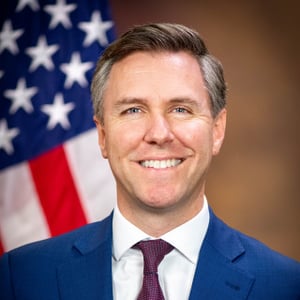
Assistant Attorney General, Civil Division, United States Department of Justice
Brett A. Shumate was sworn in as the Civil Division’s 36th Assistant Attorney General on June 11, 2025. He previously served in the Civil Division from 2017 to 2019 as the Deputy Assistant Attorney General for the Federal Programs Branch. Prior to rejoining the Department, Mr. Shumate was a partner at Jones Day in Washington, D.C.
Mr. Shumate clerked for Judge Edith H. Jones on the United States Court of Appeals for the Fifth Circuit. He graduated from Wake Forest University School of Law and Furman University.
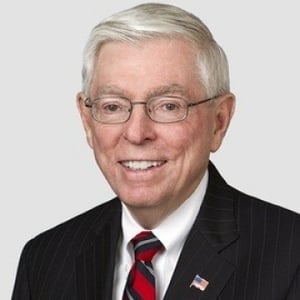
Chairman Emeritus, Wiley Rein LLP
Dick, co-founder and name partner of the firm, has received numerous accolades throughout his storied career, including being named a Washington “Visionary” by The National Law Journal, the “most influential media and telecommunications lawyer in the United States” by the International Herald Tribune, one of the top “100 Men of the Century” by Broadcasting & Cable, and the “Father of High-Definition” television by The Globe and Mail. As Chairman of the Federal Communications Commission (FCC), he fostered increased competition and lessened regulation in the communications field. Dick played a pivotal role in the development of HDTV in this country, serving for nine years as Chairman of the FCC’s Advisory Committee on Advanced Television Service. He has represented a number of major communications-oriented organizations, including Verizon, AT&T, JP Morgan, Credit Suisse, Newspaper Association of America, Motorola, CBS, Belo, Gannett, Sirius/XM, Emmis, Gray Television, and LG. Dick also is a frequent author and lecturer on telecommunications and information law.
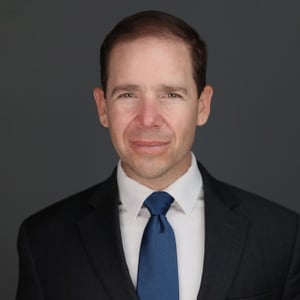
Founder and CEO, Lexpat Global Services
Adam Pearlman is the Founder and Chief Executive Officer of Lexpat Global Services. He is a National Security Law expert and a proven senior leader with experience across the U.S. Departments of Justice, Defense, and State, in the White House, and with the U.S. Federal Judiciary.
Before founding Lexpat, Mr. Pearlman served as the Senior Advisor for Legal Policy in the State Department’s Bureau of Counterterrorism. There, he counseled senior officials on matters covering the entire spectrum of programs and operations to counter terrorism and violent extremism. While participating in sensitive diplomatic engagements and helping to coordinate military operations, he also advised in the development of sanctions policy and initiatives to build legal and operational capacity in partner nations. Mr. Pearlman also managed the Bureau’s participation in federal litigation and led U.S. delegations in multilateral forums concerning criminal justice and rule of law. Separately, Mr. Pearlman supported the State Department’s Bureau of International Narcotics and Law Enforcement Affairs (INL) as the contracted Senior Justice and Rule of Law Advisor in Cabo Verde, Africa. There he was the chief implementer of a Foreign Assistance program that grew eight-fold during his tenure, building host nation capacity across the law enforcement, justice sector, rule of law, anti-money laundering, and corrections disciplines.
A former Associate Deputy General Counsel of the Department of Defense, Mr. Pearlman was agency counsel for complex civil and criminal national security matters in federal and military courts. He also led the Supreme Court and appellate unit of the team dedicated to litigating classified counterterrorism cases. His earlier service in the Department of Justice spanned four litigating divisions and the Office of the Deputy Attorney General. His diverse experience included reviewing complex international transactions and mergers, and advising on immigration removal proceedings, human rights abuses, and terrorist financing investigations. Mr. Pearlman also served with distinction in Iraq as an early advisor to the Iraqi High Tribunal’s prosecution of Saddam Hussein. He was a law clerk for The Honorable Royce C. Lamberth of the U.S. District Court for the District of Columbia, and during law school interned in the White House Counsel’s Office.
Mr. Pearlman is a Senior Fellow at the National Security Institute at George Mason University’s Antonin Scalia Law School, a member of the American Bar Association’s Advisory Committee on Law and National Security, and the Editor-in-Chief of the U.S. Intelligence Community Law Sourcebook. Previously, he has been a Term Member of the Council on Foreign Relations, National Security Fellow at the Foundation for Defense of Democracies, member of the ABA’s Africa Law Initiative Council and of the Center for Strategic & International Studies’ (CSIS) Project on Nuclear Issues, vice chairman of the ABA Section of International Law’s committees on national security, and aerospace and defense, and a liaison to the Board of Directors of the ABA’s Rule of Law Initiative. He has published articles in the Harvard National Security Journal, Stanford Law & Policy Review, Intelligence & National Security, The Foreign Service Journal, Lawfare, and many other outlets.
Mr. Pearlman earned his B.A., with honors, from UCLA, and his J.D., with honors, from The George Washington University Law School, where he was a member of the International Law Review. He also earned a Master of Science of Strategic Intelligence degree from the National Intelligence University, where he was the inaugural recipient of the Kornblum Award for national security law and ethics. Mr. Pearlman is a Certified Financial Crime Specialist and holds certificates in international human rights law from the University of Oxford and in anti-corruption law from American University’s Washington College of Law. He is admitted to the State Bars of California and Virginia, as well as to the Bar of the United States Supreme Court. He speaks and reads Portuguese at the intermediate level.
Wayne A. Abernathy, Wild Bells
Wayne A. Abernathy is a former U.S. Treasury Assistant Secretary for Financial Institutions under President George W. Bush, receiving the Alexander Hamilton Award in recognition of his service. In that office he was also a member of the Board of Directors of the Securities Investor Protection Corporation. Prior to his work at the Treasury, Mr. Abernathy served as Staff Director of the Senate Banking Committee, under Chairman Phil Gramm.
Following his service at the Treasury, Mr. Abernathy worked for 15 years on the staff of the American Bankers Association, as Executive Vice President for Financial Institutions Policy and Regulatory Affairs.
Previous experience with the Senate Banking Committee includes serving as Staff Director of the Subcommittee on Securities during 1995-1998. From 1989 until 1994, Mr. Abernathy was a Republican economist for the committee. He previously worked as a senior legislative assistant for Senator Gramm during 1987-1989 and as an economist for the Banking Committee’s Subcommittee on International Finance and Monetary Policy during 1981-1986, under Chairman Jake Garn.
Mr. Abernathy earned his bachelor’s degree in International Studies from The Johns Hopkins University in 1978. In 1980, he received a master’s degree in International Studies from the School of Advanced International Studies of The Johns Hopkins University.
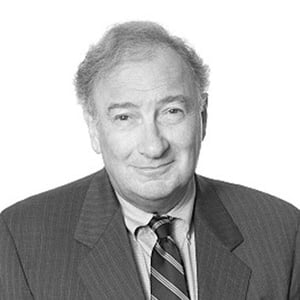
Retired, Winston & Strawn LLP
Jerry Loeser is of counsel in the Chicago office of Winston & Strawn, and his practice focuses on banking regulation. He has extensive experience in counseling financial services clients on, among other things, bank acquisitions, privacy, financial modernization, the USA PATRIOT Act, Basel II and III, lending limits, capital, trust, affiliate transactions, and Federal Reserve, OCC, FDIC, and CFPB regulations.
Prior to working at large corporate law firms, Jerry was chief regulatory and compliance counsel for Comerica Bank, where he also served as senior vice president and deputy general counsel and as general counsel of its retail bank division. Before that, he served as chief regulatory in-house counsel at Wells Fargo & Co. Jerry began his legal career advising the Board of Governors of the Federal Reserve System in Washington, D.C.

Professor of Law, South Texas College of Law Houston
Josh Blackman is a national thought leader on constitutional law and the United States Supreme Court. Josh’s work was quoted during two presidential impeachment trials. He has testified before Congress and advises federal and state lawmakers. Josh regularly appears on TV, including NBC, CBS, ABC, Fox, and the BBC. Josh is also a frequent guest on NPR and other syndicated radio programs. He has published commentaries in the New York Times, Wall Street Journal, Washington Post, and leading national publications.
Since 2012, Josh has served as a professor at the South Texas College of Law Houston. He holds the Centennial Chair of Constitutional Law. Josh is an Adjunct Fellow at the Manhattan Institute. Josh has written more than seven dozen law review articles that have been cited more than a thousand times. Josh was selected as the Jurist of the Year by the Texas Journal of Law & Public Policy, received the inaugural Meese III Originalism Award, and was awarded the Inaugural Joseph Story Award. Josh was selected by Forbes Magazine for the “30 Under 30” in Law and Policy. Josh is the President of the Harlan Institute, and founded FantasySCOTUS, the Internet’s Premier Supreme Court Fantasy League. He blogs at the Volokh Conspiracyand posts@JoshMBlackman.
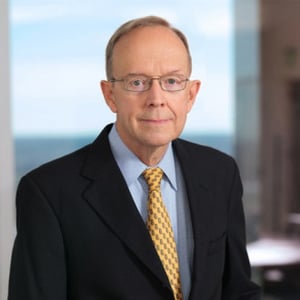
Former Deputy Attorney General for Virginia
Kennerly Davis has over forty years of experience in corporate management, public service, and the private practice of law. He has held senior executive positions in a Fortune 500 electric and gas company. He has served as Deputy Attorney General for the Commonwealth of Virginia, and as a legislative aide to a U.S. Senator and a U.S. Congressman. He practiced law for 25 years with Hunton Andrews Kurth LLP.
Davis is active in the Federalist Society as a member of the Regulatory Process Working Group of the Regulatory Transparency Project, and as a member of the Execuitve Committee of the Administrative Law and Regulation Practice Group. He is active in the national Alumni Free Speech Alliance, and involved in AFSA-chapter initiatives, including litigation, to publicize and correct the serious legal problems created by university Diversity, Equity, and Inclusion programs and the anonymous bias reporting systems used to enforce those DEI programs.
Davis writes and speaks on a wide variety of topics, including those related to the Founding of America, the natural rights foundation of our Republic, the constitutional rule of law, equal protection and free speech, DEI programs and bias reporting systems, capitalism, regulation and regulatory reform, and economic development. His articles have appeared in The Wall Street Journal, the Washington Examiner, the Richmond Times-Dispatch, The Federalist Society Review, the FedSoc Blog, Real Clear Energy, Townhall, the Daily Caller, reports of the Center for Strategic & International Studies, and other publications. He appears frequently on radio, podcasts, and television.
Davis graduated with honors from Cornell University with an A.B. degree in Government. He earned an M.A. degree from Pembroke College, Oxford, in Philosophy, Politics, and Economics. He was awarded a J.D. degree from Harvard Law School, and an M.B.A. degree from Virginia Commonwealth University.
Davis lives in Richmond, Virginia. He can be contacted by email: j.kendavis@verizon.net, and by phone: (804) 624-8525.
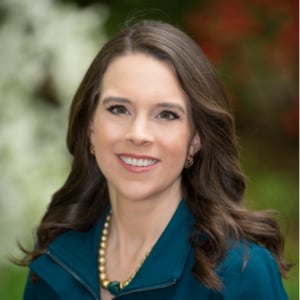
President, JCN
Carrie Campbell Severino is the president of the JCN, and co-author with Mollie Hemingway of the bestselling book Justice on Trial: The Kavanaugh Confirmation and the Future of the Court. As a go-to expert on the confirmation process, Mrs. Severino has been extensively quoted in the media. She regularly appears on television, including FOX, CNN, MSNBC, C-SPAN, and ABC’s This Week.
Severino writes and speaks on a wide range of judicial issues, including the constitutional limits on government, the federal nomination process, and state judicial selection. She has testified before Congress on constitutional questions and briefed Senators on judicial nominations, and regularly files briefs in high-profile Supreme Court cases. She was a law clerk to Supreme Court Justice Clarence Thomas and to Judge David B. Sentelle of the U.S. Court of Appeals for the D.C. Circuit, and is a graduate of Harvard Law School (J.D.), Duke University (B.A., Biology), and Michigan State University (M.A., Linguistics).

American Exceptionalism
America is the planet’s wealthiest and most powerful nation. Its gifts to the world have come...
Wanted: American Exceptionalism in Foreign Affairs
The Obama administration’s signal achievement in foreign affairs policy is its wholesale retreat from American...
Net Neutrality and the Rule of Law
Brett Shumate, Richard E. Wiley
This article is about the Federal Communications Commission’s net neutrality rules. As always, the Federalist...
2015 ABA Annual Meeting Report: Programming
From July 30th to August 4th, the American Bar Association met in Chicago for its...
U.S. Supreme Court Round-Up
Charlotte, North CarolinaLimiting Federal Power: Legal and Ethical Lessons from Practicing Indian Law
Denver, ColoradoBook Review: Lee Kuan Yew: The Grand Master’s Insights on China, the United States, and the World, Interviews and Selections
Adam R. Pearlman
Lee Kuan Yew: The Grand Master’s Insights on China, the United States, and the World,...
Developments at the Consumer Financial Protection Bureau May 12, 2015 – June 9, 2015
Wayne A. Abernathy, Julius L. Loeser
Developments at the Consumer Financial Protection Bureau May 12, 2015 – June 9, 2015 Julius...
The Legality of Executive Action after King v. Burwell
Josh Blackman
Note from the Editor: This article discusses the legality of possible executive actions if the...
Getting More Benefits From Benefit Cost Analysis
John Kennerly Davis
Note from the Editor: This article discusses the use of benefit cost analysis by federal...