
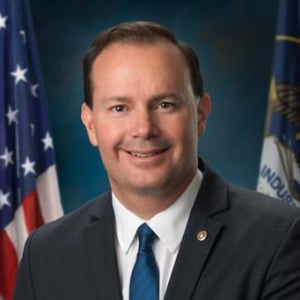
United States Senator, Utah
Elected in 2010 as Utah's 16th Senator, Mike Lee has spent his career defending the basic liberties of Americans and Utahns as a tireless advocate for our founding constitutional principles.
Senator Lee acquired a deep respect for the Constitution early on. His father, Rex Lee, who served as the Solicitor General under President Ronald Reagan, would often discuss varied aspects of judicial and constitutional doctrine around the kitchen table, from Due Process to the uses of Executive Plenary Power. He attended most of his father's arguments before the U.S. Supreme Court, giving him a unique, hands-on experience and understanding of government up close.
Lee graduated from Brigham Young University with a Bachelor of Science in Political Science, and served as BYU's Student Body President in his senior year. He graduated from BYU's Law School in 1997 and went on to serve as law clerk to Judge Dee Benson of the U.S. District Court for the District of Utah, and then with future Supreme Court Justice Judge Samuel A. Alito, Jr. on the U.S. Court of Appeals for the Third Circuit.
Lee spent several years as an attorney with the law firm Sidley & Austin specializing in appellate and Supreme Court litigation, and then served as an Assistant U.S. Attorney in Salt Lake City arguing cases before the U.S. Court of Appeals for the Tenth Circuit.
Lee served the state of Utah as Governor Jon Huntsman's General Counsel and was later honored to reunite with Justice Alito, now on the Supreme Court, for a one-year clerkship. He returned to private practice in 2007.
Throughout his career, Lee earned a reputation as an outstanding practitioner of the law based on his sound judgment, abilities in the courtroom, and thorough understanding of the Constitution.
Today, Lee fights to preserve America's proud founding document in the United States Senate. He advocates efforts to support constitutionally limited government, fiscal responsibility, individual liberty, and economic prosperity.
Lee is a member of the Judiciary Committee, and serves as Chairman of the Antitrust, Competition Policy and Consumer Rights Subcommittee protecting business competition and personal freedom.
He also oversees issues critical to Utah as the Chairman of the Water and Power Subcommittee of the Energy and Natural Resources Committee. He serves on the Commerce Committee and the Joint Economic Committee, as well.
In the 114th Congress, Lee also began his tenure as Chairman of the Senate Steering Committee, where he works with his Republican colleagues in the Senate to introduce bold and innovative solutions to issues facing the American people.
Lee and his wife Sharon live in Alpine, Utah, with their three children. He is a member of The Church of Jesus Christ of Latter-day Saints and served a two-year mission for the Church in the Texas Rio Grande Valley.
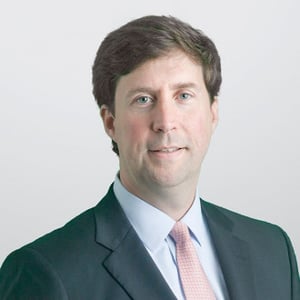
Partner, Holland & Knight
William Shepherd is a trial lawyer in Holland & Knight's West Palm Beach and Washington, D.C., offices. Mr. Shepherd, who also serves as executive partner of the firm's West Palm Beach office, represents clients involved in civil and criminal government investigations. He also assists the general counsel of public and private companies in conducting sensitive internal investigations and compliance matters. In addition to his enforcement practice, Mr. Shepherd handles complex civil litigation in related subject matters. Prior to joining the firm, Mr. Shepherd served, at the appointment of the attorney general, as the statewide prosecutor of Florida and earlier in his career, as a prosecutor in Miami, Florida.
Chambers USA – America's Leading Business Lawyers guide has recognized Mr. Shepherd since 2013 for Litigation: White Collar Crime & Government Investigations.
Mr. Shepherd was elected to serve as chair of the 20,000 member Criminal Justice Section of the American Bar Association and served as a member of its Global Anti-Corruption Task Force and as division director of its White Collar Crime Division.
Professor, The University of South Dakota School of Law
Patrick Garry is a professor of law at The University of South Dakota and the Director of the Hagemann Center for Legal & Public Policy Research.
Professor Garry has published more than forty scholarly articles and authored ten books, many of which have been the subject of numerous conferences and symposia. Professor Garry has been invited on several occasions to testify before Congress on legal and constitutional matters, and he is a frequent speaker at Federalist Society sponsored events. Aside from his public speaking appearances, Professor Garry often writes for popular audience websites, magazines, and newspapers, including the Chicago Tribune and Washington Times. These writings offer commentary and analysis of current political and legal issues.
Professor Garry received his Ph.D. and J.D. from the University of Minnesota. And he has been invited to teach as a visiting professor at the George Washington University Law School, the University of Utah School of Law, the University of Missouri School of Law, and the University of St. Thomas School of Law.
Assistant City Attorney, City of Arlington City Attorney's Office
Joshua Skinner is an assistant city attorney with the City of Arlington, Texas, with almost two decades of experience in civil rights, employment litigation, local government defense, and appellate advocacy.
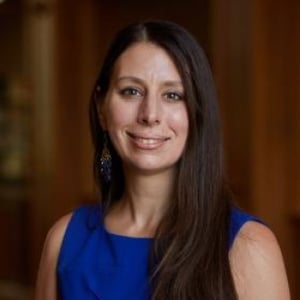
Prof. Sheley joined the College of Law in 2018. Before coming to OU she was an Assistant Professor at the University of Calgary Faculty of Law. She has also served as a Visiting Associate Professor at the George Washington University Law School and an Olin-Searle Fellow at Georgetown University Law Center. Prior to academia she practiced for several years in the litigation group of the Washington, D.C. offices of Gibson, Dunn & Crutcher LLP. While in practice she was commended by the Humane Society of the United States for her pro bono work in the prosecution of dog fighting sponsors. She is proud to have served on the Board of Directors of the Alberta Animal Rescue Crew Society.
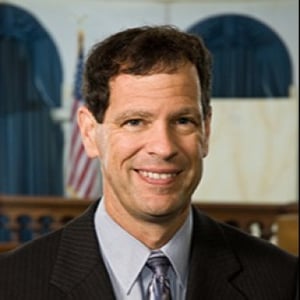
Warren Distinguished Professor of Law, University of San Diego School of Law
Michael D. Ramsey is Warren Distinguished Professor of Law at the University of San Diego School of Law, where he teaches and writes in the areas of Constitutional Law, Foreign Relations Law and International Law. He is the author of The Constitution’s Text in Foreign Affairs (Harvard University Press), co-editor of International Law in the U.S. Supreme Court: Continuity and Change (Cambridge University Press), and co-author of two casebooks, Transnational Law and Practice (2d ed., Aspen) and International Business Transactions: A Problem-Oriented Coursebook (14th ed., West). His scholarly articles have appeared in publications such as the Yale Law Journal, the University of Chicago Law Review, the Georgetown Law Journal and the American Journal of International Law. He received his B.A. magna cum laude from Dartmouth College and his J.D. summa cum laude from Stanford Law School. Prior to teaching, he served as a judicial clerk for Judge J. Clifford Wallace of the United States Court of Appeals for the Ninth Circuit and for Justice Antonin Scalia of the United States Supreme Court, and practiced law with the law firm of Latham & Watkins, where he specialized in international finance and investment. He has taught as a visiting professor at the University of California, San Diego, in the Department of Political Science and at the University of Paris – Sorbonne, in the Department of Comparative Law.

Chairman and Founder, Institute for Free Speech; Josiah H. Blackmore II/Shirley M. Nault Designated Professor of Law, Capital University Law School
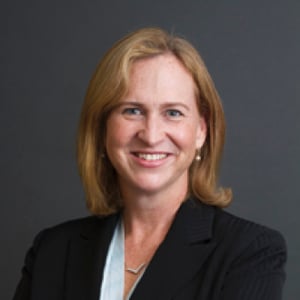
Anne Fleming Research Professor; Professor of Law, Georgetown Law
Laura K. Donohue is a Professor of Law at Georgetown Law, Director of Georgetown's Center on National Security and the Law, and Director of the Center on Privacy and Technology. She writes on constitutional law, legal history, emerging technologies, and national security law. Her most recent book, The Future of Foreign Intelligence: Privacy and Surveillance in a Digital Age (Oxford University Press, 2016), was awarded the 2016 IIT Chicago-Kent College of Law/Roy C. Palmer Civil Liberties Prize. She also has written The Cost of Counterterrorism: Power, Politics, and Liberty (Cambridge University Press, 2008); and Counterterrorist Law and Emergency Law in the United Kingdom 1922-2000 (Irish Academic Press, 2007).
Professor Donohue's articles have been published by California Law Review, University of Chicago Law Review, Stanford Law Review, University of Pennsylvania Law Review, Harvard Journal of Law and Public Policy, and other scholarly journals.
In November 2015, the U.S. Foreign Intelligence Surveillance Court appointed her as one of five amici curiae under the 2015 USA FREEDOM Act.
Professor Donohue is a Life Member of the Council on Foreign Relations; an Advisory Board Member of the Electronic Privacy Information Center; and a Member of the American Bar Association's Standing Committee on Law and National Security. She is a Senior Scholar at Georgetown Law's Center for the Constitution.
Donohue obtained her AB in Philosophy (with Honors) from Dartmouth College; her MA in Peace Studies (with Distinction) from the University of Ulster, Northern Ireland; her JD (with Distinction) from Stanford Law School; and her PhD in History from the University of Cambridge, England.
Director of the Criminal Justice Clinic and Assistant Professor, Southern Methodist University Dedman School of Law
Professor Jenks joined the SMU Law faculty in 2012. He teaches and writes on the law of armed conflict and criminal justice.
Professor Jenks is the co-author of a law of armed conflict textbook, co-editor of a forthcoming war crimes casebook, and served as a peer reviewer of the Talinn Manual on the international law applicable to cyber warfare.
He has published articles on drones, child soldiers, extraordinary rendition, law of war based detention, targeting and government contractors. He has also spoken on those same topics at universities and institutes in Australia, Italy, South Africa and the U.S., and with the militaries of the Republic of Yemen and several different European and African countries. He recently served as a consultant to the Office of the Secretary of Defense on U.S. military security sector reform in the Democratic Republic of the Congo.
Prior to joining the SMU faculty, Professor Jenks served for over 20 years in the military. After graduating from West Point, Professor Jenks was commissioned as an Infantry officer in the U.S. Army. He served as a rifle platoon leader, executive officer and in battalion and brigade staff positions in the U.S., Europe, and in deployments to Kuwait and Bosnia.
Following graduation from law school, Professor Jenks transitioned to the U.S. Army JAG Corps and was assigned as the primary international and operational law advisor near the demilitarized zone between North and South Korea. During this assignment, he defended Status of Forces Agreement rights of American soldiers during South Korean interrogations and trials in high profile and politically sensitive criminal cases.
Following his return to the U.S. in 2003, Professor Jenks served as the lead prosecutor in the Army’s first counterterrorism case, a fully contested, classified court-martial of a soldier attempting to aid al qaeda. He coordinated the investigative efforts of 30 law enforcement agents from four separate federal agencies on three continents and the Department of Justice’s Counterterrorism section nominated him for the John Marshall award for interagency cooperation.
In 2004, he deployed to Mosul, Iraq and served as chief legal advisor to a Stryker Brigade Combat Team comprised of over 4000 soldiers. There he provided targeting advice for the employment of artillery, close air support and direct fire weapons during enemy engagements in a city of two million people. He also advised investigations and served as prosecutor for crimes against the civilian population, detainee abuse, and fratricide. He also wrote and briefed rules of engagement crucial to the success of the first free elections in Iraq in more than three decades.
Before moving to Dallas, Professor Jenks was most recently stationed in Washington D.C., holding numerous positions, including senior litigation attorney and deputy division chief of the U.S. Army’s litigation division, attorney adviser at the Department of State and his most recent position as chief of the International Law Branch of the Office of The Judge Advocate General in the Pentagon.
While at the Department of State, Professor Jenks served at the U.S. mission to the United Nations in New York City and represented the U.S. during en US during negotiations on cultural and humanitarian resolutions pending before the Third Committee of the UN General Assembly
As the Army’s international law branch chief, he oversaw the foreign exercise of criminal jurisdiction over US service members, represented the Department of Defense at status of forces agreement negotiations and served as the legal advisor to the U.S. Military Observers Group, which provides military officers to United Nations Missions around the world.
Through two decades of military service, Professor Jenks received the Valorous Unit Award, the Bronze Star Medal, and both the Expert Infantryman and Parachutist Badges.
Professor of Law, Roger Williams University School of Law
As an expert in National Security Law, Professor Peter Margulies focuses on the delicate balance between liberty, equality, and security in issues involving law and terrorism. Professor Margulies has written almost a dozen articles discussing the War on Terror. He currently works with RWU Law Professor Jared Goldstein, along with litigators from the law firm Edwards Angell Palmer & Dodge, in representing two Afghan detainees. Professor Margulies led a national conference entitled “Legal Dilemmas in A Dangerous World: Law, Terrorism and National Security” held at RWU.
Professor Margulies also has an extensive background in immigration law and has represented Haitian refugees and conducted outreach to community legal service providers.
Peter Marguiles teaches Immigration Law, National Security Law and Professional Responsibility. He has filed amicus briefs in high-visibility cases with the U.S. Supreme Court and has been frequently cited in the New York Times, the National Law Journal and other media outlets.

Judge, United States Court of Appeals, D.C. Circuit
Judge Randolph was confirmed by the Senate and appointed to the United States Court of Appeals for the District of Columbia Circuit by President George H. W. Bush in July 1990.
Judge Randolph received his B.S. degree in 1966 from Drexel University, majoring in economics and basic engineering. At Drexel, he was president of the debate society, vice president of the Student Senate, and a member of the varsity wrestling squad. In 1969, he received his J.D. from the University of Pennsylvania, summa cum laude. Judge Randolph ranked first in his law school class all three years and was managing editor of the Law Review.
After graduation, Judge Randolph served as a law clerk to Judge Henry J. Friendly of the United States Court of Appeals for the Second Circuit in New York.
Admitted to the California Bar in 1970 (and to the District of Columbia bar in 1973), Judge Randolph worked as Assistant to the Solicitor General, U.S. Department of Justice, in Washington, D.C., 1970-1973.
After two years in private practice, Judge Randolph was named Deputy Solicitor General of the United States, a position he held from 1975-1977.
In 1979, Judge Randolph was appointed Special Counsel to the Committee on Standards of Official Conduct (the Ethics Committee) of the United States House of Representatives, remaining in this position until 1980.
In the 1980s, Judge Randolph held a number of positions while in private practice, including Special Assistant Attorney General for the states of New Mexico (1985 90), Utah (1986-1990) and Montana (1983-1990). He also served as a Member of the Advisory Panel of the Federal Courts Study Committee.
From 1971-1990, Judge Randolph argued 23 times in the United States Supreme Court, winning 20 of his cases.
As an Adjunct Professor of Law at Georgetown University Law Center from 1974-1978 he taught courses in civil procedure and injunctions. In 1992 he taught a course in constitutional law. He is a Distinguished Adjunct Professor of Law at George Mason School of Law and for the past ten years has been teaching First Amendment law. He also serves on the Judicial Advisory Board of the George Mason University Law and Economics Center.
From 1993 through 1995 Judge Randolph was a member of the Committee on Codes of Conduct of the Judicial Conference of the United States, and from 1995 to 1998 served as the Committee's chairman. He also served as the judicial liaison to the American Bar Association’s Administrative Law Section.
Judge Randolph is a member of the Board of Visitors at Drexel University Law School and was named to the “Drexel One Hundred” as a leading alumnus. In 2002 he was presented the James Wilson Award by the University of Pennsylvania Law School. In November 2005 he delivered the Fifth Annual Barbara K. Olson Memorial Lecture at the Annual Lawyers Convention of the Federalist Society. He has published numerous articles, the most recent of which is in the June 2006 issue of the Harvard Journal of Law and Public Policy.
Judge Randolph is married to the Honorable Eileen J. O’Connor, formerly Assistant Attorney General, Tax Division, U.S. Department of Justice. His son John Trevor Randolph is an investment banker in New York. His daughter Cynthia Lee Randolph is an artist living in San Francisco.
Journalist/Author
Trevor W. Coleman is a national award-winning journalist and author who served s Chief Speechwriter to Michigan Gov. Jennifer M. Granholm and as Director of Communications for the Michigan Department of Civil Rights and the Governor’s Southeast Michigan office. Coleman was also a long time member of the editorial board of the Detroit Free Press where he won numerous awards for editorial and column writing prior to his appointment to the Granholm administration. He is currently working fulltime on the authorized biography of legendary federal Judge Damon J. Keith. Its working title is “Crusader for Justice: The Life and Amazing Times of Federal Judge Damon J. Keith.”
As the Director of Communications for the Michigan Department of Civil Rights, he was responsible for crafting a global communications strategy which included developing all internal and external communications policies, managing media relations and executive speechwriting responsibilities. Because of his unique joint appointment, he was also required to establish an effective external communications strategy for the Governor’s Office for SE Michigan. In that position he also served as the official liaison to the Governor’s Advisory Council on Arab and Chaldean Affairs and the Governor’s Advisory Council on Asian and Pacific Islander Affairs.
As Chief Speechwriter for Governor Granholm, Coleman wrote or contributed to all major public policy speeches including in the areas of international relations, automotive industry, education, economics, budgetary, race relations, and health, poverty and gender issues. He wrote major commencement addresses and contributed to State of the State address. Coleman also wrote the Governor’s guest OPEDS for state and regional newspapers as well as articles for public policy and other niche magazines. This included the Detroit News, Detroit Free Press, Detroit Crain’s Business, Detroit Magazine, the Michigan Chronicle and others. He also helped develop the Governor’s communication strategy for her “One Michigan” tour and campaign to unite citizens.
As a member of the editorial board of the Detroit Free Press, Coleman specialized in writing on education, health care and urban policy. He also frequently wrote on civil rights, civil liberties and the U.S. criminal justice system. He was the editorial board’s senior foreign affairs writer for three years. Prior to joining the Free Press, Coleman was an urban affairs and civil rights reporter for The Detroit News, an editorial writer for the Cincinnati Enquirer, reporter and columnist for the Hartford Courant and city desk reporter for the Times-Leader in Wilkes-Barre, Pennsylvania. He was also a contributing editor and writer for Emerge Magazine, Black Enterprise and the NAACP Crisis Magazine. Coleman also wrote a Sunday column for several years for his hometown newspaper, The Hudson Register Star.
Among his many journalism awards are a 2001 American Diabetes Association Award of Merit for a series of editorials urging the state to expand medical coverage for diabetics; a 1999 Michigan Press Association Award for column writing; a 1999 National Association of Black Journalist Award for Commentary; the 1998 Detroit Press Foundation Michigan Journalism Award for Commentary; the 1993 Detroit Press Foundation Journalism Award for News Reporting, 1993 Best of Gannett Award for News Reporting and the 1993 and 1999 Lincoln University Unity Awards for coverage of minority and social issues. Coleman is listed in “Who’s Who among African-Americans,” and in 2010 was listed in the “Who’s Who of Black Detroiters.”
Among his many honors have been a 2009 Michigan Department of Civil Rights Dedicated Service Award, 2008 Brown Chapel AME Church Civil Rights Leadership Award, 2004 Macomb County NAACP Freedom Fund Leadership Award, 2004 Over Comers Ministries Inc. Leadership Award, 2002 Wayne Community College District Award for Community Service and the 1993 Distinguished Alumni Award, from the Kappa Chapter of Alpha Phi Alpha Fraternity at The Ohio State University.
He has been a guest speaker at many colleges and universities across the nation; among them Harvard Law School, The Ohio State University, the University of Michigan and University of Michigan School of Law, Michigan State University, Wayne State University, The University of Toledo Law School, Delaware State University, Schoolcraft College, Wayne Community College and many others. He has also appeared on numerous television and radio talk and public affairs programs.
A native of New York, he received his undergraduate degree in communications from The Ohio State University and is a fellow at the Knight Center for Specialized Journalism at the University of Maryland. He is also is a graduate of the American Press Institute in Reston, VA and Poynter Institute in Fla. Coleman resides in Bloomfield Hills and is the divorced father of two children Sydnie, a college junior and TJ, a high school junior.
Attorney (of counsel), Witte Law Offices
Matthew G. Davis practices in the areas of appellate law, civil rights (including alleged violations of the First and Second Amendments), election law, campaign finance, and defamation. Mr. Davis is also experienced in general civil litigation.
Mr. Davis graduated from the The Ohio State University with a bachelors of arts in journalism in 1990 and earned his juris doctorate from Thomas M. Cooley Law School in 2005. He started his legal career in the pre-hearing division of the Michigan Court of Appeals before becoming law clerk for Judge Brian K. Zahra. Following his clerkship, Mr. Davis joined Witte Law Offices as an associate.
Prior to his legal career, Mr. Davis spent approximately twelve years as a reporter for various daily newspapers, including the Columbus ( Ohio ) Dispatch, the St. Paul (Minn. ) Pioneer Press, and the Detroit Free Press, where he covered the state Legislature in Lansing. Mr. Davis left newspapers to attend the Thomas M. Cooley Law School and, concomitantly, serve as director of communications for the Michigan Department of Corrections and the Michigan Department of Attorney General. Mr. Davis led the creation and development of the Offender Tracking Information System at the MDOC, which allows Internet access of offender information.
Racial Justice Staff Attorney, ACLU of Michigan
Through his work as the attorney for the Racial Justice Project of the ACLU of Michigan, Mark P. Fancher addresses: racially disproportionate rates of incarceration; racial discrimination against public school students of color, racial profiling, public defender system reform, attacks on affirmative action and juvenile sentencing issues.
Fancher was formerly the Senior Staff Attorney for the Sugar Law Center for Economic and Social Justice where he specialized in workers' rights. He served on the staff of the State Bar of Michigan from 1998 to 2000 where he coordinated projects to encourage greater pro bono participation by Michigan's lawyers. He was a visiting assistant clinical professor at the University of Michigan Law School from 1996 through 1998.
Before moving to Michigan, Fancher was the Director of Litigation for Camden Regional Legal Services in New Jersey. He has also been in private practice where he specialized in employment discrimination and community economic development. Fancher is a graduate of Rutgers University School of Law - Camden. He received a Bachelor of Science Degree from the University of Tennessee.
Fancher has played a leadership role in the National Conference of Black Lawyers (NCBL) for numerous years. He is a past chair of the organization’s International Affairs Section, and he served as NCBL’s national co-chair from 1995-1998. He is also a member of the State Bar of Michigan Pro Bono Initiative.
Fancher has lectured across the country and written extensively on issues that include: self-determination for Africa and the African Diaspora; indigenous peoples’ land and resource rights; and political repression in the U.S.
Co-Founder, XIV Foundation
Jennifer Gratz is a modern-day civil rights leader. In 1997 she challenged race preferences (also known as affirmative action) at the University of Michigan and was victorious at the U.S. Supreme Court.
Ms. Gratz was the lead plaintiff in the landmark case Gratz v. Bollinger which challenged affirmative action at the University of Michigan. On June 23, 2003 the U.S. Supreme Court ruled that Ms. Gratz was discriminated against and U-M’s admission policy was unconstitutional. However, in a companion case decided the same day (Grutter v. Bollinger), the Supreme Court allowed race preferences to continue at U-M’s law school. Ms. Gratz called the split decision flawed and continued the fight for equality in her home state. She spearheaded the Michigan Civil Rights Initiative (MCRI), a state constitutional amendment that made race and gender preferences unconstitutional in public education, employment and contracting. In Nov 2006 Michigan voters approved MCRI by a 16-point landslide.
At CPAC following the Michigan vote, Ms. Gratz was honored with the prestigious Ronald Reagan Award from the American Conservative Union for leadership. Jennifer has spent many years working to end programs that grant preferential treatment based on race or sex and because of Ms. Gratz’s leadership eight states have now banned race and gender preferences.
Recently, Ms. Gratz co-founded the XIV Foundation (XIV) and Equal Protection Advocates (EPA). XIV, named after the 14th amendment, is a not-for-profit 501c3 dedicated to teaching the personal and societal advantages of fair and equal treatment. EPA is a 501c4 dedicated to advocating for fair and equal treatment without regard to race or gender for all Americans.
Ms. Gratz’s story and work has been featured in nearly every major media outlet – Fox News, CNN, MSNBC, Dateline, 60 Minutes, The Today Show, Wall Street Journal, NY Times, Washington Post, Washington Times, LA Times, Detroit Free Press, Detroit News, National Review, US News and World Report, Newsweek, Time Magazine, People Magazine, Glamour Magazine – to name a few.

Editorial Cartoonist, Editorial Writer, and Weekly Columnist, The Detroit News
Henry Payne is an editorial cartoonist, editorial writer, and weekly columnist The Detroit News.
A Pulitzer-Prize nominated cartoonist, Payne produces five local editorial cartoons a week for The News. He also writes and draws a weekly column, “Payne & Ink.” Additionally, Payne draws five cartoons a week on national and international subjects for United Feature Syndicate in Kansas City which distributes his cartoons to 40 newspaper clients worldwide. His work is reprinted in USA Today, National Review,Townhall.com and other publications.
Payne has been voted Best Editorial Cartoonist in Michigan by the Associated Press. He has been a runner-up for both the Pulitzer and Mencken awards.
As a writer, Payne reports regularly on economic, consumer and environmental issues. His articles have appeared in The Wall Street Journal, The Weekly Standard magazine, National Review, Reason, Scripps Howard News Service and newspapers around the country. He also is a correspondent for National Review’s popular “Planet Gore” blog.
Payne came to The Detroit News in 1999 after 13 years as an editorial cartoonist, writer, and editor forScripps Howard News Service in Washington, DC .
Payne published his first book, “Payne & Ink: The Cartoons and Commentary of Henry Payne, 2000-2001,” in 2002. He has also illustrated two children’s books for Random House: “Where did Daddy’s Hair Go?” (by Joe O’Connor) in 2006, and Dr. Seuss’ “The Ear Book” in 2007. In 1998, Payne created “Hub & Axel,” a comic panel distributed by the Tribune Company Syndicate about an American family and its very American passion for the automobile.
Born in 1962 in Charleston, West Virginia, Payne received a degree in history from Princeton University in 1984. As editorial cartoonist for two student newspapers, The Daily Princetonian and the Nassau Weekly, Payne won the College Media Advisers Cartoon Contest and the Tribune Company Syndicate’s National College Cartoonist’s Contest. Upon graduation from Princeton, Payne began his newspaper career as staff artist and editorial cartoonist with the Charleston (WV) Daily Mail. In 1986 he joined Scripps Howard News Service and began syndication with United Feature in 1987.
Payne is an active race car driver, tennis and squash player. He is the father of two boys and lives with wife, Talbot, in Bloomfield Hills, Michigan.

Senior Legal Fellow, Edwin Meese III Institute for the Rule of Law, Advancing American Freedom

President, Thomas M. Cooley Student Chapter
Penelope holds a Political Science and Pre-Law undergraduate degree from the University of Texas at El Paso. She also received a Master of Science degree in Intelligence and National Security Studies with focus on Latino Immigration from the University of Texas at El Paso. Penelope has worked in several projects within the Latino Community such the LSPI Pre-Law Institute at UTEP as an outreach minority coordinator for recruitment of young Latino and underrepresented minorities to participate in the pre-law institute and later access IVY league Law Schools all across the country. Under the Kauffman Initiative she worked as an outreach specialist for the Hispanic Entrepreneur Center at UTEP She is now a J.D Law candidate 2014 at Thomas M. Cooley Law School.

Vice President, Edwin Meese III Institute for the Rule of Law, Advancing American Freedom
John G. Malcolm oversees Advancing American Freedom’s work to increase understanding of the Constitution and the rule of law as Vice President of the organization’s Edwin Meese III Institute for the Rule of Law. Malcolm brings to the challenge a wealth of legal expertise and experience in both the public and private sectors.
Prior to joining Advancing American Freedom in 2025, Malcolm was the Vice President of the Institute for Constitutional Government and the Director of the Meese Center for Legal and Judicial Studies at the Heritage Foundation. Prior to joining Heritage in 2012, Malcolm was general counsel at the U.S. Commission on International Religious Freedom, as well as a distinguished practitioner in residence at Pepperdine Law School. From 2004 to 2009, Malcolm was executive vice president and director of worldwide anti-piracy operations for the Motion Picture Association.
Malcolm served as a deputy assistant attorney general in the Department of Justice’s Criminal Division from 2001 to 2004, where he oversaw sections on computer crime and intellectual property, domestic security, child exploitation and obscenity, and special investigations. Immediately prior to that, he was a founding partner in the Atlanta law firm of Malcolm & Schroeder, LLP.
From 1990 to 1997, Malcolm was an assistant U.S. attorney in Atlanta, assigned to the fraud and public corruption section, and also an associate independent counsel, investigating fraud and abuse in the Department of Housing and Urban Development. He was honored with the Director’s Award for Superior Performance for his work in connection with the successful prosecution of Walter Leroy Moody Jr., who assassinated an 11th Circuit judge and the head of the Savannah chapter of the NAACP.
A graduate of Harvard Law School and Columbia College, Malcolm began his career as a law clerk to a federal district court judge and a federal appellate court judge, and as an associate at the Atlanta-based law firm of Sutherland, Asbill & Brennan (new Eversheds Sutherland).
Malcolm, who resides in Washington, D.C., serves on the Board of Trustees of the Washington National Opera and is a Senate-confirmed member of the Board of Directors of the Legal Services Corporation, the largest funder of civil legal aid in the United States.

Former Adjunct Professor of Law; former Special Counsel to the President; former federal prosecutor, Georgetown Law (ret.)
Bill Otis is a former Adjunct Professor of Law at Georgetown University, a one-time federal prosecutor, and a former Special White House Counsel for President George H. W. Bush. After graduating from Stanford Law School, he started his career in the Criminal Division of the Justice Department, then became chief of appeals for the US Attorney's Office for the Eastern District of Virginia. In the 1980's he served on the Department's "Train the Trainer" team, which taught US Attorneys Offices across the county how to implement the then-new Sentencing Reform Act. He has held several posts in the federal government, including Special Assistant to the Secretary of Energy and Counselor to the head of the Drug Enforcement Administration, in addition to the White House post. He has testified before Congress on issues in criminal procedure, illegal drugs, the US Sentencing Commission, and the death penalty, and has given numerous media interviews on those and other subjects. He currently teaches a seminar at Georgetown Law titled "Conservatism in Law in America" with his wife, Federalist Society co-founder Lee Liberman Otis.

Keynote Remarks by Senator Mike Lee
Mike S. Lee, William N. Shepherd
The Administrative Conference, together with The Federalist Society, the American Bar Association's Criminal Justice and...
Wood v. Moss - Post-Decision SCOTUScast
Patrick Garry
On May 27, 2014, the Supreme Court issued its decision in Wood v. Moss. This...
Plumhoff v. Rickard - Post-Decision SCOTUScast
Joshua Skinner
On May 27, 2014, the Supreme Court issued its opinion in Plumhoff v. Rickard. This...
Navarette v. California - Post-Decision SCOTUScast
Erin Sheley
On April 22, 2014 the Supreme Court issued its decision in Navarette v. California. The...
Sovereign Immunity and Freedom of Contract - Republic of Argentina v. NML Capital - Podcast
Michael D. Ramsey
In 2001, Argentina defaulted on $80 billion of government bonds. When issuing the bonds in...
The First Amendment and Campaign Finance: Assessing the Recently-Decided McCutcheon v. FEC Case - Podcast
Bradley A. Smith
Stating that “There is no right more basic in our democracy than the right to...
Panel II: Detained Suspected Terrorists: Try in Military Courts or Civilian Courts?
Laura Donohue, Christopher Jenks, Peter S. Margulies, Deborah Pearlstein, A. Raymond Randolph
This panel will address the ongoing debate regarding trying, convicting and punishing suspected terrorists. Should...
Smarter Sentencing Act
TeleforumWhat? Me Worry? Taking Freedom Seriously: The Role of the Judiciary in Protecting Rights and Liberties
Jacksonville, FloridaThe Twilight of Race-Based Preferences in College Admissions
Trevor W. Coleman, Matthew G. Davis, Mark Fancher, Jennifer Gratz, Henry Payne, Hans A. Von Spakovsky, Penelope S. Williams
The Michigan Lawyers Chapter hosted this event on February 12, 2014, at Thomas M. Cooley...