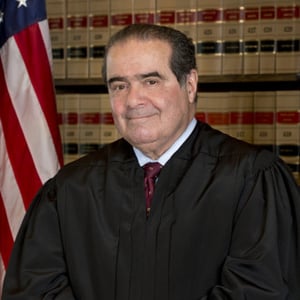
Antonin Scalia, Associate Justice, was born in Trenton, New Jersey, March 11, 1936. He married Maureen McCarthy and has nine children- Ann Forrest, Eugene, John Francis, Catherine Elisabeth, Mary Clare, Paul David, Matthew, Christopher James, and Margaret Jane. He received his A.B. from Georgetown University and the University of Fribourg, Switzerland, and his LL.B. from Harvard Law School, and was a Sheldon Fellow of Harvard University from 1960-1961. He was in private practice in Cleveland, Ohio from 1961-1967, a Professor of Law at the University of Virginia from 1967-1971, and a Professor of Law at the University of Chicago from 1977-1982, and a Visiting Professor of Law at Georgetown University and Stanford University. He was chairman of the American Bar Association's Section of Administrative Law, 1981-1982, and its Conference of Section Chairmen, 1982-1983. He served the federal government as General Counsel of the Office of Telecommunications Policy from 1971-1972, Chairman of the Administrative Conference of the United States from 1972-1974, and Assistant Attorney General for the Office of Legal Counsel from 1974-1977. He was appointed Judge of the United States Court of Appeals for the District of Columbia Circuit in 1982. President Reagan nominated him as an Associate Justice of the Supreme Court, and he took his seat September 26, 1986.
Garwood Visiting Professor and Visiting Fellow, James Madison Pr, Cleveland-Marshall College of Law
Biography
David F. Forte is Professor of Law at Cleveland State University, where he was the inaugural holder of the Charles R. Emrick, Jr.- Calfee Halter & Griswold Endowed Chair. This fall, Professor Forte will be the Garwood Visiting Professor at Princeton University in the Department of Politics, and Visiting Fellow at the James Madison Program in American Ideals and Institutions. He holds degrees from Harvard College, Manchester University, England, the University of Toronto and Columbia University.
During the Reagan administration, Professor Forte served as chief counsel to the United States delegation to the United Nations and alternate delegate to the Security Council. He has authored a number of briefs before the United States Supreme Court, and has frequently testified before the United States Congress and consulted with the Department of State on human rights and international affairs issues. His advice was specifically sought on the approval of the Genocide Convention, on world-wide religious persecution, and Islamic extremism. He has appeared and spoken frequently on radio and television, both nationally and internationally. In 2002, the Department of State sponsored a speaking tour for Professor Forte in Amman, Jordan, and he was also a featured speaker to the Meeting of Peoples in Rimini, Italy, a meeting which gathers over 500,000 people from all over Europe. He has also been called to testify before the state legislatures of Ohio, Kansas, and Idaho as well as the New York City Council. He has assisted in drafting a number of pieces of legislation for the Ohio General Assembly dealing with abortion, international trade, and federalism. He has sat as acting judge on the municipal court of Lakewood Ohio and was chairman of Professional Ethics Committee of the Cleveland Bar Association. He has received a number of awards for his public service, including the Cleveland Bar Association’s President’s Award, the Cleveland State University Award for Distinguished Service, the Cleveland State University Distinguished Teaching Award, and the Cleveland-Marshall College of Law Alumni Award for Faculty Excellence. He served as Consultor to the Pontifical Council for the Family under Pope St. John Paul II and Pope Benedict XVI. In 2003, Dr. Forte was a Distinguished Fulbright Chair at the University of Trento and returned there in 2004 as a Visiting Professor. For the academic year, 2008-2009, Professor Forte was Senior Visiting Scholar at the Center for the Study of Religion and the Constitution in at the Witherspoon Institute in Princeton, New Jersey. He was the Robert E. Henderson Constitution Day Lecturer at the Ashbrook Center at Ashland University, and he has given over 300 invited addresses and papers at more than 100 academic institutions. His work has been cited by the U.S. Supreme Court.
Professor Forte was a Bradley Scholar at the Heritage Foundation, and Visiting Scholar at the Liberty Fund. He has been President of the Ohio Association of Scholars, was on the Board of Directors of the Philadelphia Society, and is also adjunct Scholar at the Ashbrook Center. He has been appointed to the Ohio State Advisory Committee to the U.S. Commission on Civil Rights. He has also been a Civil War re-enactor and a Merit Badge Counselor for the Boy Scouts.
He writes and speaks nationally on topics such as constitutional law, religious liberty, Islamic law, the rights of families, and international affairs. He served as book review editor for the American Journal of Jurisprudence and has edited a volume entitled, Natural Law and Contemporary Public Policy, published by Georgetown University Press. His book, Islamic Law Studies: Classical and Contemporary Applications, has been published by Austin & Winfield. He is Senior Editor of The Heritage Guide to the Constitution (2006), 2d edition (2014), published by Regnery & Co, a clause by clause analysis of the Constitution of the United States.
His teaching competencies include Constitutional Law, the First Amendment, Islamic Law, Jurisprudence, Natural Law, International Law, International Human Rights, the Presidency, and Constitutional History.
Tazewell Taylor Professor of Law and William H. Cabell Research Professor, William & Mary Law School
Biography
Jonathan H. Adler joined the William & Mary law faculty as the Tazwell Taylor Professor of Law and William H. Cabell Research Professor in 2025. Prior to joining the faculty, he was the inaugural Johan Verheij Memorial Professor of Law and the founding Director of the Coleman P. Burke Center for Environmental Law at the Case Western Reserve University School of Law.
Professor Adler is the author or editor of seven books, including Climate Liberalism: Perspectives on Liberty, Property and Pollution (Palgrave, 2023), Marijuana Federalism: Uncle Sam and Mary Jane (Brookings Institution Press, 2020), Business and the Roberts Court (Oxford University Press, 2016) and Rebuilding the Ark: New Perspectives on Endangered Species Act Reform (AEI Press, 2011).
His articles have appeared in publications ranging from the Harvard Environmental Law Review and Yale Journal on Regulation to the Wall Street Journal, New York Times, and Washington Post. He has testified before Congress a dozen times, and his work has been cited in the U.S. Supreme Court. A 2024 study identified Professor Adler as the seventh most cited legal academic in administrative and environmental law from 2019 to 2023.
Professor Adler is a contributing editor to Civitas Outlook and a regular contributor to the popular legal blog, The Volokh Conspiracy. A regular commentator on constitutional and regulatory issues, he has appeared on numerous radio and television programs, ranging from the PBS Newshour and National Public Radio to the Fox News Channel and Entertainment Tonight.
Professor Adler is a senior fellow at the Property & Environment Research Center in Bozeman, Montana. In 2018, Professor Adler was elected to membership in the American Law Institute and helped co-found the organization Checks and Balances. In 2024, Professor Adler was appointed a public member of the Administrative Conference of the United States.
Professor Adler clerked for the Honorable David B. Sentelle on the U.S. Court of Appeals for the District of Columbia Circuit.
Roger Pilon is the Cato’s Institute’s vice president for legal affairs, the founding director of Cato’s Robert A. Levy Center for Constitutional Studies, the inaugural holder of Cato’s B. Kenneth Simon Chair in Constitutional Studies, and the founding publisher of the Cato Supreme Court Review.
Prior to joining Cato, Pilon held five senior posts in the Reagan administration, including at State and Justice, and was a national fellow at Stanford’s Hoover Institution. In 1989 the Bicentennial Commission presented him with its Benjamin Franklin Award for excellence in writing on the U.S. Constitution. In 2001 Columbia University’s School of General Studies awarded him its Alumni Medal of Distinction. Pilon lectures and debates at universities and law schools across the country and testifies often before Congress.
His writing has appeared in the Wall Street Journal, the Washington Post, the New York Times, the Los Angeles Times, Legal Times, National Law Journal, Harvard Journal of Law and Public Policy, Stanford Law and Policy Review, and elsewhere. He has appeared on ABC’s Nightline, CBS’s 60 Minutes II, Fox News Channel, NPR, CNN, MSNBC, CNBC, C-SPAN, and other media.
Pilon holds a BA from Columbia University, an MA and a PhD from the University of Chicago, and a JD from the George Washington University School of Law.
Charles R. Walgreen, Jr. Chair in Law and Co-Director, Program in Law and Philosophy, University of Illinois College of Law
Biography
One of the country’s most prominent authorities on the intersection of law and philosophy, and widely regarded as the country’s leading theoretician of the criminal law, Professor Moore joined the faculty in 2002 as the Charles R. Walgreen, Jr. Chair, the first and only university-wide chair for the University of Illinois’ three campuses. He is jointly appointed as professor of law in the College of Law and as a professor with the Center for Advanced Studies, an honor bestowed on faculty on the basis of their outstanding scholarship and among the highest forms of campus recognition. Professor Moore was just the second UI College of Law faculty member to have held such an appointment.
Before coming to Illinois, Professor Moore served as the Warren Distinguished Professor of Law and as co-founder and co-director of the Institute for Law and Philosophy at the University of San Diego. From 1989-2000, he was the Leon Meltzer Professor of Law and Professor of Philosophy at the University of Pennsylvania, where he co-founded and directed the University of Pennsylvania Institute for Law and Philosophy.
Over the course of his career, he also has been a professor of law at the University of California at Berkeley, the University of Southern California (where he held the Robert Kingsley Chair), and the University of Kansas. In addition, he has been the William Minor Lile Distinguished Visiting Professor of Law at the University of Virginia, the Florence Rogatz Visiting Professor at the Yale Law School, The Mason Ladd Distinguished Visiting Professor at the University of Iowa Schools of Law and of Medicine, as well as a visiting professor at Stanford University, Northwestern University, Tel Aviv University in Israel, di Tella University in Buenos Aires, and the Universität Erlangen in Germany.
He has held a number of fellowships and visiting scholar positions, including two in the Law and Humanities Program of Harvard University, five at the Australian National University’s Research School of Social Sciences in Canberra, Australia, and one each at the Humanities Research Institute of the University of California at Irvine, the Rockefeller Center in Bellagio, Italy, the Georgetown University Law Center, the University of Pennsylvania’s Center for Neuroscience and Society, and the Yale Law School.
Over an academic career spanning more than 50 years Moore has published more than 140 books, articles, editorials, and other pieces of scholarship, documented recently in a festschrift published in his honor, K. Ferzan and S. Morse, eds., Legal, Moral, and Metaphysical Truth: The Philosophy of Michael S. Moore (Oxford University Press, 2016). He is the author of Placing Blame: A General Theory of the Criminal Law (Oxford University Press, 1997), widely regarded as the leading modern statement of the retributivist theory of the criminal law. In an earlier book, Act and Crime: The Philosophy of Action and its Implications for Criminal Law (Oxford University Press, 1993), Moore provided a unified theory of action that underlies English and American criminal jurisprudence. In a later book, Causation and Responsibility: An Essay in Law, Morals, and Metaphysics (Oxford University Press, 2009), Moore explored the nature of causation and its relation to both moral and legal responsibility. Earlier in his career, he authored Law and Psychiatry: Rethinking the Relationship (Cambridge University Press, 1984), which explored the tension that often exists between legal and psychiatric theories. His latest book, Mechanical Brains and Responsible Choices, still forthcoming, will return to these same issues, this time as they are raised by contemporary neuroscience rather than by dynamic psychiatry.
Professor Moore has presented hundreds of lectures and papers around the world in law, jurisprudence, political theory, legal philosophy, political science, economics, philosophy, psychology, psychiatry, and neuroscience, including most recently endowed, named lectures at Duke, Dartmouth, Columbia, Tel Aviv, Pennsylvania universities, as well as the annual Public Philosophy Lecture and the annual Center for Advanced Studies Lecture at the University of Illinois. He is on the board of editors of numerous journals in law and in philosophy and for a decade served as editor-in-chief of the journal, Law and Philosophy.
He regularly rotates his law teaching between first-year courses of criminal law, torts, contracts, property, and constitutional law, and upper-year courses in jurisprudence and legal philosophy. During his 13 years on the Philosophy Department faculty at Illinois he taught undergraduate courses in the philosophy of law and political philosophy and graduate seminars in neuroscience, ethics, the theory of action, and the metaphysics of causation.
Professor Farmer’s research interests include U.S. and foreign antitrust and trade regulation law, issues of federalism, and comparative competition policy. She has served as a non-governmental advisor and rapporteur for the International Competition Network annual conferences in 2010 (Istanbul) and 2009 (Zurich) and is currently working the Agency Effectiveness Working Group on a chapter for the Competition Agency Practices Manual that will address agency prioritization and strategic planning, project management techniques and project evaluation. Before entering academia, she was an antitrust law enforcement attorney with the New York attorney general's office and counsel with the National Association of Attorneys General in Washington, D.C.
Professor Farmer’s recent publications focus on Chinese competition law and on the pre-merger notification guidelines, competition in the insurance sector, and an analysis of U.S. and European multi-jurisdictional competition enforcement. Professor Farmer serves on the advisory board of the American Antitrust Institute, the board of the Center for State Enforcement of Antitrust and Consumer Protection Law, and on several committees of the ABA Antitrust and International Law Sections.
Penn State University, Department of History & Religious Studies
Biography
Speaker Information
Timothy Sandefur
Vice President for Legal Affairs, Goldwater Institute
Biography
Timothy Sandefur is the Vice President for Legal Affairs at the Goldwater Institute’s Scharf-Norton Center for Constitutional Litigation and holds the Duncan Chair in Constitutional Government. He litigates to promote economic liberty, private property rights, free speech, and other crucial values in states across the country.
Timothy is the author of nine books, including most recently You Don’t Own Me: Individualism and the Culture of Liberty (2025), and Freedom’s Furies: How Isabel Paterson, Rose Wilder Lane, and Ayn Rand Found Liberty in an Age of Darkness (2022), as well as more than 50 scholarly articles on a wide variety of legal subjects. A frequent guest on radio and television, he is well known to radio audiences as “Tim the Lawyer” on The Armstrong & Getty Show, and his writings have appeared in Reason, National Review, The Weekly Standard, The Wall Street Journal, and The Objective Standard, where he is a contributing editor. He has taught classes at Pepperdine University, McGeorge School of Law, George Mason University’s Antonin Scalia Law School, and Arizona State University, where he held the 2023-24 Barry Goldwater Chair in American Institutions.
He is an Adjunct Scholar with the Cato Institute and is a graduate of Hillsdale College and Chapman University School of Law.
Senior Fellow and Director of Constitutional Studies, Manhattan Institute
Biography
Ilya Shapiro is a senior fellow and director of constitutional studies at the Manhattan Institute and a contributing editor of City Journal. Previously he was executive director and senior lecturer at the Georgetown Center for the Constitution, and before that a vice president of the Cato Institute.
Shapiro has testified many times before Congress and state legislatures and has filed more than 500 amicus curiae “friend of the court” briefs in the Supreme Court. He lectures regularly on behalf of the Federalist Society, is a member of the board of fellows of the Jewish Policy Center, was an inaugural Washington Fellow at the National Review Institute, and has been an adjunct law professor at the George Washington University and University of Mississippi. He is also the chairman of the board of advisers of the Mississippi Justice Institute, a barrister in the Edward Coke Appellate Inn of Court, and a former member of the Virginia Advisory Committee to the U.S. Commission on Civil Rights.
Earlier in his career, Shapiro was a special assistant/adviser to the Multi-National Force in Iraq on rule-of-law issues and practiced at Patton Boggs and Cleary Gottlieb. Before entering private practice, he clerked for Judge E. Grady Jolly of the U.S. Court of Appeals for the Fifth Circuit. He holds an AB from Princeton University, an MSc from the London School of Economics, and a JD from the University of Chicago Law School.
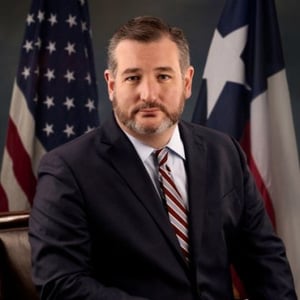
Ted Cruz represents 28 million Texans in the U.S. Senate as a passionate fighter for limited government and economic growth. He has authored 39 legislative measures signed into law. Recent victories include expanding 529 college savings accounts to allow parents to save for K–12 public, private, and religious education, leading the effort to repeal Obamacare’s individual mandate, imposing sanctions on terrorists who use civilians as human shields, designating North Korea as a state sponsor of terrorism, reauthorizing and reforming NASA, ensuring the availability of additional records to help solve civil rights cold cases, supporting thousands of Texas jobs, and leading the fight to confirm principled constitutionalists to our courts.
Senator Cruz is a graduate of Princeton University and Harvard Law School, a former law clerk to Chief Justice William Rehnquist, and former solicitor general of Texas. He has argued nine cases before the Supreme Court. In November of 2018, he was re-elected to the Senate by the people of Texas.