2007
Michigan Supreme Court Upholds Voter Photo ID Law
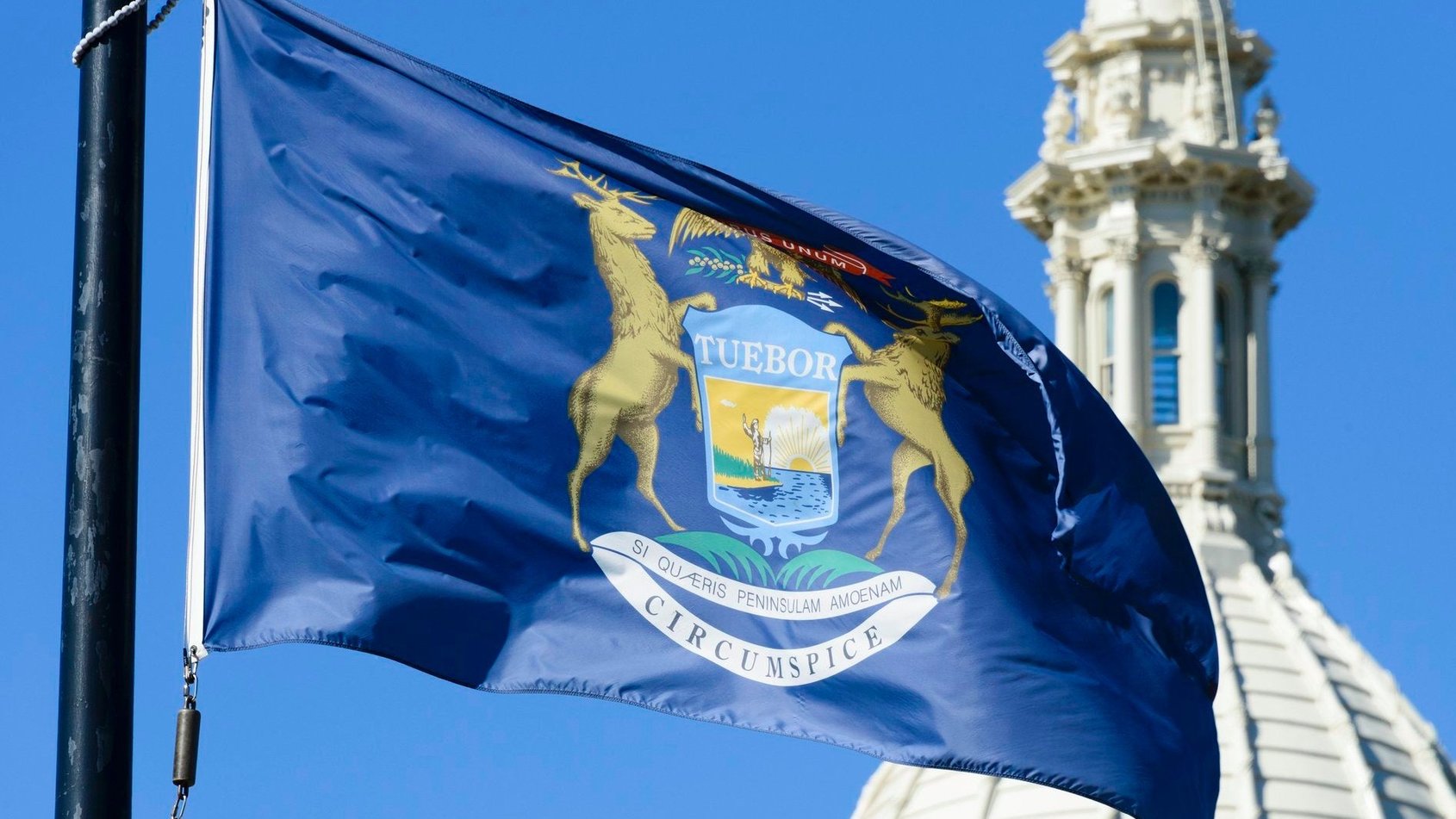
On July 18, 2007, the Michigan Supreme Court upheld a provision of Michigan election law that requires voters to show photo identification before voting. In the case In re Request for Advisory Opinion Regarding Constitutionality of 2005 PA 71, the court held in a 5-2 opinion that the photo identification requirement is a reasonable, non-discriminatory restriction that has the legitimate goal of preserving the fairness of elections.1
The case centered on Section 523 of the Michigan Election Law.2 In 1996, the Michigan Legislature amended the Election Law to include Section 523, which requires that a potential voter present photo identification in the form of a driver’s license, state-issued identification card, or other commonly known picture identification card before receiving a ballot at a polling location. Section 523 also requires the voter to complete an application listing his or her signature and address. If the voter does not have photo identification, he need only sign an affidavit affirming his valid voter status before being allowed to vote.3
Shortly after Section 523 was passed by the legislature and signed into law by the governor, Michigan Attorney General Frank J. Kelley4 issued an opinion concluding that the photo identification provision violated the Equal Protection Clause of the Fourteenth Amendment to the United States Constitution.5 The attorney general opined that the photo identification requirement was “not necessary to further a compelling state interest” in the absence of significant voter fraud, and that the requirement created “economic and logistical burdens” on people who did not have photo identification.6 Thereafter, although the law was validly passed and issued, the Michigan Secretary of State refused to comply with or enforce Section 523.
In 2006, the Michigan House of Representatives adopted a resolution requesting the Michigan Supreme Court to issue an advisory opinion on whether the photo identification requirement of Section 523 violated either the Michigan or the United States constitutions.7 The court accepted the invitation and requested briefing and argument from the newly elected attorney general Michael A. Cox, who argued as both the opponent and the proponent of the issue.8
After hearing oral argument, the Michigan Supreme Court upheld Section 523 in an opinion authored by Justice Robert P. Young, Jr. and joined by Chief Justice Clifford W. Taylor, and Justices Maura D. Corrigan, Stephen J. Markman, and Elizabeth A. Weaver.
The court first recognized, as the U.S. Supreme Court has, that although a citizen’s right to vote is fundamental, it is not absolute.9 For example, legislatures may regulate the time, place, and manner of elections.10 Legislatures may also enact laws to ensure the purity of elections, preserve ballot secrecy, and establish voter registration requirements.11 The court noted that the purpose of these laws is not to discourage qualified persons from voting but instead to prevent voter fraud.12 Thus, an individual’s right to vote competes with the state’s compelling interest in ensuring the integrity of its elections.13
Second, the court relied upon U.S. Supreme Court precedent, holding that a “flexible standard” of scrutiny, rather than strict scrutiny analysis, applies when considering the constitutionality of election laws.14 Under the federal balancing test set forth in Burdick v. Takushi, the initial step in determining the legitimacy of the election law is to consider the nature and signifi cance of the law’s burden on the right to vote in comparison to the state’s interest.15 If the burden on the right to vote is severe, the law must be “narrowly drawn” in order to advance a compelling state interest. But if the law is reasonable and not discriminatory, the law should be upheld because it furthers the state’s important interest in fairly regulating elections.16
Third, the court applied the Burdick v. Takushi balancing test to Michigan’s Section 523, and determined that the law is constitutional. The court reasoned that, although the photo identification requirement imposes some burden on the voter, the burden is not severe.17 Most Michigan voters already possess voter identification.18 Moreover, “the act of reaching into one’s purse or wallet and presenting photo identification before being issued a ballot” does not impose a “severe” burden.19 For those people without photo identification, they may sign an affidavit instead of presenting identification.20 Thus, the court found, there is no basis to conclude that such a requirement imposes a “severe” burden.21 Moreover, in order to prevent in-person voter fraud—a goal in which the state has a tremendous interest—the state may impose the reasonable, nondiscriminatory restriction of the photo identification requirement.22
Finally, the court held that Section 523 is not a poll tax. The court explained that, while the Michigan Secretary of State charges a fee of $10.00 to obtain a state identification card, voters may bypass the fee by signing an affidavit affirming their validity to vote instead of producing identification.23 For voters who elect to obtain identification, the fee is waived for the elderly, disabled, and persons who present good cause for a waiver.24
Justice Michael A. Cavanagh dissented, arguing that the photo identification burden imposed a severe restriction and a disparate impact on racial and ethnic minorities, the poor, the elderly, and disabled voters, because such voters might not be able to readily obtain photo identification.25 Under such a severe burden, he argued, the law should be subject to strict scrutiny and narrowly tailored.26 Justice Cavanagh opined that, because there was nothing in the record to demonstrate that any voter fraud actually existed, the photo identification requirement was not narrowly tailored and therefore violated the Equal Protection Clause of the Fourteenth Amendment.27 He alleged that the claim of voter fraud was “a tactic used to suppress the votes of minorities and the poor,”28 and that “our government has failed its citizens” because the majority “endorses misguided legislation that significantly impairs the fundamental right of thousands of our citizens to vote.”29 Justice Marilyn Kelly, dissenting separately, agreed that the Michigan Election Law should be subject to strict scrutiny. She found that the “tragic decision” of the majority severely burdened the right to vote, particularly for the poor and disadvantaged.30
The majority criticized Justice Cavanagh’s dissent as “inflammatory” and “emotional.”31 The majority found that the right to vote, though important in its own right, also includes the assurance that one’s vote will be protected and will not be cancelled out by fraudulent votes.32 That is, the state is not required to present proof of voter fraud before it tries to prevent it.33 Rather, the state is entitled to implement a system that prevents fraudulent votes, even where that system requires photo identification or an affidavit to vote.34
Some have argued that the Michigan Supreme Court’s opinion is significant not for what it held but for what it declined to hold. In the months prior to the court’s decision, the Speaker of the Michigan House and the Michigan Attorney General clashed over whether attorney general Frank Kelly had acted within his state constitutional authority to issue an opinion that effectively struck down Section 523. The Speaker reasoned that attorney general opinions were not binding, and to treat them as such would violate the separation of powers.35 The attorney general, who by that time was Mike Cox, vehemently defended his office’s ability to issue binding opinions, and claimed support for the practice in the state constitution, common law, and statute.36 This debate quickly exploded into the media, and newspaper editorials were quick to publicize the dispute.37 Despite this intense and public debate, however, the court reserved the matter for another day by finding that “the effect of an Attorney General opinion is beyond the scope of the advisory opinion.”38
Significantly, the majority was unwilling to consider the appropriateness of the policy choice behind the photo identification requirement. The voter identification requirement was a politically charged public policy issue in Michigan. Both the Michigan Republican Party and the Michigan Democrat Party had waded deeply into the debate and had even submitted amici curiae briefs to the court. In public comments outside the briefing papers, the Democrat Party Chair called the law “part of an ongoing strategy by Michigan Republicans to disenfranchise minority and older voters.”39 The Republican Party Chair said the law was essential to make sure legitimate votes “will not be canceled out by a fraudulent vote.”40 Sidestepping all of these arguments about whether the law was “wise” or “proper,” and in reply to the policy arguments made by the primary dissent, the court’s majority stated:
It is clear that [Justice Cavanagh] passionately dislikes the enacted voter photo identification requirement and believes it to be “ill-advised.…” Whether the statute is an “ill-advised” policy choice is not a judgment open to the judiciary, this Court, or any member of it. (emphasis original).41
Finally, the court’s opinion is important because it marked the first significant test of Michigan’s voting laws following the turbulent election of 2000. Every state, in conjunction with the Help America Vote Act of 2002, has adjusted its election laws or regulations in some fashion in order to enhance ballot integrity.42 Challenges to those reforms are currently pending in many state court systems. One thing is for sure: while this might be the first genuine test of Michigan’s newly reformed election law, it is certainly not the last.
Endnotes
1 ___ Mich. ___ (2007), 2007 Mich. LEXIS 1582.
2 Mich. Comp. Law §168.523 (passed as Public Act 71 of 2005).
3 Id.
4 Attorney General Kelley, a Democrat, was the 50th Attorney General of Michigan. He served from 1961 to 1998, making him the youngest (36 years old), the oldest (74 years old), and the longest serving (37 years) attorney general in Michigan’s history.
5 See Opinions of the Attorney General, 1997-98, No. 6930, p. 1 (January 29, 1997).
6 Id. at 3,5.
7 See Michigan House of Representatives Resolution 199, adopted February 22, 2006. The Michigan House of Representatives requested the advisory opinion pursuant to Article 3, Section 8 of the Michigan Constitution of 1963, which allows the Supreme Court to opine “on important questions of law upon solemn occasions as to the constitutionality of legislation.”
8 Attorney General Cox, a Republican, was elected in 2002 and took office on January 1, 2003. He was re-elected to his second and final four-year term in 2006.
9 2007 Mich. LEXIS 1582 at *20.
10 Id.
11 Id.
12 Id. at *22, citing Attorney General ex rel Conely v. Detroit Common Council, 78 Mich. 545, 559 (1889).
13 Id. at *26-27.
14 Id. at *27.
15 504 U.S. 428 (1992).
16 2007 Mich. LEXIS 1582 at *29.
17 Id. at *30.
18 Id. at *30, *31-32.
19 Id. at *30.
20 Id.
21 Id. at *33.
22 Id. at *35-36.
23 Id. at *56-57.
24 Id. at *58; see also Mich. Comp. Law §28.292(14).
25 2007 Mich. LEXIS 1582 at *89.
26 Id. at *79.
27 Id. at *87.
28 Id. at *89.
29 Id. at *70.
30 Id. at *173-74.
31 Id. at *62.
32 Id. at *64.
33 Id. at *37.
34 Id. at *69.
35 See Brief of the House of Representatives, Michigan Supreme Court Case No. 130589, at 3, n.1.
36 See “Cox to Speaker: Hands Off AG’s Constitutional Powers,” Press Release of Attorney General Michael A. Cox, July 28, 2006.
37 See, e.g., “House Speaker vs. People’s Watchdog,” Detroit Free Press, August 2, 2006.
38 2007 Mich. LEXIS 1582 at *6, n. 5.
39 Court OKs Photo ID for Voting, The Detroit News, July 19, 2007.
40 Id.
41 2007 Mich. LEXIS 1582 at *62.
42 42 U.S.C. §15301 et seq.
Note from the Editor: The Federalist Society takes no positions on particular legal and public policy matters. Any expressions of opinion are those of the author. We welcome responses to the views presented here. To join the debate, please email us at info@fedsoc.org.