Who Will Guard the Fed?
Note from the Editor: The Federalist Society takes no positions on particular legal and public policy matters. Any expressions of opinion are those of the author. We welcome responses to the views presented here. To join the debate, please email us at [email protected].
This post was originally published at the New York Sun.
The ancient Roman poet Juvenal posed the incisive question that must be applied to all structures of power and authority, “Sed quis custodiet ipsos custodes?”: “But who will guard the guardians?” Let us apply Juvenal’s question to the Federal Reserve.
The Federal Reserve is supposed to be, and supposes itself to be, a monetary, financial, and economic guardian of the nation. It also endlessly repeats that it ought to be “independent.” But if it is independent, who will guard the Fed? It should be the Congress, in line with the express provision of the Constitution that Congress has the responsibility to “coin Money, and regulate the Value thereof.”
Every economist with whom I have ever discussed this question immediately replies, “You certainly don’t want a bunch of politicians managing monetary policy!” They all assume that elected politicians will always impose an inflationary bias which the expert central bank will resist. Yet it was the Fed itself, without congressional approval, that unilaterally announced in 2012 that it was committing the nation to perpetual inflation and perpetual depreciation of its currency, at the rate of 2% a year. That means average prices quintuple in a lifetime—an odd interpretation of the Fed’s statutory mandate to pursue “stable prices.”
Read more at the New York Sun.

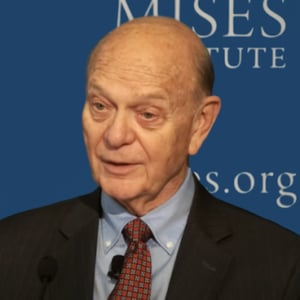
Senior Fellow, Mises Institute
Alex J. Pollock is a Senior Fellow with the Mises Institute, providing thought and policy leadership on financial issues and the study of financial systems. His work includes cycles of booms and busts, financial crises with their political responses, housing finance, government-sponsored enterprises, risk and uncertainty, central banking, banking and financial regulation, corporate governance, retirement finance, student loans, and the politics of finance.
He previously served as the Principal Deputy Director of the Office of Financial Research in the U.S. Treasury Department 2019-2021. He was a Distinguished Senior Fellow with the R Street Institute 2015-2019 and 2021, and a resident fellow at the American Enterprise Institute, 2004-2015. Among the many aspects of his AEI work, he developed the One Page Mortgage Form to give borrowers in clear form the key information they need in order to know what they are committing themselves to. He was President and CEO of the Federal Home Loan Bank of Chicago from 1991 to 2004. There he invented the Mortgage Partnership Finance program, which successfully created front-end mortgage credit risk sharing beginning in 1997. His decades of banking experience include being a Visiting Scholar at the Federal Reserve Bank of St. Louis, 1991.
Pollock was a director of the CME Group 2004-2019 and of Ascendium Education Group 1989-2019. He is a director and past-chairman of the Great Books Foundation and a past president of the International Union for Housing Finance.
He is the co-author of Surprised Again! - The COVID Crisis and the New Market Bubble (2022), and the author of Finance and Philosophy—Why We’re Always Surprised (2018) and Boom and Bust: Financial Cycles and Human Prosperity (2011), as well as numerous articles and Congressional testimony.
Pollock is a graduate of Williams College, the University of Chicago, and Princeton University.
His work is available on alexjpollock.com.