Scientific silencers on the left are trying to shut down climate skepticism
Note from the Editor: The Federalist Society takes no positions on particular legal and public policy matters. Any expressions of opinion are those of the author. We welcome responses to the views presented here. To join the debate, please email us at info@fedsoc.org.
George Will writes for the Washington Post:
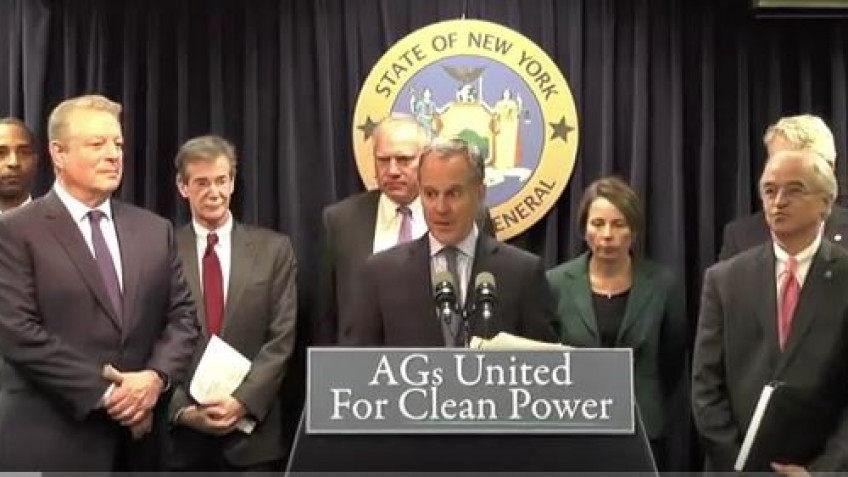
Authoritarianism, always latent in progressivism, is becoming explicit. Progressivism’s determination to regulate thought by regulating speech is apparent in the campaign by 16 states’ attorneys general and those of the District of Columbia and the Virgin Islands, none Republican, to criminalize skepticism about the supposedly “settled” conclusions of climate science.
Four core tenets of progressivism are: First, history has a destination. Second, progressives uniquely discern it. (Barack Obama frequently declares things to be on or opposed to “the right side of history.”) Third, politics should be democratic but peripheral to governance, which is the responsibility of experts scientifically administering the regulatory state. Fourth, enlightened progressives should enforce limits on speech (witness IRS suppression of conservative advocacy groups) in order to prevent thinking unhelpful to history’s progressive unfolding.
Read the full article.

NBC News Justice Correspondent
Pete Williams is an NBC News correspondent based in Washington, D.C. He has been covering the Justice Department and the U.S. Supreme Court since March 1993. Williams was also a key reporter on the Microsoft anti-trust trial and Judge Jackson's decision.
Prior to joining NBC, Williams served as a press official on Capitol Hill for many years. In 1986 he joined the Washington, DC staff of then Congressman Dick Cheney as press secretary and a legislative assistant. In 1989, when Cheney was named Assistant Secretary of Defense, Williams was appointed Assistant Secretary of Defense for Public Affairs. While in that position, Williams was named Government Communicator of the Year in 1991 by the National Association of Government Communicators.
A native of Casper, Wyo. and a 1974 graduate of Stanford University, Williams was a reporter and news director at KTWO-TV and Radio in Casper from 1974 to 1985. Working with the Radio-Television News Directors Association, for which he served as a member of its board of directors, he successfully lobbied the Wyoming Supreme Court to permit broadcast coverage of its proceedings and twice sued Wyoming judges over pre-trial exclusion of reporters from the courtroom. For these efforts, he received a First Amendment Award from the Society of Professional Journalists.
Assistant Director, Practice Groups, The Federalist Society