
Chairman, Washington Utilities and Transportation Commission
Governor Jay Inslee appointed David W. Danner chair of the Utilities and Transportation Commission (UTC) in February 2013.
Commissioner Danner was the UTC’s Executive Director from 2005 until his appointment as Chair. Before that, he was executive policy advisor to Washington Governor Gary Locke, where he worked on energy, telecommunications, finance, and elections issues. In 2004, Governor Gary Locke named him to the state Environmental Hearings Boards, where he served before moving to the UTC.
Commissioner Danner has also been a telecommunications attorney in private practice, counsel to the Washington Senate Energy and Utilities Committee, and senior policy advisor at the Washington State Department of Information Services.
He currently serves Energy Resources and Environment and International Committees of the National Association of Regulatory Utility Commissioners (NARUC). He also serves on the Board of Directors of the National Regulatory Research Institute.
Commissioner Danner has a B.A. from Columbia University, an M.A. in communications from the University of Washington, and a law degree from George Washington University.
President, Idaho Public Utilities Commission
Paul Kjellander rejoined the Idaho Public Utilities Commission in April 2011 following his service as Administrator of the Office of Energy Resources (OER). Commissioner Kjellander, who serves as Commission President, was appointed to his current six year term by Idaho Governor C.L. “Butch” Otter.
Paul Kjellander previously served on the Idaho Public Utilities Commission from January 1999 until October 2007. In 2007 Governor Otter appointed Commissioner Kjellander to head up the newly created OER. During his 3.5 years as the head of OER, Commissioner Kjellander created an aggressive energy efficiency program funded through the federal stimulus act. Commissioner Kjellander was also elected to serve as a board member on the National Association of State Energy Officials.
Commissioner Kjellander was elected to three terms (1994-1999) in the Idaho House of Representatives, where he served as a member of the House State Affairs, Judiciary and Rules, Ways and Means, Local Government and Transportation committees. During his last term in office, Commissioner Kjellander was elected House Majority Caucus Chairman. His legislative service includes membership on the Legislature’s Information Technology Advisory Council and the House/Senate Joint Committee on Technology. He also served as co-chairman of the Legislative Task Force on the Federal Telecommunications Act of 1996 and vice chairman of the Council of State Governments-West “Smart States Committee.” His interim legislative committee assignments included the Optional Forms of County Government Committee, Capital Crimes Committee and the Private Property Rights Committee.
Commissioner Kjellander has also served as director of Boise State University’s College of Applied Technology Distance Learning, program head of broadcast technology, station manager of BSU Radio Network, director of the Special Projects Unit for BSU Radio, and BSU Radio’s director of News and Public Affairs.
Commissioner Kjellander’s undergraduate degrees from Muskingum College, Ohio, were in communications, psychology and art. He holds a master’s degree in telecommunications from Ohio University.
As a member of the National Association of Regulatory Commissioners, Commissioner Kjellander has served on the Telecommunications, Consumer Affairs, and Electricity Committees. He also served as Chairman of the Joint Board on Jurisdictional Separations. Commissioner Kjellander is a member of the NARUC Presidential Federalism Task Force and serves as vice chairman of the NARUC Telecommunications Committee. He is currently serving as a NARUC representative to the North American Numbering Council (NANC).
Commissioner Kjellander is a licensed youth soccer coach and has qualified teams for various state and regional tournaments.
President, The Free State Foundation
Randolph J. May is Founder and President of The Free State Foundation. The Free State Foundation is an independent, non-profit free market-oriented think tank founded in 2006.
From October 1999-May 2006, May was a Senior Fellow and Director of Communications Policy Studies at The Progress & Freedom Foundation, a Washington, DC-based think tank. Prior to joining PFF, he practiced communications, administrative, and regulatory law as a partner at major national law firms. From 1978 to 1981, May served as Assistant General Counsel and Associate General Counsel at the Federal Communication Commission.
May has held numerous leadership positions in bar associations. He is a past Chair of the American Bar Association’s Section of Administrative Law and Regulatory Practice. He is a Fellow of the National Academy of Public Administration. Mr. May also has served as a Public Member of the Administrative Conference of the United States and currently is a Senior Fellow at ACUS.
Mr. May has published more than two hundred articles and essays on communications, administrative and constitutional law topics. He is author of A Call for a Radical New Communications Policy: Proposals for Free Market Reform, and co-author of #CommActUpdate: A Communications Law Fit for the Digital Age and The Constitutional Foundations of Intellectual Property. Mr. May is editor of two books, Communications Law and Policy in the Digital Age: The Next Five Years and New Directions in Communications Policy. In addition, he is the co-editor of two other books, Net Neutrality or Net Neutering: Should Broadband Internet Services Be Regulated? and Communications Deregulation and FCC Reform. In the past, Mr. May has written regular columns on legal and regulatory affairs for Legal Times and the National Law Journal, leading national legal periodicals.
He received his A.B. from Duke University and his J.D. from Duke Law School, where he serves as a member of the Board of Visitors.
Associate General Counsel, Black hills Corporatioon
Greg Sopkin has been practicing energy and telecommunications law for over fifteen years. Sopkin has handled complex transmission, rate, generation, and communications regulatory cases, often in a first-chair capacity. He was the Chairman of the Colorado PUC from January 2003 until January 2007. While Chairman, Sopkin presided over numerous Phase I and II electric rate cases as well as integrated resource planning cycles; investigated service outages; guided the redrafting of the Commission's electric, gas and transmission rules; implemented a renewable energy initiative; and oversaw transmission line disputes, the electric price response pilot program, high cost fund administration and the Qwest deregulation case.
Greg also has represented energy and telecommunications clients at Squire Sanders and Gorsuch Kirgis LLP and represented the Colorado PUC as an assistant attorney general in the Colorado Attorney General's office. He taught at the University of Colorado and has been a member of the National Association of Regulatory Utility Commissioners, serving on the telecommunications, energy and critical infrastructure committees; a member of the Federalist Society, serving on the telecommunications and electronic media practice group executive committee; and director of the Federation for Economically Rational Utility Policy. He received his J.D. in 1991 from the University of Colorado School of Law, where he was on the University of Colorado Law Review, and his BS, with high honors, in 1988 from the University of Illinois. Sopkin, his wife Rebecca and six children live in Lakewood, Colorado.
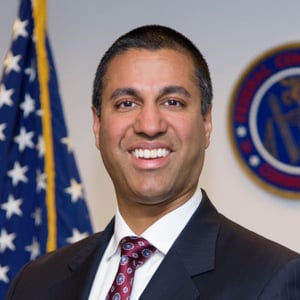
Nonresident Fellow, American Enterprise Institute
Ajit Pai, a former chairman of the Federal Communications Commission (FCC), is a nonresident fellow at the American Enterprise Institute, where he focuses on issues pertaining to technology and innovation, telecommunications regulatory policy, and market-based incentives for investment in broadband deployment. Concurrently, he is a partner at Searchlight Capital Partners, a global investment firm.
Mr. Pai’s distinguished career at the FCC includes two leadership roles following presidential appointments. He was appointed commissioner by President Barack Obama in 2012, designated chairman by President Donald Trump in 2017, and twice confirmed by the US Senate. While at the helm of the FCC, Mr. Pai had a transformative impact on the future of US technology and communications policy, implementing major initiatives to help close the digital divide; advance US leadership in 5G and other wireless technologies; promote innovation; protect consumers, public safety, and national security; and make the agency itself more open, transparent, and data-driven.
Earlier in his career, Mr. Pai served in various public-sector positions in the FCC’s Office of General Counsel, the US Department of Justice, the US Senate Judiciary Committee, and the US District Court for the Eastern District of Louisiana. He also worked as a partner at Jenner & Block and associate general counsel at Verizon Communications.
Mr. Pai graduated with honors from Harvard University, where he received a bachelor’s degree, and from the University of Chicago Law School, where he received a law degree and was an editor on the University of Chicago Law Review.
Associate General Counsel, Black hills Corporatioon
Greg Sopkin has been practicing energy and telecommunications law for over fifteen years. Sopkin has handled complex transmission, rate, generation, and communications regulatory cases, often in a first-chair capacity. He was the Chairman of the Colorado PUC from January 2003 until January 2007. While Chairman, Sopkin presided over numerous Phase I and II electric rate cases as well as integrated resource planning cycles; investigated service outages; guided the redrafting of the Commission's electric, gas and transmission rules; implemented a renewable energy initiative; and oversaw transmission line disputes, the electric price response pilot program, high cost fund administration and the Qwest deregulation case.
Greg also has represented energy and telecommunications clients at Squire Sanders and Gorsuch Kirgis LLP and represented the Colorado PUC as an assistant attorney general in the Colorado Attorney General's office. He taught at the University of Colorado and has been a member of the National Association of Regulatory Utility Commissioners, serving on the telecommunications, energy and critical infrastructure committees; a member of the Federalist Society, serving on the telecommunications and electronic media practice group executive committee; and director of the Federation for Economically Rational Utility Policy. He received his J.D. in 1991 from the University of Colorado School of Law, where he was on the University of Colorado Law Review, and his BS, with high honors, in 1988 from the University of Illinois. Sopkin, his wife Rebecca and six children live in Lakewood, Colorado.
Associate General Counsel, Black hills Corporatioon
Greg Sopkin has been practicing energy and telecommunications law for over fifteen years. Sopkin has handled complex transmission, rate, generation, and communications regulatory cases, often in a first-chair capacity. He was the Chairman of the Colorado PUC from January 2003 until January 2007. While Chairman, Sopkin presided over numerous Phase I and II electric rate cases as well as integrated resource planning cycles; investigated service outages; guided the redrafting of the Commission's electric, gas and transmission rules; implemented a renewable energy initiative; and oversaw transmission line disputes, the electric price response pilot program, high cost fund administration and the Qwest deregulation case.
Greg also has represented energy and telecommunications clients at Squire Sanders and Gorsuch Kirgis LLP and represented the Colorado PUC as an assistant attorney general in the Colorado Attorney General's office. He taught at the University of Colorado and has been a member of the National Association of Regulatory Utility Commissioners, serving on the telecommunications, energy and critical infrastructure committees; a member of the Federalist Society, serving on the telecommunications and electronic media practice group executive committee; and director of the Federation for Economically Rational Utility Policy. He received his J.D. in 1991 from the University of Colorado School of Law, where he was on the University of Colorado Law Review, and his BS, with high honors, in 1988 from the University of Illinois. Sopkin, his wife Rebecca and six children live in Lakewood, Colorado.
Kathleen Q. Abernathy recently returned to Wilkinson Barker Knauer LLP as special counsel. She was previously elected to the Board of Directors of Frontier Communications as an independent director in 2006 following her term as a Commissioner at the Federal Communications Commission from 2001 to 2005. In 2010 she joined the company as Chief Legal Officer and Executive Vice President, Regulatory and Governmental Affairs. Prior to her term as an FCC Commissioner, Ms. Abernathy worked for a number of different telecommunications companies and law firms. She has received numerous awards in recognition of her professional accomplishments and has taught as an adjunct professor at Georgetown University Law Center and Catholic University’s Columbus School of Law. She received her B.S. from Marquette University and her J.D. from Catholic University’s Columbus School of Law.
President, The Free State Foundation
Randolph J. May is Founder and President of The Free State Foundation. The Free State Foundation is an independent, non-profit free market-oriented think tank founded in 2006.
From October 1999-May 2006, May was a Senior Fellow and Director of Communications Policy Studies at The Progress & Freedom Foundation, a Washington, DC-based think tank. Prior to joining PFF, he practiced communications, administrative, and regulatory law as a partner at major national law firms. From 1978 to 1981, May served as Assistant General Counsel and Associate General Counsel at the Federal Communication Commission.
May has held numerous leadership positions in bar associations. He is a past Chair of the American Bar Association’s Section of Administrative Law and Regulatory Practice. He is a Fellow of the National Academy of Public Administration. Mr. May also has served as a Public Member of the Administrative Conference of the United States and currently is a Senior Fellow at ACUS.
Mr. May has published more than two hundred articles and essays on communications, administrative and constitutional law topics. He is author of A Call for a Radical New Communications Policy: Proposals for Free Market Reform, and co-author of #CommActUpdate: A Communications Law Fit for the Digital Age and The Constitutional Foundations of Intellectual Property. Mr. May is editor of two books, Communications Law and Policy in the Digital Age: The Next Five Years and New Directions in Communications Policy. In addition, he is the co-editor of two other books, Net Neutrality or Net Neutering: Should Broadband Internet Services Be Regulated? and Communications Deregulation and FCC Reform. In the past, Mr. May has written regular columns on legal and regulatory affairs for Legal Times and the National Law Journal, leading national legal periodicals.
He received his A.B. from Duke University and his J.D. from Duke Law School, where he serves as a member of the Board of Visitors.
Associate General Counsel, Black hills Corporatioon
Greg Sopkin has been practicing energy and telecommunications law for over fifteen years. Sopkin has handled complex transmission, rate, generation, and communications regulatory cases, often in a first-chair capacity. He was the Chairman of the Colorado PUC from January 2003 until January 2007. While Chairman, Sopkin presided over numerous Phase I and II electric rate cases as well as integrated resource planning cycles; investigated service outages; guided the redrafting of the Commission's electric, gas and transmission rules; implemented a renewable energy initiative; and oversaw transmission line disputes, the electric price response pilot program, high cost fund administration and the Qwest deregulation case.
Greg also has represented energy and telecommunications clients at Squire Sanders and Gorsuch Kirgis LLP and represented the Colorado PUC as an assistant attorney general in the Colorado Attorney General's office. He taught at the University of Colorado and has been a member of the National Association of Regulatory Utility Commissioners, serving on the telecommunications, energy and critical infrastructure committees; a member of the Federalist Society, serving on the telecommunications and electronic media practice group executive committee; and director of the Federation for Economically Rational Utility Policy. He received his J.D. in 1991 from the University of Colorado School of Law, where he was on the University of Colorado Law Review, and his BS, with high honors, in 1988 from the University of Illinois. Sopkin, his wife Rebecca and six children live in Lakewood, Colorado.

The FCC and the States: A Division of Authority - Podcast
David W. Danner, Paul Kjellander, Randolph May, Gregory E. Sopkin
Telecommunications & Electronic Media Practice Group Podcast
This Teleforum conference call examined how the Federal Communications Commission and states can work together...
A Conversation with Federal Communications Commissioner Ajit Pai - Podcast
Ajit V. Pai, Gregory E. Sopkin
Telecommunications & Electronic Media Practice Group Podcast
Ajit Pai was nominated to the Federal Communications Commission by President Barack Obama and on...
State Revanchism: Can the Latest Efforts to Regulate Voice over Internet Protocol be Stopped?
Gregory E. Sopkin
The last “war” fought over Voice over Internet Protocol (“VoIP”) occurred in 2003-2004, when the...
The Role of Public Utility Commissions
Kathleen Q. Abernathy, Larry S. Landis, Randolph May, Connie Murray, Gregory E. Sopkin
2006 Telecommunications Federalism Conference
The convergence of voice, video, and data on internet protocol-based platforms undermines the traditional regulatory...