
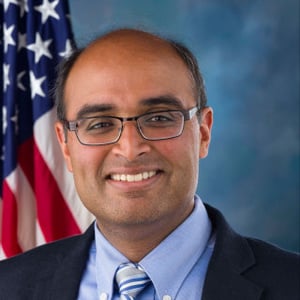
Consultant, American Edge Project and U.S. Chamber of Commerce
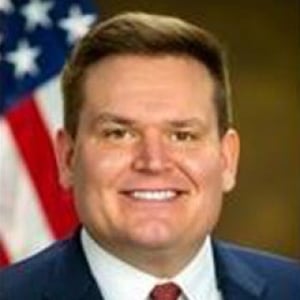
Chief Counsel, Senate Judiciary Committee
Thomas DeMatteo is Chief Counsel on the Senate Judiciary Committee to Senator Mike Lee. He previously served as counsel to the Assistant Attorney General of the Department of Justice Antitrust Division, where he worked closely with leadership and staff on civil merger and non-merger matters across numerous industries including, large technology platforms, defense, finance, and consumer products.
Mr. DeMatteo joined the Antitrust Division through the Attorney General’s Honors Program as a Trial Attorney and previously worked at an international law firm, where he advised clients on antitrust and competition matters. He is a graduate of Washington and Lee University School of Law and the University of Rochester, where he was a member of the football team and selected to the Liberty League All-Academic Team.

President and Founder, International Center for Law & Economics
Geoffrey A. Manne is the president and founder of the International Center for Law and Economics (ICLE), a nonprofit, nonpartisan research center based in Portland, Oregon. He is also a distinguished fellow at Northwestern Law School’s Searle Center on Law, Regulation, & Economic Growth. In April 2017 he was appointed by FCC Chairman Ajit Pai to the FCC’s Broadband Deployment Advisory Committee, and he recently served for two years on the FCC’s Consumer Advisory Committee.
Mr. Manne earned his JD and AB degrees from the University of Chicago and is an expert in the economic analysis of law, specializing in competition, telecommunications, consumer protection, intellectual property, and technology policy.
Prior to founding ICLE, Manne was a law professor at Lewis & Clark Law School. From 2006-2009, he took a leave from teaching to develop Microsoft’s law and economics academic outreach program. Manne has also served as a lecturer in law at the University of Chicago Law School and the University of Virginia School of Law. He practiced antitrust law and appellate litigation at Latham & Watkins, clerked for Hon. Morris S. Arnold on the 8th Circuit Court of Appeals, and worked as a research assistant for Judge Richard Posner. He was also once (very briefly) employed by the FTC.
Mr. Manne’s publications have appeared in numerous journals including the Journal of Competition Law and Economics, the Harvard Journal of Law and Technology, the Supreme Court Economic Review, and the Arizona Law Review, among others. With former FTC Commissioner, Joshua Wright, Manne is the editor of a volume from Cambridge University Press entitled, Competition Policy and Intellectual Property Law Under Uncertainty: Regulating Innovation. Manne has also testified on several occasions before Congress and at the FCC and FTC, and he regularly files written comments and amicus briefs on key antitrust, IP, and telecommunications issues. His analysis is frequently published in popular print and broadcasting outlets such as the Wall Street Journal, Wired, Foreign Affairs, NPR, and Bloomberg, among others.
Manne is a member of the American Law and Economics Association, the Canadian Law and Economics Association, and the Society for Institutional & Organizational Economics. He blogs at Truth on the Market (www.truthonthemarket.com) (of which he is also the co-founder), is a contributor at WIRED, and tweets at @geoffmanne. His scholarly publications are available at http://ssrn.com/author=175541.
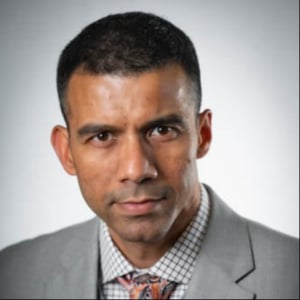
Public Advisor, National Institute of Standards and Technology
Anant Raut am a public advisor to the National Institute of Standards and Technology, part of an expert group developing a risk management framework for generative artificial intelligence (AI) systems. He advises on governance and pre-deployment testing standards.
Anant is the former global head of competition policy for Meta Platforms, Inc. There he stood up a global policy team; provided centralized subject matter expertise for our regional leads; worked cross-functionally on business priority issues; and developed some of the company’s key public policy positions, including proactive stances on interoperability and data sharing. Later he layered on a product counseling role, providing competition and regulatory guidance for every Meta product and service worldwide.
Anant is an experienced antitrust law and policy practitioner, having been an enforcer at both the Federal Trade Commission and the Department of Justice Antitrust Division.
Mr. Raut has deep experience with legislative and federal budget processes through my time on Capitol Hill. He previously served as antitrust counsel to the Democratic Chair and Ranking Member of the House and Senate Judiciary Committees. There he worked across the aisle to pass bills such as the Music Modernization Act, the Marrakesh Treaty Implementation Act, the SUCCESS Act, and reauthorization of the Antitrust Criminal Penalty Enhancement Reform Act. He worked closely with my Republican colleagues for bipartisan oversight and investigations of industries as varied as digital advertising, airlines, and railroads. As counsel, Anant helped shape key policy positions for the Democratic leaders of each of those committees. He was also the de facto in-house expert for the Senate Democratic Caucus on antitrust, consumer protection, privacy, intellectual property, bankruptcy, and arbitration law and policy.
Anant serves on the board of advisors to some of the most forward-looking institutions on antitrust policy, including the American Antitrust Institute and the Loyola Chicago Institute for Consumer Antitrust Studies. He also co-hosts two popular industry podcasts, Our Curious Amalgam and Trust and Trade, which tackle leading edge antitrust and consumer protection issues every month.
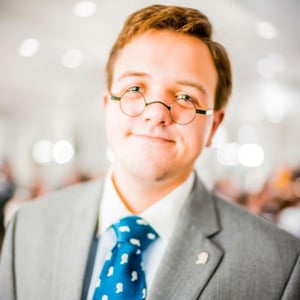
Adam Griffin is a graduate of the University of North Carolina School of Law. During law school, he served as a research assistant to Professor Stephen E. Sachs and UNC Law Dean Martin Brinkley. After law school, Adam spent two years litigating for liberty at the Institute for Justice as an inaugural Law and Liberty Fellow. He then served as a law clerk to Chief Judge Richard E. Myers in the United States District Court for the Eastern District of North Carolina, and previously worked at Pacific Legal Foundation and the Civil Rights Division of the Department of Justice.
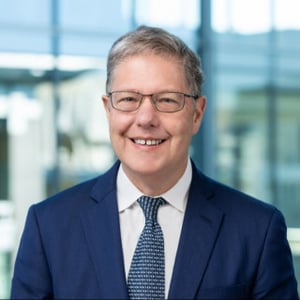
Partner, Harris, Wiltshire & Grannis LLP
Sean Lev, a former General Counsel of the FCC and acting General Counsel of the Department of Energy, advises and advocates in both courts and agencies for clients with complex regulatory problems in technology, energy, and other fields.
He serves as chair of HWG’s Energy Practice and co-chair of the Issues and Appeals Practice.
Sean has more than 30 years of experience helping clients in the public, private, and non-profit sector solve problems involving critical issues of administrative law. He has argued scores of cases in federal and state appellate and trial courts both supporting and challenging agency decisions and has advised Cabinet Secretaries, three FCC Chairs, sophisticated regulated companies, and numerous non-profits and individuals.
As General Counsel of the Federal Communications Commission, Sean was responsible for all legal advice provided to the FCC Chair and Commissioners and oversaw all FCC litigation. Sean was also heavily involved in the Commission’s review of major transactions and enforcement activity. Prior to being named General Counsel, Sean served as Deputy General Counsel and Senior Advisor to the Chairman.
Before joining the FCC, Sean was designated by President Obama to serve as the Acting General Counsel of the United States Department of Energy (DOE). In that role, he was the chief legal officer for the Department, and provided advice on the full range of issues relevant to its mission, including those involving energy efficiency standards, nuclear energy, oil and gas, environmental remediation, and national security. Sean also served as the Deputy General Counsel for Environment and Nuclear Programs at DOE. In that role, he led the agency’s litigation before the Nuclear Regulatory Commission and served as the lead agency lawyer in resolving major environmental and other disputes.
Sean most recently served as Legal Director of Democracy Forward, a public interest nonprofit dedicated to furthering the rule of law and fighting unlawful agency decision making. In this role, he oversaw a team of more than a dozen litigators and supervised numerous successful legal challenges against federal agencies and state and local governments.
Sean has significant experience advising clients in private practice, having spent more than fifteen years as a partner of a major Washington, DC based law firm. During that time, Sean had leading roles in numerous key cases involving technology law and policy and in advocating on regulatory and litigation issues raised by major industry transactions.
He started his legal career as an Honors Program attorney on the Civil Division, Appellate Staff at the United States Department of Justice and as a clerk to the Honorable Patricia M. Wald of the U.S. Court of Appeals for the District of Columbia Circuit.
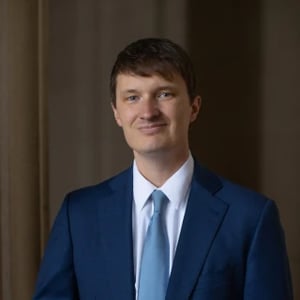
Partner, Boyden Gray PLLC
Trent McCotter is a partner with Boyden Gray PLLC. He previously served as Deputy Associate Attorney General of the United States and as an Assistant U.S. Attorney.
Mr. McCotter maintains an extensive appellate practice. He has considerable experience identifying and briefing cases that draw the Supreme Court’s attention, having persuaded the Court to grant certiorari in numerous cases raising issues of sovereignty, constitutional rights, due process, and criminal law. He has authored and submitted over 60 briefs at the Court.
He has also personally argued more than fifteen federal appeals across the Second, Fourth, Fifth, Sixth, Ninth, Eleventh, Federal, and D.C. Circuits—including once arguing three separate appeals in just four days. He has also twice argued before the 17-judge en banc Fifth Circuit. He has been counsel in over 50 other appeals raising matters from FOIA and the APA to constitutional rights and statutory construction.
As Deputy Associate Attorney General, Mr. McCotter oversaw DOJ’s Civil Appellate and Federal Programs branches, which are responsible for defending nearly all major litigation against the federal government. During his three years as a federal trial attorney in the Eastern District of Virginia’s “Rocket Docket,” Mr. McCotter won the Attorney General’s Award for Distinguished Service.
During his DOJ tenures, Mr. McCotter also assisted with the confirmations of two Supreme Court justices and over a dozen lower-court judges.
Mr. McCotter served as an inaugural clerk to the Hon. Steven J. Menashi on the U.S. Court of Appeals for the Second Circuit and also clerked for the Hon. R. Lanier Anderson III on the U.S. Court of Appeals for the Eleventh Circuit.
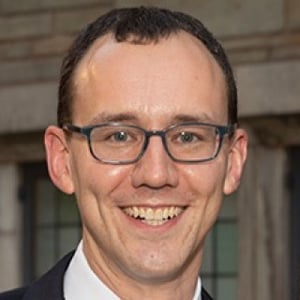
William K. Townsend Professor of Law, Yale Law School
Nicholas R. Parrillo is Townsend Professor of Law at Yale, with a secondary appointment as Professor of History. His research and teaching focus on administrative law and government bureaucracy and extend to legal history, remedies, and legislation. He has received the ABA’s award for the year’s best scholarship in administrative law and the Law and Society Association’s Hurst Prize for the year’s best book in legal history.
Parrillo’s Yale Law Journal article finding new originalist evidence of broad congressional delegations to agencies was discussed in the Solicitor General’s winning brief in the Supreme Court’s latest nondelegation case and in the en banc 5th Circuit opinion in that case. His Harvard Law Review article on how the judiciary handles the federal government’s disobedience to court orders has been discussed in The Washington Post, The Wall Street Journal, and The New York Times. Parrillo also authored a study that provided the empirical basis for best practices adopted by the Administrative Conference of the United States (ACUS) on the federal government’s ubiquitous but controversial use of guidance documents. Peer scholars at Jotwell, in selecting the “best new scholarship” in law, selected each of these three publications (one of them twice). Parrillo’s most recent article, invited for GW’s annual administrative law issue, reveals and analyzes dramatic variation among industries in their willingness to sue their federal health-and-safety regulators.
Parrillo has testified before Congress, been quoted by the Supreme Court, is a senior fellow of ACUS, and has been an instructor at the New York Historical Society’s graduate institute and an invited speaker before the 2nd Circuit Judicial Conference, the U.S. Department of Justice (in 2019 and again in 2024), the ACLU’s national legal staff, and the Federalist Society’s national convention (two times). He is a recipient of the Law School’s annual teaching award.
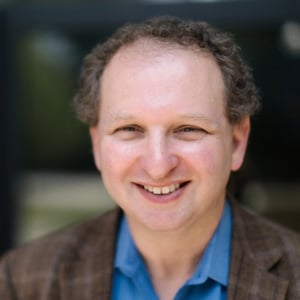
Assistant Professor of Law, Emory University School of Law
Alexander "Sasha" Volokh is an assistant professor of law, joining the Emory Law faculty in Fall 2009.
Professor Volokh earned his B.S. from UCLA and his J.D. and Ph.D. in economics from Harvard University. He clerked for Judge Alex Kozinski of the Ninth Circuit and for Supreme Court Justices Sandra Day O'Connor and Samuel Alito. Before coming to Emory, he was a visiting associate professor at Georgetown University Law Center and a visiting assistant professor at University of Houston Law Center.
His interests include law and economics, administrative law and the regulatory process, environmental law and policy, and legal history. His current research topics include the private management of government services, medieval law, judicial decisionmaking and statutory interpretation.
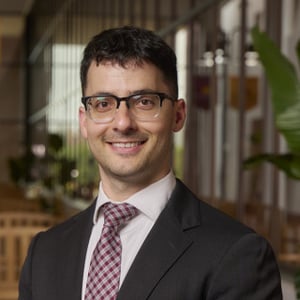
Professor, University of Minnesota Law School
Ilan Wurman is the Julius E. Davis Professor of Law at the University of Minnesota, where he teaches administrative law and constitutional law. He previously taught at Arizona State University. He writes primarily on the Fourteenth Amendment, administrative law, separation of powers, and constitutionalism. His academic writing has appeared in the Yale Law Journal, the Stanford Law Review, the University of Chicago Law Review, the University of Pennsylvania Law Review, the Virginia Law Review, the Duke Law Journal, the Minnesota Law Review, the Notre Dame Law Review, and the Texas Law Review among other journals.
Professor Wurman is the author of the new book The Constitution of 1789: A New Introduction (Cambridge 2026). His previous books include A Debt Against the Living: An Introduction to Originalism (Cambridge 2017), and The Second Founding: An Introduction to the Fourteenth Amendment (Cambridge 2020). He is also the author of the casebook, Administrative Law Theory and Fundamentals: An Integrated Approach (Foundation Press 3d ed. 2025).
Professor Wurman practices law with the firm Tully Bailey. He has litigated a variety of administrative law and constitutional law cases, including cases involving COVID-19 restrictions, transmission lines, and Appointments Clause challenges. He also devised winning public nuisance theories to force city governments to address the increasingly challenging public camping crises throughout the country.
Adam Griffin is a graduate of the University of North Carolina School of Law. During law school, he served as a research assistant to Professor Stephen E. Sachs and UNC Law Dean Martin Brinkley. After law school, Adam spent two years litigating for liberty at the Institute for Justice as an inaugural Law and Liberty Fellow. He then served as a law clerk to Chief Judge Richard E. Myers in the United States District Court for the Eastern District of North Carolina, and previously worked at Pacific Legal Foundation and the Civil Rights Division of the Department of Justice.
Partner, Harris, Wiltshire & Grannis LLP
Sean Lev, a former General Counsel of the FCC and acting General Counsel of the Department of Energy, advises and advocates in both courts and agencies for clients with complex regulatory problems in technology, energy, and other fields.
He serves as chair of HWG’s Energy Practice and co-chair of the Issues and Appeals Practice.
Sean has more than 30 years of experience helping clients in the public, private, and non-profit sector solve problems involving critical issues of administrative law. He has argued scores of cases in federal and state appellate and trial courts both supporting and challenging agency decisions and has advised Cabinet Secretaries, three FCC Chairs, sophisticated regulated companies, and numerous non-profits and individuals.
As General Counsel of the Federal Communications Commission, Sean was responsible for all legal advice provided to the FCC Chair and Commissioners and oversaw all FCC litigation. Sean was also heavily involved in the Commission’s review of major transactions and enforcement activity. Prior to being named General Counsel, Sean served as Deputy General Counsel and Senior Advisor to the Chairman.
Before joining the FCC, Sean was designated by President Obama to serve as the Acting General Counsel of the United States Department of Energy (DOE). In that role, he was the chief legal officer for the Department, and provided advice on the full range of issues relevant to its mission, including those involving energy efficiency standards, nuclear energy, oil and gas, environmental remediation, and national security. Sean also served as the Deputy General Counsel for Environment and Nuclear Programs at DOE. In that role, he led the agency’s litigation before the Nuclear Regulatory Commission and served as the lead agency lawyer in resolving major environmental and other disputes.
Sean most recently served as Legal Director of Democracy Forward, a public interest nonprofit dedicated to furthering the rule of law and fighting unlawful agency decision making. In this role, he oversaw a team of more than a dozen litigators and supervised numerous successful legal challenges against federal agencies and state and local governments.
Sean has significant experience advising clients in private practice, having spent more than fifteen years as a partner of a major Washington, DC based law firm. During that time, Sean had leading roles in numerous key cases involving technology law and policy and in advocating on regulatory and litigation issues raised by major industry transactions.
He started his legal career as an Honors Program attorney on the Civil Division, Appellate Staff at the United States Department of Justice and as a clerk to the Honorable Patricia M. Wald of the U.S. Court of Appeals for the District of Columbia Circuit.
Partner, Boyden Gray PLLC
Trent McCotter is a partner with Boyden Gray PLLC. He previously served as Deputy Associate Attorney General of the United States and as an Assistant U.S. Attorney.
Mr. McCotter maintains an extensive appellate practice. He has considerable experience identifying and briefing cases that draw the Supreme Court’s attention, having persuaded the Court to grant certiorari in numerous cases raising issues of sovereignty, constitutional rights, due process, and criminal law. He has authored and submitted over 60 briefs at the Court.
He has also personally argued more than fifteen federal appeals across the Second, Fourth, Fifth, Sixth, Ninth, Eleventh, Federal, and D.C. Circuits—including once arguing three separate appeals in just four days. He has also twice argued before the 17-judge en banc Fifth Circuit. He has been counsel in over 50 other appeals raising matters from FOIA and the APA to constitutional rights and statutory construction.
As Deputy Associate Attorney General, Mr. McCotter oversaw DOJ’s Civil Appellate and Federal Programs branches, which are responsible for defending nearly all major litigation against the federal government. During his three years as a federal trial attorney in the Eastern District of Virginia’s “Rocket Docket,” Mr. McCotter won the Attorney General’s Award for Distinguished Service.
During his DOJ tenures, Mr. McCotter also assisted with the confirmations of two Supreme Court justices and over a dozen lower-court judges.
Mr. McCotter served as an inaugural clerk to the Hon. Steven J. Menashi on the U.S. Court of Appeals for the Second Circuit and also clerked for the Hon. R. Lanier Anderson III on the U.S. Court of Appeals for the Eleventh Circuit.
William K. Townsend Professor of Law, Yale Law School
Nicholas R. Parrillo is Townsend Professor of Law at Yale, with a secondary appointment as Professor of History. His research and teaching focus on administrative law and government bureaucracy and extend to legal history, remedies, and legislation. He has received the ABA’s award for the year’s best scholarship in administrative law and the Law and Society Association’s Hurst Prize for the year’s best book in legal history.
Parrillo’s Yale Law Journal article finding new originalist evidence of broad congressional delegations to agencies was discussed in the Solicitor General’s winning brief in the Supreme Court’s latest nondelegation case and in the en banc 5th Circuit opinion in that case. His Harvard Law Review article on how the judiciary handles the federal government’s disobedience to court orders has been discussed in The Washington Post, The Wall Street Journal, and The New York Times. Parrillo also authored a study that provided the empirical basis for best practices adopted by the Administrative Conference of the United States (ACUS) on the federal government’s ubiquitous but controversial use of guidance documents. Peer scholars at Jotwell, in selecting the “best new scholarship” in law, selected each of these three publications (one of them twice). Parrillo’s most recent article, invited for GW’s annual administrative law issue, reveals and analyzes dramatic variation among industries in their willingness to sue their federal health-and-safety regulators.
Parrillo has testified before Congress, been quoted by the Supreme Court, is a senior fellow of ACUS, and has been an instructor at the New York Historical Society’s graduate institute and an invited speaker before the 2nd Circuit Judicial Conference, the U.S. Department of Justice (in 2019 and again in 2024), the ACLU’s national legal staff, and the Federalist Society’s national convention (two times). He is a recipient of the Law School’s annual teaching award.
Assistant Professor of Law, Emory University School of Law
Alexander "Sasha" Volokh is an assistant professor of law, joining the Emory Law faculty in Fall 2009.
Professor Volokh earned his B.S. from UCLA and his J.D. and Ph.D. in economics from Harvard University. He clerked for Judge Alex Kozinski of the Ninth Circuit and for Supreme Court Justices Sandra Day O'Connor and Samuel Alito. Before coming to Emory, he was a visiting associate professor at Georgetown University Law Center and a visiting assistant professor at University of Houston Law Center.
His interests include law and economics, administrative law and the regulatory process, environmental law and policy, and legal history. His current research topics include the private management of government services, medieval law, judicial decisionmaking and statutory interpretation.
Professor, University of Minnesota Law School
Ilan Wurman is the Julius E. Davis Professor of Law at the University of Minnesota, where he teaches administrative law and constitutional law. He previously taught at Arizona State University. He writes primarily on the Fourteenth Amendment, administrative law, separation of powers, and constitutionalism. His academic writing has appeared in the Yale Law Journal, the Stanford Law Review, the University of Chicago Law Review, the University of Pennsylvania Law Review, the Virginia Law Review, the Duke Law Journal, the Minnesota Law Review, the Notre Dame Law Review, and the Texas Law Review among other journals.
Professor Wurman is the author of the new book The Constitution of 1789: A New Introduction (Cambridge 2026). His previous books include A Debt Against the Living: An Introduction to Originalism (Cambridge 2017), and The Second Founding: An Introduction to the Fourteenth Amendment (Cambridge 2020). He is also the author of the casebook, Administrative Law Theory and Fundamentals: An Integrated Approach (Foundation Press 3d ed. 2025).
Professor Wurman practices law with the firm Tully Bailey. He has litigated a variety of administrative law and constitutional law cases, including cases involving COVID-19 restrictions, transmission lines, and Appointments Clause challenges. He also devised winning public nuisance theories to force city governments to address the increasingly challenging public camping crises throughout the country.

Patrick Hotung Professor of Constitutional Law, Georgetown University Law Center; Faculty Director, Georgetown Center for the Constitution
Randy E. Barnett is the Patrick Hotung Professor of Constitutional Law at the Georgetown University Law Center and is the Faculty Director of the Georgetown Center for the Constitution. After graduating from Northwestern University and Harvard Law School, he tried many felony cases as a prosecutor in the Cook County States’ Attorney’s Office in Chicago. A recipient of a Guggenheim Fellowship in Constitutional Studies and the Bradley Prize, Professor Barnett has been a visiting professor at Penn, Northwestern and Harvard Law School.
Professor Barnett’s publications includes thirteen books, more than one hundred articles and reviews, as well as numerous op-eds. His most recent book is Felony Review: Tales of True Crime and Corruption in Chicago (2026). His other books on the Constitution include: A Life for Liberty: The Making of an American Originalist (2024); The Original Meaning of the Fourteenth Amendment: Its Letter and Spirit (2021) (with Evan Bernick); An Introduction to Constitutional Law: 100 Supreme Court Cases Everyone Should Know (2019) (with Josh Blackman); Restoring the Lost Constitution: The Presumption of Liberty (2nd ed. 2013); Our Republican Constitution: Securing the Liberty and Sovereignty of We the People (2016); and Constitutional Law: Cases in Context (5th ed. forthcoming 2027) (with Josh Blackman). His books on contracts are The Oxford Introductions to U.S. Law: Contracts (2010) and Contracts: Cases and Doctrine (7th ed. 2021) (with Nate Oman). And he is the author of The Structure of Liberty: Justice and the Rule of Law (2nd ed. 2014).
In 2004, he argued the medical marijuana case of Gonzalez v. Raich before the U.S. Supreme Court. In 2012, he was one of the lawyers representing the National Federation of Independent Business in its constitutional challenge to the Affordable Care Act in NFIB v. Sebelius. He’s appeared in numerous documentaries and portrayed a prosecutor in the 2010 science-fiction feature film, InAlienable: The Movie. On X he is @RandyEBarnett
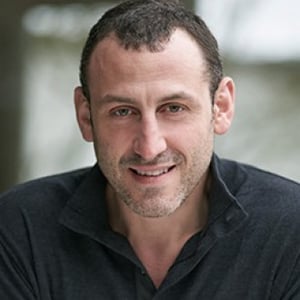
Professor of Law, Northwestern University Pritzker School of Law
Joshua Kleinfeld teaches and writes about political, legal, and moral philosophy, criminal law, and criminal procedure. He also practices law in Northwestern's Juvenile Criminal Defense Clinic. He is a full professor with tenure at the Northwestern Pritzker School of the Law and (by courtesy) in Northwestern’s philosophy department. In 2017-18, he was a visiting professor at Harvard and Stanford Law Schools. He is the recipient of the Bator Award, given annually to one American law professor under the age of 40 who has demonstrated "excellence in legal scholarship, a commitment to teaching, a concern for students, and who has made a significant public impact."
In philosophy, Kleinfeld's research focuses on the idea of "embodied ethical life," as developed in the socio-theoretic tradition of Hegel, Weber, and Durkheim. This tradition aims to understand and critique social life by bringing to light the normative ideas implicit in social practices and institutions. In law, this means that the most interesting philosophical concepts are often those reflected or actualized in legal practice – in the law as judges and lawyers think of it and wield it.
In criminal law and procedure, Kleinfeld has developed a theory known as "reconstructivism," which holds that the chief office of criminal law is not to dole out retributive justice, nor to optimize crime and cost control, but to reconstruct a violated normative order in the wake of a crime. This work, which draws on the thought of Hegel, Durkheim, Jean Hampton, and Antony Duff, develops an alternative to retributive and utilitarian theories of criminal law by focusing on the distinctive social function and sense of justice at work in the criminal system.
Kleinfeld is also involved in practical criminal justice reform. In this vein, he defends children accused of homicide in the Northwestern Juvenile Criminal Defense clinic and assists in litigation efforts meant to reform American criminal law through the courts. He has also developed a view of criminal justice reform known as "democratization," which holds that the root of the American criminal justice crisis is a set of bureaucratic attitudes, structures, and incentives divorced from the American public’s concerns and sense of justice, and that the primary solution is to make criminal justice more community-focused and responsive to lay influences. Working with others, he has developed a number of policy proposals meant to reform American criminal justice in a democratic direction.
Kleinfeld holds a JD from Yale Law School, a PhD in philosophy from the Goethe University of Frankfurt (supervised by Axel Honneth, Klaus Günther, and Rainer Forst), and a BA in philosophy from Yale College. He clerked for Judge J. Harvie Wilkinson on the United States Court of Appeals for the Fourth Circuit; Judge Janice Rogers Brown on the United States Court of Appeals for the D.C. Circuit; and President (chief justice) Aharon Barak of the Supreme Court of Israel. He worked as an Associate at Debevoise & Plimpton LLP in Frankfurt, Germany, in the area of corporate criminal law. Before law school, he worked as a Senior Research Analyst at the White House’s Council on Bioethics.
Consultant, American Edge Project and U.S. Chamber of Commerce
Chief Counsel, Senate Judiciary Committee
Thomas DeMatteo is Chief Counsel on the Senate Judiciary Committee to Senator Mike Lee. He previously served as counsel to the Assistant Attorney General of the Department of Justice Antitrust Division, where he worked closely with leadership and staff on civil merger and non-merger matters across numerous industries including, large technology platforms, defense, finance, and consumer products.
Mr. DeMatteo joined the Antitrust Division through the Attorney General’s Honors Program as a Trial Attorney and previously worked at an international law firm, where he advised clients on antitrust and competition matters. He is a graduate of Washington and Lee University School of Law and the University of Rochester, where he was a member of the football team and selected to the Liberty League All-Academic Team.
President and Founder, International Center for Law & Economics
Geoffrey A. Manne is the president and founder of the International Center for Law and Economics (ICLE), a nonprofit, nonpartisan research center based in Portland, Oregon. He is also a distinguished fellow at Northwestern Law School’s Searle Center on Law, Regulation, & Economic Growth. In April 2017 he was appointed by FCC Chairman Ajit Pai to the FCC’s Broadband Deployment Advisory Committee, and he recently served for two years on the FCC’s Consumer Advisory Committee.
Mr. Manne earned his JD and AB degrees from the University of Chicago and is an expert in the economic analysis of law, specializing in competition, telecommunications, consumer protection, intellectual property, and technology policy.
Prior to founding ICLE, Manne was a law professor at Lewis & Clark Law School. From 2006-2009, he took a leave from teaching to develop Microsoft’s law and economics academic outreach program. Manne has also served as a lecturer in law at the University of Chicago Law School and the University of Virginia School of Law. He practiced antitrust law and appellate litigation at Latham & Watkins, clerked for Hon. Morris S. Arnold on the 8th Circuit Court of Appeals, and worked as a research assistant for Judge Richard Posner. He was also once (very briefly) employed by the FTC.
Mr. Manne’s publications have appeared in numerous journals including the Journal of Competition Law and Economics, the Harvard Journal of Law and Technology, the Supreme Court Economic Review, and the Arizona Law Review, among others. With former FTC Commissioner, Joshua Wright, Manne is the editor of a volume from Cambridge University Press entitled, Competition Policy and Intellectual Property Law Under Uncertainty: Regulating Innovation. Manne has also testified on several occasions before Congress and at the FCC and FTC, and he regularly files written comments and amicus briefs on key antitrust, IP, and telecommunications issues. His analysis is frequently published in popular print and broadcasting outlets such as the Wall Street Journal, Wired, Foreign Affairs, NPR, and Bloomberg, among others.
Manne is a member of the American Law and Economics Association, the Canadian Law and Economics Association, and the Society for Institutional & Organizational Economics. He blogs at Truth on the Market (www.truthonthemarket.com) (of which he is also the co-founder), is a contributor at WIRED, and tweets at @geoffmanne. His scholarly publications are available at http://ssrn.com/author=175541.
Public Advisor, National Institute of Standards and Technology
Anant Raut am a public advisor to the National Institute of Standards and Technology, part of an expert group developing a risk management framework for generative artificial intelligence (AI) systems. He advises on governance and pre-deployment testing standards.
Anant is the former global head of competition policy for Meta Platforms, Inc. There he stood up a global policy team; provided centralized subject matter expertise for our regional leads; worked cross-functionally on business priority issues; and developed some of the company’s key public policy positions, including proactive stances on interoperability and data sharing. Later he layered on a product counseling role, providing competition and regulatory guidance for every Meta product and service worldwide.
Anant is an experienced antitrust law and policy practitioner, having been an enforcer at both the Federal Trade Commission and the Department of Justice Antitrust Division.
Mr. Raut has deep experience with legislative and federal budget processes through my time on Capitol Hill. He previously served as antitrust counsel to the Democratic Chair and Ranking Member of the House and Senate Judiciary Committees. There he worked across the aisle to pass bills such as the Music Modernization Act, the Marrakesh Treaty Implementation Act, the SUCCESS Act, and reauthorization of the Antitrust Criminal Penalty Enhancement Reform Act. He worked closely with my Republican colleagues for bipartisan oversight and investigations of industries as varied as digital advertising, airlines, and railroads. As counsel, Anant helped shape key policy positions for the Democratic leaders of each of those committees. He was also the de facto in-house expert for the Senate Democratic Caucus on antitrust, consumer protection, privacy, intellectual property, bankruptcy, and arbitration law and policy.
Anant serves on the board of advisors to some of the most forward-looking institutions on antitrust policy, including the American Antitrust Institute and the Loyola Chicago Institute for Consumer Antitrust Studies. He also co-hosts two popular industry podcasts, Our Curious Amalgam and Trust and Trade, which tackle leading edge antitrust and consumer protection issues every month.
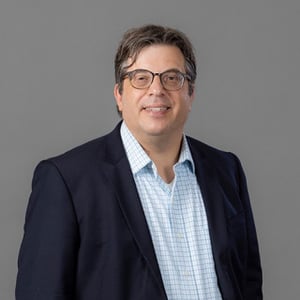
University Professor of Law and Executive Director, Liberty & Law Center, Antonin Scalia Law School, George Mason University
David Bernstein holds a University Professorship chair at the Antonin Scalia Law School, where he has been teaching since 1995. He has also been a visiting professor at the University of Michigan, Georgetown University, William & Mary, Brooklyn Law School, the University of Turin, and Hebrew University. Professor Bernstein teaches Constitutional Law, Evidence, and Products Liability.
A prolific author, Professor Bernstein often challenges the conventional wisdom with prodigious research and sharp, original analysis. He is the author of five books, and coauthor of two more. Professor Bernstein’s book Rehabilitating Lochner was praised across the political spectrum as “intellectual history in its highest form,” a “fresh perspective and a cogent analysis,” “delightful and informative,” “sharp and iconoclastic,” and “a terrific work of historical revisionism.” Columnist George Will praised Bernstein’s most recent book, Classified, The Untold Story of Racial Classification in America, as “perhaps the most consequential American book of 2022.”
Professor Bernstein has also written dozens of articles and essays published in major law reviews, including the California Law Review, Columbia Law Review, Michigan Law Review, and Yale Law Journal. An article he coauthored, Defending Daubert: It’s Time to Amend Federal Rule of Evidence 702, directly inspired a pending amendment to Rule 702.
Professor Bernstein blogs at the Instapundit.com, the Times of Israel, and the Volokh Conspiracy. He is a graduate of the Yale Law School, where he was senior editor of the Yale Law Journal and a John M. Olin Fellow in Law, Economics, and Public Policy.

Searching for the Right Remedy in U.S. v. Google
Asheesh Agarwal, Thomas DeMatteo, Geoffrey A. Manne, Anant Raut
In August 2024, a federal district court held that Google possesses monopolistic power over “general...
Searching for the Right Remedy in U.S. v. Google
Three Bad Ideas About Race in America
Case Western Student Chapter
Cleveland, OHTopics
Why Weak Intellectual Property Rights Threaten Innovation and Competition
Over the past two decades, a largely overlooked revolution in intellectual property law has taken...
Topics
On Day One, President Trump Took Meaningful Steps to Rein In Administrative Abuse, Protect Due Process, and Improve Government Transparency
As soon as he took office, President Trump issued several Executive Orders aimed at bringing...
The Nondelegation Doctrine’s Next Good Year?
Adam F. Griffin, Sean Lev, Trent McCotter, Nicholas R. Parrillo, Alexander Volokh, Ilan Wurman
The Supreme Court is set to hear argument this term in a case raising both...
The Nondelegation Doctrine’s Next Good Year?
Adam F. Griffin, Sean Lev, Trent McCotter, Nicholas R. Parrillo, Alexander Volokh, Ilan Wurman
The Supreme Court is set to hear argument this term in a case raising both...
Open Minds: Prof. Randy Barnett & Prof. Joshua Kleinfeld Part II
Randy E. Barnett, Joshua Kleinfeld
In Part Two of Open Minds with Prof. Randy Barnett and Prof. Joshua Kleinfeld, Prof....
Topics
The Equal Rights Amendment: Is It the 28th Amendment?
On Friday, January 17, then-President Joe Biden stated his opinion that “the Equal Rights Amendment...
Topics
Supreme Court Sticks to the Statute In Latest Wage and Hour Case
In a recent decision, the Supreme Court once again stuck to the text and declined...